



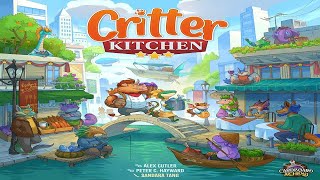




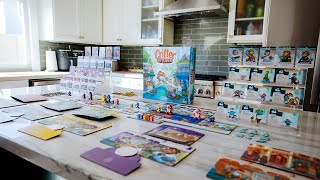

































It's Restaurant Week in Bistro Bay! Restaurants are competing in food challenges, while also planning an epic meal to impress a celebrity critic. As one of 1-5 players in Critter Kitchen, you'll send your chefs into the city to gather ingredients to create amazing meals and demonstrate that your restaurant is the best in town.
Each round, new random ingredients are placed in locations throughout the city. Players simultaneously and secretly plan which locations to send their three chefs to, hoping to collect the best ingredients. Some chefs are fast, but can gather only one item, while others can carry three items but arrive late. Rumors are also available at locations and provide guidance on what the critic desires.
Challenges revealed in rounds 1-6 offer the players opportunities to earn stars for crafting dishes with specific ingredient requirements. After round 7, the players must create an epic meal to impress the celebrity critic and cater to their appetites. A multitude of different critics, rumors, and restaurateurs mean every game is fresh!
—description from the publisher
- Array
- Array
- cute animal workers, kitchen strategy, meal building
- Array
- A bustling, whimsical kitchen where critters cook meals for a discerning critic
- Array
- Array
- Array
- positive
Mechanics (from transcript analysis)
Video topics + discussion points
Quotes (from this video)
- Critter Kitchen is the clear winner here. It's sharper, smarter, and cheaper.
- Downtime is a deal breaker at three to seven players.
- We taught Critter Kitchen to our friend Mark in about 15 minutes.
- The tension of the reveal, the cheering when someone busts at the market, the groans when the mouse steals the cheese.
- If you have a group of three or four, avoid Tea Witches.
- Critter Kitchen left us wanting to play just one more round.
References (from this video)
- distinct critter types with different carrying/carrying capacities add depth
- ties to Flamecraft lineage provide familiar appeal
- meal preparation and kitchen variety with critter characters
- Culinary world where critters visit kitchens to fetch ingredients
- light, whimsical kitchen-themed play
- Flamecraft
Mechanics (from transcript analysis)
- resource/item collection — critter-specific items and kitchen needs drive the game
- set collection — critter-specific items and kitchen needs drive the game
Video topics + discussion points
Quotes (from this video)
- The fate of creatures touched by the spark of intelligence hangs in the balance
- This is a flip and roll and scratch and stamp and whatever else you want to do and write
- open world Cooperative Adventure game even for solo
- windmill valley was a big hit for me Solo in 2024
- you start as a child and as such you will have limited sense of interest and skills that will determine your development
References (from this video)
- deluxe edition with expansions
- ingredients clearly defined by value
- great table presence
- engaging without overwhelming players
- creature kitchen and dish creation.
- Beastro Bay, a cute culinary world.
- Array
Mechanics (from transcript analysis)
Video topics + discussion points
Quotes (from this video)
- gorgeous game where you are collecting different plant specimens.
- really cool acrylic resources.
- it's really approachable in what you're doing.
- you do get to have this full experience on the table and enjoy some upgraded bits.
- you have a cruise ship that you are trying to put your passengers on.
- the order in which the passengers come out and how you place them will change.
- approachable enough that you can teach it to people who don't have a ton of gaming experience
- they're going to get that full table experience.
- this game introduces deck building.
- you have this really cool like whirlpool that you actually get to spin
- it's really really cool
- deck building approachable
- This is the deluxe edition, so it is bigger because it has a whole bunch of expansions.
- it's very clear what it is, what it's worth, and the dishes that you are trying to make.
- there's so much happening that you feel like you got a full experience without feeling overwhelmed.
- you are traveling around the world and you are collecting different plant specimens to bring back to your estate.
- this is a big game that really spraws across the table, takes up a lot of room, but the rule set is very straightforward and approachable.
- the plant specimens are gorgeous.
References (from this video)
Mechanics (from transcript analysis)
Video topics + discussion points
Quotes (from this video)
- I actually just got to San Francisco I'm actually here for a little like weekend thing with Lucky Duck games as well as Cardboard Alchemy we're going to be doing some like filmed playthroughs and stuff.
- Corey’s house is freaking beautiful.
- I’m so excited I actually got a Critter Kitchen apron.
- I actually played this one I did like a full-on filmed playthrough of Andromeda's Edge.
- I'm going to feel like a Starbucks barista from Critter Kitchen universe.
References (from this video)
- Keeps the base game's feel intact in solo play
- Clear structure for setup and round flow specific to solo mode
- Utilizes familiar components and scoring logic in a new AI-driven context
- Adds layer of complexity with multiple decks and new rules that may overwhelm new solo players
- Requires careful tracking of several moving parts (manager/mouse/lizard/B cards, critic cards, and ingredient upgrades)
- Culinary competition with critter chefs and critics
- Beastro Bay restaurant environment with McDougall’s kitchen and the critic setup
- instructional tutorial within a thematic kitchen scenario
Mechanics (from transcript analysis)
- boss AI (McDougall) management — McDougall’s actions are governed by a dedicated setup (kitchen board, three chefs, critic card) and a prioritized ingredient track
- card-driven resolution — Manager, Mouse, Lizard, and Bore decks are drawn sequentially to drive events during Running
- Compound Scoring — Tokens drawn from a bag define soup value; McDougall’s soup value is compared against the player’s to determine soup-based scoring
- end-of-round and refrigeration nuances — Solo mode requires discarding certain drawn cards; refrigeration rules are simplified for McDougall’s space
- ingredient tracking and upgrading — Highest-valued ingredient per type is kept on the critic plate; lower-valued ingredients are kept aside until upgraded
- location-based placement — Chefs are placed on locations, with occupancy checks and tie-breaking via card arrows
- Phase structure — Divides each round into Planning, Running, Shopping, and End-of-Round phases, with solo-specific rules layered on top
- rumors and stars — Rumor cards grant stars based on day and type; star tokens affect final scoring
- soup scoring mechanic — Tokens drawn from a bag define soup value; McDougall’s soup value is compared against the player’s to determine soup-based scoring
- spice and allspice management — Spice is accumulated and applied to crit meals; allspice tokens affect scoring when present
- Variable Phase Order — Divides each round into Planning, Running, Shopping, and End-of-Round phases, with solo-specific rules layered on top
Video topics + discussion points
Quotes (from this video)
- Your goal in the solo mode of Critter Kitchen is to have more stars at the end of the game than McDougall.
- You are going to play Critter Kitchen the same way that you would a multiplayer game but McDougall's do have some different rules.
- Let's go through how exactly McDougall scores victory points at the end of the game.
- The next phase is called running so this is when the chefs from McDougall will be added to their locations.
- For the solo mode you will also discard any drawn manager, Mouse, Lizard and B cards.
- The final scoring we have the critic's meal which McDougall is going to score just like any other player does.
References (from this video)
- Engaging, charming theme with animal chefs that appeals to families and casual players
- Clear setup and thoughtful component layout supports quick onboarding
- Multiple layers of strategy (planning, carrying capacity, academy incentives, and rumor-driven scoring) add depth
- Steeper learning curve due to multiple interacting rules
- Potentially long playtime and downtime on higher player counts or for new players
- anthropomorphic animal chefs (mouse, lizard, boar) competing to prepare high-quality seven-course meals
- Beastro Bay restaurant district, seven rounds spread over three days with a waterfront board overseeing timing and scoring
- instructional overview emphasizing setup, planning, execution, and scoring
Mechanics (from transcript analysis)
- Compound Scoring — Rounds culminate in plan execution, item collection, and scoring based on ingredient quality, rumor modifiers, and a culminating seven-course critic meal.
- End-of-round and final scoring loop — Rounds culminate in plan execution, item collection, and scoring based on ingredient quality, rumor modifiers, and a culminating seven-course critic meal.
- hidden action planning — Each round, players secretly select three location cards to direct their chefs; these plans are revealed and executed during resolution.
- Internships / sous-chef mechanic — The chef academy provides a sous-chef intern each round, granting a temporary special ability for the next round; leftovers exit the academy after use.
- set collection — Players collect ingredients, spices, soups, bisque, and rumors to assemble meals and maximize scoring opportunities.
- set collection / resource management — Players collect ingredients, spices, soups, bisque, and rumors to assemble meals and maximize scoring opportunities.
- worker placement — Chefs with different carrying capacities join queues at locations; the queue order and capacity influence item collection and turn order.
- Worker placement / queueing — Chefs with different carrying capacities join queues at locations; the queue order and capacity influence item collection and turn order.
Video topics + discussion points
Quotes (from this video)
- The object of the game is to become the most celebrated restaurant in Beastro Bay by earning the most stars by the end of the game.
- It's time to cook.
- The academy offers a sous chef intern, giving you an extra chef with a unique special ability for the next round.
- When planning, you must assign them instructions by placing an extra face down location card onto their sous chef card.
References (from this video)
- Heavier, crunchier gameplay relative to Flamecraft
- Beautiful art by Sandara Tang
- High component quality with modular variants
- Multiple modules (Tofu, Sauce, Ice, Trophy, Organic) for replayability
- Solo mode planned as a stretch goal
- Zoo Chef and critic-chef mechanics add strategic depth
- Screens function as useful player aids
- No solo mode at launch (yet)
- Prototype components may still change
- Learning curve may be steep for newcomers
- Kickstarter preview may omit final rule refinements
- Cooking competition and strategic ingredient management
- Restaurant world with traveling critter chefs and town locations
- Whimsical, animal-themed, punny flavor in branding
- Flamecraft
Mechanics (from transcript analysis)
- Drafting/tile placement from shops — Items are taken from town shops by routing chefs to different locations and choosing which items to collect.
- Private player screens doubling as aids — Screens hide plates and secret scores while providing a quick reference aid for players.
- Secret/rumor tokens — Rumor tokens give hidden insights into the critic chef’s preferences and scoring twists.
- Serve challenges with end-round scoring — Rounds include serve challenges where dishes are plated for points, driving strategic timing.
- set collection — Items have strength levels and contribute to dish quality when assembling plates.
- Set collection and item quality — Items have strength levels and contribute to dish quality when assembling plates.
- Simultaneous action selection — Players secretly choose actions for their three chefs and reveal simultaneously to determine movement and gathering.
- Simultaneous Actions — Players secretly choose actions for their three chefs and reveal simultaneously to determine movement and gathering.
- Spice multipliers — Spice tiles multiply ingredient values (with variations, e.g., threefold with certain critters).
- Three-chef worker system — Each player controls three chefs (mouse, lizard, boar) with different speeds and pickup limits.
- tile placement — Items are taken from town shops by routing chefs to different locations and choosing which items to collect.
- Zoo Chef temporary workers — Zoo Chef tokens grant temporary abilities for the next round, adding variability.
Video topics + discussion points
Quotes (from this video)
- Critter Kitchen is definitely one step up from Flamecraft
- This is heavier in weight, more crunchy and has more difficult decisions
- There is not a solo mode yet, but they are working on it as a stretch goal
- I really love the puns for restaurant tour abilities
- The art is by Sandara Tang, you might recognize the style
References (from this video)
- Fast-paced, highly interactive, and simultaneous-play mechanics
- Charming animal-themed components and goofy flavor in the Zoo Chef concepts
- Flexible player counts with scalable modules and expansions
- Engaging production value and community-driven Kickstarter ecosystem
- Rule complexity with rumors, spices, and multiple locations may overwhelm new players
- Heavy amount of components and setup could increase setup time
- Animal-themed restaurant management with modular locations, critter chefs, and evolving scoring via rumors and critics
- A whimsical three-day restaurant competition where animal-themed chefs operate competing eateries, featuring multiple themed locations and a dynamic market/critic system.
- Presenter-led live playthrough with banter, audience chat interaction, and dog interruptions
- Flamecraft
Mechanics (from transcript analysis)
- Compound Scoring — Three serve challenges per round yield stars; a final critic round with a rotating critter (e.g., raccoon) reshapes scoring rules and capacity.
- Endgame scoring and critic meals — Players aim to collect the best ingredients across courses, score via serve challenges and critic meals, and account for leftovers and rumors.
- Modular board — Locations like Chef Academy, Midnight Merchant, Lantern Lane, Garden Top Shop, and Desert Vendor provide various ingredients and strategic options.
- Modular market/locations — Locations like Chef Academy, Midnight Merchant, Lantern Lane, Garden Top Shop, and Desert Vendor provide various ingredients and strategic options.
- Serve challenges and critic rounds — Three serve challenges per round yield stars; a final critic round with a rotating critter (e.g., raccoon) reshapes scoring rules and capacity.
- Simultaneous action selection — On each turn, players secretly choose locations for their three chefs; selections are revealed and resolved left-to-right.
- Simultaneous Actions — On each turn, players secretly choose locations for their three chefs; selections are revealed and resolved left-to-right.
- Spices and rumors — Spice tokens double the value of an ingredient (per token) and rumors set secret scoring criteria; both influence end-game decisions.
- worker placement — Three distinct Zoo Chefs (Mouse, Lizard, Boar) determine how many ingredients can be taken and how quickly, affecting strategy and reach.
- Worker placement with varying speeds/capacities — Three distinct Zoo Chefs (Mouse, Lizard, Boar) determine how many ingredients can be taken and how quickly, affecting strategy and reach.
Video topics + discussion points
Quotes (from this video)
- Cardboard Alchemy so huge huge thank you to them we are showing off Critter Kitchen
- We're going to be playing a two-player game of Critter Kitchen
- Critter Kitchen is up on Kickstarter
- I absolutely love it
References (from this video)
- fast setup and approachable rules with depth in drafting and scoring
- whimsical art and theme that fits the animal restaurant flavor
- interactive, chaotic play that is engaging on stream
- apparent complexity from many tokens and scoring rules can be confusing
- tendency toward player-AP in drafting when multiple options appear
- cooking, resource drafting, and chaotic player interaction
- Adorable animal restaurant setting; cooking and ingredient drafting to build recipes
- whimsical and lighthearted
- Ark Nova
- Galaxy Trucker
- Ticket to Ride
Mechanics (from transcript analysis)
- drafting — Simultaneous drafting of ingredients by sending chef pieces to locations.
- hand_management — Manage a hand of location cards, rumors, and bonus tokens.
- scoring — End-of-round and end-of-game scoring based on recipes, rumors, and spices.
- set_collection / recipe building — Drafted ingredients are used to assemble recipes for scoring stars.
Video topics + discussion points
Quotes (from this video)
- This is such a quick simple game
- Ben crushed all of us
- It's a chaotic playthrough
- We did Critter Kitchen
- Kinfire Chronicles from Incredible Dream sponsored the playthrough
- I love that there's a streamlined treasure/loot flow
- This revolutionizes how you think about campaign games without an app
References (from this video)
- cute theme
- family-friendly
- cute cooking competition
- critter-themed kitchen
- family-friendly cooking fun
Mechanics (from transcript analysis)
- set collection / ingredient drafting — Players assemble critter-friendly recipes using ingredients.
Video topics + discussion points
Quotes (from this video)
- it's a boat we created this event just to get people together
- the schedule is in flux
- please join us even if you can only join us for like 15 minutes
- if you share pictures and we highly encourage you to
References (from this video)
- engaging theme with strong artwork
- delightful components
- may be too spicy for some non-gamers
- not identical to Flamecraft but similar vibe
- anthropomorphic animals running kitchens
- city culinary scene
- colorful, flavorful theme
- Flamecraft
Mechanics (from transcript analysis)
- set collection / worker placement-lite — send chefs to gather ingredients to fulfill dishes
Video topics + discussion points
Quotes (from this video)
- it's yatsi with monsters fighting
- open it up, play right away
- this is one game that I will sort of put any wager on
- Just One is a guaranteed winner
- Star Wars and Memoir 44 together
References (from this video)
Mechanics (from transcript analysis)
- resource drafting / hand optimization — Players draft recipe tokens and optimize picks to submit higher-valued ingredients for recipes.
Video topics + discussion points
Quotes (from this video)
- This is 10 through 1. This is not easy.
- Logic and Lore is a two-player logical game with tons of variants.
- Shout out to Puerto Rico. That would have been my number one.
- Flamecraft DS is a two-player head-to-head where you are placing out these different dragon tile chips.
- Zenith is absolutely delightful.
- Amber Leaf is my number one game from 2025.
References (from this video)
- Clever seven-course scoring structure with seven types and a dynamic end-game critic that incentivizes strategic planning
- High replayability due to expansive critic roster, carts, and rumor systems; modularity allows many playthroughs
- Thematic presentation is charming and cohesive; critters, tree meat, and a whimsical restaurant world create a distinct vibe
- Deluxe components and wood tokens (in the deluxe) elevate tactile quality; cart expansion adds depth
- Accessible teaching style with a natural flow from rule explanation to live play; enthusiastic hosts make complex rules approachable
- Rule density is high; new players may find the sheer number of tokens, locations, and interactions intimidating
- End-game scoring requires careful calculation and may be error-prone without careful setup or a player familiar with the system
- Some mechanics (rumors, multiple critics, and on-break tokens) can feel overwhelming during a first few plays
- culinary competition, hospitality, and playful critter governance within a kitchen economy
- Beastro Bay, a whimsical world of anthropomorphic animals running a restaurant
- lighthearted, chaotic, stream-of-consciousness banter with live rule explanation
- Flamecraft
- Ark Nova
- Castles of Burgundy
Mechanics (from transcript analysis)
- Cart-based components and restro-tour modules — Deluxe/component carts (restro tours) introduce modules that modify how ingredients are stored and scored (e.g., balloons, gelato, panda carts, etc.), increasing replayability and variability.
- Final critic scoring — Seven-course critic meal with per-course scoring; highest course values, pairing wines to courses for the Fruit Bat critic; star rewards scale with seven-course perfection and rumor-driven bonuses.
- On-break / extra Zoo Chefs — Each round can introduce a new Zoo Chef token; players may gain additional chefs (or Apprentice Chefs like Newton) that add capacity or special powers; special powers can dramatically shift strategy (e.g., scoring bonuses for serving all three challenges, or a Chef that increases end-game rewards).
- resource management and set collection — Seven ingredient types (bread, carrot, cheese, fish, meat, mushroom, wine) are collected in limited or variable quantities to fulfill challenge cards and form a seven-course critic meal.
- Rumors and critic modifiers — Rumor tokens reveal end-game scoring modifiers for the critic; some rumors amplify particular ingredient values, some affect timing or how leftovers score; rumors are visible to players but not always to all players at once.
- Soup / bisque substitution — If players lack a required ingredient for a challenge, they can substitute soup/bisque(s) which may count as a weaker substitute but offer flexibility; some soups are unlimited and can be supplemented for scoring.
- spice economy — Spice tokens multiply ingredient values; all spice is wild (all spice), and spices themselves are consumable; spices can be applied to any ingredient (except soup) and can dramatically alter scoring outcomes.
- Tiered market flow — Locations resolve in a fixed sequence each round; leftovers flow down to other locations; the order of actions and the tie-break mechanism (based on the color/size of the Zoo Chef) determine who picks first from contested spots.
- Worker placement / action selection — Three different Zoo Chefs (Bo, Mouse, Lizard) each with distinct speeds/limits; players place chefs to collect ingredients and trigger outcomes at varied locations (Water Market, Desert Vendor, Black Market, Chef Academy, Soup Truck, etc.).
Video topics + discussion points
Quotes (from this video)
- Critter Kitchen is a spiritual successor to Flamecraft; it uses the same artist and publisher but for a new world and game loop.
- This has been described as a cute but stressful game; we love cute but stressful.
- Every seven is a star; seven is an important trigger for scoring, especially with the critic.
- In the deluxe version every token here that you see is made of wood; the tactile quality is fantastic.
- The fruit bat loves wine; you can pair wine to each course and double the reward for those pairings.
- This is a seven-type system that drives a lot of dynamic scoring; the seven-course critic meal is the core of the endgame.
References (from this video)
- Deluxe components add fun to play
- Fast teach; quick pacing
- flavorful kitchen management
- Crafting dishes with critter-themed helpers
Mechanics (from transcript analysis)
Video topics + discussion points
Quotes (from this video)
- SETI, I learned it, loved it. My type of game.
- This is by the creators of Terraforming Mars, and it’s a castle defense game set within a Viking theme.
- Parks is a fantastic game.
- It's a basic worker placement, right? That's the base feel of Russian Railroads.
- I absolutely love Tissue. It’s a richly thematic game with different modules that carry the theme.
- Galactic Cruise is my number two. I am so in love with this game.
- Heat Pedal to the Metal is my number one. It’s a quick, fast card-driven race that just sings.
- In the Footsteps of Marie Curie is based upon Marie Curie's lifetime and the research she did.
References (from this video)
- adorable aesthetic
- family-friendly puzzle elements
- compact footprint
- setup can be fiddly
- rulebook clarity could be improved
- tile-placement and area scoring with fauna motifs
- cute critters cooking in a whimsical kitchen
- light, family-friendly puzzle
Mechanics (from transcript analysis)
- growth and animals — trees/animals appear from completed areas for scoring
- tile/area completion — place tiles to complete areas and score
Video topics + discussion points
Quotes (from this video)
- We are making board games happen by playing Scales of Fate.
- This is a prototype.
- Trust the process.
- We love Ivy Studio.
References (from this video)
- hidden information tension keeps players engaged
- fast and highly interactive with fast rounds
- case of possible bottlenecks with simultaneous actions
- hidden information and set collection
- Charming animal chefs in a competitive kitchen
- light, family-friendly with crunchy decisions
- Mystic Veil
- Kverna
Mechanics (from transcript analysis)
- Hidden information placement — place workers using hidden cards behind the board
- Simultaneous action activation — order of worker activations matters for bonus effects
Video topics + discussion points
Quotes (from this video)
- This is the kind of game you play when you want to feel smart.
- Everything feels like a good decision.
- The card play in this game is absolutely stellar.
- A lot of little things come together to feel cohesive and satisfying.
- You reap what you sew, you know, you need to be strategic and methodical about it.
References (from this video)
- Loopy and funny, great for breaking fatigue
- Works well with multiple players and a light feel
Mechanics (from transcript analysis)
- party-style party game — Loopy, chaotic round-based interactions with lots of interaction and humor.
Video topics + discussion points
Quotes (from this video)
- we had around 10,000 live views so people kind of dropping in and dropping out
- 1,282 challenge entries that's wild
- this is where we started to fall off of our schedule
- I will be staying up the full 24 hours again because it's just the best way to do it
- it's a food day
References (from this video)
- tight integration of market action with cooking goals
- appealing production and theme
- may require careful planning to avoid bottlenecks
- simultaneous item selection for dish construction
- market cooking and recipe creation
- fast-paced kitchen logic
Mechanics (from transcript analysis)
- Deck/hand management — managing ingredients and counter picks to satisfy dish requirements.
- Simultaneous action selection — players select actions in parallel to assemble dishes.
Video topics + discussion points
Quotes (from this video)
- This game has a lot going on.
- the middle player counts works pretty well for this one.
- It's not cooperative. It is too short.
References (from this video)
- cute theme and approachable
- fun with more players
- two-player version feels light
- cute, cooking-themed worker-placement
- fantasy kitchen with critters
- light and accessible
- Flamecraft
- Sushi Go
Mechanics (from transcript analysis)
- set collection — collect ingredients to complete recipes
- set_collection — collect ingredients to complete recipes
- worker placement — place workers to prepare dishes
- worker_placement — place workers to prepare dishes
Video topics + discussion points
Quotes (from this video)
- We love Santorini. It is so much fun.
- Lightning Train is a bag builder.
- Mystery Flux is fun, but it has player elimination quickly.
- The cover art is amazing.
- Earth Abundance expands Conservas with seeds and sprouts.
- Message in a Bottle is a unique packaging idea.
References (from this video)
- Better bot gameplay than Flamecraft
- Felt upsold on expansion
- Flamecraft
Mechanics (from transcript analysis)
Video topics + discussion points
Quotes (from this video)
- The expo has just gotten too big.
- I always go alone. And I'm not sure if it's worth the effort or cost just to pay retail price on games.
References (from this video)
- fun pun-filled theme and colorful humor
- dog-centric charm and approachable subject matter
- appealing visuals that align with a lighthearted vibe
- rules may feel dense for absolute beginners
- some players may desire more depth beyond the family-friendly scope
- Culinary chaos with pun-filled humor and animal-friendly whimsy
- A playful kitchen environment where critters cook and cardboards become ingredients.
- Lighthearted, dog-centered narration with food-based gags
- Castle Panic
Mechanics (from transcript analysis)
- cooperative or semi-cooperative pacing — The board emphasizes shared goals with individual moments of decision that affect the group.
- hand management — Players manage a hand of recipe cards and actions to assemble dishes while keeping the critters in check.
- set collection — Players collect ingredients or recipe components to complete meals and score points.
Video topics + discussion points
Quotes (from this video)
- I am in fact a dog see here are my feet uh and that's my face with my tall ears and this is me eating a dog treat
- my number one game of all time is a little game called exploding kittens
- this bone can get bit watch me bite
- I would rather just eat the food
- there cannot be too many bones
References (from this video)
- adorable theme with strong art
- clear, approachable family-weight gameplay
- mechanics may feel familiar to experienced gamers
- preparing a multicourse tasting menu for a critic
- cute animal chefs in a cozy kitchen world
- lighthearted and charming
Mechanics (from transcript analysis)
- set collection / combo potential — collect ingredients to complete dishes and menus.
- simultaneous reveal / turn order — ingredients appear at locations and are revealed to determine turn order.
- worker placement — place workers at locations to gather ingredients.
Video topics + discussion points
Quotes (from this video)
- This is a critical darling, a bestseller of the year, and one that really earns that place with its interesting gameplay and punchy return of investment in time to game play.
- Really love this one. Certainly one to play if you value your time.
- gorgeous world that you are living in for those 30 minutes to an hour.
- This is a really neat game that also plays very quick because you are drafting them into your deck.
- one of the funniest games that you will have your entire family rolling on the ground laughing about.