/pic4705171.jpg)
/pic7155574.png)
/pic4705171.jpg)









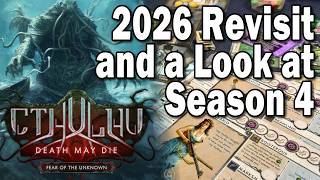




























Cthulhu: Death May Die Deep Dive
What the Community Thinks About Cthulhu: Death May Die
Cthulhu: Death May Die occupies a beloved niche in the cooperative gaming landscape, consistently praised for delivering genuine Lovecraftian tension without the hours-long commitment that similar games demand. Reviewers with deep backgrounds in Lovecraftian titles, including Arkham Horror Second Edition and Elder Sign, highlight how this game distills the genre into a tighter, more tactically focused experience. The enthusiasm centers on a core loop that feels both accessible and deeply satisfying: players enter each session with weak, fragile investigators and emerge, if they survive, as powerhouses throwing fistfuls of dice at elder god minions. Criticism centers on two areas: an insanity flip mechanic that can abruptly shift win conditions in ways that feel jarring, and a progression system where the most reliable path to victory often runs through generic abilities rather than each character's distinctive unique power. Neither concern erases the goodwill the game has earned, and reviewers consistently return to the same phrase when describing what they found at the table: it is just really fun.
Core Mechanics That Define Cthulhu: Death May Die
Boss Battler: Elder Ones With Multi-Stage Escalation
At the center of every session stands an elder one: a colossal, multi-stage threat that reshapes the entire encounter as it progresses. In practice, this means players cannot simply rush the ancient evil and trade blows from the opening round. Each elder one stages into the game through a ritual that investigators must disrupt before the creature can even be wounded. Scenarios against Cthulhu, for example, feature multiple stages with twelve health each and distinct attack behaviors per stage, plus the terrifying possibility of the elder one spawning directly onto the board mid-game as an additional presence that must be managed alongside existing minions. The boss battler structure keeps every scenario feeling like a narrative climax: there is always a specific enemy to confront, a ritual to race against, and escalating stakes that force increasingly desperate decisions from players. Reviewers who have run the game through playthroughs emphasize how the ingredient-collection objectives layered on top of the boss encounter, like gathering sulfur, charcoal, and saltpeter to destroy specific locations, prevent any session from settling into a simple grind. The elder one is not merely a hit point sponge; it is a dynamic threat that transforms the entire board state.
The Insanity Track: Risk, Reward, and Unraveling
The insanity track is where Cthulhu: Death May Die separates itself from genre peers most distinctly. Each investigator begins psychologically intact but mechanically limited, and the path to power runs directly through madness. As characters advance up the insanity track, they unlock ability tiers and gain access to additional green dice that expand their combat effectiveness in dramatic fashion. Stress tokens, accumulated through the horrors of play, can be spent to reroll dice, giving investigators a meaningful resource to manage in tense moments. The counterbalance is severe: die at the track's end and the investigator is eliminated; trigger an insanity event mid-game and the character faces a dramatic, often disruptive consequence. In the most extreme cases, a character who crosses into full insanity may have their win condition altered entirely, potentially turning them against the group. Playthrough reviewers who have witnessed these insanity flips describe them as both thematically resonant and mechanically disorienting, a genuine duality the game never fully resolves. Still, the progression from fragile scholar to dice-hurling force of chaos is the experience most reviewers describe as the game's emotional signature.
The Cthulhu: Death May Die Experience
The Power Fantasy Arc: From Fragile to Unstoppable
Reviewers consistently describe the same emotional arc across sessions of Cthulhu: Death May Die. Players begin as investigators who struggle to accomplish basic actions reliably, vulnerable to every threat on the board and carefully rationing their limited capabilities. As the game progresses and insanity deepens, the dice pool expands and combinations emerge that feel increasingly explosive. By the late game, a single character might launch an attack rolling ten or more dice, watching them scatter across the table while the rest of the group reacts with genuine excitement. This escalating power fantasy is not accidental: the entire design pulls players toward it, rewarding madness with mechanical capability and creating a second-act transformation that cooperative games rarely achieve so viscerally. Foster the Meeple identified this as some of the best gaming experiences they had encountered, specifically calling out the moment when unleashing a massive dice roll obliterates a crowd of minions as a peak table memory. The arc gives each session a shape: a slow, desperate opening that builds toward an explosive, high-stakes finale.
Tension That Builds to the Final Round
Among the qualities reviewers value most in a cooperative game is the sensation that the outcome genuinely hangs in the balance, that a loss feels possible right up until the final moments. Cthulhu: Death May Die delivers this consistently. The structure pushes players toward a climactic confrontation with escalating timers, a growing summoning track, and increasing enemy pressure that prevents comfortable strategic planning. Reviewers who have played multiple sessions describe a recurring pattern: the group enters the final elder one confrontation barely holding together, with investigators depleted, board positions compromised, and timers threatening to resolve the game before the boss is defeated. Meet Me at the Table reflected on this tension directly, noting that the game always seems to come down to the wire, and identifying that quality as exactly what a cooperative game should deliver. The scenario-based structure means this tension is not accidental but designed into each episode, with specific objectives and enemy spawns calibrated to keep the group under sustained pressure across the full ninety-minute runtime.
What Makes Cthulhu: Death May Die Stand Out
Modular Scenario System With True Combinatorial Replayability
One of the most frequently praised structural decisions in Cthulhu: Death May Die is how the content is organized for maximum replayability through simple mix-and-match construction. Players select an elder one and combine it with a separate episode or mission, and any combination is valid. This means the game's content does not exhaust itself linearly but multiplies: different elder ones bring distinct mechanics, attack patterns, and threat behaviors, while different episodes impose entirely different objective structures, board configurations, and narrative contexts. Rolls in the Family highlighted this system as a meaningful differentiator, noting that players who want to explore the full range of the game have many distinct experiences ahead of them without any single combination serving as the definitive version. The modular board assembles differently based on scenario requirements, and Discovery cards provide context-specific equipment, companions, and items that shift character builds session to session. For groups who regularly return to the same cooperative game, this architecture provides the sustained freshness that keeps Cthulhu: Death May Die on shelves for years.
The Ninety-Minute Cooperative Sweet Spot
The board gaming cooperative genre tends to cluster at extremes: short, light experiences that resolve in thirty minutes, and sprawling campaign games that demand three or four hours minimum. Cthulhu: Death May Die lands in a space that reviewers identify as genuinely underserved. At approximately ninety minutes, it is long enough to build narrative momentum, develop investigator arcs, and deliver a satisfying climactic confrontation, but short enough to fit into a typical game night alongside other titles. Rolls in the Family articulated this directly, noting that the ninety-minute cooperative range has very few strong options, and that this game fills that gap effectively. Importantly, the game achieves its runtime without sacrificing depth: the insanity track, stress economy, multi-stage boss structure, and scenario objectives all function within the ninety-minute window without feeling rushed or truncated. For groups looking for a cooperative experience that delivers weight and consequence without consuming an entire evening, Cthulhu: Death May Die represents a rare structural achievement.
Potential Drawbacks
The Insanity Flip and Shifting Win Conditions
The insanity mechanic that drives so much of the game's best moments also introduces its most discussed friction point. When a character's insanity progresses to specific trigger thresholds, the resulting events can be severe and disruptive in ways that some players find more frustrating than thematically exciting. In the most extreme cases, an insanity flip can alter that investigator's win condition, potentially turning them from a cooperative partner into a source of interference for the group. Foster the Meeple specifically called attention to this mechanic when describing the game, framing it as a feature that carries genuine consequences for group dynamics. The challenge is tonal: for players who embrace chaotic, high-stakes outcomes, watching an investigator go fully mad and begin working against the group is a memorable story. For groups seeking consistent cooperative alignment and predictable team structure, the possibility that a single mechanic can undermine the entire session's social contract is a meaningful concern. The game does not offer a clean way to mitigate this risk without also dulling the insanity system's best rewards.
Ability Optimization Versus Unique Character Identity
Cthulhu: Death May Die features unique investigator abilities that level up through the insanity track, giving each character a distinct identity on paper. In practice, however, reviewers who have played extensively note that the most reliable path to consistent wins runs through the basic, shared ability track rather than the unique character abilities. Meet Me at the Table's playthrough commentary reflected on this tension directly, observing that leveling up basic abilities tends to produce more dependable results across different scenarios and elder ones than investing heavily in the unique powers. This creates a quiet conflict at the heart of character building: the unique abilities are the most interesting and thematically evocative options, but they can underperform in efficiency relative to the more generic upgrade path. Competitive or optimization-minded groups may find themselves repeatedly making the same practical decision against their creative instincts. Related to this, scenario difficulty can spike sharply based on the elder one and episode combination selected, and groups without prior knowledge of specific encounters may find certain combinations punishingly steep relative to the apparent learning curve.
If You Enjoy Cthulhu: Death May Die
Players drawn to the Lovecraftian setting will find rich territory in Eldritch Horror, which expands the scope dramatically with a global map, deep narrative arcs, and sprawling investigator content, though at a significantly longer runtime. Arkham Horror: The Card Game offers the tightest thematic expression of the mythos in a living card game format, with investigator customization and campaign structure that rewards long-term engagement. Arkham Horror Second Edition represents the genre's classic form: dense, complex, and narratively rich, though demanding in both time and ruleset. For players who love the boss battler structure specifically, Aeon's End delivers a similarly escalating cooperative encounter design with a deck-building twist and surprisingly elegant breach mechanics that reward strategic layering. Mansions of Madness shifts the dungeon crawl into an app-driven narrative experience set in Lovecraftian houses and locations, trading dice-fueled combat for puzzle-solving and story beats. Those who enjoy the scenario-based modular structure of Cthulhu: Death May Die may also appreciate Gloomhaven for its campaign depth and evolving character progression, or Descent: Legends of the Dark for app-enhanced dungeon crawl encounters with rich component production.
What Reviewers Are Saying
"It's really fun to get super powerful and just be throwing ten dice at an enemy and just everyone's like oh my God you just killed like six minions. It's like some of the best gaming experiences I've had is playing that game. I always play as Rasputine."
— Foster the Meeple
"Cthulhu Death May Die is this really nice game in fitting the feel of that in a shorter time frame and a more shrunk tactical experience where you're actually going through rooms and like a scenario where something's happening. It's a lot more zoomed in and it just really nails focusing on just fun with very simple game flow and not a lot to remember."
— Rolls in the Family
"I always feel like it comes down to the wire and that's really what matters to me in a game."
— Meet Me at the Table