/pic1205385.jpg)
Game Info
Year
2007
Players
2
Collection
Ratings
Creator Score
Mechanic profile
Not enough video data yet
Vibe profile
Not enough video data yet
Description
Game description from the publisher:
Cuba prior to the revolution: Under turbulent circumstances, the villages of the island strive for independent wealth and influence. Who can buy and sell his products and goods on the domestic market profitably or take in the most on the trading ships? Who can send the right delegate to parliament in order to influence the government legislative process, or erect distilleries, hotels and banks at the right moment to the benefit of his village?
Whoever has accumulated the most victory points in Cuba by the end of the game wins. Players earn victory points by shipping merchandise from the harbor, but also by erecting and using buildings, and by abiding by the law.
Featured Videos

Ask a Rules Question
All mentions
Browse transcript mentions, sentiments, pros/cons, mechanics, topics, quotes, and references.
Total mentions: 21
This page: 21
Sentiment:
pos 14 ·
mix 3 ·
neu 1 ·
neg 1
Showing 1–21 of 21
Video A4oNlToouj4
Grant Lyon Rules Teach at 0:07 sentiment: positive
video_pk 94927 · mention_pk 260445
Click to watch at 0:07 · YouTube ↗
Overall sentiment (raw)
positive
Pros
- Super fun lawn game
Cons
none
Thematic elements
- Knocking over wooden blocks with dowels
- Lawn
Comparison games
- Cornhole
Mechanics (from transcript analysis)
- Object placement/retrieval — When a Kubb is knocked over, it is tossed back to the other side and stood up where it lands, becoming a 'field Kubb'.
- Targeted throwing — Players throw dowels to knock over their opponent's Kubbs.
- team play — Players divide into two teams.
- Winning condition — The first team to knock over all opposing Kubbs and the king wins.
Video topics + discussion points
No key topics recorded for this video.
Quotes (from this video)
- Are you looking for a new lawn game to play?
- Cornhole is great, but everybody already knows it.
References (from this video)
No references stored for this video.
Video NLu46nZUqQA
Rolling Dice & Taking Names Discussion at 51:38 sentiment: mixed
video_pk 93528 · mention_pk 253894
Click to watch at 51:38 · YouTube ↗
Overall sentiment (raw)
mixed
Pros
- Medium weight euro with interesting decisions and mechanics
- Good player interaction
- Multiple paths to victory
- Slow build that unlocks more options
- Thematic integration
- Good art
- Decent rulebook
Cons
- Misleadingly straightforward appearance
- Text-heavy locations that require constant reading
- Potential for kingmaking
- Can start slow before building momentum
Thematic elements
- Lovecraftian
Comparison games
- Mansions of Madness II
- Eldritch Horror
Mechanics (from transcript analysis)
- Area Control — Marty describes it as an 'area control game'.
- Card Drafting — Mentioned in the context of actions and abilities.
- Multiple paths to victory — Marty highlights 'three paths to victory'.
- Set Collection — Mentioned as part of a strategy for victory conditions.
- Variable player powers — Marty mentions it has 'variable player powers'.
- Worker Placement — Marty describes it as a 'worker placement game'.
Video topics + discussion points
No key topics recorded for this video.
Quotes (from this video)
- We have recovered from the swirlies
- We were told to get more relevant stop showing our age
- You know who Mayfair games is yeah I know who made they produce games yeah what's their big game oh crap like I'm gonna remember are you freaking kidding me you on a board game podcast for the past five years
- Basically everybody cheats and monopoly it's a given you're going to somehow you're going to cheat
- The goal is you gotta learn all the locations and how they work and that's one thing I don't think that's gonna be on here but I wish that I did wish there was symbology on the board all the locations are text which means you're constantly reading
- you're a priest trying to get followers the theme is your recruiting cuz your deity is the best plain and simple and you want people to come to your side
- When you open up the box there are no rules you just basically have a deck of cards that are wrapped
- This is the kind of game that is not for everybody it's not going to be your type of game it's not going to be my type of game but I can see the value in it
References (from this video)
No references stored for this video.
Video 5AWQyb-l2B4
Analysis at 31:37 sentiment: other
video_pk 93396 · mention_pk 253553

Click to watch at 31:37 · YouTube ↗
Overall sentiment (raw)
humorous/dismissive
Pros
none
Cons
none
Thematic elements
Comparison games
none
Mechanics (from transcript analysis)
- dexterity — Dexterity games are not ball games. Like I want to a t-shirt, a hat and ball game. It's dexterity games are not ball game.
Video topics + discussion points
No key topics recorded for this video.
Quotes (from this video)
- Felt a little bit lackluster in terms of big releases for me.
- But you know, if uh there's no one around to Does the forest still shuffle?
- This is a game of managing resources, is a game of um uh territorial control and tableau building.
- Dexterity games are not ball games.
- IV Studios smashed it out of the park with this one.
- My main point of contention with Drillers is maybe it might run long with too many players and there is a little bit of downtime in the game when you're waiting.
- It's all to play for. It's only half time.
- The industry is backloaded. It's like heavily weighted towards the second half of each year.
References (from this video)
No references stored for this video.
Video Uu3CZV0LU7g
Getting Games Discussion at 14:31 sentiment: neutral
video_pk 91361 · mention_pk 331505

Click to watch at 14:31 · YouTube ↗
Overall sentiment (raw)
neutral
Pros
none
Cons
none
Thematic elements
Comparison games
none
Mechanics (from transcript analysis)
Mechanics unknown.
Video topics + discussion points
No key topics recorded for this video.
Quotes (from this video)
- I finally decided that it's something that I should try to see how much money I'll actually make
- it's something I've been putting off for years like literally since I very first started this channel
- 80% is still well and good enough for me to go ahead with this
- sound is a bit magical in my old career that I've been doing for like 12 years
- I am planning on leaving them on as they are right now for the foreseeable future
- I don't want to flood people's timelines with all these little five to ten minute videos
References (from this video)
No references stored for this video.
Video r48M9io0lgc
Man vs Meeple Discussion at 0:26
video_pk 86901 · mention_pk 226430
Click to watch at 0:26 · YouTube ↗
Pros
none
Cons
none
Thematic elements
Comparison games
none
Mechanics (from transcript analysis)
Mechanics unknown.
Video topics + discussion points
No key topics recorded for this video.
Quotes (from this video)
- they shared three trailers for three of their new games they're coming out very very soon
References (from this video)
No references stored for this video.
Video E2_544A6S0A
Sir Thecos Top List at 10:37 sentiment: positive
video_pk 86264 · mention_pk 338292
Click to watch at 10:37 · YouTube ↗
Overall sentiment (raw)
Positive
Pros
- Neat card game
- Cute
- Easy to teach and get to the table
- Plays quickly
Cons
- Not amazing
Thematic elements
Comparison games
none
Mechanics (from transcript analysis)
- Card game — Described as a neat card game.
- tactics — Described as a very nice tactical card game.
Video topics + discussion points
No key topics recorded for this video.
Quotes (from this video)
- this one is an abstract game that actually worked pretty well
- oh boy oh boy this is a game I don't have to think about it I I I could even think about giving it lower than a d but I will give it a d now
- the design doesn't work at all it's so specific there's like so much text on the cards it's i' I've I've never seen cards like that
- this is we have the suspicion that this is AI generated or at least some of it uh like what the regarding the rules in the design because wow this is really cumbersome
- it's a solid game this is like a game that is has a cool premise it works very well but it's nothing special but still I keep coming back to it because the Bame Marina implementation is so great
- Kaber of course uh this needs to be an S tier because it's my top three game in both my list solo and general
- Secret identity I will also give an a yeah it works really well
- it's very very tough but I like it it's always fun
- very good Abra game I can just I just recomend can recommend that to pretty much everyone
- Not turn I just reviewed on my channel uh I like this game I will give this a B I think B is fine uh it's a good game it has a very interesting Bing mechanism and a it has a few mechanisms that are very unique
- Missana uh I'm still really torn now that I played the cave of Gins which is really good um I might rank this higher I would also give this a B I don't know this game I think this game like will become even better like when you have more expansions right the base game is okay it's fine probably just a b Toc
- just one srank one of the best party games out there definitely srank uh I always like to pull it out it's one of my most favorite party games
- K grip also clear srank let me just put it up here clear srank game is one of my most most favorite portable solo games ever
- Kites Kites I will give a H A or B uh it's a very good game but I think I will give it a b it's also like a fun time you play like one two three four games and then you're over it and then you don't want to play it for a few weeks right at least that's how I feel but every time I pull it out it's very very fun I like it
- fun facts also clear S rank I like this a little bit more than just one uh but they're both incredible party games so definitely also S rank
- belati um a game that is not very well known I think internationally but a very cool deduction party game I also have to give this an S it's always a fun time like really really fun party games
References (from this video)
No references stored for this video.
Video dRTg-vnuL8o
Board Stupid Analysis at 34:30 sentiment: positive
video_pk 80672 · mention_pk 197177

Click to watch at 34:30 · YouTube ↗
Overall sentiment (raw)
positive
Pros
- Silly and amazing
- Incredible nonsense
- Loved it
Cons
none
Thematic elements
Comparison games
none
Mechanics (from transcript analysis)
- balancing — Core mechanic of the game.
- Dexterity Game — Involves balancing sticks between fingers.
Video topics + discussion points
No key topics recorded for this video.
Quotes (from this video)
- This I was mega excited about.
- We sneak the copy away.
- So, the idea behind this one, of course, card drafting, tableau building, similar to those games that we really enjoy where you're creating your grid of cards and having those have various effects, like for example in Annual X or for example in Car Combo, but with slightly more behind it as well.
- And again, sitting into that lovely sort of 45 minutes to an hour exciting interactive game, which I'm super excited about.
- The artwork is absolutely stunning.
- We can't do a 7-hour video. So, we going to in the upcoming weeks, we're going to in the in the other different episode that we do of the hype factor, the playlist or uh review, stuff like that. We're going to talk about all the other games as well.
- We have the best community of people and we love every single one of you.
References (from this video)
No references stored for this video.
Video CK_aY_9Y_-U
Top List at 2:04 sentiment: positive
video_pk 73221 · mention_pk 174945

Click to watch at 2:04 · YouTube ↗
Overall sentiment (raw)
positive
Pros
- Very affordable and cute
- Really solid little set collection game
- Easy to play
- Still a really good game
Cons
- Risk of losing points if not banked before the game ends
Thematic elements
- Set collection with banking points
Comparison games
none
Mechanics (from transcript analysis)
- Card Drafting — Taking cards from shared rows and columns.
- Set Collection — Players take cards from rows and columns to collect sets of different colors.
Video topics + discussion points
No key topics recorded for this video.
Quotes (from this video)
- these games have a tiny footprint so not only is the Box small the actual game itself is pretty small when it's on the table and also these games are very affordable
- it's much more difficult than it sounds and it's actually much more fun than it sounds as well because normally I don't like games like this but this one is tremendous fun
- it's kind of an efficiency puzzle where you are playing with your luck you know can you keep everything in front of you without banking them or are you going to spend that extra time to be a bit more cautious
- it's a lot of fun and if you like games like cockroach poker this is a great alternative that I actually think is a lot better
- it's only six turns so it's lightning fast and again it's a great way to dip your toe into the kind
- very luck dependent but it's charming and it's fast and easy to play
- this one probably the gamest of all of them in terms of I'm being a bit more restrictive and some of the rules being you know a little bit more gamified but it's still super easy to play
- the more cards you play your options quickly start to dwindle and it's all about trying to squeeze every single point out of this game it's a wonderful design and one of the best filler games to come out in the last 5 years or so
References (from this video)
No references stored for this video.
Video Vgy9fzAo9Zw
Discussion at 5:49 sentiment: positive
video_pk 69605 · mention_pk 166200
Click to watch at 5:49 · YouTube ↗
Overall sentiment (raw)
positive
Pros
- Nice one
Cons
- Costs negative victory points if not banked before game end
Thematic elements
- Set collection
Comparison games
none
Mechanics (from transcript analysis)
- Card Drafting — Collecting rows and columns of these cars and bank them.
- Set Collection — Little set collection game trying to collect rows and columns of these cards and bank them before the game end comes up.
Video topics + discussion points
No key topics recorded for this video.
Quotes (from this video)
- this is where I talk about all of the games that I have been playing over the last couple of weeks this episode covering the second half of July 2024
- this one you can add worker placement spots as the board Goes On by Building uh new buildings along this track getting better yields and better Rewards or conversion rates as you go
- I do think this game is very welld designed I think it's a classic and almost like a Hall of Fame Style game
- worker placement games and especially Resource Management ones where you're converting cubes into other things or building stuff um those kind of games have dried up for me I don't enjoy them too much um kis I think is the best of them but still I think this spark is starting to wne
- Devon uh is really hitting home with me at the moment I'm loving this one
- you have to be hyper alert otherwise you can be definitely struck by a move like that and that will completely paralyze you and hinder your chances of winning
- I'm loving my abstract strategy games at the moment definitely on the lookout for um the great ones
- Lovely little kind of family plus weight Style game
- I think the game is very smart very um sharp
- still I think this is a lovely family weight game tragically overlooked and I think the best of the matchi Coro Style of games out there
- no not too many but still a good spread of uh you know heavy to uh you know Gateway plus style and pure fill of games and even some uh simple but comp not complex but deep abstract games such as Devon
References (from this video)
No references stored for this video.
Video rzIPT2DPtvA
Review at 0:17 sentiment: mixed
video_pk 69356 · mention_pk 165826
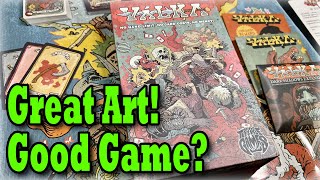
Click to watch at 0:17 · YouTube ↗
Overall sentiment (raw)
mixed
Pros
- Fantastic art
- Solo mode uses more components than multiplayer
- Quest cards add narrative elements not used in multiplayer
Cons
- Solo game not great
- Location compositions can be too luck-based
- Battles can be on rails or too luck-based
- Combat is not exciting
- Potential for battles to go on infinitely
- Expansion content use can be unclear
- Rules aren't great, especially for warband powers
- Text on cards is very small and hard to read
- Not enough market cards in the deck
- Setup of cards can be brutal
- Combat can be deterministic and boring
- Static combat with no ability to swap strategies or gear mid-battle
- Missing 'spice' or 'magic'
Thematic elements
- Head-to-head competitive battle game with warbands fighting for survival and glory.
- A Savage post-apocalyptic fantasy realm
Comparison games
- Magic the Gathering
- Mini Rogue
- Iron Helm
- Rogue Dungeon
- Dragon's Dungeons of Drore
Mechanics (from transcript analysis)
- Buffs, actions, spells, traps, items — Used to strategically bolster fighters.
- Card-based combat — Fighters have strike, health, and defense stats.
- Legacy/unlockable rewards — War band leaders can be unlocked and added to the deck permanently for multiplayer.
- map exploration — Players move between locations on a map trying to clear out cards.
- Quest cards — Little narrative encounters or events that players overcome.
- Stamina and Gold (Crones) — Currencies used in the solo mode for movement and purchasing.
- Warbands — Players control different warbands and can buff their creatures to attack each other.
Video topics + discussion points
No key topics recorded for this video.
Quotes (from this video)
- the art in this game is off the charts good
- unfortunately I feel kind of the same way about vulka I'm not really sure about the game at least the solo game
- in the solo mode for vulka you actually get to use more stuff because you do get to use this pretty big deck of quest cards and these are little narrative encounters kind of narrative events that you will have to overcome that you will have to encounter while you are playing and these are actually not used at all in the multiplayer game
- for a solo version I just don't don't think it really got there and I think with some tweaking maybe some additional house rules or maybe kind of revamping the solo rules this could be a pretty cool game that could kind of push it maybe into that uh that great spot of something like mini Rogue or iron Helm or Rogue dungeon something like that
- the text is very very small and and and the border is quite large around the cards I think the Border could have been shrunk down a little bit to give some more room for the text and the font can be quite hard to read
- it can become this kind of NeverEnding fight where you are doing a point of damage then it's the enemy's turn then they roll for a reinforcement ments it comes out you do another point of damage kill one of them and then it's their turn they can't damage you and they roll for a uh reinforcement and that keeps coming out and it's this proc this process that just keeps happening over and over and over again and it can be really boring because the the combat in this game just isn't very exciting
- one of the main issues I have with this game is once you set up your warriors once you set out your your one or two uh guys from your warband and then buff them up with with some of your equipment this never changes from during the battle you can never say oh I need to rest strategize I'll switch my guys out for different abilities or switch my gear out it's set in stone once you do this it's set and then it just the game kind of plays itself in a way
- unfortunately the game is just kind of okay and it's not really doing a lot to make me want to play it anymore than I already have
References (from this video)
No references stored for this video.
Video HTlNB-BVE3g
Game Night Picks - Pair Of Dice Paradise Discussion at 9:26 sentiment: positive
video_pk 37061 · mention_pk 111273

Click to watch at 9:26 · YouTube ↗
Overall sentiment (raw)
positive
Pros
- novel 3D gameplay for its era
- strong sentimental value tied to travel and memory
Cons
- no documented solo mode in rules
- rules/box info can be incomplete or hard to verify
Thematic elements
- three-dimensional tic-tac-toe with physical chips
- postwar era, early plastic/plasticized game production
Comparison games
none
Mechanics (from transcript analysis)
- 3D tic-tac-toe — Players aim to align three in a row in a 3D grid using table-top cubes.
- tactile component-driven play — Physical chips and structures contribute to the experience.
Video topics + discussion points
No key topics recorded for this video.
Quotes (from this video)
- I still got it. This copy from my childhood. This copy of it is from 1999.
- The main strategy in this game is to get good at spinning.
- Acquire is the oldest game I still play.
- It's a funny piece of marketing to me.
- I love The Castles of Mad King Ludwig.
References (from this video)
No references stored for this video.
Video QY1MIK0jMOA
Board Game Animal Discussion at 0:00 sentiment: positive
video_pk 30591 · mention_pk 151410
Click to watch at 0:00 · YouTube ↗
Overall sentiment (raw)
positive
Pros
- Adds a new interaction and decision point through the Leap Frog mechanic.
- Introduces tactical trade-offs that can shift tempo and board position.
- Enhances player interaction via negotiation-centered design.
Cons
- Requires two pieces to execute, which may constrain situational use.
- Potential balance concerns if the leap effect is too powerful or disruptive.
- Ambiguity in how it scales with other game components not shown in the excerpt.
Thematic elements
- Negotiation-driven expansion mechanic with a Leap Frog action tied to frog-themed faction concepts.
- Not specified in the excerpt; discussion centers on an expansion concept for Zuva.
- Abstract/strategic framing with thematic frog faction ideas.
Comparison games
none
Mechanics (from transcript analysis)
- Leap Frog — A proposed action that lets a player leap one of their pieces forward, at the cost of moving another of their pieces back. Requires at least two pieces to be able to execute.
- Negotiation — The Leap Frog action is mediated by player negotiation, adding social dynamics to timing and resource trade-offs within the expansion.
- negotiation-based interaction — The Leap Frog action is mediated by player negotiation, adding social dynamics to timing and resource trade-offs within the expansion.
Video topics + discussion points
No key topics recorded for this video.
Quotes (from this video)
- Leap Frog it allows you to Leap Frog one of your pieces but at the expense of making another one of your pieces go back
References (from this video)
No references stored for this video.
Video Pas-TtJBf9o
Chairman of the Board Discussion at 10:34 sentiment: positive
video_pk 13729 · mention_pk 129489
Click to watch at 10:34 · YouTube ↗
Overall sentiment (raw)
positive
Pros
- Charming and accessible; good for teaching new players
- Pleasant twist on banking mechanics
Cons
- Idle negative scoring for unbanked cards may feel punishing to some
Thematic elements
- categories and animal tokens with scoring banks
- card drafting on a grid; a family-friendly drafting experience
- charming, approachable
Comparison games
none
Mechanics (from transcript analysis)
- banking with animals — bank multiple cards of the same type using an animal card
- Grid drafting — draft cards on a grid and collect animals to bank for scoring
- Multi-Use Cards — bank multiple cards of the same type using an animal card
Video topics + discussion points
No key topics recorded for this video.
Quotes (from this video)
- this one is a lovely game by Stephan Dora, a great design in his own right.
- you are trying to collect exactly three of these animal tokens of each type to get the maximum amount of points
- a real brain burner but so simple and elegant to play as well
- Lost Cities a joy to get that one back to the table
- it's far too long I think it took us nearly two hours to play this which is obscene for the weight of the game
- Katarena one of the best abstract strategy games out there
- this is a bit of a whitewash of a game
References (from this video)
No references stored for this video.
Video x6M-6arZ_jc
Chairman of the Board Discussion at 3:56 sentiment: positive
video_pk 12836 · mention_pk 99211
Click to watch at 3:56 · YouTube ↗
Overall sentiment (raw)
positive
Pros
- quick, approachable filler with family appeal
- good for a couple, easy to teach
Cons
- rules misread by a player can impact balance
- some ambiguity in scoring potential
Thematic elements
- little grid-based drafting with set-collection flavor
- Light, family-weight drafting game
- quick, approachable drafting experience
Comparison games
none
Mechanics (from transcript analysis)
- Grid drafting — drafting from a grid with opportunities to bank cards
- Set Collection — collecting card sets for scoring
Video topics + discussion points
No key topics recorded for this video.
Quotes (from this video)
- this is going to be one of the coolest examples of a programming game that you will see out there
- Wallenstein has become one of my favorite games of all time
- it's beyond genius
- Tower Up is fantastic
- it's pure system
- this is one of the most overlooked games from the Oink brand
References (from this video)
No references stored for this video.
Video cqoTWloOkjg
Board Game Design Lab Interview at 1:11:43 sentiment: positive
video_pk 12681 · mention_pk 103356

Click to watch at 1:11:43 · YouTube ↗
Overall sentiment (raw)
positive
Pros
- Distinctive visual art and branding that matches the game’s metal/underground vibe
- Robust solo mode and well-structured two-player drafting option
- Nontraditional constraints (no hand limit, no resource-casting cost) that create fresh strategy space
Cons
- It can be polarizing to players who prefer traditional hand management
- Licensing and collaboration dynamics could complicate development paths
Thematic elements
- metal/rock-and-roll aesthetic fused with dark fantasy combat
- savage dice and card battle on a cloth map
- focus on vibe and style; strong visual-forward identity
Comparison games
- Cosmic Frog
- Other high-visual-impact battle games
Mechanics (from transcript analysis)
- Deck-based combat with a six-space map — Players use a 30-card deck to control a war band, battling across a cloth map with tactical positioning.
- No hand limit, no action point economy — A counterintuitive design choice that emphasizes aggressive play and fluid decision-making.
- Solo and two-player modes with drafting — Standalone solo game (Lone Quest) and a two-player mode that uses deck drafting to ensure balanced play.
Video topics + discussion points
No key topics recorded for this video.
Quotes (from this video)
- deadlines are how you live and die in the freelance world
- face-to-face time is marketing power
- this is the long con
- lean into the hand you've been dealt
- put your shoes on
- the more you swing the bat, the better you get
References (from this video)
No references stored for this video.
Video 49nBAGyXK3U
BoardGameBollocks Top List at 6:08 sentiment: positive
video_pk 7975 · mention_pk 115289

Click to watch at 6:08 · YouTube ↗
Overall sentiment (raw)
positive
Pros
- unique, one-of-a-kind concept
- very kid-friendly and engaging
Cons
- not widely available; niche theme
Thematic elements
- air-based dexterity
- board with tiles and magic carpet action
- light, whimsical
Comparison games
none
Mechanics (from transcript analysis)
- dexterity with air propulsion — place a magic carpet tile and use a puffing/air mechanism to move items into stores
- tile/collection progression — collect all items by reaching stores in sequence
Video topics + discussion points
No key topics recorded for this video.
Quotes (from this video)
- it's actually fantastic so flew under the radar
- it's a wonderful game, it's very tense, it's very close
- it's a one-of-a-kind game
- it's an incredibly simple game but it gets kids thinking about planning ahead
- my kids absolutely love this one
- this is looping Louie, and you can bash Louie up and he'll be floating up and down
- it's a very, very tense, very close
- Pitch Car Mini is perfect to introduce kids into that sort of dexterity flicking type thing
- it's the best children's games you can get today
References (from this video)
No references stored for this video.
Video dMtU6Zx3scM
Chairman of the Board Discussion at 6:38 sentiment: negative
video_pk 7519 · mention_pk 22358

Click to watch at 6:38 · YouTube ↗
Overall sentiment (raw)
negative
Pros
- Stunning production and artwork
- Elegant core engine and card-drive flow
- Polished Euro feel
Cons
- Limited replayability after a few plays
- Lacks momentum and grand crescendos
- Expansion needed for more variety (not tested)
Thematic elements
- card-driven Euro with building and resource management
- Caribbean island economy, resource markets, and building up ships
- engine-building through buildings and ship valuation, dynamic market
Comparison games
- Santa Maria
Mechanics (from transcript analysis)
- Card-driven actions — Play character cards to perform actions and unlock abilities.
- Dynamic market and ship docking — Ships dock and their demand affects scoring; waiting can let opponents steal slots.
- Resource harvesting and building — Harvest resources based on board rows/columns and build structures that convert resources.
- Voting power from unused cards — Unused cards grant voting power to influence end-game bonuses.
Video topics + discussion points
No key topics recorded for this video.
Quotes (from this video)
- this is Bombay by estari games
- this is a more traditional pickup and deliver Style game
- it's a nice way to maybe introduce pickup deliver and logistics for younger children or you know less experienced gamers
- you’re going to outgrow this one pretty quickly
- not really cut the mustard for experienced Gamers
- it does what it does well and it's a good example of a very simple pickup and deliver game
- this is more of your traditional Euro as you are essentially trying to manage your Fleet of ships
- I thought this was kind of surplus to requirements
- the game also has this investment system where you can actually invest in other players
- I didn't really think that the again incremental way of scoring was that significant
- this game suffers a lot of the same fate as Francis Drake
- this is one of the nicest looking board games I've ever played
- very attractive I think it's Michael Manziel artwork really does look fantastic
- this is a card driven Euro as you have a hand of these character cards
- the pacing of the game is really good
- it's a very polished Euro I think
- not being able to carry certain resources from round to round unless you pretty much spend your whole time to use a resource
- I couldn't really recommend
References (from this video)
No references stored for this video.
Video o9g7IvUK5yo
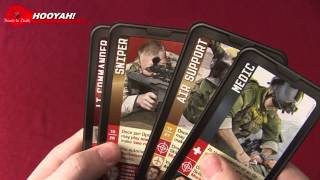
Board to Death TV - Board Game Reviews Review at 0:00 sentiment: mixed
video_pk 6705 · mention_pk 116514
Click to watch at 0:00 · YouTube ↗
Overall sentiment (raw)
mixed
Pros
- Easy to teach and accessible for new players
- Fast-paced with quick rounds and rapid decision making
- The core mechanics are solid and adaptable to different themes
- Tense, privacy-driven interaction that strengthens player engagement
- Asymmetric Navy Seal cards add variety and a touch of flavor
Cons
- The Navy Seals theme feels tacked on; the artwork and events don’t reinforce the flavor (no art on events, and the cover promises a COD-like vibe)
- Limited strategic depth for experienced gamers
- Health/timer interaction can feel punitive if players draw poorly or mismanage timing
- Some players may find the art/theme disconnect reduces immersion
Thematic elements
- Teamwork under pressure, covert operations, and resource/hand management under a ticking clock.
- Cooperative, time-sensitive operation scenarios presented as Navy SEAL missions; a compact, forward-deployed combat theme without being tied to a specific real-world unit.
- Procedural framing of missions with minimal cinematic storytelling; emphasizes system mechanics over flavor text.
Comparison games
- Call of Duty
Mechanics (from transcript analysis)
- Asymmetric roles and mission arc — Each Navy Seal card carries small abilities that subtly alter gameplay for different players, creating a light asymmetry. Five ops must be completed to reach the mission and win as a team.
- Color-matched resource drafting — During the preparation phase players try to draw two cards per turn; they aim to collect cards that match the color of the current objective (OP). This creates color-encoded synergy with the mission; players coordinate to assemble the right colors without revealing their hands.
- Event deck and skill deck interactions — The game provides an event deck and a skill/equipment deck. Events can force discards or damage; skills provide specialized options to manipulate the flow of rounds and improve odds of passing tests during the ops phase.
- Ops tests and color matching — During the ops phase players flip event cards and attempt to meet color requirements using their held cards. Success allows progression to the next op; failure can cost health and discard cards, making subsequent ops harder.
- Secret hand and roll-call — Players can be secret about their cards; the lieutenant can call a 'roll call' to allow sharing of color counts. This mechanic encourages social deduction and strategic concealment.
- Time counter and health risk — A shared time counter tracks how many turns are allowed for the current operation. If the counter reaches zero during a player's turn, that player loses health, adding tension and a real-time feel to a turn-based system.
Video topics + discussion points
No key topics recorded for this video.
Quotes (from this video)
- Huya is a co-op game where players are trying to complete missions.
- It's easy to teach and anyone can play.
- The mechanics are good and can be used in any theme really.
- It's just a simple yet fun card game.
- The one big problem we have with that is that you not feel like a Navy Seals playing this game.
- Huya is a fast-paced card game with little strategy and fun.
- we're giving it a 6.5 out of 10
References (from this video)
No references stored for this video.
Video wlIeooaozuE
Adam in Wales - Board Game Design Rules Teach at 26:13 sentiment: positive
video_pk 4927 · mention_pk 110397
Click to watch at 26:13 · YouTube ↗
Overall sentiment (raw)
positive
Pros
- simpler of the pair
- custom dice sides
- special abilities
Cons
- some complexity
Thematic elements
none
Comparison games
- Roll for the Galaxy
Mechanics (from transcript analysis)
Mechanics unknown.
Video topics + discussion points
No key topics recorded for this video.
Quotes (from this video)
- Formula D is really the epitome of roll and move games in the modern era
- Settlers of Catan which was perhaps the most significant euro game that really sparked this whole new wave of modern board games
- Yahtzee has become a mechanic in its own right
- epitomises dice games really and how far they've come
- this is a bit of a tricky one to learn, it's well worth the effort
- ridiculously more fun than it should be
- playing with children it's fantastical
- absolutely brilliant
- this is my top 10 different ways to use dice in wooden board games
References (from this video)
No references stored for this video.
Video S7pP-givpnA
Chairman of the Board Top List at 5:37 sentiment: positive
video_pk 3573 · mention_pk 101702

Click to watch at 5:37 · YouTube ↗
Overall sentiment (raw)
positive
Pros
- 15-minute, breezy and charming
- polished design that works smoothly
- tension with an accessible pace
Cons
- deck burn can catch players off guard
- rules may require careful explanation to new players
Thematic elements
- animal companions and banking for scoring
- offset grid drafting with animals, cute theme
- chill yet tense due to push-your-luck elements
Comparison games
- Citrus
Mechanics (from transcript analysis)
- banking / banking cards — certain cards let you bank tokens for later, increasing efficiency
- grid draft of rows/columns — players draft a row or column from an offset grid
- Multi-Use Cards — certain cards let you bank tokens for later, increasing efficiency
- Push Your Luck — the deck can burn through quickly, forcing timely decisions
- push-your-luck and deck burn — the deck can burn through quickly, forcing timely decisions
- Set Collection — collecting items to bank and score based on banking rules
Video topics + discussion points
No key topics recorded for this video.
Quotes (from this video)
- the last five new to me games that I've played and I review and rank them from my least favorite up to my most favorite
- the art is very nice on the cards
- Breezy so quick so smooth
- it's polished and it works it does what it does so so well
- this is such a cool game I I was really impressed with it more so than I was anticipating actually even though it is just borrowed mechanisms from different games but again that six niip simultaneous selection with the mandala scoring just comes together so so well
- I would definitely recommend picking up a copy of mind up
References (from this video)
No references stored for this video.
Video i7UVXtHkVxY
Chairman of the Board Discussion at 4:04 sentiment: positive
video_pk 2802 · mention_pk 124711
Click to watch at 4:04 · YouTube ↗
Overall sentiment (raw)
positive
Pros
- straightforward with quick tension
- good flow and pacing
Cons
- endgame ramp can feel abrupt
- not the most innovative
Thematic elements
- set collection and quick tempo
- rows and columns of cards to draft and bank for scoring
- compact and accessible
Comparison games
none
Mechanics (from transcript analysis)
- End Game Bonuses — end triggers quickly, creating a tense finish
- rapid endgame — end triggers quickly, creating a tense finish
- Set Collection — collecting cards from rows/columns to bank points before the game ends
Video topics + discussion points
No key topics recorded for this video.
Quotes (from this video)
- it's really tight this Bard is and the opportunity cost of doing one thing
- there are so many different ways you can score in this game
- it's punchy
- the game end really does rush up on you
- polished, refined, gorgeous to look at
- you can just take the pieces off the board and go again
References (from this video)
No references stored for this video.
Transcript Navigation
Showing 1–21 of 21