/pic584779.jpg)



















Cyclades Deep Dive
What the Community Thinks About Cyclades
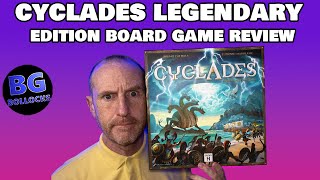
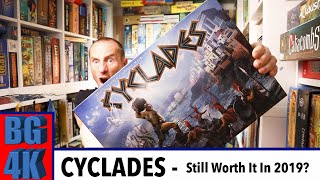
Cyclades stands as one of the most celebrated area control games in modern board gaming. Across multiple years and channels, reviewers consistently rank it among their top games of all time. The game's longevity is remarkable, remaining relevant and engaging more than a decade after its 2009 release. What makes this achievement particularly notable is not nostalgia but active engagement: players continue exploring new strategies, discovering fresh combinations in expansions, and finding reasons to return to the ancient Greek islands.
Core Mechanics That Define Cyclades
The Auction System for Divine Favor
The auction mechanism sits at the heart of Cyclades and represents one of the most elegant designs in modern board games. Each round, players bid gold to gain the favor of different gods, but once outbid, they cannot return to that same god and must select another. This creates a constant tension between desperation and restraint. Players frequently find themselves deliberately overbidding to block opponents from specific actions, knowing they will be kicked out and forced to pursue secondary goals. This bluffing layer transforms what could be a straightforward bidding system into a psychological game where table talk, reputation, and reading opponents become critical skills. The mechanism forces interaction at every turn while maintaining surprising depth from simple rules.
Multiple Paths to Victory
Victory in Cyclades requires controlling two metropolises, but the routes to achieve this are genuinely diverse. Players may build four different building types (fortresses, ports, temples, universities) to transform into cities. Alternatively, they can gather four philosopher cards to convert directly into a metropolis. Conquest offers another route, seizing control of already-built structures from opponents. This flexibility means different player types can pursue authentic strategies: aggressive players focus on combat, builders concentrate on construction chains, and control players manipulate the auction to deny opponents critical resources. No single strategy dominates, and victory often rewards those who remain adaptable as the game state shifts.
The Cyclades Experience
Relaxed Pacing with Explosive Turns
Cyclades builds gradually. For much of the game, the board appears wide open, with players slowly accumulating resources and positioning armies. This creates a false sense of security. Then, suddenly, one player realizes they are one or two god favors away from victory. The table shifts into crisis mode. Suddenly every action matters. Alliances form and break. The auction becomes vicious. What began as a leisurely strategic experience becomes tense and interactive. Reviewers consistently note this quality: the game never feels like wasted time, and the climactic endgame justifies every earlier decision and bluff.
Mythology as Living Theme
The Greek mythological setting permeates every aspect of Cyclades without feeling pasted on. Gods grant thematically appropriate powers: Ares commands armies, Poseidon rules the seas, Athena grants wisdom, Zeus provides economic advantages, and Apollo offers a safety net. The mythological creatures that can be hired during the game (Pegasus, Minotaur, Harpy, Kraken, Medusa) feel earned and narrative-significant rather than mechanically arbitrary. Reviewers frequently mention childhood connections to Greek myths and how Cyclades captures that sense of wonder. The game evokes epic struggle in the ancient world without requiring players to know anything about Greek history or literature.
What Makes Cyclades Stand Out
Elegant Simplicity Masking Strategic Depth
Teaching Cyclades takes approximately fifteen minutes. The combat system is perhaps the simplest possible implementation: roll a die, add your troop count, highest total wins. The god actions are straightforward. Yet within this accessibility lies surprising strategic richness. The same games never play twice the same way. The placement of mythological creatures on the market each turn creates variation. Different starting positions and player counts shift optimal approaches. The expansion content adds layers without overwhelming the core experience. This balance between accessibility and depth marks truly exceptional game design.
Extraordinary Expansion Support
Cyclades has received consistent publisher support across the years. The Titans expansion adds a second board configuration and introduces titan units that shift combat dynamics. The Monuments expansion provides buildings with special abilities, opening fresh strategic pathways. The Hades expansion introduces new gods, heroes, and artifacts. The Kemet crossover allows importing mythological creatures from another Matagot game. This modular expansion philosophy respects the base game while providing growth for experienced players. New players can enjoy vanilla Cyclades immediately, while veterans can customize their experience. Critically, expansions never feel mandatory; the base game stands complete, yet they extend the game's life indefinitely.
Potential Drawbacks
Combat System Lacks Modern Polish
The combat mechanic has not aged particularly well. Rolling a single die and adding unit counts creates high variance that can feel anticlimactic or random, particularly in critical moments. Reviewers acknowledge that newer area control games like Rising Sun and Cry Havoc feature more sophisticated combat systems with greater tactical texture. The simplicity that serves accessibility in the auction system feels like a weakness in combat, where more options might increase player agency. Some players embrace the simplicity as part of the game's charm; others see it as the one mechanical element that would benefit from evolution.
Expansion Bloat and Accessibility Concerns
While expansion support is a strength, the sheer volume of add-ons creates a paradox. New players learning the game need a streamlined experience, yet the full catalog presents overwhelming choice. Simultaneously, mixing all expansions into a single game creates rules overhead that obscures the elegant core. The player base splits between vanilla enthusiasts and those exploring full-rules variants. Adding Titans, Hades, and Monuments components to a single game transforms the experience dramatically. Reviewers note this creates a responsibility for teachers to curate what players experience, restricting the organic growth that newer players might enjoy through discovery.
If You Enjoy Cyclades
Cyclades shares DNA with Kemet, another Matagot mythology game with asymmetric powers and area control. Small World captures similar auction-like tension and territory control through the rotation of asymmetric races. Ethnos provides a faster, lighter take on area control with fantasy theming and set collection instead of combat. Blood Rage, while more violent, offers comparable asymmetric powers and limited area interaction. Twilight Imperium delivers the epic scope and long-form strategic engagement in a space opera setting. Game of Thrones: The Board Game provides similar political complexity and the tension of never wanting to lead. Players drawn to Cyclades typically value elegant auction systems, meaningful asymmetric player powers, and games where multiple viable strategies exist.
What Reviewers Are Saying
"The auction system is absolutely stellar. I don't think I've seen an auction system that's beating this. It's just a perfect complement to the theme, to the area control."
— BoardGameBollocks
"It's a solid game, it's a fantastic strategy game. With five people, just having all the gods out there to be chosen each turn makes the game move a lot faster. The game is a lot of fun because you can totally destroy your friends in it."
— Board Game Replay
"Cyclades was a majorly impactful game on my own development as a gamer and becoming more interested in the world of game design and development and how games were made. It's also a very impactful game for many designs that have come subsequently. A lot of people point to that game as a source of inspiration."
— The Cardboard Herald