/pic7566828.png)


















Cyclades: Legendary Edition Deep Dive
What the Community Thinks About Cyclades: Legendary Edition
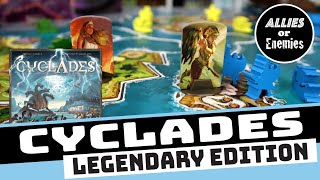
Cyclades: Legendary Edition has received strong praise from the board gaming community for its refinement of a classic 2009 design. Reviewers consistently highlight the game as a standout area-control experience elevated by careful reimplementation. Channels like Allies or Enemies and The Dice Tower note that this edition successfully combines the base game with expansion elements while improving overall playability and table presence. The consensus centers on the game's bidding mechanism as its defining feature, creating dynamic player interaction that makes each cycle feel unpredictable and competitive.
Core Mechanics That Define Cyclades: Legendary Edition
The Auction System for Divine Favor
The core tension of Cyclades revolves around the bidding system where players compete for the favor of gods each round. In each cycle's offerings phase, players place pawns on various gods to claim their powers, but with a twist: if another player offers more gold than you, you are immediately bumped off and forced to bid on a different god instead. This cascading bump system means players must carefully balance their gold reserves and priestess cards (which reduce bid costs) against their rivals' likely strategies. As reviewers note, the dynamic bidding in this edition improves upon the original, allowing for more varied opening bids and forcing tactical pivots throughout play. The genius lies in the fact that you never know exactly how the round will unfold, and every action you take depends entirely on where your offering lands.
Area Control Through Military and Economic Engines
Once players secure a god's favor, they gain specific actions tied to that deity. Ares grants fortress building and troop recruitment for land warfare. Poseidon supplies port building and fleet management for sea dominance. Athena provides universities and philosopher cards that accumulate toward metropolis victories. Zeus offers priestesses to reduce future costs. Apollo, printed permanently on the board, rewards the player who could not secure another god with prosperity and gold to boost future income. The interplay between these action sets forces players to build economic engines that fund their bids while simultaneously positioning troops, ships, and buildings across the modular archipelago map. This creates a delicious tension: should you invest in priestesses to reduce costs, recruit heroes with unique powers, or build the structures needed for a metropolis?
The Cyclades: Legendary Edition Experience
Escalating Tension and Repeated Strategic Pivots
Reviewers praise the game's pacing and how it naturally ramps in complexity and stakes. Each cycle introduces fresh godly powers due to the rotating auction board, ensuring that no two games feel identical. The modular map design further guarantees variety from setup to setup. Players describe the experience as a series of high-stakes gambles where early economic decisions directly influence your ability to compete militarily and politically in later rounds. The simple yet brutal combat system, where each side rolls a die and adds unit strength plus fortress and port bonuses, keeps the game's focus on bidding and positioning rather than complex combat resolution. This allows the true gameplay to shine: figuring out how to maximize your gold income, secure the right gods, and position your forces before your opponents do.
The Satisfying Leap to Metropolis Victory
The multiple paths to claiming a metropolis (controlling all four basic buildings, collecting philosopher cards, sacrificing a hero with an appropriate power, or conquering an opponent's metropolis) create viable strategies that shift based on which gods become available. Reviewers note that heroes add memorable decision points. Each hero boasts a military power useful in battle and a sacrificial power, triggered by discarding the hero, that often grants a metropolis directly. Watching the board fill with metropolises over the course of a game creates a visible countdown to endgame, ensuring games do not drag. The first player to control two metropolises at the end of a cycle wins, creating clarity around the victory condition and an exciting final sprint where players make desperate plays to block rivals or secure their winning city.
What Makes Cyclades: Legendary Edition Stand Out
Hybrid Design Balancing Bidding and Area Control
Unlike pure area-control games or pure auction games, Cyclades fuses both mechanics into a cohesive whole. The bidding is not window dressing; it directly constrains your actions each turn. You cannot simply steamroll militarily because you must afford your gods first. Conversely, you cannot win through economic dominance alone; you must eventually translate gold into military and territorial control. Reviewers highlight this balance as a core strength, noting that the game feels like a natural evolution of bidding mechanics seen in games like Ra, but with far deeper long-term strategy. The unpredictability of the bidding system and the rotating gods ensure that even experienced players must adapt.
Production Quality and Playability Improvements
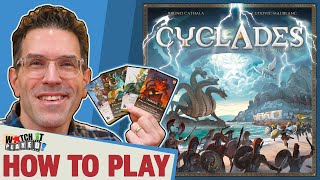
The Legendary Edition production is widely praised. The board and tiles are clean and colorful, with well-defined borders between regions. The wooden pieces, chunky coins, and detailed player screens all contribute to a premium feel. Reviewers with the deluxe version specifically commend the miniatures for creatures and heroes, which add character to a game that could otherwise feel abstract, and note that they make it far easier to read the board state at a glance. The insertion of mythological monsters and heroes as both thematic elements and mechanical drivers gives the experience texture. Several reviewers call this the definitive way to own Cyclades, citing how thoroughly the components and rules have been upgraded.
Potential Drawbacks
The Six-Player Format Requires Team Play
A consistent criticism centers on the six-player variant. While the game supports six players, they must play in teams. Reviewers note this limits the game for competitive groups that want pure versus play at higher player counts. The three, four, and five-player counts receive the most praise; three plays faster for impatient groups, while four and five-player games hit the sweet spot for bidding wars and shifting military tensions. The team constraint feels like an opportunity lost for players who prefer a free-for-all at the top end.
Card Clarity Issues and Minor Rules Ambiguities
Some reviewers flag card effects and hero abilities that lack complete clarity even after consulting the rulebook. Certain card interactions, such as exactly when a hero's sacrificial power can trigger, remain fuzzy enough to send players searching online for clarification. While the rulebook includes a reference guide, there were reports of minor errors that, although not game-breaking, suggest the rules could have been more thoroughly proofed. These issues are small but noticeable in a production otherwise praised for its polish.
If You Enjoy Cyclades: Legendary Edition
Fans of Ra will appreciate Cyclades' auction system, though with far deeper strategic meat. 7 Wonders players will recognize the tension of simultaneous decision-making, albeit reimagined through bidding and area control. Those who love Twilight Imperium for its political intrigue and economic engines will find Cyclades' blend of economic planning and military execution similarly rewarding in a much shorter package. Players seeking Brass: Birmingham levels of interconnected systems will appreciate how Cyclades layers economy and conflict without spiraling into rules overhead. Anyone who enjoyed the original Cyclades or its expansions will see the Legendary Edition as the definitive compilation.
What Reviewers Are Saying
"The additions are solid pretty much across the board. If you're deciding if you want to upgrade from the original, this is kind of like adding a streamlined version of the expansions with a few small missions. And if you don't know if you'd like Cyclades at all, it is a really interesting mix of a game."
— Allies or Enemies
"This is the definitive version of it. There are two versions that came out, the normal version and legendary. This is one of the few times I'm going to say you really should get the legendary one, because the other one doesn't have the miniatures. I don't need miniatures in all my games, but in Cyclades, it feels like they matter."
— The Dice Tower
"Cyclades really is at its best at four or five players. At those numbers, you get the most out of the bidding for the various gods and the shifting wars on the map. The time scales pretty well at higher counts because nothing destroys metropolises, so every one that gets built brings the game closer to the end."
— Allies or Enemies