



Dark Domains Deep Dive
What the Community Thinks About Dark Domains
Dark Domains starts with a premise that reviewers find easy to embrace. Each player leads a city that appears to serve the crown while secretly working for a necromancer, turning helpful civic buildings into bastions of villainy. Pair of Dice Paradise describes it as a worker placement game with some pretty interesting twists on the genre, and Watch Review calls it one of their go-to medium-heavy Euros, a title that keeps hitting their table with their group.
Enthusiasm comes with caveats. The same reviewers who enjoy the game also warn that its luck can be harsh, and that the rulebook leaves players guessing during early sessions. The Squirrely Awards hosts on Rolling Dice & Taking Names gave Dark Domains their Go Do My Bidding award for worker placement, and 3 Minute Board Games listed it among games they want back in print, while openly acknowledging that it is not a finely balanced design.
Core Mechanics That Define Dark Domains
Worker Placement With Timing at the Center
Players send workers onto a shared board of action spaces, and reviewers keep returning to timing. Watch Review describes the sequence: workers placed on a player's own board resolve first, the expansion board comes next, and the main board resolves last. Deciding when to convert a productive building into an evil one, and when to switch a resource engine over, is central to the experience. The Black Library lets players take spells from its decks, the Market trades evil for workers or wood at varying rates, and the henchmen spots offer special powers that Watch Review says make each visit to them exciting.
The Squirrely Awards hosts also appreciate worker placement where spaces resolve one at a time, because players must plan ahead. Pair of Dice Paradise summarizes the core loop as players gathering resources and constructing civic buildings, then facing the consequences of how those buildings were used.
The Fortune Deck and Secret Villainy
The second pillar is the fate deck. Watch Review calls the Fortune cards one of the coolest parts of the game: each turn, two are drawn and turned over, and the combination creates an aspect that affects how the game plays for that turn. Pair of Dice Paradise describes the same engine as a set of randomized decks, including fate cards that set special rules for each round. Adventuring parties then test whatever a player has built. Pair of Dice Paradise says players "gonna need to contend with unpredictable dice rolls when they defend the structures that they've built," which is where the secret-villain fantasy turns into a tense defensive scramble.
The Dark Domains Experience
Chaos, Tension, and Getting to Be Evil
Reviewers describe a game where a carefully laid plan can be upended at any moment. Pair of Dice Paradise says the game can be very brutal and does not care what the players think about it, and that these challenges are admitted as part of the fun. Rolling Dice & Taking Names describe the interaction as a little bit nasty, with event cards that can help or punish anyone, and a spell that can destroy another player's most productive building.
The emotional hook is the villainy. The Squirrely Awards hosts admit that Dark Domains went over their heads the first time they played, yet they kept coming back to it, enjoying the chance to play the bad guys. Pair of Dice Paradise adds that the game rewards a player who arrives in the right mood, so it helps to know what can happen before sitting down.
Learning Curve and Table Rhythm
Pair of Dice Paradise found the rulebook well written overall, though the deck setup needed deduction and mechanisms like the adventuring party's order of operations, target selection, and monster placement needed a second look until the group had played a couple of times. Their first game was rough: a fate card cost each player two of their eight coins, another took three more, and a spell wiped out the rest of the gold. Their second game went better because they knew what to expect.
Rolling Dice & Taking Names had a similar experience. Their early turns were slow because they kept flipping between the reference cards and the rules, but once the flow clicked the game became a lot of fun. Their main complaint was the lack of a flowchart for the round structure, which they thought could cover seven or eight phases.
What Makes Dark Domains Stand Out
Second Edition Refinements
Watch Review had played the first edition and reviewed the enhancements for this release. Their verdict is that the changes improve an already enjoyable game without forcing players to relearn it. A tracker board replaces piles of resource tokens, each player gets a personal phase board, and the spell deck is split by type so players can see whether they are drawing attack, production, defense, or control spells. Building cards were trimmed so that each one appears more often, which means the castle-to-evil-fortress transformation is something players actually see. When adventurers overrun a converted building, it flips back to normal instead of disappearing, and a minion can turn it evil again.
The expansion material is equally praised. Watch Review notes that it can be used as a simple add-in, or with rules that bring the new monsters, heroes, henchmen, buildings, and Fortune cards into every game. That flexibility matters to them because they dislike expansions that throw away a game's core rules.
A Theme That Commits
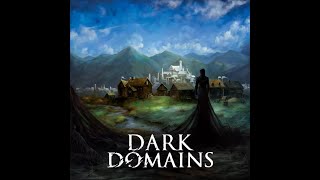
Reviewers respond to how fully the game commits to its premise. Rolling Dice & Taking Names describe the board as really cool and really dark, with a demonic feel that suits playing evil people trying to corrupt a town. 3 Minute Board Games praise the novelty of evil minions competing for a dark overlord's attention, a setup that gives the game an identity few worker placement titles share. Watch Review also describes the expansion's new monsters as taking an Asian-inspired feel, and calls them more exotic additions to the theme.
Potential Drawbacks
Luck and a Demanding First Game
The main criticism reported by Pair of Dice Paradise is that Dark Domains presents as a worker placement euro while hiding random, luck-driven elements underneath, which can make players feel their plans belong to a city of royal planners that secretly has a heart of chaos. Fate cards are randomized each game and cannot be controlled, and a bad run early on can leave some players frustrated. Pair of Dice Paradise points out that removing the harshest cards from the deck would have softened that first game without leaving the game short of options.
Balance, Rules Clarity, and Availability
The balance concern is candid. 3 Minute Board Games say that Dark Domains is far from the most balanced game they have played, and Rolling Dice & Taking Names point to a spell that destroyed a building producing the most points, leaving its owner unhappy. They also note that people get upset when a powerful card like that shows up. On the logistics side, Rolling Dice & Taking Names describe the box as a heavy beast and encourage buyers to purchase directly from the smaller publisher, Laboratory H, before the game moves into distribution, because the publisher earns a better margin on direct sales.
If You Enjoy Dark Domains
- Champions of Midgard: Rolling Dice & Taking Names compare the two directly. Both are worker placement games where workers are resolved location by location at the end of a round, buildings can flip to a darker side to generate victory points, and adventurers attack the buildings players leave exposed. Fans who enjoy planning around attacks will feel at home.
- Pillars of the Earth: Watch Review cites its expansion as a model for how added content can add a board that synergizes with existing worker placement spots, changing the timing of the whole turn without rewriting the core game. That is the same kind of added layer Dark Domains offers.
- Paladins of the West Kingdom: This was one of the other Go Do My Bidding nominees on Rolling Dice & Taking Names, and the hosts called the category a tough one, with Paladins of the West Kingdom among the titles that could have won. It is a natural pick for players who want another worker placement title in the same league.
- Taverns of Tiefenthal: The same awards segment named it as a nominee, and the hosts praised how its theme worked together with its mechanics, comparing that success to Dark Domains. It suits players who want a thematic worker placement game with a clear sense of place.
What Reviewers Are Saying
"This took a game that I already really enjoyed and it fixed it in ways that I didn't even know it needed fixing because I already enjoyed the game and made it cooler and then added some cool new content."
— Watch Review
"I found this to be a game with some pretty interesting twists on the whole worker placement genre but those twists did not come without challenges of their own."
— Pair of Dice Paradise
"It's far from the most balanced game I've ever played but the novelty of it was really interesting so that's one I would like to see come back."
— 3 Minute Board Games