

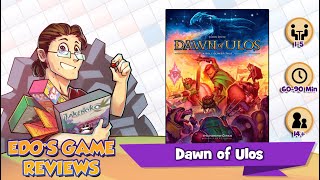

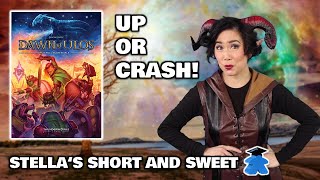

Dawn of Ulos box art

Dawn of Ulos

Game ID: GID0087166
Game Info
Year
2023
Players
1-5
Age
14+
Playtime
90 min
Collection
Rating
Mechanic profile
Percentile rank vs. all games
Vibe profile
How this game feels to play
Description

For untold eons, the mortal races lived in separate planes, unaware of other worlds beyond their own. But now the dragon god Azema forges a new world by opening rifts to other planes…

Dawn of Ulos is an economic tile-laying game for 1-5 players set in the world of Roll Player and Cartographers. You compete in a game among gods of the planarverse, wagering on and manipulating the rise and fall of mortals.

Control the fate of Ulos! Develop a new world, invest in your favorite factions, and pit armies against each other. Choose wisely when to exert your influence. As factions rise and fall, will you earn the most favor with the world creator?

—description from the publisher

Description

For untold eons, the mortal races lived in separate planes, unaware of other worlds beyond their own. But now the dragon god Azema forges a new world by opening rifts to other planes…

Dawn of Ulos is an economic tile-laying game for 1-5 players set in the world of Roll Player and Cartographers. You compete in a game among gods of the planarverse, wagering on and manipulating the rise and fall of mortals.

Control the fate of Ulos! Develop a new world, invest in your favorite factions, and pit armies against each other. Choose wisely when to exert your influence. As factions rise and fall, will you earn the most favor with the world creator?

—description from the publisher

Ask a Rules Question
All mentions
Browse transcript mentions, sentiments, pros/cons, mechanics, topics, quotes, and references.
Total mentions: 6
This page: 6
Sentiment: pos 6 · mix 0 · neu 0 · neg 0
Mentions per page
Showing 1–6 of 6
Video VM7fxiLsV1c Meeple University Review at 0:05 sentiment: positive
video_pk 64821 · mention_pk 158354
Meeple University - Dawn of Ulos video thumbnail
Click to watch at 0:05 · YouTube ↗
Overall sentiment (raw)
positive
Pros
  • Unique economic/stock manipulation system.
  • Engaging battle system with player negotiation and potential backstabbing.
  • Strategic depth with various factions and mix-and-match capabilities.
  • Thematic integration of stock market concepts like 'up and dead' and company takeover.
Cons
none
Thematic elements
  • Living, expanding territories, and manipulating factions through a rift.
  • The world of Ulos
Comparison games
none
Mechanics (from transcript analysis)
  • Area Control — Controlling areas on the map is a core mechanic.
  • card drafting — Players can buy faction cards and play or discard them for abilities and currency.
  • Combat — When areas of at least two factions are linked, a battle occurs where all players can influence the outcome by playing faction cards.
  • Stock holding — Manipulating the strength and value of factions, akin to stock market fluctuations.
  • territory building — Expanding faction territories on the map by placing tiles.
  • tile placement — Players place development tiles matching patterns to expand faction territories.
Video topics + discussion points
No key topics recorded for this video.
Quotes (from this video)
  • it's almost like company take over
  • just like the stock market
  • but there is no binding agreement in the world of ulos every guards for themselves
References (from this video)
No references stored for this video.
Video A08QDWIQCTM watch it played Rules Teach at 0:13 sentiment: positive
video_pk 64811 · mention_pk 158332
watch it played - Dawn of Ulos video thumbnail
Click to watch at 0:13 · YouTube ↗
Overall sentiment (raw)
positive
Pros
  • Variable map layouts due to random tile arrangement.
  • Unique faction abilities offer different gameplay experiences.
  • Thematic integration of gods influencing mortal battles.
  • Mechanics encourage shifting player allegiances.
Cons
  • Some rules, like conflicts, are explained later to ensure better understanding.
  • Certain factions (elves, flares, ogres) have restrictions on how many can be in a game.
Thematic elements
  • Overseeing gods placing wagers on who will win battles and potentially influencing the outcome.
  • In the world of Ulos, goblins, elves, frogkin, and a host of other mortals do battle as one of the overseeing gods.
Comparison games
none
Mechanics (from transcript analysis)
  • Area Control — Factions establish camps on territories, and their strength is determined by the number of matching foundation terrain types within their occupied territory.
  • hand management — Players manage a hand of development tiles and faction cards, keeping them secret from opponents.
  • Player Combat — Conflicts occur when territories connect, involving players committing cards, playing conflict abilities, and determining a winner based on combined strength.
  • Resource management — Favor is used to buy cards, and players gain favor throughout the game from various actions and abilities.
  • set collection — Players collect cards from various factions and gain favor based on the strength of faction cards in hand during final scoring.
  • tile placement — Players place development tiles onto the map, matching terrain types underneath. Tiles can be placed anywhere as long as terrain matches and they don't overlap or hang off the map.
  • Variable player powers — Each faction has unique abilities explained on their cards, affecting gameplay differently.
Video topics + discussion points
No key topics recorded for this video.
Quotes (from this video)
  • you may be a God but you're a Fickle one.
  • Once you've resolved the ability on a card you've played you return it back to the supply if an ability triggers one or more events to occur they're resolved in the same way we saw during step one of a turn but you wait until the card ability is complete and return to the supply and then you resolve those events.
  • you can't just discard extra cards from your hand so perhaps I'll choose to return all three of the Goblins I had committed and we'll see why it might be a good idea to choose to get rid of more cards in a moment.
  • you earn their strength as favor not their spoils as we often did before.
References (from this video)
No references stored for this video.
Video skPSRL8LUT0 3 Minute Board Games Review at 0:16 sentiment: positive
video_pk 13117 · mention_pk 38343
3 Minute Board Games - Dawn of Ulos video thumbnail
Click to watch at 0:16 · YouTube ↗
Overall sentiment (raw)
positive
Pros
  • Interesting blend of Euro-style tile placement with a grim, cut-throat currency/stock market motif
  • Dynamic reversals and big shifts in fortune create dramatic gameplay moments
  • The thematic presentation is strong and visually appealing; camps look cool, especially when painted
  • Great for groups that enjoy high-tension interactions and a non-collaborative atmosphere
  • The stock-market metaphor is executed in an approachable way that rewards timing and risk assessment
Cons
  • Rule complexity can be non-intuitive at first glance; the reviewer notes initial confusion after reading the rules
  • Emotional attachment to a faction is discouraged because fortunes swing unpredictably, which can be frustrating for some players
  • The game’s length and potential for dramatic reversals may not suit players seeking a light, breezy experience
Thematic elements
  • divine intrigue, risk, and fortune contested through faith, territory, and spectacle
  • A mythic, contested pantheon era where gods vie for favor over mortals across a developing world
  • mythic parlor-game meets light economic sim; dynamic shifts driven by player bets and combat outcomes
Comparison games
  • Small World
  • Tigris and Euphrates
Mechanics (from transcript analysis)
  • bluff mechanics — Cards not involved in the active battle function as bluffs, returned to players, while real combat cards contribute to strength
  • camp placement and faction tracks — Each faction has a camp model and a track; advancing on the track is triggered by matching terrain, and a camp presence changes the faction’s position and territory influence
  • card management — Each faction card has three uses: playing a turn, using it for a special action, or holding it for later; some options affect combat and territory in nuanced ways
  • combat resolution — If two groups are linked by tiles, combat is resolved by players submitting combat cards secretly; strengths are revealed to determine the winner
  • Multi-use cards — Each faction card has three uses: playing a turn, using it for a special action, or holding it for later; some options affect combat and territory in nuanced ways
  • player elimination — Eliminated factions are sent to a 'Lost' bin; a Rift token is awarded to the winner of battles and influences future territory dynamics
  • replacement draw — After tile placement and any card actions, players draw a replacement terrain tile from a shuffled pool to refresh options
  • rift tokens and Lost track — Eliminated factions are sent to a 'Lost' bin; a Rift token is awarded to the winner of battles and influences future territory dynamics
  • stocks/fortune mechanic — Players invest in factions as if they are stocks, using favor as currency to influence future outcomes and gain power/value from the factions
  • terrain preferences and favorite terrains — Factions have favored terrains; placing matching terrain tiles increases their position on the track for each match
  • tile placement — On each turn a player places a terrain tile to extend their control and potentially bring a camp into play; placement also interacts with terrain preferences and faction tracks
  • Track advancement — Each faction has a camp model and a track; advancing on the track is triggered by matching terrain, and a camp presence changes the faction’s position and territory influence
Video topics + discussion points
No key topics recorded for this video.
Quotes (from this video)
  • Dawn of Ulos, its small world meets 18xx, gold medal game
  • the grimiest, most Savage game I've played in a long time and that's what makes it wonderful
  • a fascinating game where you play a Disconnected God wagering on the outcomes of massive Wars
  • The best thing about this game is watching stock market tropes play out, invest in goblins now!
  • however, you cannot get emotionally attached to any faction in this game because what goes up does go down
References (from this video)
No references stored for this video.
Video oj-IJycctTg 3 Minute Board Games Discussion at 1:45 sentiment: positive
video_pk 6505 · mention_pk 19257
3 Minute Board Games - Dawn of Ulos video thumbnail
Click to watch at 1:45 · YouTube ↗
Overall sentiment (raw)
positive
Pros
none
Cons
none
Thematic elements
Comparison games
none
Mechanics (from transcript analysis)
Mechanics unknown.
Video topics + discussion points
No key topics recorded for this video.
Quotes (from this video)
  • This video is brought to you by the 3minut board game patrons. Keep us independent by supporting us on Patreon.
  • It's to talk these games out of my collection to say goodbye to them.
  • The bigger the game boxes are, the easier they are to get rid of.
  • The purpose of these videos is really catharsis for me.
  • Two copies of Pandemic Legacy sheltered away.
  • I have to thank my patrons and everyone who watches these videos for giving me this opportunity as well.
References (from this video)
No references stored for this video.
Video _f6CRguEx5Y Rolling Dice & Taking Names Discussion at 5:44 sentiment: positive
video_pk 2329 · mention_pk 93434
Rolling Dice & Taking Names - Dawn of Ulos video thumbnail
Click to watch at 5:44 · YouTube ↗
Overall sentiment (raw)
positive
Pros
  • Clever economic engine with evolving card value
  • Factions on board create dynamic interplay
  • Good production/art generally appreciated
Cons
  • No traditional map can feel abstract
  • Setup requires punching/minis; painting appreciated
Thematic elements
  • Factions and territory influence via cards
  • Economic power struggle with faction presence on a board
  • Engine-building/economy-focused
Comparison games
  • Ethnos
Mechanics (from transcript analysis)
  • Area influence with factions — Factions vie for space; larger spaces yield more points.
  • Card-driven actions — Play cards to influence board space and scoring.
  • Card-value growth with expansion — Playing cards in larger areas increases their value.
  • Conflict tokens — Place tokens to expand territory and conflict with opponents.
  • Economic engine using VP as currency — Spend points to buy cards and increase their value.
  • Multi-use cards — Play cards to influence board space and scoring.
Video topics + discussion points
No key topics recorded for this video.
Quotes (from this video)
  • I do not like when event cards force me to have no options
  • this is not Ethnos
  • it's a completely different scaled down game set collection
  • Ethnos to me was an intense area control game
  • this is literally just set collection and managing boards
  • it's a clever economic game because you've got factions coming out on the board
References (from this video)
No references stored for this video.
Video TVxbYdEjqG0 Foster the Meeple Discussion at 15:33 sentiment: positive
video_pk 660 · mention_pk 1915
Foster the Meeple - Dawn of Ulos video thumbnail
Click to watch at 15:33 · YouTube ↗
Overall sentiment (raw)
positive
Pros
none
Cons
none
Thematic elements
Comparison games
none
Mechanics (from transcript analysis)
Mechanics unknown.
Video topics + discussion points
No key topics recorded for this video.
Quotes (from this video)
  • I freaking love it
  • we are not gonna spend time explaining all of the games
  • this is also includes games from before Gen Con and we cannot be held accountable for our actions
  • we will let you know if we forget to say it will be on the screen every time
  • it's for one or two players I kinda want to bring this to Disney
References (from this video)
No references stored for this video.
Transcript Navigation
Top
Showing 1–6 of 6
Game Deep Dive
View on BoardGameGeek