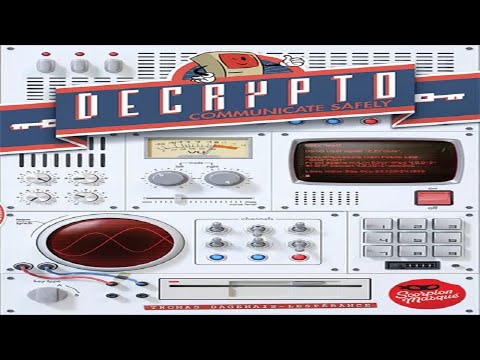











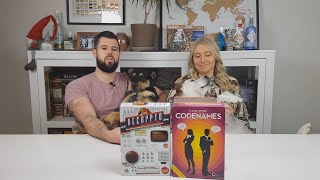














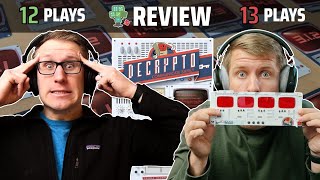











Players compete in two teams in Decrypto, with each trying to correctly interpret the coded messages presented to them by their teammates while cracking the codes they intercept from the opposing team.
In more detail, each team has their own screen, and in this screen they tuck four cards in pockets numbered 1-4, letting everyone on the same team see the words on these cards while hiding the words from the opposing team. In the first round, each team does the following: One team member takes a code card that shows three of the digits 1-4 in some order, e.g., 4-2-1. They then give a coded message that their teammates must use to guess this code. For example, if the team's four words are "pig", "candy", "tent", and "son", then I might say "Sam-striped-pink" and hope that my teammates can correctly map those words to 4-2-1. If they guess correctly, great; if not, we receive a black mark of failure.
Starting in the second round, a member of each team must again give a clue about their words to match a numbered code. If I get 2-4-3, I might now say, "sucker-prince-stake". The other team then attempts to guess our numbered code. If they're correct, they receive a white mark of success; if not, then my team must guess the number correctly or take a black mark of failure. (Guessing correctly does nothing except avoid failure and give the opposing team information about what our hidden words might be.)
The rounds continue until a team collects either its second white mark (winning the game) or its second black mark (losing the game). Games typically last between 4-7 rounds. If neither team has won after eight rounds, then each team must attempt to guess the other team's words; whichever team guesses more words correctly wins.
Let's Play... DECRYPTO | Board Game Club
Mechanics (from transcript analysis)
Video topics + discussion points
Quotes (from this video)
- it's the meanest game in my top 10, no question
- there's just always something exciting to do on your turn
- it's an absolute hit
- it's the best social deduction experience I've ever had
- the shortest playing time
References (from this video)
- Tense, clever gameplay; strong social deduction without overt hostility
- Clarity can waver with inexperienced players; misinterpretations can be harsh
- word clues, coded messages, misdirection
- modern espionage vibe
- tense, competitive
- Code Names
Mechanics (from transcript analysis)
- Code interpretation — Teams attempt to decode the clue sequences while avoiding leaks to opponents.
- deduction — Two teams alternate clue-giving rounds and score on successful deductions.
- team-based play — Two teams alternate clue-giving rounds and score on successful deductions.
- Word clues and clue decoding — Two teams give clues to guesses keywords without revealing them to the other team.
- Word Deciphering — Two teams give clues to guesses keywords without revealing them to the other team.
Video topics + discussion points
Quotes (from this video)
- for once I'd like to tell you about a few games that I'm excited about
- these are all games that have been reprinted so many times that not only can you find them right now but you'll probably be able to find them long into the future
- it's one of the most yoy Euro games that I know
- the thing that I really like about it is that it's not a point salad game
- the game has this tightness to it that I really enjoy
- it's a game that involves a lot of laughter
- the crypto highly recommend it
References (from this video)
- highly engaging with the right group
- great family/peer group appeal and tradition potential
- strong replay value when players are familiar with the rules and dynamics
- requires the right group and social dynamic to shine
- can be confusing or less accessible to casual players
- depends on players' ability to craft clever clues without revealing too much
- codes, encryption, and misdirection
- cryptographic word-guessing environment during party game sessions
- competitive team-based deduction with encrypted clues
- So Clover
Mechanics (from transcript analysis)
- clue-giving — teams provide clues to teammates that convey target words without revealing them to the opposing team.
- Compound Scoring — teams score points by correctly identifying encrypted clues; penalties for incorrect guesses.
- encrypted clues / clue selection — clues are paired with keywords to be decrypted by the other team; misdirection can be used.
- round-based scoring — teams score points by correctly identifying encrypted clues; penalties for incorrect guesses.
- team-based deduction — teams guess which clues correspond to which words from the opposing team's clues.
- Word Deciphering — teams provide clues to teammates that convey target words without revealing them to the opposing team.
Video topics + discussion points
Quotes (from this video)
- play our game of Decrypto. And when you have that group, this game is incredible.
- it's almost tradition at this point to play our game of Decrypto.
- This dropped below So Clover, which is an interesting they're they're in a pretty they're similar rankings, but very different game experiences.
- the crypto is a hard one because it is very hard to have the right group for it and like the right situation.
References (from this video)
- Great for party environments with the right group
- Downtime and reading can slow play for some groups
- communication and deduction
- Code-cracking word party game
- Social bluffing with word clues
- Codenames
- Hughes and Q's
Mechanics (from transcript analysis)
- Word Deciphering — Teams convey clues to help teammates guess words while avoiding other teams.
- word deduction — Teams convey clues to help teammates guess words while avoiding other teams.
Video topics + discussion points
Quotes (from this video)
- Killer Bunnies really opened our minds and then we found more games like Small World and Dominion.
- 320 plus plays later, we got over that.
- Time has been the bigger constraint on our hobby than money.
- Production quality matters, there is this toy factor and tangible aspect of board games.
- We grew into a taste for simpler, shorter games and still love our heavy titles, but the curve shifted.
- We want a collection that can serve up our favorites for any scenario.
References (from this video)
- strong teamwork dynamics
- high replayability
- clue management can be tricky for beginners
- cryptic clue communication and code-breaking
- spy-themed party game
- clever, competitive
Mechanics (from transcript analysis)
- Code interception — Opponents attempt to decipher clues and intercept meaningful signals.
- Word Deciphering — Opponents attempt to decipher clues and intercept meaningful signals.
- word-clue deduction — Teams craft clues to lead teammates to secret words.
Video topics + discussion points
Quotes (from this video)
References (from this video)
- tight, tense bluff and decode interplay
- great party/house game with multiple teams
- scalable to larger groups
- requires good clue-giving to avoid giving away too much
- miscommunication can derail players new to the game
- cooperative wordplay with misdirection
- teams giving coded clues to guess words
- spymaster-style clue interpretation
Mechanics (from transcript analysis)
- communication/puzzle construction — one team provides clues to words while the other team tries to intercept
- decryption/guessing — teams decode the clues under pressure to identify target words
Video topics + discussion points
Quotes (from this video)
- my number 10 is tachu
- it's fun I mean plant and I mean so you obviously I would say do you like that kind of having to siphon through
- the real MVP comment Micah down below
- Kay's number one game of all time tune in next year geez
References (from this video)
- brain-burning word-puzzle
- escalating tension with information leakage
- can become harsh if teams guess poorly
- codes and clues
- cryptography and code-decryption in a team-based spy scenario
- competitive co-op clue deciphering
- Codenames
- Code Names: Pictures
Mechanics (from transcript analysis)
- clue-based deduction — teams give three clues to four secret words while opposing teams listen
- Code-breaking — teams try to decipher each other's clues while avoiding misdirection
- Word Deciphering — teams try to decipher each other's clues while avoiding misdirection
Video topics + discussion points
Quotes (from this video)
- What's the best entry-level board game? Wrong question. There is no best entry-level board game. There's only the chart.
- This is the chart chart.
- Don't optimize too hard. We aren't playing scythe right now.
- This is the gateway to an entire genre.
- For entry-level gamers, you want to have that fun to admin ratio heavily tilted towards fun.
- If someone has real enthusiasm for a game, just play it.
- Trust on your group, trust on your instinct.
- It's the gateway game that opened the floodgates to the modern industry.
References (from this video)
- Rich strategic tension and clever wordplay
- Strong social interaction during reveals
- Tough to teach; fragile if players don’t latch onto strategy quickly
- Requires attentive group to shine
- Code-breaking and wordplay under pressure
- Two teams race to decipher and transmit coded clues
- Strategic and social deduction with escalating rounds
- Code Names
- Codenames Duet
Mechanics (from transcript analysis)
- Cooperative clueing with interception — Clue Giver writes clues to steer their team while opposing team listens.
- Interception and misdirection — Friends try to intercept each other’s clues while avoiding miscommunication tokens.
- Word Deciphering — Friends try to intercept each other’s clues while avoiding miscommunication tokens.
Video topics + discussion points
Quotes (from this video)
- Party games are one of the biggest, most important parts of a versatile collection.
- Telestrations has created some of the funniest moments you can have at a table.
References (from this video)
- Engaging deduction and bluffing dynamics
- Tense, back-and-forth rounds that reward clever clueing
- Strong social interaction and competitive banter
- Steep initial learning curve for newcomers
- Online play adds friction due to interface and timing
- Can feel punishing when miscommunications cost a round
- communication, encryption, deception, competitive wordplay
- Two teams compete in a word-decryption round, each team privately viewing four words and providing clues to convey a secret code while opponents try to intercept.
- competitive party game with back-and-forth clueing and misdirection
- Fake Artist Goes to New York
- Secret Hitler
Mechanics (from transcript analysis)
- Clue writing — Players give clues to guide teammates toward the correct code without revealing it to the opposing team.
- Code interception — If the opposing team correctly guesses a code, they score an interception; miscommunications tokens may be issued for incorrect guesses.
- Hidden Information — Each team can see its own four words and its own code; opponents see none of those words or codes.
- Public guessing and deduction — Teams write down their guesses; players on both sides observe clues and try to map associations.
- team-based play — Two teams compete in rounds, alternating as encrypter and guesser; communication and misdirection are central.
Video topics + discussion points
Quotes (from this video)
- it's a tricky game to wrap your head around from the outside but you'll definitely pick it up very quickly
- the clues just have to be as obvious as possible
- if they guess it correctly they get an interception token
- we've got a lifeline there
- this is difficult
- you've got them right and we've got them wrong in a way that makes this all very exciting
References (from this video)
- Unique physical components and puzzle motif
- Some players may favor more traditional euro mechanics
Mechanics (from transcript analysis)
- Card-based puzzle / deduction — Physical mechanism with contraptions to decode messages; puzzle-driven play.
Video topics + discussion points
Quotes (from this video)
- Dominant species is a truly awful game that I really really dislike
- this is a very very light worker placement game
- the seventh continent for us
References (from this video)
- clear tension between being obvious and not obvious
- highly replayable with varied clue strategies
- depends on group cohesion and clue quality
- can be punishing if clues mislead teammates
- secret codes and clue interception
- team-based word-code clue game
- cooperative-competitive with information asymmetry
Mechanics (from transcript analysis)
- clue interception — opponents attempt to decipher your clues and intercept your codes
- team clue-giving and guessing — give clues to guide teammates toward a sequence of words
- Word Deciphering — give clues to guide teammates toward a sequence of words
Video topics + discussion points
Quotes (from this video)
- There's a lot of games out there that I feel like you do stuff you're like, 'Ooh, I feel like you figured that out.'
- It just makes you feel clever as you build out this thing and start really cascading finishing those tasks.
- This is a game where you are going to be doing actions by putting these kind of double-sided hexom tiles into this cauldron.
References (from this video)
- Good for various social settings
- Helps understand how people think
- Accessible to non-gamers
- Puzzle solving
- Party game setting
- Social interaction
Mechanics (from transcript analysis)
- Party Game — Icebreaker style game
Video topics + discussion points
Quotes (from this video)
- We want to capture the feeling of games, not necessarily just the mechanics.
- Sometimes you just want a game that plays beautifully at two players.
References (from this video)
- engaging party game with tension and clever clues
- accessible to teach and quick to play
- great for mixed groups when dynamics click
- depends heavily on group chemistry; miscommunication can sour a session
- not ideal for very large or very small groups
- cooperative-framed deduction with competitive tension
- spy themed word-code decoding
- team vs team code breaking and clue giving with interception
Mechanics (from transcript analysis)
- clue generation — teams provide word clues to help teammates guess a code order
- interception and deception — the opposing team hears clues and tries to intercept and reinterpret
- team-based deduction — teams collaboratively deduce the right code sequence under pressure
- Word Deciphering — teams provide word clues to help teammates guess a code order
Video topics + discussion points
Quotes (from this video)
- the variety of the aliens is just incredible
- it's not only the mechanics of what's happening but a lot of what's happening between players at the table
- it's pretty group dependent
- I just love the pressure when a team is on you
- you need four people exactly four that are going to want to play a card game
- the strategy of it is so much deeper
- you've got to take off the training wheels for you Daniel, it's time for ride the Mage Knight bike on your own
- the rule book is dense and hard to learn
- it's a doozy
- it's eight hours long and an all day experience
- you really want six people, that's the ideal
References (from this video)
- three integrated gameplay experiences in one box
- high production value and stylish components
- engaging tension as teams try to crack or protect codes
- pace can depend on players' clue quality
- thematic flavor may be niche for some players
- codebreaking, teamwork vs competing teams
- 1980s Cold War vibe with a spy/codes theme
- three interwoven modes (Clue Giver, Decrypter, Guesser) in a single party game
- Code Names
Mechanics (from transcript analysis)
- code cracking / deduction — teams attempt to deduce both their own and the opposing teams' codes
- multi-role integration — the game combines clue giving, guessing, and decoding into one experience
- team-based clue giving — one player on a team provides clues in a fixed order to guide teammates to a code
- Word Deciphering — teams attempt to deduce both their own and the opposing teams' codes
Video topics + discussion points
Quotes (from this video)
- the crypto absolutely gets actual love
- it's probably going to be the best party game of 2018
- I think the crypto is a flawless game
- it's this perfect little box of what I think party games should be in 2018
- I absolutely love New York Slice
References (from this video)
- high tension, very interactive
- great party/large group game when you have a big crew
- fast rounds keep energy high
- can be punishing if clues are misinterpreted
- scoring and rule nuances can be confusing for newcomers
- cryptic communication, teamwork vs. misdirection
- modern spy-themed word clues
- competitive, intense
- Codenames
- Dixit
Mechanics (from transcript analysis)
- clue giving and word association — teams provide clues to guess codes based on set words
- code guessing and deduction — opposing team tries to deduce the secret code from clues
- memory and partial information — teams track clues and past rounds to avoid cryptic traps
- Word Deciphering — teams provide clues to guess codes based on set words
Video topics + discussion points
Quotes (from this video)
- it's a really intense game
- this is the meanest tree game out there
- it's the best trick-taking game of all time
- the economy in this game is probably one of the most interesting parts
References (from this video)
- excellent when played with groups online via video chat
- high tension and laughter when clues collide
- very replayable with different clue strategies
- some players struggle with subtlety of clues
- scoring can be opaque without a quick reference
- spy/secret communication with cryptic clues
- Codeword-based communication game with encryption flavor
- paranoid yet playful team-based deduction
- Code Names
- Coup
Mechanics (from transcript analysis)
- clue-giving with misdirection — Players encode clues to steer teammates toward the correct codewords while avoiding opponents.
Video topics + discussion points
Quotes (from this video)
- it's so quick and snappy and you don't have to worry about like the tiles
- these are our bga recommendations and now we also have some board game app recommendations
- open internationally boooooom
- you have to put down in the comments what's your favorite superhero
- we are doing another giveaway for our 2000 subscriber milestone
References (from this video)
- engaging, fast-evolving team deduction with high replayability
- easy to learn in practice, but with deep strategic potential
- great on-camera banter and social interaction
- tension and excitement during guessing rounds keeps players engaged
- cryptic clues can become opaque or overspecific, risking confusion
- round length can feel long if teams stall or overthink
- best experienced with a full group; less ideal for very small sessions
- cryptography, word association, and team-based clue interpretation
- London, at a board game cafe during a social gathering
- competitive, humorous, high-tension rounds with banter
- Code Names
Mechanics (from transcript analysis)
- inter-team interaction — rounds feature guessing, cross-checking clues, and potential interception where opponents deduce others' words from the clues
- role rotation and memory — clue-givers rotate and players must remember prior clues and deductions across rounds
- team-based clue giving — one player acts as clue-giver and supplies three clues that relate to three target words; teammates must deduce a three-digit code from those clues
- word-guessing and code deduction — teams attempt to identify their partner's code using clues, while the opposing team tries to intercept or mislead
Video topics + discussion points
Quotes (from this video)
- we're playing decrypto, a team game all about cracking Clues and trying not leave your teammates behind
- it's a game that's quite tricky to wrap your head around conceptually but in practice it's super easy
- this game is so tense
- one miscalculation away from losing the entire game
References (from this video)
- clever
- tense
- fun
- can be hard to explain
- Code Names
Mechanics (from transcript analysis)
- word association — teams give hints to guess codes without revealing them to opponents
- Word Deciphering — teams give hints to guess codes without revealing them to opponents
Video topics + discussion points
Quotes (from this video)
- this is like the pinnacle of board gaming awards that we know of
- paleo is really really punishing
- chaos pure chaos
- not a game for first-timers
- decrypto is so good
References (from this video)
- solid party game with word clues
- great for larger groups
- can be tricky for non-native speakers
Mechanics (from transcript analysis)
- team clue-guessing with word association — Teams give one-word clues to help teammates guess a set of words while avoiding opposing teams' clues.
Video topics + discussion points
Quotes (from this video)
- mind was a big hit for me in 2018
- this is the second Wolfgang Warsch game
- Gloomhaven really did blow me away
- absolutely genius mechanisms