/pic8156363.jpg)

















































Deep Regrets Deep Dive
What the Community Thinks About Deep Regrets
Deep Regrets has captured the imagination of board gaming enthusiasts across multiple review channels, generating considerable excitement since its retail release. Reviewers consistently praise the game for blending a Lovecraftian horror theme with a fishing mechanic that feels both thematic and mechanically sound. The game's push-your-luck elements combined with the madness system create a compelling loop where taking risks feels rewarding. Most importantly, the game generates memorable moments and genuine engagement from players who find themselves invested in catching increasingly terrifying creatures from the depths.
Core Mechanics That Define Deep Regrets
Push-Your-Luck Fishing and Dice Management
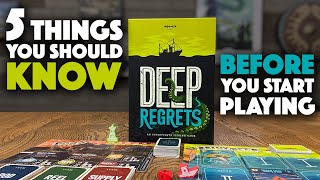
At its heart, Deep Regrets is a push-your-luck game where players spend custom dice to venture deeper into the ocean and catch fish of escalating value and horror. Players roll buoy-shaped dice at the start of each day to determine their catching power, then choose to fish at various depths or return to port. The deeper you go, the more valuable the fish, but also the more horrific creatures lurk. You can spend dice to drop a sinker and descend to deeper waters, or simply stay at your current depth and fish in a column. Each fish requires a specific dice value to catch, and you don't get change if you overspend. This creates genuine tension as players decide whether a big fish is worth committing multiple dice to the attempt.
Madness as a Currency and Mechanic
Regret cards form the brilliant backbone of Deep Regrets. These cards don't just track who has the most regrets at the end (a significant penalty), but more importantly, the number of cards in your hand determines your position on the madness track. This has cascading mechanical effects: crazier fishermen can carry more dice (up to seven), can catch foul fish more cheaply, and earn more points from those foul fish when they sell them. Conversely, saner players get bonuses on fair fish values. This encourages players to engage with madness as a strategic choice rather than purely as a threat, creating multiple viable paths to victory.
The Deep Regrets Experience
Lovecraftian Horror Grounded in Evocative Production
The theme of Deep Regrets is reinforced not just through mechanics but through absolutely gorgeous yet disturbing artwork. Every card features different fish designs, from mundane fair fish like the colossal squid and striped marlin to grotesque foul creatures like the silky shark, ghoul ray, and the whale of Rockabara. The flavour text is both humorous and unsettling, describing regrets with dry humour like "gaze too long into the abyss" and "caught more than I bargained for." The buoy-shaped dice are tactile and lovely, and the overall production quality elevates what could have been a simple card game into an immersive experience. Reviewers note the art is not afraid to go for it, creating an atmosphere of abyssal horror mixed with dark comedy.
Quick-Playing Turns with Surprising Strategic Depth
Despite the substantial theme, Deep Regrets moves quickly at the table. Turns are typically snappy because most actions involve flipping a fish and either catching it or taking a dink card. Port visits use a full round but provide meaningful strategic choices about equipment, dice purchases, and which fish to mount for end-game scoring. Once players understand the system, the game plays faster than expected, with rounds flowing smoothly around the table. Players stay engaged on others' turns because the fish revealed can affect their planning and madness levels.
What Makes Deep Regrets Stand Out
A Solo Mode That Builds Campaign Progression
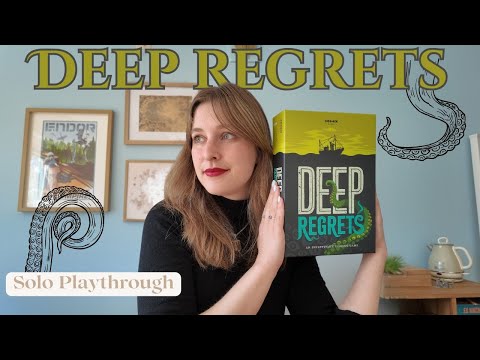
The solo mode transforms the game into something special: a campaign where you conduct a survey to catalog every fish in the ocean. You fish for five days, then visit port to purchase equipment upgrades and journal your catches, gradually building a collection of all available fish across multiple plays. The madness track is scrapped entirely, and you simply try to catch and return all fish without throwing them overboard. This cozy-yet-eerie mode offers surprising replayability, as each game brings different fish based on the random tableau and your equipment choices shape what you are capable of catching.
Thematic Alignment That Justifies Every Mechanic
What reviewers consistently highlight is how Deep Regrets feels different and fresh precisely because the theme is not window dressing. The madness track makes thematic sense: the deeper you go, the more horrific things you see, which drives you to madness but also paradoxically makes you stronger (you can carry more dice, earn more from foul fish). Regrets accumulate naturally through fishing encounters, and the end-game penalty for having the most regrets creates a subtle but constant tension. The core loop of fishing at sea and visiting port to sell catches and buy equipment mirrors real fishing commerce. Every system serves the theme of a gradually unraveling fisherman descending into the abyss.
Potential Drawbacks
Limited Strategic Agency in Individual Turns
While engaging, individual turns in Deep Regrets can feel somewhat passive. Most of the time you declare fishing at a specific depth, then either catch a fish or take a dink card. You have some control via peaking with the can of worms or dropping sinkers, but much of your success depends on what cards you reveal and what dice you rolled. This makes it a game where luck plays a significant role, which works well for push-your-luck fans but may feel limiting to players who crave deep strategic efficiency.
Game Length Scaling with Player Count
Deep Regrets plays differently at two players versus five players. At higher player counts, the game can drag as players wait for others to fish. BoardGameGeek reported a session stretching to four hours at five players, noting they were so invested they lost track of time. The six-round structure is tight, meaning some strategic opportunities never materialize. At two players specifically, the +2 bonus die marker always goes to the other player, removing a small bit of the politicking that makes three-to-five player games interesting.
If You Enjoy Deep Regrets
If Deep Regrets grabbed you, several games offer similar experiences. Lost Ruins of Arnak shares the push-your-luck element and exploratory theme, though it plays with a different mechanical framework. For pure push-your-luck thrills, games like Can't Stop deliver that same escalating tension with simpler rules. If you are drawn to the horror and madness aspects, Dredge (which inspired direct comparisons from reviewers) offers a similar maritime horror experience in video game form. For those who love the fishing and commerce loop, The Crew provides trick-taking-driven cooperative missions at sea. And if you crave the solo campaign experience, Arkham Horror: The Card Game offers deeper narrative progression with Lovecraftian themes, though with higher complexity.
What Reviewers Are Saying
"This Lovecraftian horror fishing game is an absolute blast. You're using push your luck elements to go fishing to score as many points as you can while watching your madness. Because if you have the most madness at the end of the game, you will lose vital scoring opportunities. What I love about this game is it reminds me so much of Dredge."
— Board With Steve
"It's sardonic and fun, upsetting and enjoyable with enough gameplay hooks to keep me feeling invested. Even if fate's cold touch pervades every fathom of this ocean, there's a certain madness that calls a captain from his rolling hearth and dry roof back to the sea, and deep regrets continues to call out to me."
— The Cardboard Herald
"I got invested and I wanted to see this game to the end. So we ended up playing and found out it was 4 hours. I was like, 'Oh my god, we've been playing that long.' It's that kind of game. This is one that I want to get back on the table because there's an expansion coming out called Deeper Regrets."
— BoardGameGeek