














Tactical area control meets fantasy adventure in this card-driven cooperative game of animals against machines from the designer of PARKS and the creator of Bloc by Bloc. Play as one of four unique factions and assemble your crew of defenders from a wide range of animal characters to resist the machines across a modular map that changes with each game.
War has come to the Wild. For millennia, animals have weathered shifting alliances and the cycle of hundred-year seasons—but they’ve never faced an enemy like this. An army of machines powered by corrupted magic is rampaging across the Commonwood, enclosing everything in its path and exploiting the warmth of the world. Across the marshes, plains, mountains, and forests, scrappy crews of defenders rise up to resist the machine occupation. The partisans hail from four factions, each determined to fight back in their own way: the Council with its fortitude and bread, the Order with its wisdom of the flame, the Sect with its ingenious inventions, and the Coven with its spells and subterfuge.
Players are organizers of the animal resistance who have converged on a dangerous flashpoint in the war against the machines. Construction has begun on a new machine core and sprawling factory complex where an animal village once stood. Engines are building walls that enclose habitat after habitat while mechs guard expanding factories and toxic pollution spreads. Organizers must cooperate with each other despite longstanding factional disagreements and help their network of fellow defenders take actions in the right locations and at the right times in order to win this crucial battle. Clear pollution, fight mechs, breach walls, build camps, and rewild factories before the machines complete construction of the core and conquer this region of the Commonwood.
Can the Defenders band together to heal the land and outsmart a seemingly impossible enemy? Or will the Commonwood succumb to an endless industrial winter? It’s up to you and your comrades to decide.
—description from the designer
Defenders of the Wild | Playthrough
- streamlined rulebook and clearer rule flow
- strong hand management and high faction/leader variety
- great balance between strategy and replayability with expansions
- compact box with substantial crunch and content
- improved machine movement mechanics over the first edition
- prototype copy; final rules/components may still change
- hand management can feel tight and require careful planning
- cooperative pacing may feel slow for some players until coordination clicks
- Environmental protection and cooperative resistance against encroaching machines
- Forest region in Commonwood where animal organizers resist machine occupation
- Cooperative faction-led struggle with leader-focused decks guiding play
Mechanics (from transcript analysis)
- action-based card play — cards show a bottom-left action count; players reveal and execute actions accordingly
- build camps and gain support — gaining support enables building camps; camps allow card draws and defensive reinforcement
- combat dice and damage — damage is resolved via combat dice; misses reduce life and can trigger card burial if thresholds are reached
- Combat: Dice — damage is resolved via combat dice; misses reduce life and can trigger card burial if thresholds are reached
- Cooperative Game — players work together to build camps and infiltrate the machine core to win
- cooperative play — players work together to build camps and infiltrate the machine core to win
- hand management — each turn uses a defender card; redraws are limited and primarily gained by building camps
- infiltration of the core — once camps are built and adjacent to the core, players infiltrate and resolve the core to win
- machine movement and rewilding — machines move toward the core; rewilding removes factories and grants items
- Movement and terrain — movement depends on terrain linked to the chosen character and land-type affinity
- pollution and walls — pollution spreads as walls grow; players clear pollution and breach walls to progress
- variable leaders — each faction provides two leader options with distinct abilities and associated card pools
Video topics + discussion points
Quotes (from this video)
- This second edition of Defenders of the Wild is a much streamlined version of the game.
- I absolutely recommend this version over the first version.
- I really love the hand management that you are dealing with in regards to your own personal faction.
References (from this video)
- Engaging cooperative feel with a strong forest-theme and mission to restore the woods
- Bread action and potions provide flexible, meaningful extra actions and healing options
- Map design with walls and corridors creates interesting positioning and planning decisions
- Two-player dynamic feels tight and focused, with cooperative planning emphasized
- Rule complexity can lead to confusion during play (noted several times in playthrough)
- Pollution/toxic site management can become punishing and nervy if not balanced carefully
- Enemy deployment can spike difficulty in later rounds if players are not prepared
- Nimble tracking of multiple effects (pollution, walls, streams) can be challenging
- Cooperative survival and ecosystem restoration against invading machines
- Forest realm of Rewi Wilderness State, with pollution and mechanized threats encroaching on natural habitats
- Semi-cooperative, story-driven strategy with card-driven actions and simultaneous reveals
Mechanics (from transcript analysis)
- Camps and tents as territorial objectives — Players build camps; completing a set (tents) is tied to winning conditions and terrain rekindling.
- Card-driven actions — Players secretly select a card each turn; cards are revealed to determine actions and timing.
- cooperative actions — Players can combine identical habitat cards to gain extra actions, increasing cooperative opportunities.
- Hex-based movement with walls and corridors — Movement is set by hexes; corridors allow special movement through walls via certain cards or actions.
- Mechs with Hunters and Snipers — Mechs advance and deploy Hunters (close-range) and Snipers (long-range) that interact with player positions.
- Pollution and toxic tiles — Factories spread pollution; accumulation can create toxic sites that hurt players and complicate the board state.
- Round structure with organized and action phases — Each round has a preparation/organized phase and a execution/action phase where cards are resolved and machines move.
- Support tracks and healing resources — Players gain support and use items (potions, bread) to heal or gain extra actions; items alter dice outcomes.
- Teaming up / card synergies — Players can combine identical habitat cards to gain extra actions, increasing cooperative opportunities.
- Variable Phase Order — Each round has a preparation/organized phase and a execution/action phase where cards are resolved and machines move.
Video topics + discussion points
Quotes (from this video)
- our goal for this game is to put out all of our camps
- the way the game will work is we'll play in rounds
- two phases in each round: organized phase and the action phase
- bread action is the best because it's a free action
- we nailed it
References (from this video)
- Streamlined rules compared to first edition
- Deeper asymmetrical play with varied factions
- Tighter, tenser game clock
- Rule density for expansions may challenge newcomers
- Some components are bulky (perimeter pieces)
- asymmetric, cooperative defense with evolving threats
- Futuristic wilderness where animal factions defend against invading machines
- cooperative, component-driven with scenario-based progression
Mechanics (from transcript analysis)
- asymmetric deck-building — Each faction has a different set of abilities and organizer cards, affecting actions and strategy.
- breach/rew actions — Factories and repair actions allow expansion and resource management via specific actions.
- machine core and walls — A central machine core and walls create a dynamic board that can encage or block progress.
- pollution/toxic track — Pollution spreads from a furnace to adjacent hexes and onto a toxic track, driving tension.
- randomized map/hex setup — Map hexes are randomized to provide a new layout each game.
Video topics + discussion points
Quotes (from this video)
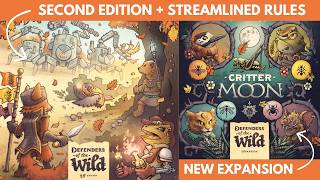
- This second edition dramatically streamlines those rules, removing many of the contingencies and exceptions.
- The result is a game that is easier for new players to learn, but also offers increased depth and a shorter game length.
- The Critter Moon expansion will add eight more organizers, two per faction.
- When you build a camp, you'll flip over a Critter token to perform its action.
References (from this video)
- Charming theme and art direction
- Accessible asymmetry with cooperative play
- Backer-driven release timeline; retail availability pending
- Lesser-known publisher/designer footprint may affect visibility
- nature defense with light asymmetry
- Cute woodland creatures defending their homeland from invading mechanical robots
- Root-inspired vocabulary and accessible design
- Spirit Island
- Root
Mechanics (from transcript analysis)
- area_defense — Territorial defense mechanics echoing Root-style tension.
- asymmetric player powers — Light asymmetry with powers that are accessible to players.
- asymmetric_powers — Light asymmetry with powers that are accessible to players.
- Cooperative Game — Players defend against an invading robotic force in a cooperative framework.
- cooperative_play — Players defend against an invading robotic force in a cooperative framework.
Video topics + discussion points
Quotes (from this video)
- the five most viral games right this second
- it's absolutely beautiful
- my hype level is a 7 out of 10
- the consensus at eight it's not a topheavy distribution
- I backed it so you know I think this will be widely available at retail
- hype level it's honestly it's a 10 out of 10
References (from this video)
- Fiddly machine system cleaned up; rules overhead reduced; board tells a story with permanent walls.
- Shorter, tighter game that retains Spirit Island-like feel.
- Expanded asymmetry via Critter Moon expansion without overwhelming complexity.
- Better solo/play experience and accessibility for mid-weight players.
- Some fiddly elements remain and require occasional rule checks.
- Some players may still desire deeper asymmetry; expansion not fully explored yet.
- Rulebook still requires occasional consultation despite shorter length.
- Asymmetric cooperation and urgency against a sprawling machine threat; cascading failure puzzle.
- Woodland habitats under a mechanical invasion, with four factions attempting to reclaim and defend their world.
- Story told through board state dynamics (walls, factories, pollution) rather than cutscenes; emphasis on strategic planning and survival.
- Spirit Island
- Root
Mechanics (from transcript analysis)
- Asymmetric Mechanics — Four different woodland factions with unique terrain connections and abilities.
- asymmetric_factions — Four different woodland factions with unique terrain connections and abilities.
- camp_building_and_territory_control — Players build camps on their native terrain after flipping factory tiles to wild territory.
- factory_and_wall_system_update — New wooden factories and a factory deck with special effects; walls stay on the board; breach tokens added.
- machine_core_infiltration — Upon completing camps, players infiltrate the machine core by moving into its gates, spending actions, and exiting to win.
- pollution_and_toxic_sites — Toxic sites accumulate pollution tokens; a six-token threshold triggers a disaster and increases pressure.
- Resource management — All resources (pollution tokens, mechs, walls, factories) are tracked; depleting any supply ends the game.
- Resource_and_supply_management — All resources (pollution tokens, mechs, walls, factories) are tracked; depleting any supply ends the game.
Video topics + discussion points
Quotes (from this video)
- The soul of this game is still 100% intact.
- This is a nice simplification.
- It's a tool in my belt and could be a staple in your belt.
- The game is a fairly quick setup.
References (from this video)
- Streamlined rule book for faster onboarding
- Tighter action economy reducing downtime between turns
- New win condition requiring full camp-building and core infiltration
- Redesigned machines with wooden factories, permanent walls, and an updated pollution system
- Critter Moon expansion adds eight new organizers and defender cards for more variety
- cooperative animal factions resisting an oppressive machine regime
- Commonwood, a woodland region under machine occupation
- cooperative, scenario-driven progression toward dismantling the machine core
Mechanics (from transcript analysis)
- Action point economy — On your turn, you spend action points equal to your active defender's capabilities to perform actions.
- Action points — On your turn, you spend action points equal to your active defender's capabilities to perform actions.
- Area movement — Move across locations; habitat corridors allow long-distance movement within the same habitat, with blockage rules.
- breach a wall — Spend an action near a wall to place a breach marker, making the wall passable.
- camp building — Build camps to draw more defender cards, heal, and advance toward the win condition of infiltrating the core.
- Cooperative Game — All players work together; either everyone wins or everyone loses as a group.
- cooperative play — All players work together; either everyone wins or everyone loses as a group.
- destroy and reclaim mech — Spend an action to remove a mech in your location, triggering a damage roll and gaining support.
- heal and damage tokens — Heal actions flip damage tokens to their healing side when in a faction's camp location.
- infiltration victory condition — Win by building all camps and infiltrating the machine core, then resolving the core to end the game.
- movement and corridors — Move across locations; habitat corridors allow long-distance movement within the same habitat, with blockage rules.
- pollution and walls — Pollution tokens and walls constrain movement and strategy; walls can be breached to open paths.
- Reclaim as Action — Spend an action to remove a mech in your location, triggering a damage roll and gaining support.
- regroup and relocation — Regroup lets you relocate to any location with a camp, regardless of distance, for strategic repositioning.
- resolve machine cards — After actions, resolve the top card from the machine deck, which can deploy, move, or manage components.
- rewards and items — Ending moves in a location with a camp grants items; various actions yield cards or tokens.
- Secret card selection — During the organized phase, players secretly select a defender card to play this round, revealed simultaneously.
- two-phase round structure — Each round consists of an organized phase where actions are planned, followed by an action phase for individual turns.
- Variable Phase Order — Each round consists of an organized phase where actions are planned, followed by an action phase for individual turns.
Video topics + discussion points
Quotes (from this video)
- The second edition brings some significant changes. A streamlined rule book, a tighter action economy for faster play, and a new win condition where players must build all their camps then infiltrate the machine core.
- The machines themselves have been redesigned with new wooden factories, permanent walls, and an overhauled pollution system.
- The Critter Moon expansion adds eight new organizers to choose from to perfection.
References (from this video)
- Strong cooperative emphasis with a clear villain and multiple pathways to victory.
- High replayability due to modular board and variable map setup.
- Distinct faction mechanics and habitat-based synergies encourage varied play styles.
- Tense, multi-layer decisions between healing, movement, and conflict with machines.
- Rule complexity may deter casual or new players at the table.
- Scaling to solo or two players can feel uneven without careful balancing.
- Pollution and wall mechanics can dominate pacing if not managed early.
- Cooperative resistance and diplomacy among rival animal factions to heal the land, defend camps, and outsmart a technologically superior foe.
- A wild, evolving forest world under invasion by rampaging machines; animal factions unite to defend habitats across forests, plains, marshes, and mountains.
- Emergent, faction-driven story where alliances form and fracture through card play, map control, and environmental challenges.
- Block Uprising
Mechanics (from transcript analysis)
- Action Point System — Players gain action points from the Defender card they played and can perform actions in any order, repeatedly.
- Action points — Players gain action points from the Defender card they played and can perform actions in any order, repeatedly.
- Combat dice and snipers — Melee combat uses dice to determine damage; snipers on adjacent hexes add risk during movement and engagement.
- Combat: Dice — Melee combat uses dice to determine damage; snipers on adjacent hexes add risk during movement and engagement.
- Cooperative Game — Four animal factions must coordinate to defend the land; failure by any faction can jeopardize the group.
- cooperative play — Four animal factions must coordinate to defend the land; failure by any faction can jeopardize the group.
- Hand management and simultaneous reveal — Each round players secretly pick a card; all cards are revealed together, simulating distrust and uneasy alliances.
- Hidden deployment — The machine deck drives factory deployment and mechs that pursue active players, increasing pressure each round.
- Machine deployment and pursuit — The machine deck drives factory deployment and mechs that pursue active players, increasing pressure each round.
- Modular setup and tile-driven board — The board is randomized each game with tiles that may begin with pollution or mechs, creating a different map each play.
- Pollution and toxic sites — Factories emit pollution; accumulating pollution can create toxic sites that contribute to a loss condition unless cleaned.
- resource and item economy — Camps, map tokens, and items (bread/maps/potions/potions) grant benefits, healing, or movement options.
- Resource management — Camps, map tokens, and items (bread/maps/potions/potions) grant benefits, healing, or movement options.
- Simultaneous reveal — Each round players secretly pick a card; all cards are revealed together, simulating distrust and uneasy alliances.
- Team-up mechanic via habitat matching — Discard a card of the same home habitat as another Defender card to gain an extra action; teamwork is contingent on habitat alignment.
- Wall-breaching and rewilding — Breaching walls enables movement; some factories can be rewilded by flipping tiles to wild habitats, adding strategic depth.
Video topics + discussion points
Quotes (from this video)
- it's up to you and your comrades to decide
- the machines are rampaging across the common wood intent on exploiting the warmth of the world and enclosing every habitat town and Village in their path
- fighting back with Guerrilla tactics and clandestine sabotage
- a cooperative game for one to four players
- there's a lot of ways we can lose and only one way we can win
- the Defenders band together to heal the land and outsmart a seemingly endless enemy
References (from this video)
- Strong cooperative emphasis with clear thematic integration
- Rich tactical depth and variability via modular map setup
- Varied Defender abilities and organizer cards create unique rounds
- Supports solo and multiplayer play with adaptable rules
- Tutor-style presentation with concrete setup and gameplay examples
- Initial learning curve can be steep for new players
- Component count and setup time can be daunting
- Two-player balance may differ from larger player counts
- Some edge-case rules require careful reference to the rulebook
- Cooperative defense of nature against industrial invasion by animal factions
- Commonwood, a lush wild region threatened by rampaging machines
- episodic, faction-driven narrative with evolving threats and a central machine core
Mechanics (from transcript analysis)
- Camp building and deck refresh — Building camps increases hand size and replenishes Defender cards, unlocking more strategic options.
- Cooperative action economy — Players share a pool of actions to achieve common goals; timing and planning are crucial to success.
- cooperative actions — Players share a pool of actions to achieve common goals; timing and planning are crucial to success.
- Deck building — Building camps increases hand size and replenishes Defender cards, unlocking more strategic options.
- end game bonuses — All players must build camps and rewild all factories to win; failing conditions include toxic disasters and factory overgrowth.
- Endgame condition and victory — All players must build camps and rewild all factories to win; failing conditions include toxic disasters and factory overgrowth.
- Factory and machine deck management — Machine cards drive engine advancement, wall deployment, and pollution spread, creating a tense, evolving map state.
- Hex grid with walls and breaches — Movement is constrained by walls; breach tokens allow passing through walls and modify map control.
- hexagon grid — Movement is constrained by walls; breach tokens allow passing through walls and modify map control.
- Mech vs Hunter combat and dice resolution — Engagement involves melee dice for damage; Hunters pursue and Mechs can punish missteps during actions.
- Pollution, toxic sites, and rewilding — Pollution tokens can become toxic sites; players clear pollution, breach walls, and rewild factories to progress toward victory.
- Simultaneous card selection — During the organize phase, players secretly choose Defender cards and reveal them together, with no discussion of their hands.
Video topics + discussion points
Quotes (from this video)
- Defenders of the Wild a new Cooperative board game for four players from Outlandish Games.
- The factions must put aside long-standing disagreements in order to join forces in this war against the rampaging machines.
- Communication is not allowed while players select their cards.
- Building camps and rewilding factories is how you win.
- Mechs and Hunters provide tactical depth with dice-based combat and movement restrictions.
References (from this video)
- potential for engaging solo play found in the channel's upcoming content
- limited information in the video snapshot
- Heroic exploration and wildlife preservation
- Animal-themed adventure
- Adventure-driven solitaire/solo-friendly
- Wizards of the Grimoire
- Darwin's Journey
Mechanics (from transcript analysis)
- Cooperative/Solo play — team-based or solo challenges against the board
Video topics + discussion points
Quotes (from this video)
- It's been 6 years at this point that I have been doing YouTube videos.
- I still like Welcome to the Moon. I still find it to be the best iteration of Welcome to giving you fresh versions of the same system so it constantly doesn't feel like you're just repeating the same roll.
- Having too many games just for the sake of owning them is not my personal jam.
- Wish me luck.
- This is a video series on how I do if you want to check that out.
- I thought it was very interesting.
References (from this video)
- Asymmetric factions with unique abilities and items create varied play experiences
- Habitat movement and territory control add thematic depth
- Interactive machine AI and breach mechanics generate tension and strategic choices
- Short setup and accessible core loop with meaningful decisions
- Rule-heavy with many interacting systems; a learning curve for new players
- AI and deployment timing can feel punitive or unforgiving in early plays
- Complex setup of the machine core and initial placements may slow initial play
- environmental defense and machine-driven conflict; camps and rewiring factories to reduce pollution
- post-industrial wilderness with machines; hex-grid board featuring a machine core, factories, pollution, and habitat-themed regions
- cooperative, asymmetric faction playthrough with emergent strategy and commentary
Mechanics (from transcript analysis)
- Asymmetric faction decks and items — Each faction has a unique action deck and items (Bread, Rockets, Maps) that alter available actions and strategy.
- Breach tokens and wall mechanics — Breach tokens allow moving through walls and entering factories; walls and breaches shape board control.
- Camp building and card replenishment — Players place camps to gain better hand size and access to cards; building camps is a key objective.
- Factory placement and pollution management — Factories generate pollution; players must rewild or remove factories to prevent loss conditions and end the game.
- Habitat-based movement — Defenders move through terrain corridors defined by their habitat, influencing ease of travel and combat effectiveness.
- Machine AI deck and rounds — A deck of machine cards drives enemy behavior each round, introducing varied threats and challenges.
- worker placement — Factories generate pollution; players must rewild or remove factories to prevent loss conditions and end the game.
Video topics + discussion points
Quotes (from this video)
- This is Defenders Of The Wild; it's a really interesting game.
- I'm really excited to show this to you.
- I love all the different factions and they play very differently.
- This should show you how this game played; it's really fun.
- My wife and I had a very quick game; it was only 20 minutes long because we ended up losing two Defenders of the same type.