/pic4145901.jpg)
With a piece of land to call your own, a handful of resources, a few families and a head full of dreams you embark on a journey of a lifetime. Beyond lies the New World full of opportunities to make your dreams of a new home a reality. But beware, other settlers have come here as well, and although their beginnings are as humble as yours, each of them will want to influence these new lands as much as you. Will you become the most powerful?
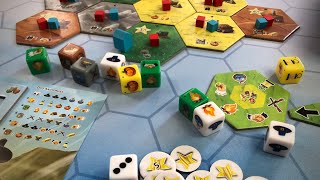
Dice Settlers is a civilization dice game of pool building, resource gathering and area control. Each turn players reach into their bags of dice, roll and choose their own actions: from exploring new lands and building the board, through gathering resources and trading, to developing technologies which offer new abilities, each player chooses their own path to victory.
A changing board, a set of different technologies every time you play, and a vast array of available strategies await!


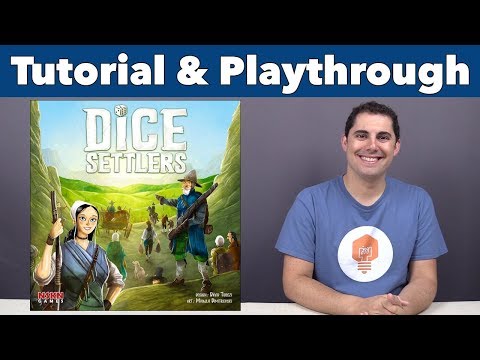
- Gorgeous deluxe edition components
- Hefty, colorful, and clear dice
- Thick and nice quality tiles
- Fantastic deluxe components for resources
- Production quality is very good
- Technologies can mitigate dice luck
- Cloth dice bags are too small
- Cardboard tracker not suitable for deluxe edition components
- The 'trade' action is disliked as it provides easy points without earning them
- Game is boring and boring to watch
- More complicated than it needs to be for a gateway game
- Lack of meaningful player interaction
- Forgettable game
- Pioneers settling
- Twilight Imperium
- Roll for the Galaxy
Mechanics (from transcript analysis)
- Area Control — Placing tents and houses on tiles to gain presence and control, which contributes to victory conditions.
- Bag Building — Dice are drawn from a bag and go into a spent pool. Dice are only drawn from the spent pool when the player has nothing left to draw from their bag.
- Dice Rolling — Players roll dice which have faces representing different actions. These dice are spent to perform actions.
- Set Collection — Implied through removing sets of resources for points or collecting dice/markers for technologies.
- Technology/Card Drafting — Players can strive for technologies that provide end-game points or mitigate dice luck by allowing icons to be used as other symbols.
- Tile Placement — Players draw and place tiles on the board, which can have abilities that trigger upon placement.
Video topics + discussion points
Quotes (from this video)
- The game is pretty boring like that's really just kind of what games down to.
- Fundamentally mechanically it works there's really I have no I have no problem with how the game plays at all ultimately I just don't want to do it for the channel because it's boring I feel like it'd be boring to watch it's boring for everyone to play.
- On scale of 1 to 10 it's a 5 it's an average game like it I wouldn't say it's below average like it does normal and say this but it does what it wanted to do I guess I don't know if it was trying to be the next sweet dice game but it is definitely not that.
References (from this video)

- Many gameplay options and strategic depth (varied actions like explore, settle, raid, trade, and tech) as discussed.
- Rules are taught during the playthrough, showing multiple strategic approaches.
- Host notes a misunderstanding of a house-placement rule during the session.
Mechanics (from transcript analysis)
- Dice Placement — Dice can be rerolled or set to specific faces by spending resources or Pioneer symbols.
- Die manipulation and face setting — Dice can be rerolled or set to specific faces by spending resources or Pioneer symbols.
- End Game Bonuses — Endgame can be triggered by multiple conditions such as deck exhaustion and five houses on the board.
- endgame triggers — Endgame can be triggered by multiple conditions such as deck exhaustion and five houses on the board.
- Exploration, settlement, and presence — Exploring tiles, placing tents, and gaining presence to control tiles and gain rewards.
- Governance to place houses — If a player has enough tents, they can govern a tile to place a house and gain points.
- Pioneer symbols as wilds — Two Pioneer symbols can act as a wild symbol to substitute a die face when used.
- Raid and tent replacement — Raid actions remove opponents' tents from a tile and place the raider's tent in its place.
- scoring and end-game scoring — End-game scoring combines territory control, houses, dice, and technology points, with special multipliers.
- Simultaneous roll phase — All players roll dice simultaneously based on their quota from the setup.
- Technologies and dice quota — Technology cards affect dice quota and provide end-game bonuses; some increase exploration or provide other effects.
- Tile Placement — Exploring tiles, placing tents, and gaining presence to control tiles and gain rewards.
- Trade actions and resource sets — Trade actions exchange resources (often in sets) for victory points; gold is wild in sets.
Video topics + discussion points
Quotes (from this video)
- I was definitely trying to show the different players going after different strategies
- a straight tie all the way through
- I’m a bit bummed that I kind of misunderstood the rule for doing the house placement
References (from this video)
- Player cheat sheet is handy for understanding dice faces and icons.
- Deluxe version has cute player tokens in different shapes and colors.
- Good artwork by the Mico.
- Elements of deck building where players research technology cards to make actions more powerful.
- Ability to modify dice rolls.
- Don't have to stick to one strategy; can change based on icons rolled.
- Main board is different each game due to tile exploration.
- Actions can be made more powerful by overfilling tiles or exploring.
- Researching technology early can make subsequent actions more powerful.
- Player initially didn't remember what action refers to what in the dice.
Mechanics (from transcript analysis)
- Deck Building — Players research technology cards which make their actions more powerful.
- Dice modification — Players have abilities to modify their dice rolls, such as reroll powers and setting powers, to get closer to their ideal turn.
- Dice Rolling — Players roll dice, and the icons determine available actions. The game provides a cheat sheet for understanding dice faces and icons.
- Resource Management — Players can gain resources, such as cocoa, which can be used to pay for workers.
- Tile exploration — Players use explore actions to reveal tiles on the main board, which changes every game.
Video topics + discussion points
Quotes (from this video)
- The trick with by settlers is that its dice based obviously because it's dice bank the other game and because of that at the surface it looks like that each round you get a set of random options but the thing is there are no bad options.
- To me the soul of the game is looking at the starting set up and trying to pick one or two strategies that promise to be the most juicy in that game.
- Make bend the dice to your will and then eventually you won't need luck at all.
References (from this video)
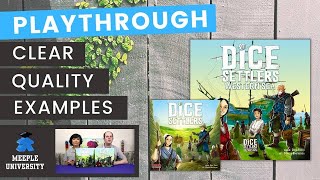
- Expansion modules add significant variety and new strategic options (n boys, enclosures, advisors, Western Sea).
- Treasure Island and treasure dice create high-scoring opportunities and exciting end-game potential.
- Port setup and exploration create dynamic map-building and tactical choices.
- Host expresses enthusiasm for the modules and flow of playthrough.
- Some interactions (pink hat vs pink dye) are unclear during gameplay (noted uncertainty).
- Playing with all four modules is not recommended by the rules.
- Maritime exploration and trade
- Maritime exploration with ports and islands
- dice-driven resource management with exploration and port-building
Mechanics (from transcript analysis)
- dice manipulation — Players spend resources to modify dice outcomes (e.g., hats and fish to change faces).
- die rolling — Players roll dice to determine actions and get a first pick order (e.g., choosing end envoy and rolling dice).
- draw tiles with compass icons — After dice manipulation, players draw and select tiles using compass icons.
- embassy effects — Embassy mechanics trigger effects when choosing resources (embassy at the top).
- end boy — End round tokens (endboy) and handling around the round end.
- explore — Exploration phase involves revealing new tiles and placing tents and ports.
- hire/raid/recruit — Hiring, raiding and recruiting to acquire dice and abilities.
- port setup and sailing — Port setup with new tiles; sailing actions to move ships and collect benefits.
- Research actions — Special abilities to research technologies for free or reduced costs.
- settle on land — Settling on land as a scoring and resource mechanic.
- Tent placement — Tent placement on the map to establish presence and score points.
- treasure dice — Treasure dice introduce high-value opportunities and special dice with extra icons.
- use ships as hiring actions — Ships can be used as hiring actions in addition to regular actions.
Video topics + discussion points
Quotes (from this video)
- Dice Settlers with the Western Sea expansion is shown in this playthrough.
- Weve got the four modules: the n boys modules, enclosures, advisors, and Western Sea.
- Treasure Island what lets you use those.
- I really like the modules by the way.
References (from this video)
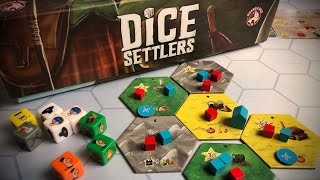
- Lots of variety
- Interesting mash-up of mechanisms (Euro + dice rolling)
- Populating empty land
Mechanics (from transcript analysis)
- AI Opponent — A solo mode variant uses an AI to simulate an opponent.
- Area Control — Players earn victory points through controlling tiles on the map.
- dice building — The game is described as a dice building game where dice are collected and used for actions.
- Dice Rolling — Dice are rolled to determine actions and their strengths.
- Resource Management — Resources like food and wood are gathered and spent.
- Technology tree — Players can research technologies for benefits and victory points.
- Tile Placement — Players explore and place new tiles on the board.
- Worker Placement — Tents represent workers placed on tiles to establish presence and control.
Video topics + discussion points
Quotes (from this video)
- hi welcome to boxes alliance i'm ricky
- i'm playing dice settlers i'm gonna be playing the solo game for you
- we've got a civilization that we're creating where we're going to earn victory points through area control
- the dice that you'll be rolling are your means to taking actions
- the game encourages you to use a fixed set of cards for your first game
- all right so during setup any dice on the tiles that you draw go to your spent dice area
- victory points come from area control of the tiles they've explored
- presence on a tile just means you've got a tent there
- control of a tile means you've got the most tense there
- the game ends if this stack of tiles through exploring becomes exhausted the game ends
References (from this video)
Mechanics (from transcript analysis)
Video topics + discussion points
Quotes (from this video)
- hi I'm Tarrant and I'm Stella and this is me poor University
- in this video we're going to play through a single round of this game describing what we're doing in order to give you a flavor for how the game flows
- we each have one Dyer that we've carried over from the previous round yeah and we both have a dice quote of five dice
- so I'm going to start by being a little bit aggressive so I'm going to for my first action do two raids
- I can't really do if I have to lantern or research I can't put my die in two different cuts this is a bit of a dilemma here
- I grabbed two tiles I can get another dice quota or I can get this one which will let me use a factory to get a brown dye
- This gives me flexibility to record I and also some of these that one for example requires you to have presence in the gray tile so Tarrant can't brush me there as well
- we hope this video was helpful and if you'd like to learn the rules for the game in full you can click on the link in the description to check out our how to play video for this game
- if you have any comments feedback questions or just want to say hi to us please write in the comment sections below
- if you'd like to be among the first to know what's new from Maple University please consider subscribing to our channel click on that maple up there in the corner to do so
References (from this video)
Mechanics (from transcript analysis)
Video topics + discussion points
Quotes (from this video)
- Dice Settlers is a 4X-style dice pool building game.
- It is a light to medium complexity game which plays briskly meaning players must progress quickly from engine building to point-scoring or risk being left behind.
- The more matching icons a player spends at once the more powerful the action will be and so players will typically spend the roll phase trying to manipulate their dice into a high frequency of just a few specific icons so that they can then maximize the efficiency of the two actions that they can take in each round.
- There is no player elimination and there is no direct victory point incentive just for attacking weak players.
References (from this video)
- Upgrading tents to houses provides 8 points for control.
- Exploring can grant bonus actions or additional dice quotas.
- Having flexibility with dice allows for different strategic options.
- Can have too many of one type of die, limiting options.
- Dice rolls might not always provide a clear pattern or desired outcome.
- Player interaction can lead to territorial disputes.
Mechanics (from transcript analysis)
- Area Control — Players compete to control territories on the map by placing tents and expanding.
- Dice Placement — Dice are placed on action spaces or to claim territory.
- Dice Rolling — Players roll dice as a core part of the game to determine available actions or resources.
- exploring — Players can explore to draw map tiles.
- Recruiting — Players can recruit to increase their dice quota.
- Resource Management — Players manage resources such as wood and gold to perform actions.
- Settling — Players can use actions to settle new areas or upgrade tents to houses.
- tile laying — Players draw and place map tiles to expand the game board and gain benefits.
Video topics + discussion points
Quotes (from this video)
- hi I'm Tarrant and I'm Stella and this is me poor University
- in this video we're going to play through a single round of this game describing what we're doing in order to give you a flavor for how the game flows
- we each have one Dyer that we've carried over from the previous round yeah and we both have a dice quote of five dice
- so I'm going to start by being a little bit aggressive so I'm going to for my first action do two raids
- I can't really do if I have to lantern or research I can't put my die in two different cuts this is a bit of a dilemma here
- I grabbed two tiles I can get another dice quota or I can get this one which will let me use a factory to get a brown dye
- This gives me flexibility to record I and also some of these that one for example requires you to have presence in the gray tile so Tarrant can't brush me there as well
- we hope this video was helpful and if you'd like to learn the rules for the game in full you can click on the link in the description to check out our how to play video for this game
- if you have any comments feedback questions or just want to say hi to us please write in the comment sections below
- if you'd like to be among the first to know what's new from Maple University please consider subscribing to our channel click on that maple up there in the corner to do so
References (from this video)
- Plays briskly
- Can be played solo
- Upgraded components in deluxe version
- Gaining new settlers (dice) to access more diverse and powerful actions
- Players can gain control of tiles for victory points and bonuses
- House grants permanent control of a tile
- Increasing points for subsequent houses built
- Tiles control grants end of game victory points and in-game bonuses
- Game plays quickly and emphasizes efficient play
- Players control the end of the game
- Players must progress quickly from engine building to point-scoring or risk being left behind
- exploring and settling new lands
- new lands
Mechanics (from transcript analysis)
- action selection — In the actions phase one at a time players spend sets of matching icons to take an action until all players have taken two actions for the round.
- Area Control — A tile is generally controlled by the player or players with the most tents on it.
- dice pool building — Dice Settlers is a '4X-style dice pool building game'.
- Engine Building — Players spend resources for victory points or to develop engine building technologies.
- Player elimination (none) — There is no player elimination.
- Set Collection — Players spend sets of matching icons to take an action.
- Worker placement (implied) — Players use settlers (dice) to access actions, harvest resources, and develop technologies.
Video topics + discussion points
Quotes (from this video)
- Dice Settlers is a 4X-style dice pool building game.
- It is a light to medium complexity game which plays briskly meaning players must progress quickly from engine building to point-scoring or risk being left behind.
- The more matching icons a player spends at once the more powerful the action will be and so players will typically spend the roll phase trying to manipulate their dice into a high frequency of just a few specific icons so that they can then maximize the efficiency of the two actions that they can take in each round.
- There is no player elimination and there is no direct victory point incentive just for attacking weak players.
References (from this video)

- Kickstarter deluxe edition includes upgraded components like custom dice, resources, and plastic houses/tents.
- Map configuration is kept clustered through tile placement rules.
- Technologies provide ongoing or once-off benefits, and end-game victory points.
- Dice can be manipulated using pioneer or resource icons.
- Players can gain victory points through various means: resources, area control, building houses, and researching technologies.
- settling new lands
- new lands
Mechanics (from transcript analysis)
- Area Control — Players can gain their victory points by controlling area on the land.
- building — Players can build houses on tiles.
- Dice Rolling — Players will be gaining new settlers represented by custom dice and then on each turn they'll go through a phase of rolling and manipulating these dice.
- Raiding — Players can remove opponent's tents and replace them with their own.
- Resource Management — Players harvest resources which are then used for trading and researching.
- Set Collection — Players will be spending sets of dice in order to take actions out on the map.
- Technology tree — Players can research technologies which provide ongoing or once-off benefits and end-game victory points.
- Tile Placement — Players place tiles onto the map, and must place them adjacent to at least two other tiles if possible.
- Trading — Players can trade resources for victory points.
- Worker Placement — Players spend dice icons to take actions on the map, similar to worker placement.
Video topics + discussion points
Quotes (from this video)
- this is People University how to play - settlers die
- in this video we're showing you the Kickstarter deluxe edition of the game
- and that's how to play die settlers we hope you enjoyed this video
- if you'd like to get a flavor for how the game plays in practice you can click on the link in the description below to check out our one round playthrough for this game
References (from this video)
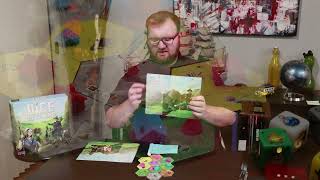
- Upgraded art and components
- Centralized board with area-control feel
- Interesting tent/land expansion mechanic
- Busy player board with a lot of empty space
- Dice pool can outstrip available actions, leading to inefficiency
- Limited tangible shuffling/draw mechanics due to the dice bag design
- Castles of Burgundy
Mechanics (from transcript analysis)
- Area Control — Exploration places tents on land; adjacent players can place tents as well, with the original action taker gaining a second tent and maintaining control of that tile.
- area control / tile expansion — Exploration places tents on land; adjacent players can place tents as well, with the original action taker gaining a second tent and maintaining control of that tile.
- Dice Drafting — Players roll and/or select dice outcomes to power actions, with the aim of converting tents into houses and scoring via cards.
- Dice Rolling — Dice results are used to perform various actions, and players must optimize combinations to maximize actions beyond what a single roll might seem to allow.
- dice-to-resource conversion — Dice results are used to perform various actions, and players must optimize combinations to maximize actions beyond what a single roll might seem to allow.
Video topics + discussion points
Quotes (from this video)
- I like it primarily because it has upgraded art
- it's a lot like castles of burgundy but on one Central bird board
- the entire game is explained on this side of the player board here
- dice settlers you are up for elimination
- overall the game's okay
- One of the interesting mechanics that I liked was that when somebody explores a new land they're going to place a tent
- the person who did the original action also gets to play a second tent so they remain in control of the tile
- it's not really big enough so that when you put these in here you're actually shaking around and shuffling because they don't actually go anywhere
- the dice themselves are silk screen printed on there
References (from this video)

- Surprisingly deep for a lighter game
- High control over die outcomes
- Engaging bag-building element
- Can be detail-heavy for some players
- dice drafting, resource generation, bag-building
- Island settlement with dice-driven systems
- engine-building Euro
Mechanics (from transcript analysis)
- bag-building — Acquire dice to your bag and draw to roll
- Dice drafting / manipulation — Roll dice and re-roll or set faces via resources
- Resource Management — Spend resources to activate actions and scoring
- Tile placement / map expansion — Place huts to claim spaces on the map
Video topics + discussion points
Quotes (from this video)
- this game is so much fun because it gives you such a wide variety of things that you could do
- I think this is a game of skill and you don't see games of skill very often with very short
- Isle of Skye Journeyman adds a lot to this game but it detracts from some of the greatness of the original game
- Lisboa is a heavy game; there's a lot going on
- Teotihuacan has a lot going on
- Western Legends is a sandbox with tons of directions you can go
References (from this video)
- Engaging dice-driven action selection
- Strong solo play dynamic with a convincing AI opponent
- Varying strategies via exploration and settlement choices
- Endgame scoring incentives push proactive play
- Complex rules can be nonintuitive without reference
- Aggressive AI can overwhelm early in the game
- Drafting of technologies was limited in this run
- Resource management, exploration, and territory control with a light fantasy-adjacent theme.
- A tile-based island-world where players settle tiles, gather resources, trade, and raid to gain victory points.
- Procedural, strategic with a focus on tactical dice-driven actions.
Mechanics (from transcript analysis)
- Dice pool management — Each turn you roll a set of dice representing worker actions; you balance re-rolls to optimize outcomes.
- Dominance on tiles — Tiles track dominance; opponents attempting to gain tile control can contest and gain points when they lead.
- Endgame trigger and scoring — Game ends when victory resources run out; scoring includes tiles, technologies, stored resources, dice-based VP, and houses.
- exploration — Explore tiles to reveal benefits such as resources, victory points, or special actions.
- Factories and tokens — Factories convert tokens to resources and may create additional strategic effects during trades.
- Housing/Houses scoring — Building houses yields escalating VP as you develop more housing on the board.
- Raid and tents — Tents stored by players enable raid actions to steal or affect opponent VP; resource management impacts raid capability.
- Settlement and placement — Place dice on tiles to settle and activate effects like gaining resources or triggering factories.
- Trade and icon economy — Trading allows converting resources into points and grants extra trade icons for future trades.
Video topics + discussion points
Quotes (from this video)
- super game great work david terzi
- there's a lot of tents out here he's got none
- we could actually during cleanup we could get rid of this one factory