






























Diced Veggies Deep Dive
What the Community Thinks About Diced Veggies
Diced Veggies has captured the hearts of board gamers since its release, with reviewers consistently praising its accessible charm and innovative design. The game strikes a rare balance between simple rules and engaging decisions, making it equally appealing to casual family gamers and experienced hobbyists. The cute kitchen-themed artwork and whimsical presentation have made this a standout title for anyone looking for light, fun game nights that appeal across age groups. Its solid mix of clever mechanics, beautiful components, and quick playtime has earned it a well-deserved spot in many collections.
Core Mechanics That Define Diced Veggies
The Knife-Cutting Drafting Mechanism
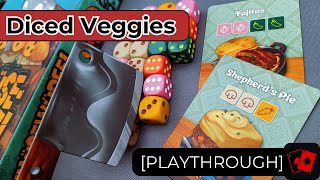
At the heart of Diced Veggies lies its signature drafting system: players use a cardboard cleaver to slice ingredient dice from a shared block. This physical mechanism might seem gimmicky at first glance, but reviewers emphasize that it is absolutely integral to the gameplay. The knife-cutting action creates a meaningful constraint, players can only cut from the outside edges of the block and may take no more than 10 pips worth of dice per turn. This elegantly simple rule creates surprising depth, as players must balance grabbing many low-value ingredients against securing fewer high-value dice. The tactile nature of the cutting action enhances the theme without becoming a distraction; it is thematic design that actually matters to strategy.
Recipe Fulfillment and the Hype Cards
Players work toward cooking recipes by collecting the exact ingredient combinations depicted on recipe cards. What elevates this familiar set-collection mechanic is the presence of hype cards, bonus objective cards that reward players for fulfilling recipes in specific, creative ways. One hype card might award points for using only a single die, while another requires assembling a recipe using dice with particular pip values or combinations. These hype cards inject meaningful variety into what could otherwise be straightforward recipe completion, encouraging players to think about which ingredients they pursue and how they pursue them. The interaction between the basic recipes and the dynamic hype cards creates the kind of light puzzle-solving that keeps the game fresh across plays.
The Diced Veggies Experience
A Game That Makes You Hungry
Multiple reviewers noted that the artwork on the recipe cards is beautiful enough to trigger genuine cravings. The food illustrations are rendered with care and appeal, depicting appetizing dishes like Greek salad, coq au vin, and various stews. Players often find themselves eyeing the recipe cards not for their victory points but simply because the food looks delicious. This is a testament to the game's visual design, it creates genuine thematic immersion without requiring complex rule structures or lengthy thematic flavor text. The theme is not pasted on; it lives in every component and decision.
Quick, Satisfying Turns and Accessible Depth
Each turn in Diced Veggies follows a lightning-quick structure: cut ingredients, cook if possible, draw a card. This simplicity makes the game easy to teach and fast to play, with sessions typically running 45 minutes or less. Despite its brevity and accessible rules, the game offers engaging decisions at every turn. Players must constantly evaluate which ingredients are most useful, whether to attempt difficult hype cards, and when to use their single-use chef's token wisely. The constant flow of new recipe and hype card options keeps players engaged and prevents anyone from feeling stuck or stalled, as a bad recipe draw can always be cycled out through hand management. The combination of clarity and decision-making depth explains why reviewers describe this game as equally enjoyable for families with young children as for experienced gamers seeking a quick, satisfying play.
What Makes Diced Veggies Stand Out
Elegant Component Design and Production Quality
The physical components of Diced Veggies demonstrate thoughtful design throughout. The dice are chunky and colorful, easy for players to identify by vegetable type (mushroom, carrot, tomato, onion, pepper). The cardboard frame holding the dice block is brilliantly conceived, it already provides the square grid structure needed for the game, eliminating the need for a separate game board. The cleaver, despite being simple cardboard, functions well as a knife and adds tactile engagement to the turn structure. Reviewers noted that the quality of the cards and overall production feels good in hand, creating a premium feel for a game at this price point. Every component serves a purpose and contributes to the theme.
Surprising Replayability Through Card Variety
Diced Veggies contains a large deck of both recipe and hype cards, which ensures that no two games unfold identically. The combination of recipes available and the hype card objectives create enough variability that experienced players find themselves exploring different strategies across plays. Some games might reward aggressive pursuit of specific hype cards, while others make straightforward recipe completion more viable. The game includes simplified rules for families playing with young children (using fewer recipes, ignoring hype cards, or changing the pip limit), but the core game maintains sufficient complexity that experienced gamers appreciate the decision space it offers.
Potential Drawbacks
Hype Cards Can Create Frustration in Solo Play
While the hype cards are a brilliant design choice in multiplayer, solo players have noted that certain hype cards with very specific requirements (such as achieving exactly 25 pips, or cooking two recipes in a single turn) can feel artificially difficult. In the solo variant, an AI opponent rolls to simulate ingredient removal from the block, and these extreme hype card requirements sometimes appear unattainable through no fault of the player's strategy. Some reviewers found themselves holding difficult hype cards for entire games, unable to trigger them and unable to swap them out without using their limited card-draw turns. This occasionally creates a minor sense of frustration during otherwise smooth solo experiences, though it does not significantly diminish the enjoyment of the game.
Physical Cutting Has Minor Limitations
While the knife-cutting mechanism is thematically excellent and strategically sound, the cardboard cleaver has a limitation in terms of physical usability. The blade edge is somewhat dull, making it difficult to make perfectly clean cuts between dice in tight spaces. Some reviewers found themselves occasionally nudging dice off the block with their fingers rather than cutting them cleanly. This is a minor inconvenience and does not impact gameplay meaningfully, but it represents a small gap between the thematic ideal and practical execution. Players with very tight dice arrangements sometimes need to be creative about their cutting approach.
If You Enjoy Diced Veggies
Players who love Diced Veggies tend to enjoy light, tactile games with strong thematic integration and clear decision-making spaces. If the knife-cutting mechanism appeals to you, consider other games that feature physical interaction as a core element rather than a gimmick. If you appreciate set-collection games with a twist, you might explore games that similarly subvert familiar mechanics through clever card interactions. The comparison game No Thanks shares similar design philosophy, it is simple to teach but full of tactical depth and player interaction. For families seeking games that work across age groups while maintaining genuinely engaging decisions, Diced Veggies demonstrates that accessibility and depth are not mutually exclusive. The game proves that a strong thematic premise, beautiful artwork, and excellent component design can elevate even familiar mechanics into something special.
What Reviewers Are Saying
"I really enjoyed the way dice were used in this game. I like how the pips were used in terms of some of the special scoring cards or hype cards, and I like how the dice were used in limiting how many you could take. Sometimes you are able to take a lot, sometimes you could only take like one if you really need it. So I just really liked how dice were used in this game."
— Ryan and Bethany Board Game Reviews
"I really enjoy this game. It's very very simple but I like the mechanism. It has the way you're drafting your dice for your recipes. It's just a pretty simple recipe fulfilling game, but it's very easy to play as always. Very lovely game. The drafting mechanism with the knife, it might seem like a gimmick at first but I don't think it is a gimmick. It's a really cool idea and works really well."
— Sir Thecos
"This is a cute family game, you know? It's got these cute little color dice and then they give you this little cleaver. The art is really good. It's a really fun game and it's really cute. Great for families, especially families with small children."
— Our Family Plays Games