




Discworld: Ankh-Morpork Deep Dive
What the Community Thinks About Discworld: Ankh-Morpork
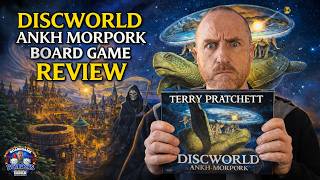
Reviewers describe Discworld: Ankh-Morpork as a loud, funny, and deceptively sharp card game that rewards players who can keep their intentions hidden. Martin Wallace's design draws consistent praise, and most reviewers agree that the humor is central to the experience. The enthusiasm is tempered by a shared frustration with availability, since the game has been out of print for years and copies can be hard to find at a fair price.
Opinions differ on how the game holds up over time. All You Can Board is the most enthusiastic voice, calling it one of the best games the host had newly discovered in a long time and urging viewers to track down a copy at a reasonable price. The host of All You Can Board also describes it as a game that made the table laugh at card names before anyone had played them. BoardGameBollocks is more measured. The reviewer finds the game oddly satisfying for a simple area control design, but argues that it is only "maybe worth a look" for players who do not mind being backstabbed and are willing to pay for a copy. A separate Watch Review ranks the game in a personal top 100 and points to its hidden objectives as the reason it stays interesting after many plays. Game Night Picks - Pair Of Dice Paradise approaches the game through its market price, connecting its collector interest to the fandom around Terry Pratchett's books.
Core Mechanics That Define Discworld: Ankh-Morpork
Hidden Victory Points
The defining mechanic is the secret personality card. Each player receives a personality with its own win condition, and those goals stay concealed from the rest of the table until someone wins. Reviewers explain that players may know the full list of possible objectives but not which one their opponents are pursuing, so every move becomes a guess about intent. The reviewers describe a hidden victory structure where a player who masks their plans well can take a win from under the noses of the table. If nobody achieves a personal goal by the time the deck runs out, Lord Vetinari wins by default, a rule that gives the game a stinging final twist.
Area Majority
The board is divided into city areas, and players compete for control of them by placing minions and building structures. Reviewers note that some personality goals require controlling four areas, which turns every placement into a contest for presence. Trouble markers, assassinations, and building abilities give the struggle for each district its texture, since a building brings a unique regional ability that is lost if it is removed. In Martin Wallace's design, this control fight runs alongside the hidden goals, so a player trying to dominate a district must also disguise why they want it.
The Discworld: Ankh-Morpork Experience
Playful Absurdity
Reviewers repeatedly describe the game as a comedy first. The card names and abilities are the main source of humor, and several reviewers say the table often reads cards aloud before they are played. The tone never tries to take itself seriously, which reviewers credit with keeping even the cutthroat moments light. BoardGameBollocks argues that the game clearly does not take itself too seriously, and that this is part of what makes it worth a look. The result feels more like a tabletop sketch than a heavy strategy session, with laughter as a constant companion to the scheming.
Tense Bluffing
Beneath the jokes, reviewers describe real pressure. Because no one knows the others' win conditions, every player must read the table, guess what opponents are building toward, and decide whether to reveal progress or hide it. The reviewers from All You Can Board describe the satisfaction of masking intentions effectively, while BoardGameBollocks notes how quickly a carefully built position can be dismantled in a single turn. That mixture of bluffing and vulnerability gives the game its edge, and it is the reason reviewers keep returning to the question of who might be about to win.
What Makes Discworld: Ankh-Morpork Stand Out
Cards Rooted in the Novels
BoardGameBollocks praises the care that went into the card design. Rather than repeating characters and locations, the cards draw on a wide range of characters and places from the Discworld novels, so fans of the books find familiar names throughout the deck. The reviewer, who admits to not being a major Discworld fan, still notes that the card art and text reward anyone who knows the series. For players who love the source material, the deck is a rich collection of references, and for everyone else it provides a steady stream of strange new cards to read.
Rules That Are Easy to Teach
Reviewers consistently highlight how little explanation the game needs. BoardGameBollocks describes a rulebook of only about eight pages and says that the game is so accessible that almost anyone can learn it quickly. All You Can Board makes the same point, advising players to start playing rather than study the rules, since the card text carries nearly all of the instruction. Players resolve each card's abilities from left to right, and that simple loop is enough to reveal the strategy and the chaos over time. This accessibility makes the game a reliable choice when the group wants something quick, funny, and easy to explain.
Potential Drawbacks
Scarcity and Price
Almost every reviewer raises availability as a concern. BoardGameBollocks notes that the game is long out of print, that the publisher's IP is unlikely to return to board games, and that the reviewer paid about 70 pounds for a copy that is sometimes listed on eBay for much more. All You Can Board encourages viewers to avoid overpaying on the secondary market, and Game Night Picks points to the game's high listing value as a sign of its collector status. For a game this fun, reviewers agree that scarcity is a real barrier, and some readers may decide that a cheaper alternative is the better purchase.
Swingy Draws and Backstabbing
BoardGameBollocks raises two related criticisms. The first is that the game can feel swingy, because what a player can do on a turn depends heavily on which cards they draw. A hand full of cards that let a player act in areas where they have minions can be powerful, while a hand of dependent cards can leave a player stuck. The second concern is the removal of minions and buildings by opponents, which the reviewer describes as disheartening when a player is one minion away from victory and the table keeps knocking them back. Reviewers who enjoy the bluffing can find these moments exhilarating, but players who dislike direct confrontation may find them frustrating.
If You Enjoy Discworld: Ankh-Morpork
Players who enjoy Discworld: Ankh-Morpork's hidden personality goals will find similar satisfaction in Nantarkin, the game that All You Can Board identifies as a re-implementation of the same design. Reviewers who value the bluffing and area control in Discworld: Ankh-Morpork may also appreciate how Nantarkin keeps the unknown objectives at the center of the decision making. Because the Discworld edition is rare and expensive, Nantarkin offers a practical route to the same hidden-agenda experience for players who want the game without paying a premium for the original cardboard.
What Reviewers Are Saying
"Discworld Ankh-Morpork is a very very simple game and it is oddly satisfying for a very simple area control game. It can be really frustrating to build up your path to victory only to see it completely obliterated in the same turn."
— BoardGameBollocks
"The rules are really simple, and honestly, the best way to play this game is just to start. You just read the card abilities. You execute the abilities that are at the top from left to right, and that's pretty much going to carry you through the game."
— All You Can Board
"The most expensive disc world is just like that whole book series is just so popular, and I don't feel like there's been that many games about it. I believe that the disc World game has was for a while out of print and pretty heavily sought after."
— Game Night Picks - Pair Of Dice Paradise