/pic6706402.jpg)
Become the next Master Summoner in the battle arena game Disney Sorcerer's Arena: Epic Alliances, an expandable tabletop game inspired by the popular mobile game Disney Sorcerer's Arena.
Recruit from a battle-ready roster of Disney and Pixar heroes and villains — Sorcerer's Apprentice Mickey, Gaston, Aladdin, Demona, Sulley, Dr. Facilier, Maleficent, and Ariel — then combine the cards for your characters into a single deck. You take turns playing standard actions and cards from your hand to move your characters and attack opponents. If you knock out rival characters or occupy certain spaces near the center of the arena until your next turn, you score points. When a player reaches 20 points or runs out of cards in their deck, the game ends at the conclusion of that round, and whoever has the most points wins.
The rules for Disney Sorcerer's Arena: Epic Alliances Core Set are spread out across four chapters, with each chapter building on what's come before to introduce players to new skills, upgrades, and abilities over multiple games. Multiple expansions will be released for the game line to allow for more team combinations.


- Disney themed strategic battle arena
- Recruit a fantastical battle-ready roster of Disney and Pixar heroes and villains
- Creating incredible combinations
- Endless replayability
- Strategize their every move using their unique abilities to earn the most victory points
- Expandable tabletop game
- Recruiting Disney and Pixar heroes and villains to battle
- Disney themed strategic battle arena
- Players build teams and compete.
Mechanics (from transcript analysis)
- Area Control — Players compete to earn victory points by controlling the arena.
- Deck Building — Players build their roster of Disney/Pixar heroes and villains.
- Expandable Game — The game can be expanded with new content, like the 'Turning the Tide' expansion.
- Modular Board — Expandable tabletop game.
- Team building — Players build teams and compete.
- Variable player powers — Characters have unique abilities that influence gameplay.
- Victory Points — Earn the most victory points by strategizing moves using unique abilities.
Video topics + discussion points
Quotes (from this video)
References (from this video)
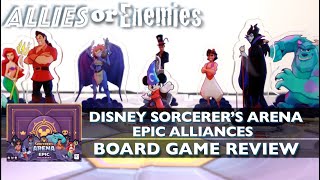
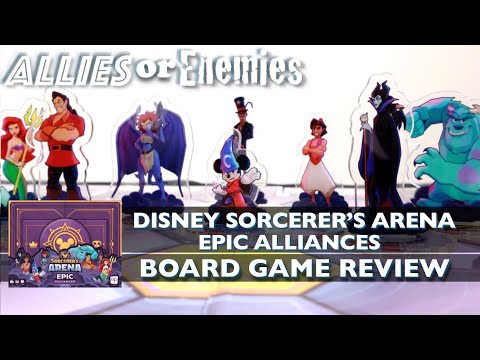
- strong character variety and theme integration
- clear, accessible entry point for mass-market players
- innovative status markers and initiative interaction
- great design for expansion potential
- cards are basic and may require sleeve protection for heavy use
- some fiddly components like damage dials and small markers
- expansions may add costs and balance considerations
- character-driven skirmish with crossovers between Disney properties
- Disney universe, arena combat featuring iconic Disney characters
- cartoonish, lighthearted tone with episodic clashes
- Unmatched
- Disney Villainous
- Marvel Champions
Mechanics (from transcript analysis)
- Card-based combat — players use character-specific abilities from their decks to move, attack, and use skills
- Combat: Deck/Hand — players use character-specific abilities from their decks to move, attack, and use skills
- Hidden Victory Points — points are earned by occupying spaces, KO'ing opponents, and completing card effects
- initiative track — an ordering mechanism where characters act one at a time along a track
- points-based victory — points are earned by occupying spaces, KO'ing opponents, and completing card effects
- respawn on diamond spaces — KOed characters return to the board on the next round via diamond spaces
- standees — clear standees with transparent tokens
- status effects and markers — markers track ongoing effects; some interact with the initiative track
- Team Variants — 1v1 or 2v2 team configurations with separate control across players
- Teams — 1v1 or 2v2 team configurations with separate control across players
Video topics + discussion points
Quotes (from this video)
- the biggest selling point for this game will be the character variety
- it's certainly light and it's built for the mass market
- you could do a lot worse
References (from this video)

- Showcased collaboration and on-set production aesthetic with licensing theme
- confrontations among iconic characters in a battleground setting
- Disney license world with characters clashing in themed battles
- lifestyle-commercial approach illustrating collaboration between publisher and creator
Mechanics (from transcript analysis)
- arena combat — competitive skirmish mechanics centered on character abilities
Video topics + discussion points
Quotes (from this video)
- I think this challenge really pushed me creatively on how to make it interesting for let's see a minute and 11 seconds
- this is how I answered that question... when you have just cards like what do you do with that
- I love doing DSA I think what's really engaging and what makes me happy about doing these lifestyle photos is that we meet in the middle between me and client
- Tang Garden... I just love doing those Fast Cuts
- the evolution of this game and this it wasn't even a game by the end honestly
References (from this video)
Mechanics (from transcript analysis)
Video topics + discussion points
Quotes (from this video)
- it's easy to teach if you've got a background in the sorts of modern card play
- we have a hex grid here and we have a three on three battle game
- the end game is triggered when someone has an empty deck or someone gets 20 points
- the password is ariel
- i like the acrylic standees
References (from this video)
- Friendly for players with card-driven tactical game experience
- Thematic IP and recognizable Disney characters
- Easy to teach for experienced players
- Good production components (acrylic standees)
- Complex status effects may require teach effort
- Asymmetric power could affect balance if not managed
- Learning curve due to many cards and upgrades
- Disney IP battle with heroes and villains
- Hex-grid tactical battle featuring Disney characters
- asymmetric character-driven skirmishes with upgrade progression
- Final Fantasy (mobile app)
- War Chess
Mechanics (from transcript analysis)
- character decks — Each character has its own deck made from three character decks; players can upgrade via gear icons.
- Combat: Deck/Hand — Each character has its own deck made from three character decks; players can upgrade via gear icons.
- Hex grid combat — Battle takes place on a hex grid in a 3v3 setup with characters represented by cards.
- Hexagon Grid — Battle takes place on a hex grid in a 3v3 setup with characters represented by cards.
- Status Effects — Various status effects like taunt, strong, immobilized, stealthy, cursed, shrink, etc.
- Turn structure — Each character turn consists of three phases (move, action, skill) that can be taken in any order.
- Upgrade system — Gear icons can be discarded to upgrade characters during the game.
- victory conditions — End condition triggered when a player reaches 20 points or when the opponent's deck is empty.
Video topics + discussion points
Quotes (from this video)
- it's easy to teach if you've got a background in the sorts of modern card play
- we have a hex grid here and we have a three on three battle game
- the end game is triggered when someone has an empty deck or someone gets 20 points
- the password is ariel
- i like the acrylic standees
References (from this video)
Mechanics (from transcript analysis)
Video topics + discussion points
Quotes (from this video)
- the two or four player game disney sorcerers arena epic alliances the core set
- the first to twenty victory points or whenever somebody's draw deck runs out when they need to go and draw a new card that'll end the game at the end of the round
- stealthy and this is gonna last for one round
- this is shove and i'm going to shove aladdin
- you gain two immobilized
- oh my gosh well-earned thanks gaston
- the game is over
- you are the winning summoner
References (from this video)
- Clear endgame condition: first to 20 points (or when the draw deck runs out) dictates pacing and finale.
- Stealthy protection adds strategic depth and counterplay opportunities.
- Sleight of Hand upgrade and Shove provide dynamic, impactful table-state shifts.
- Chain Lightning enables dramatic, multi-target damage and immobilization that can swing the fight.
- Deck manipulation and banishing create tension and decision points during play.
- Early knockout of a character (e.g., Demona) showcases aggressive turns that can swing balance and frustrate a player.
- Immobilized tokens can stall strategy for a turn or two, reducing maneuverability and tempo for affected players.
- Stealthy/banishing mechanics require constant attention to card states; potential for rule confusion was acknowledged during play.
Mechanics (from transcript analysis)
- Card Crafting — Upgrading a character’s card by banishing appropriate gears to flip to an upgraded card with new abilities.
- Chain Lightning — An attack that can target multiple rivals and spread damage to adjacent rivals, with immobilization applied to affected targets.
- Immobilized — A status effect that prevents movement for a certain duration; e.g., Maleficent can be immobilized for rounds as a result of actions.
- Shove — A direct effect that lets a player move an adjacent rival up to two spaces and deal damage (e.g., deal three damage to an adjacent rival and then relocate them).
- Sleight of Hand (upgrade path) — Upgrading a character’s card by banishing appropriate gears to flip to an upgraded card with new abilities.
- Stealthy — A status effect that provides protection from direct effects; to affect the stealthed character, the attacker must banish the card from their hand first.
Video topics + discussion points
Quotes (from this video)
- the two or four player game disney sorcerers arena epic alliances the core set
- the first to twenty victory points or whenever somebody's draw deck runs out when they need to go and draw a new card that'll end the game at the end of the round
- stealthy and this is gonna last for one round
- this is shove and i'm going to shove aladdin
- you gain two immobilized
- oh my gosh well-earned thanks gaston
- the game is over
- you are the winning summoner
References (from this video)
Mechanics (from transcript analysis)
Video topics + discussion points
Quotes (from this video)
- gathering heroes and villains from the disney and pixar universe to go up against your opponents in a contest of magic muscle and wits
- battling in an arena to claim spaces and knock out rivals in order to earn victory points
- the game is played over a series of rounds and in each round every character will get to take a single turn
References (from this video)
- Stylish standees and artwork; good visual appeal
- IP blending feels natural and accessible
- Rulebook uses chapter structure to teach gameplay
- Accessible for non-gamers; gateway into tabletop hobby
- Potential for expansion; an expansion is already announced
- Clear turn order tracker and status markers for quick glance
- Not overly violent; approachable combat
- Effective integration of app IP into tabletop form
- Rulebook organization can be confusing when referencing rules after learning; potential cross-chapter lookup
- Requires a separate or more accessible reference for ongoing reference to certain rules
- Arena-style combat might not appeal to everyone
- Crossover of IP characters in competitive battle
- Disney/Pixar universes mash-up arena combat
- Competitive skirmish with power cards and upgrade systems
- Smash Up
Mechanics (from transcript analysis)
- Actions / Attack — Standard action deals damage; upgraded via cards to higher damage
- Board control objectives — Three gold spots in the middle grant an extra point if starting next turn there
- Component use — Standees with front/back faces; two-colour minis and health dials
- Deck / discard pile — Each character has its own mini-deck; can upgrade by discarding symbols to flip cards
- endgame conditions — Game ends when a player reaches 20 points or when a deck runs out
- Health tracking — Health shown on a dial on the base of the figure; spin dial to track loss
- Hidden Victory Points — Knock out opponents to gain points; central board spots grant extra points
- Movement — Base move of two spaces; can be boosted by character or action cards
- Status effects / conditions — Conditions like shrunken or flustered placed on characters and cleared at start of turns
- turn order / initiative — Turn order tracked on side track; alternates teams; initiative determines starting player
- Upgrade system — Discard pile resources to flip character cards to advanced skills
- Victory points & KO — Knock out opponents to gain points; central board spots grant extra points
Video topics + discussion points
Quotes (from this video)
- a disney sorcerer arena epic alliance
- a mashup of all different disney pixar universes
- we're trying to knock out the opponents and score victory points based off of how tough they are
- i really like the standees in this game
- this reminds me a little bit of a game like smash up
- it's based off of an app called sorcerer's arena
- not overly violent
- the rule book has a really kind of neat learning system
- it's going to be an easily expandable game
- you can bring IPs into tabletop world
References (from this video)
- Strategic character selection
- Dynamic turn-based gameplay
- Unique Disney character interactions
- Tactical character battles with Disney heroes and villains
- Disney and Pixar universe arena
- Competitive team-based skirmish
Mechanics (from transcript analysis)
- Character upgrades — Players can upgrade characters by banishing specific gear type cards
- Hidden Victory Points — Points earned by controlling golden hexes and defeating opponents
- Turn-based Movement — Characters move and act based on turn order tiles
- Victory point scoring — Points earned by controlling golden hexes and defeating opponents
Video topics + discussion points
Quotes (from this video)
- The player with the most victory points at the end of the game wins
- Each team will have three different characters
References (from this video)
- Strong Disney theming with familiar characters and flavor
- Clear yet deep turn structure with distinct phases (movement, action, skill)
- Rich status effects system adds strategic depth and variability
- Upgrade/gear system provides meaningful customization across rounds
- Two-player team drafting and direct combat creates tense, dynamic play
- Steep learning curve due to many rules interactions and status effects
- Keeping track of numerous status counters can be tedious
- Some mechanics rely on card draws and random reveals, leading to swingy outcomes
- team-based arena combat with character-specific decks and abilities
- Arena battles featuring Disney characters
- fantasy battle with pop-culture flavor
Mechanics (from transcript analysis)
- attack system — Standard attacks deal fixed damage (often two) and can be augmented by discarding action cards; damage reduces HP on an indicator track.
- Card Crafting — Cards have gear symbols; upgrades require discarding specific gear from discard to flip cards to their upgraded sides.
- Combat: Damage Based — Standard attacks deal fixed damage (often two) and can be augmented by discarding action cards; damage reduces HP on an indicator track.
- Deck fusion — Each character has a 10-card deck; three decks are combined into a 30-card summoner deck for the round.
- Direct vs indirect effects — Some effects target specific rivals directly; others have indirect effects affecting multiple characters based on phase interactions.
- gear and upgrades — Cards have gear symbols; upgrades require discarding specific gear from discard to flip cards to their upgraded sides.
- Movement options — Standard movement or movement cards; you can discard a movement card to increase the standard move by one.
- Respawn mechanics — Knocked-out characters respawn at the start of their next turn on back rows, bringing strategic repositioning into play.
- Status Effects — Various status tokens (color-coded) attach to characters; effects are tracked on a status track and can be removed or intensified by skills or cards.
- Top-deck interactions — Card reveals from the top of decks (tarot-like reveals) can grant extra actions or alter future draws.
- Turn structure — Three phases per character turn: movement, action, and skill, with phase order chosen by the player for each turn.
- Variable Phase Order — Three phases per character turn: movement, action, and skill, with phase order chosen by the player for each turn.
- Victory points and end conditions — Knocking out foes or reaching crown spaces yields VP; game ends when a round finishes with a player at 20+ VP or when a deck is exhausted.
Video topics + discussion points
Quotes (from this video)
- it's a disney battle royale
- a race to 20 victory points
- each character has their own 10 card deck
- we basically combine all three of our character decks together to form our own summoner deck
- the skill phase is where you can use this skill
- banish the cards from your discard pile