
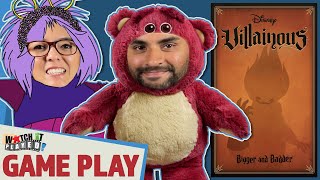
In Villainous: Bigger and Badder, each player takes control of one of three Disney characters, each one a villain in a different Disney movie, specifically Syndrome (The Incredibles), Lotso (Toy Story 3), and Madam Mim (The Sword in the Stone). Each player has their own villain deck, fate deck, player board, and 3D character.
On a turn, the active player moves their character to a different location on their player board, takes one or more of the actions visible on that space (often by playing cards from their hand), then refills their hand to four cards. Cards are allies, items, effects, and conditions. You need to use your cards to fulfill your unique win condition.
One of the actions allows you to choose another player, draw two cards from that player's fate deck, then play one of them on that player's board, covering two of the four action spaces on one of that player's locations. The fate deck contains heroes, items, and effects from that villain's movie, and these cards allow other players to mess with that particular villain.
In more detail, just like in The Incredibles, Syndrome will face off against Frozone and the Parr family, using his minions and advanced technology to come out ahead. To win as Syndrome, players need to upgrade the Omnidroid, then defeat it and all heroes in his realm. Lotso seeks to control Sunnyside Daycare by reducing four heroes' strength (utilizing a game mechanism new to Disney Villainous) and moving those heroes to the toddlers' Caterpillar Room. Finally, those playing as Madam Mim will need to win a wizard's duel against Merlin, using Mim's Transformations to defeat Merlin's.
Villainous: Bigger and Badder is playable on its own, and its characters can also face off against those in the other Disney Villainous games.
Part of the Disney Villainous family — see Disney Villainous for the combined view.
/pic4849477.jpg)

/pic4559890.jpg)
/pic5172286.png)
/pic5974997.png)


Images


- Fun
- Tons of expansions
- Variety of villains
- Strategy changes based on character
- Disney villains
Mechanics (from transcript analysis)
- Villain Play — Play as the villains
Video topics + discussion points
Quotes (from this video)
- It made my number one.
- The Making it co-op completely I was like, "This is amazing."
- It's a simplistic game, but it can also get insanely complicate like the strategy I love Dominion.
- It is one of my favorite games ever made, deck building or not.
- Does a whole unique thing where you never shuffle your deck. Every time you have to draw from your deck and you can't, you take your discard pile and flip it.
- So, this is also a massive campaign uh boss battler game.
- But it is some of the best writing in board games in my opinion.
- Uh the combat is absolutely phenomenal.
References (from this video)
- Each villain has a different win condition, offering asymmetric play.
- The winning conditions are very different between villains.
- The game has more depth than initially thought.
- The thematic elements are strong, with unique abilities for each villain.
- The Fate mechanic can be crucial and prevents ganging up on one player.
- The game is ripe for expansions.
- All cards in the decks seemed very similar in their cost and effects.
- The Fate mechanic only works in five and six player games, which can become too long with significant downtime.
- Not sure it would hit the table a lot, though would play anytime someone else brought it out.
Mechanics (from transcript analysis)
- Asymmetric play — Each villain has a different way to win, making it feel like playing a different game each time.
- fate deck — The Fate deck is specific to each player and can be used to affect other players' turns by blocking actions or providing disadvantages.
- Hand Management — Players build their hand back up to four cards after taking actions.
- Player action selection — Players move their villain on their player board to perform actions based on the space they land on.
Video topics + discussion points
Quotes (from this video)
- I was wondering what you were thinking so we're gonna be talking about the game villainess later on yes we are cuz I was stupid
- you just survived you in con we've got a week back and we're back recording
- White smoke that's never good
- I don't know the reasons behind it it's kind of sad to see him go
- if nobody has that's that's really horrible English if you feel a person listening or you Tony have never seen a youtube show called spell slingers
- Every game that is sold is unique it's different in some way
- It's not like every LCG pulled us in right
- we don't have to worry about that with Key Forge but man I really have to worry about that if I walk into a store to a tournament
- The longevity it's easy to see they would keep releasing new booster packs right new sets Key 4ch I would zoom it's new factions maybe could be could be new factions but they can generate a quadrillion decks so they really don't know that's true they don't really need to
References (from this video)
- Did not live up to the hype for the reviewer.
- Had issues that prevented it from being a fantastic experience.
- Disney villains
Mechanics (from transcript analysis)
Video topics + discussion points
Quotes (from this video)
- I'm gonna throw him under the bus
- You know I don't know if that bits getting old
- The game is phenomenal and it's built in such a way that it's just one of the most addictive video game experiences I've had in a long time
- that trailer came out and it spoke to me in the most perfect of ways
- I don't own the show so I thought I was gonna be up first
- You got to get your people to get in touch with his people
References (from this video)
- disney villains
- Villainous
Mechanics (from transcript analysis)
Video topics + discussion points
Quotes (from this video)
- i've got a soft spot for the ridiculousness and stress that this game provides
- if you remember this film then boy does this hit hard in the nostalgia
- if it's a new game with kenitsia's name on it i'm probably gonna try it
- that's the news to continue your journey with us this one is all about the best ball game in awards and other burning ball game questions spoiler though they are only figuratively on fire
References (from this video)
- Good for big groups, plays under an hour.
- Wish it was a better game
- The rest of the titles suck
- Players are likely playing as villains attempting to achieve their goals.
- Star Wars
Mechanics (from transcript analysis)
- Set Collection — This is the one thing that that that that that the rest of them suck and you're like, "Fuck, I should have taken that first one."
- Worker Placement — The workers keep on rowing does that does that whole thing and in that album it's like then like the music is just building up and then stop the boat
Video topics + discussion points
Quotes (from this video)
- It's got a slanted board and like you put dams in like these rivers and stop marbles and it's got an alpaca board. I don't know what you do on an alpaca board, but I'm here for it
- It's it's it's one of those hybrid euros but it
- So, the premise is is you're all you all wake up as a prisoner in this dark cave system covered with black mold and it's whoever gets out of the cave with the most money wins.
- I just wish I was such a better game
- My brain is blanking tonight.
- You know who was never funny? That guy with the ventriloquist guy that had like the multiple different uh
- He he he he he he he he he he he he he he he he he he he he he he he he he he he he he he he he he he he he he he he he he he he he he he he he he he he he he he he he he he he he he he he he he he he he he he he he he he he he he he he he he he he he he he he he he he he he he he he he he he he he he he he he he he he he he he he he he he he he he he he he he he he he he he he he he he he he he he he he he he he he he he he he he he he he he he he he he he he he he he he he he he he he he he he he he he he he he he he he he he he he he he he he he he he he he he he he he he he he he he he he he he he he he he he he he he he he he he he he he he he he he he he he he he he he he he he he he he he he he he he he he he he he he he he he he he he he he he he he he he he he he he he he he he he he he he he he he he he he he he he he he he he he he he he he he he he he he he he he he he he he he he he he he he he he he he he he he he he he he he he he he he he he he he he he he he he he he he he he he he he he he he he he he he he he he he he he he he he he he he he he he he he he he he he
- He he whooped Batman's ass.
- I whooped Batman's ass, I whooped Mighty Thor's ass
- We'll just drain it all out, clean it, put it back in his body.
- You know, it's it's it's a cool little song.
- The only two immortals left are Willie Nelson and Keith Richards.
- The only two feel like
- But Ringo was like a metronome. He he just and he and he had he had stamina of for days
- So, here's a trivia question for you. Who's older, Yokoono or Rangoar?
- It's like you you you I saw this thing. there was a thing on there for um date of anniversary and date of birth.
- It's It's wholesome.
- He He witnessed me. He looked at me.
- It's not subtle. They that it was as subtle as a sledgehammer.
- And then they realized that like he had this weird chemical chemical imbalance thing where he just his brain didn't create the chemical to make him afraid to die.
- Have you seen that movie Free Solo?
- Well, and then they say the problem is is that your brain says swim right to the swim against it.
- Yeah, little movie called Jaws. Maybe you've seen it, you know.
- It looks good and it sounds good and it's got the first race is amazing.
- Yeah. Only left turns, please.
References (from this video)
- not really a game
- gets people in because of the IP
- not as good as expected after playing
- outgrown by hobbyists
- not much to keep players coming back
Mechanics (from transcript analysis)
Video topics + discussion points
Quotes (from this video)
- And then you can challenge each other.
- But it is like I like the fact that the game does that that it's hard.
- And when we played it, I was like, "Oh, I get it now." Cuz it's so hilariously funny.
- Mashy Meeples had said something about um like aircon feels like home cuz you're just with people who want to be there, want to play games.
- It's just a nice experience.
- And I think sometimes, you know, when we're just at home playing games, you're like, "Yeah, I love games." But there's something really special about a convention and being with people and meeting up with people that you don't always
- the buzz and the buzz of people enjoying themselves and having a good time.
- And then we drove to McDonald's. We drove to McDonald's with a view.
- And then this one, this service station happens to have a the adult supertore must be the biggest in the land.
References (from this video)
Mechanics (from transcript analysis)
Video topics + discussion points
Quotes (from this video)
- three new villains there's syndrome from the incredibles lotso from toy story as well as madame mim
- welcome to sunnyside it's gonna cost me two power
- power is how you do things in this game
- the topmost transformation is going to start here in the dueling ground
- vanquish actions are how i get this number down in strength
- demo mode buzz lightyear can be used in a vanquish action with at least one other ally
References (from this video)
- Villains compete to vanquish heroes to win, using a mix of transformations and location-based mechanics.
- A Disney-themed magical realm where villains duel and attempt to vanquish heroes using transformations.
- Dueling ground confrontations with transformations and vanquish actions driving the story.
- Disney Villainous Space Game
Mechanics (from transcript analysis)
- Archimedes effect — Card Archimedes lets you draw and return or reorder merlin transformations from your discard.
- Buzz Lightyear modes — Buzz Lightyear can be moved to guardian or demo mode, affecting vanquish interactions.
- Card costs — Playing cards costs power and provides various effects and actions.
- Deck Manipulation — Card Archimedes lets you draw and return or reorder merlin transformations from your discard.
- Dueling ground — A location where Merlin transformations appear and vanquish actions are carried out.
- fate deck — Deck revealed to draw heroes into locations; you reveal cards until a hero appears.
- Transformation deck — A deck containing Merlin transformations that must be vanquished; top transformations are placed in the dueling ground.
- Vanquish Action — Actions used to reduce a hero's strength toward zero, enabling victory.
Video topics + discussion points
Quotes (from this video)
- three new villains there's syndrome from the incredibles lotso from toy story as well as madame mim
- welcome to sunnyside it's gonna cost me two power
- power is how you do things in this game
- the topmost transformation is going to start here in the dueling ground
- vanquish actions are how i get this number down in strength
- demo mode buzz lightyear can be used in a vanquish action with at least one other ally
References (from this video)

Mechanics (from transcript analysis)
Video topics + discussion points
Quotes (from this video)
References (from this video)
Mechanics (from transcript analysis)
Video topics + discussion points
Quotes (from this video)
- If a game has take that mechanisms, it means players are encouraged to make choices that directly interfere with an opponent's plans and make it harder for them to win.
- So, remember, deduction, you're solving a mystery about the game mechanics. Social deduction, you're solving a mystery about the other players who are definitely lying to you.
- The idea is that this will encourage the division to be made as equally and evenly as possible.
References (from this video)
- Fun, accessible party-style gameplay
Mechanics (from transcript analysis)
- Asymmetric Player Powers — Characters have unique abilities and win conditions; players must adapt to others' powers.
- Asymmetric powers and win conditions — Characters have unique abilities and win conditions; players must adapt to others' powers.
- Expansions add characters and powers — Expansion content introduces new characters; players need to know powers and winning conditions to compete.
- Unique Player Powers — Expansion content introduces new characters; players need to know powers and winning conditions to compete.
Video topics + discussion points
Quotes (from this video)
- it's got a different feel from normal normal meetups or board game events because
- we're open to everyone it's not excluding men but now women's focus
- the highlight is from the Potter
- it's girls Meetup
- it's one of the melbourne meeples events
References (from this video)
- iconic IP with flavorful asymmetry
- thematic heavy for casual players
- asymmetric, competitive strategy
- Disney villains with distinct agendas
- character-driven, thematic
- Dominion
- Scythe
Mechanics (from transcript analysis)
- Asymmetric play — each player has a unique villain with different goals
- Hand Management — managing villain-specific cards to advance objectives
Video topics + discussion points
Quotes (from this video)
- I even saw wingspan there translated in Japanese which I really really wanted with all the expansions that was freaking awesome to see
- I managed to find Scout in multiple places
- I would definitely have to pick one game from that day and Le Havre would have been it if that managed to fit in my luggage
- Scythe oh my God in a Japanese how it just looks so cinematic for some reason
- the brand new Agric 15 Edition… there were so many updated titles
References (from this video)
- thematic and approachable asymmetry
- fun for fans of Disney IP and light strategy
- not as deep as heavier strategy games
- familiar IP may not appeal to all players
- villainy, strategy, character-driven powers
- Disney villain-themed asymmetrical strategy
- fantasy, thematic, asymmetric
Mechanics (from transcript analysis)
- asymmetric roles — each villain has unique abilities and goals.
- Asymmetric Teams — each villain has unique abilities and goals.
- Card-based actions — cards drive actions with villain-specific effects.
- Set Collection — collect specific items to advance schemes.
Video topics + discussion points
Quotes (from this video)
- my number five is Quacks.
- It’s a fun fun game. I love games where you pull things out of a bags, test your luck, try not to explode.
- Number two is Twilight Struggle. So cold. Probably quite nothing. Do say I’ve never played that.
- I love two-player games. Patchwork is a classic.
- Puerto Rico, which I’ve been just introduced to recently and I think it’s a great great game.
References (from this video)

- iconic characters and themes
- strong player asymmetry
- expansion heavy meta can be overwhelming
- can be verbose with many cards
- villain-centric asymmetric strategy
- Disney villains with unique decks
- character-driven
Mechanics (from transcript analysis)
- Deck Building — each villain uses a unique deck to meet a win condition
- deck-building — each villain uses a unique deck to meet a win condition
- Hand Management — manage cards to trigger effects and thwart others
- hand-management — manage cards to trigger effects and thwart others
Video topics + discussion points
Quotes (from this video)
- Walmart is not going to have a great variety of games that you might have at your local game store
- this is my climbing walmart shelf must-have game
- I still love this game because this is one of the biggest games that helped me learn about all the games that we're looking at today
- these games seem to be accepted very well and I'd expected they are good games to play
- comment and let us know what board games you would recommend for others
- Walmart again this is board game Brodie I hope you enjoyed this video
References (from this video)
- Strong IP integration; accessible for family and hobbyists; attractive components.
- Can be complex for new players; expansions can add complexity.
- asymmetrical strategy; villainy and plot
- Disney villains each have their own domain and goals
- character-driven, thematic
- Munchkin
- Evolution
- Catan
- Red Dragon Inn
Mechanics (from transcript analysis)
- asymmetrical gameplay — Each villain has unique abilities and paths to victory.
- Hand Management — Players manage action cards and resources.
- hand-management — Players manage action cards and resources.
- Unique Player Powers — Different win conditions depending on the villain.
- Variable player powers — Different win conditions depending on the villain.
Video topics + discussion points
Quotes (from this video)
- take that doesn't normally involve fully eliminating a player from a game.
- before playing a game like Munchkin, Evolution, Katan, Villainous, or the Red Dragon Inn, make sure everyone knows this game might get a little mean.
- But it's all in good fun, right?
- And now you know.
References (from this video)
- IP appeal
- highly thematic and accessible
- balance can vary with expansions
- asymmetric villain goals across multiple IPs
- Disney villain universe
- individual win conditions with shared actions
- Betrayal at House on the Hill
Mechanics (from transcript analysis)
- asymmetric_objectives — each villain has a unique objective and powers
- shared_action_base — all players execute similar base actions but diverge in goals
Video topics + discussion points
Quotes (from this video)
- Target loves party games and as you can see they keep a big section dedicated to these games
- Target will slowly place games on their shelves into their clearance section to make room for new releases
- I hope you enjoyed this video
- you can play as Brody from the movie
References (from this video)
- great couple-game dynamic
- beautiful art and pieces
- engaging with expansions
- with many players it can feel heavy to track
- antihero alignment (Disney villains) with curse tokens
- villain lairs across a shared world
- cartoonishly dark, playful
- A Game of Thrones: The Board Game (asymmetric engine)
Mechanics (from transcript analysis)
- Set Collection — collect items to meet win conditions
- Unique Player Powers — each villain has unique abilities
- Variable player powers — each villain has unique abilities
Video topics + discussion points
Quotes (from this video)
- one of the cutest games i've ever seen
- it's a great time for a movie nerd to cross those streams and get into board games
- the thing infection outpost 31 or everything epic's awesome big trouble in little china aren't on here
- the back in time is also one of the hardest games i've ever played
- this is a license to print money but a hell of a game
- it's not just the art style which is super evocative and cool