
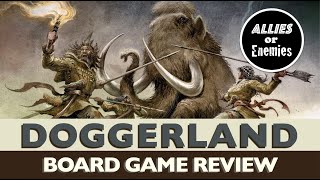
Doggerland was a landmass that connected Great Britain to mainland Europe that disappeared under the North Sea after the last ice age. Humans lived on these fertile lands where multiple resources and animals were found.
In Doggerland, you play a clan at around 15,000 BCE. Your goal is to expand your clan in order to leave a trace of its existence for centuries to come. Players increase their population, make crafts, paint murals in caves, raise megaliths for the gods, and (most of all) survive the rigors of the seasons. To do this, they explore the surrounding territory and adapt to the resources at their disposal. The territory differs in each game, thanks to modular tiles.
Each round, players program their actions, then carry them out. These actions vary, based on available resources, abundance or scarcity around their villages, and also based on the actions of other players. As time passes, resources run out, and clans must migrate to find what they need for their development and survival.
In each clan, there is a leader who brings bonuses, and a shaman who allows powerful and unique actions thanks to knowledge and magic. After 6-8 seasons, the clan with the most points wins.

Doggerland Board Game Review

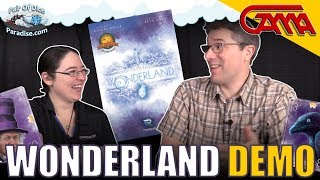
Wonderland Card Game - Overview & Demo
Images



- fascinating historical concept; enjoys the idea of programming actions
- programming actions; island history concept
- prehistoric Europe; Megalithic era
Mechanics (from transcript analysis)
- action-programming — program actions ahead of time and execute them; thematic east-to-west exploration
Video topics + discussion points
Quotes (from this video)
- I'm incredibly biased and I'm not going to sit here and tell you to back the Kickstarter campaign for this one
- I wrote the rulebooks for all these four games
- distilled two-hour 18nxx experience
- I judge games by their cover; Katamino Tower looks cool
- Clover really surprised me with how much I've enjoyed it
References (from this video)
- Looks gorgeous
Mechanics (from transcript analysis)
Video topics + discussion points
Quotes (from this video)
- Pantera that was Prototype so I'm able to be bought just taken or whatever a peaceful garden obviously the one that I showed and here is the um the wind farms in Argentina correct correct well not volcano I'd like to probably sorry if I was in Uruguay yes so for on a volcano we just feel like a Harding's game I like to try it still
- nucleum this is also a prototype that I saw this is coming David Torchy's next one yes yes by um by ball and dice so this is one that the same day is actually nuclear but they make it in the alternative world because otherwise you'll probably too controversial for nuclear
- and then the um Star Trek Discovery black alert team assistant yeah that'll be the first Star Trek game in the in the new discovery Universe yep I'll just be um Spore driving all over the place
- and then there's a game called armelo now this there is a video game called amelo and they're making the board game so it'll be exciting I don't know if you play have you played our Melo I haven't actually played I'm a lawyer yet myself have you okay it seems like a good like artwork as well it wasn't on Sega Mega Drive I probably haven't played it
- it seems like a good like artwork as well
References (from this video)
- Super thematic
- Tons of different stuff to do
- Post-Ice Age human settlement, hunting, building
- Doggerland (land bridge between UK and Europe before it was submerged)
Mechanics (from transcript analysis)
- area influence — Implied by hunting and survival.
- Resource Management — Implied by hunting and building.
- Worker Placement — Implied by building huts and performing actions.
Video topics + discussion points
Quotes (from this video)
- ukge which is the UK's biggest board game convention and it takes place from May 31st to June 2nd and it is in Birmingham
- this is just based on the descriptions that we've read about
- Yonder and this is published by Sinister fish with the same designer who did Moon streets and villagers and we really like all three of those
- it's very different than the the trilogy that I just did
- the art looks very Whimsical because the designer also does the art as well and I really like his style
- Terminus and this is published by inside up games and these are in terminous you are competing Subway companies so you are I think building Subway routes and competing with each other to build Subway Roots
- we just like really like the underground and so anything that has that I am immediately interested
- Deep regrets and I actually did get to play a an earlier play test like prototype version of this game and it kind of mixes um cthulu and fishing together like and that what an interesting mix that is
- Shout out to an indie designer who's based right here in Edinburgh and so you always want to support those
- if there's one in particular you're looking forward to please do let us know in the comments
- on Saturday from 1:30 to 4:30 I will be play testing last week of summer in the Play Test Zone
- if you can't make it for that and you just see me around and you want to do a play Test please do ask because I will be more than happy to do that
- please let us know in the comments what new game you're most looking forward to
References (from this video)

- Good component quality with dual-layered player boards and chunky wooden tokens.
- The programming aspect is mentally taxing and engaging.
- The game name is amusing.
- The game play moves at a glacial pace.
- Food is scarce, hindering meaningful actions and creating a constant struggle.
- There are not many useful actions, with many revolving around collecting items for other actions.
- The game feels repetitive.
- The game is a 'sloppy mess' compared to Stone Age.
- Survival and development of a tribe
- Prehistoric era
- Stone Age
Mechanics (from transcript analysis)
- action selection — Choosing from a variety of actions such as constructing habitats, creating handicrafts, reproducing, gathering resources, hunting, painting, improving abilities, and using village shaman abilities.
- area control/influence — Animals migrate to different tiles, and players interact with these tiles and animals.
- Programming — Players program actions in advance, needing to think ahead to execute them successfully.
- Resource Management — Managing collected resources for various actions like crafting, building, and feeding the tribe.
- Set Collection — Collecting various resources like wood, stone, fruit, shells, and small game.
- Worker Placement — Placing workers on specific spots to perform actions.
Video topics + discussion points
Quotes (from this video)
- doggerland was a real SLO for us it takes the simplistic principles of the excellent ball game Stone Ag and adds a generous helping of [__] to the soup making it largely inedible
- the programming aspect is a real brain berer
- the game play moves at a glacial Pace
- food is scarce to the point where literally there's [__] all around here and it prevents you from taking meaningful actions
- there's not really that many useful actions to take a lot the actions are just culmination of collecting stuff
- this game gave me the thousand yard stair in its final act that is not good for anybody
References (from this video)
Mechanics (from transcript analysis)
Video topics + discussion points
Quotes (from this video)
- spoiler alert is the worst Legacy game I've ever played
- it's a fun trick taking game I'm looking forward to play like all the chapters
- it was a complete bust for me at least
- it just fell flat
- it wasn't exciting at all
- it's lighter than I remembered
- it's a medium game
- it's like you are there's a city and it's in a crisis and there's like Point SCS basically
- it's like a semic coop thing because everyone can end up losing but it's a very fun game
- it is a a great game I really really like it I was very happy to be able to play it again
- it's such an amazing game
- I just love age of innovation
- it's my number one as well it's a fantastic game for all the reasons you said
- playing heyo because it's really fun
- everybody's just like vibing
- it's it's just like silly fun
References (from this video)

- Wonderfully laid-out zen
- Lots of tables
- Robust system suitable as a single book solution
- Good variety for a traditional fantasy RPG feel
- Translates well to solo play
- Does not include rules for solo play
- Creator seems inactive, no updates seen
- Hoped for a second edition with custom solo rules
- Nave
- Into the Odd
- Kairen
Mechanics (from transcript analysis)
- Generative Tables — The zen contains loved tables, contributing to its robust system.
- Traditional Fantasy RPG — Aims to provide a more traditional fantasy RPG experience with sufficient variety.
Video topics + discussion points
Quotes (from this video)
- So, uh, back in the day when I was first getting into smaller indie RPGs, there seemed to be three games, kind of the three pillars of the whole kind of uh, new school renaissance.
- These simple games had uh rules that were mostly player focused where the players rolled all of the dice.
- These three games kind of reset the reset the table for tabletop RPGs
- This is the glowup that inspired this episode because I recently purchased the complete second edition box set.
- I believe that this contains kind of all of those elements from the Zen in a single hardback collected volume.
- And man, if you want a great second edition, definitely check out Karen the complete second edition.
- But uh just one of my favorite things about this hobby is spending time with these games of getting to know them. Uh seeing them grow in popularity and seeing these new additions that come out and just add to it while still keeping things simple but just giving more variety.
References (from this video)
- Exclusive for tabletop retailers
- Quick to play
- Neat little twists and wrinkles
- One of my favorite designs
- Alice in Wonderland
Mechanics (from transcript analysis)
- area influence — Players try to gain influence for cards in the grid based on adjacent card effects.
- card effects — Cards have effects like 'poison' (zeroing out influence) and 'cake' (multiplying influence).
- Card placement — Players place cards face down to form a 3x3 grid.
- Set Collection — Players aim to gain influence over cards, effectively collecting points based on card majorities.
- Variable player powers — Players take on roles like the Evil Queen, which dictates turn order.
Video topics + discussion points
Quotes (from this video)
- hey everyone and welcome back to paradise paradises coverage of the Gama trade show for 2018
- it's only going to be available at this one time
- so Wonderland I'm gonna get a little box we have a box bag on here Wonderland tabletop they exclusive
- go and soul at retailers for the exclusive not through the website or anything LM sites
- like I said this wasn't supposed to be a review but I won't apply it more
References (from this video)
- Beautiful, Earth-tone artwork and wooden figures
- Double-layer board with clear organization
- Strong iconography and accessible rules
- High variability via map tiles and goal tiles
- Engaging theme of prehistoric livelihood and progression
- Good pacing once players understand the system
- Solid solo mode
- Stone hinges are fragile
- Occasional memory burden to place gray circles
- Resource trays can slide too easily
- Tight resource economy can cause AP in some rounds or complexity
- Not beginner-friendly as first or second game
- Resource management, village building, hunting, and progression
- Prehistoric Europe (Doggerland era, when England and France were connected)
- Archaeological/historical flavor with progression through seasons
Mechanics (from transcript analysis)
- action programming — Players assign their tribe members to tasks each round and execute them in a sequence.
- Compound Scoring — Points come from habitats, handicrafts, frescoes, and completed goals.
- double-layer boards with cutouts — Clear spaces and cutouts for tents, foods, and powers to reduce clutter.
- Resource Management — Gather and manage resources (food, materials) to feed and develop your village.
- scoring by multiple categories — Points come from habitats, handicrafts, frescoes, and completed goals.
- Simultaneous Actions — All players carry out actions in parallel after planning.
- solo mode — A solo variant uses a deck of cards to generate goals for eight rounds.
- tile-based map with randomization — Game map is composed of random tiles, changing each game.
Video topics + discussion points
Quotes (from this video)
- Doggerland is definitely one to check out
- Earth Tones darker land is prettier than we expected
- the theme very much comes through here
References (from this video)
- Tight, thematic feel with accessible, quick rounds
- Low downtime and high player engagement
- Strategic planning with satisfying resource chains
- Cave life, hunting, huts, trinkets
- Paleolithic North Sea region (Doggerland) bridging UK and continental Europe
- thematic
- Other tight worker-placement euros
Mechanics (from transcript analysis)
- low downtime with simultaneous progress — Actions can occur in parallel with turn-based programming
- Resource Management — Resources must be ordered for seasonal needs (winter furs, mammoth hunts, etc.)
- resource planning and timing — Resources must be ordered for seasonal needs (winter furs, mammoth hunts, etc.)
- Simultaneous Actions — Actions can occur in parallel with turn-based programming
- tight worker placement — Finite actions per round with strong planning and sequencing
- Worker Placement — Finite actions per round with strong planning and sequencing
Video topics + discussion points
Quotes (from this video)
- "it's about windmills"
- "the closest I've seen to Mario Kart as a board game"
- "it's a very tight worker placement game"
- "the biggest surprise of the year"
- "this is my favorite game of the year so far"
References (from this video)
- fun, thematic exploration
- engaging for the stretch of play
- some luck elements
- could be less exciting on repeat plays
- resource gathering, upgrading, and exploration
- prehistory/hunting and art-creation cave life
- adventure/ exploration with evolving board state
Mechanics (from transcript analysis)
- foraging and upgrades — forage actions provide wood or other resources; upgrades improve carrying or capacity
- Resource Management — manage collected resources and upgrade capabilities
- Worker Placement — place workers on actions with varied bonuses and special workers
Video topics + discussion points
Quotes (from this video)
- It's a very fun little game.
- We are going to keep it.
- This is a roll and write game. It was fine enough.
- I thought this was a fun resource management game.
- The core concept are very good. I do not recommend playing this game.
- It's so easy to teach. People understand it even though they haven't played a lot of games.
References (from this video)
- Fascinating historical concept
- Solid weight for heavy Euro players
- Very heavy teach; not ideal for quick sessions
- Hunter-gatherer/stone age survival and growth
- Fabled prehistoric Europe before rising seas
Mechanics (from transcript analysis)
- worker placement / resource gathering — Send hunters to gather food, grow your tribe, and manage a large teach with a heavy gaze on setup
Video topics + discussion points
Quotes (from this video)
- This is the final version right here with the final art and the final components
- Jessica honestly spent a ludicrous amount of time making this game a reality
- I designed it and she actually made this a game that you can hold in your hands
- I am so proud of this game
- It's surreal to see it here at the end
- I'm Overjoyed to see people playing it as well
- Spring cleaning oriented but there are obvious reasons
- I will cherish forever