/pic6102105.png)




















Doodle Dash Deep Dive
What the Community Thinks About Doodle Dash
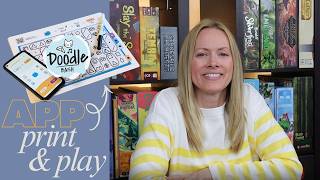
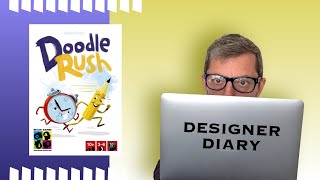
Doodle Dash is described by reviewers as immediately accessible and hilariously unpredictable. Published by Chilifox Games in 2021 for 3 to 8 players in roughly 20 minutes, the community tends to recommend it for larger groups, mixed ages, and gatherings where you need something that gets everyone laughing fast. Paula Deming, who features it in her family gathering recommendations, points to the speed element as the thing that makes it feel distinct. The "dash" in the title is not decorative. It changes everything about how drawing games feel at the table.
Reviewers who went in skeptical came away surprised. Before You Play demoed it at PAX Unplugged expecting to be hesitant about yet another drawing game and found themselves having a genuinely good time even when their drawings were terrible. That combination of stress and laughter seems to be what Doodle Dash is engineered to produce.
Core Mechanics That Define Doodle Dash
The Race to Draw First
The central tension in Doodle Dash is not whether you can draw well. It is whether you can draw well enough, and fast enough to matter. Everyone draws simultaneously, racing toward a single cylinder sitting in the middle of the table. Whoever finishes first grabs that cylinder and earns the right to show their drawing to the guesser before anyone else. Whoever finishes second grabs a die and starts rolling it. The moment that die lands on a stop symbol, all remaining drawers must put down their markers.
This creates a layered, progressive scoring structure. If the guesser identifies the image from the first drawing alone, only that first drawer and the guesser score. If not, the second drawer reveals their work for another chance. Only if the guesser still cannot identify the word do all remaining drawings get revealed together, at which point everyone in that slower group can score. As Ryan and Bethany Board Game Reviews explain, this structure creates a genuine strategic tension: you want to be first for the exclusive early guess, but a messy drawing means you have helped everyone else succeed while you score nothing.
The Word Card and Guesser Mechanic
Each round begins with the guesser closing their eyes while everyone else sees the card. The guesser calls out a number, which determines the word everyone must draw. Bethany from Ryan and Bethany Board Game Reviews notes that the cards do all the work: no one has to invent a word, and the numbered format means the guesser has no idea what is being drawn until drawings are revealed. The cards also include asterisks on harder words, providing a built-in accessibility filter for younger players.
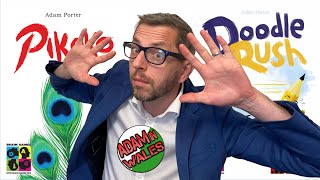
Adam Porter, the game's designer, traces the concept back to Happy Salmon. He wanted to capture that game's simultaneous, chaotic energy but apply it to drawing. The result is a game where no one is ever sitting idle and the action unfolds entirely in parallel until the moment of reveal.
The Doodle Dash Experience
Controlled Chaos at the Table
The atmosphere Doodle Dash generates is consistently described as chaotic and comedic. The die rolling mechanic adds an unpredictable time pressure: some rounds end almost immediately, cutting off drawings mid-stroke. Other rounds the die refuses to land on stop, giving everyone extra time to refine their sketches. Bethany from Ryan and Bethany Board Game Reviews notes the comedy in this: the second-place drawer can hear the countdown happening and knows exactly how much time they are or are not giving the other drawers. It becomes a small drama in itself.
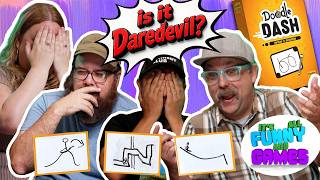
The It's All Funny and Games session with professional comedians captures this texture well. One participant drew something she was certain was a lawnmower and it was immediately recognized. Another drew what he believed was a sumo wrestler, and the guesser somehow got it from what everyone else agreed looked like a petri dish full of turtles. These mismatches between intention and execution, between the image in your head and the scribble on the board, are the core entertainment.
Speed Versus Clarity: The Central Dilemma
Every reviewer touches on the same core tension: the game rewards speed, but speed kills legibility. Paula Deming captures this perfectly when she describes finishing a drawing, grabbing the cylinder with confidence, and then looking back at what she has drawn and realizing it is "absolute nonsense." That moment of self-reckoning, visible to everyone at the table, is consistently cited as one of the funniest parts of playing Doodle Dash.
Bethany offers a counterpoint. In one game, she quickly drew a baseball bat when the word was simply "bat," while everyone else was taking their time drawing the animal. Her fast, simpler interpretation won the round. The game consistently rewards creative, economical thinking over elaborate illustration, and Before You Play noted that being a bad drawer is not a barrier to having fun.
What Makes Doodle Dash Stand Out
Designed for Larger Groups
A recurring point across reviews is how well Doodle Dash handles larger player counts. Paula Deming recommends it for family gatherings of six or more, and Before You Play suggests around six as the sweet spot. Because everyone draws simultaneously, adding more players does not slow anything down. It simply adds more drawings to the reveal and more moments of collective comedy.
Because everyone's drawings tend to be rushed and imperfect, the playing field levels out fast. Paula Deming points out that her drawings look like kid drawings anyway, which is exactly the right energy. The lack of shame around bad art is part of what makes Doodle Dash work across age ranges and player types.
The Twist on a Familiar Format
What reviewers highlight about Doodle Dash specifically is what the race mechanic does to the familiar Pictionary structure. Instead of one person drawing while everyone guesses, everyone draws and only one person guesses. Instead of unlimited time, the clock is a die that the second-place player is actively rolling. That rolling player becomes a live antagonist at the table without any direct conflict in the design.
Adam Porter traces the game back to Happy Salmon: simultaneous play, chaotic energy, all over in minutes, but applied to drawing. Brain Games improved the original prototype by splitting the single drawing board into six individual boards, letting all drawings be laid out on the table at once rather than passed around. That change made scoring cleaner and reveals more dramatic.
Potential Drawbacks
The Drawing Anxiety Factor
Not every reviewer finds the speed pressure purely fun. The It's All Funny and Games session captures something real when one comedian describes knowing exactly what he wants to draw and then watching his hand produce something completely unrelated. That gap between mental image and physical execution, under time pressure with everyone watching, produces stress that some players find energizing and others find draining. The same comedian who ended the session calling it a great time also admitted he was miserable for most of it.
For players who feel self-conscious about their skills, the repeated public reveal of bad drawings can feel like a gauntlet. The game does not punish bad drawing mechanically, but it does put bad drawings on display for everyone to comment on. Groups comfortable with self-deprecating humor will find this hilarious. More sensitive groups might need a warm-up to the format.
Component and Production Notes
Bethany from Ryan and Bethany Board Game Reviews raises one minor component concern: the drawing boards lack a recessed surface. When rested on the ground, there is a risk of smudging the drawing before reveal. She compares this to Blank Slate's recessed design and suggests it may have been a cost consideration. In practice this does not ruin the experience, but it is worth knowing about for groups playing on the floor.
The die mechanic also introduces variance. If the stop symbol appears immediately, the round ends before slower drawers can recover. If it takes long to appear, everyone gets extra time to refine their work. This randomness is part of the charm for most players, but it means some rounds feel very different from others.
If You Enjoy Doodle Dash
If Doodle Dash hits the right notes for your group, reviewers suggest several related games. Happy Salmon is the direct inspiration and suits groups who love the frantic everyone-at-once style. Just One offers a cooperative angle on word interpretation at a calmer pace. Ice Cool delivers real-time competitive energy through a physical activity rather than drawing. Blank Slate suits groups who want word-based party play without the drawing component. Genius Square and Quizzle offer puzzle and word-building alternatives for gatherings that want slightly more structure.
Doodle Dash distinguishes itself from other quick party drawing games through its race structure and simultaneous play. The 20-minute runtime makes it easy to play twice in a row or use as an opener before heavier games.
What Reviewers Are Saying
"I think it is so funny when you draw something and then you realize: I thought this was great and it's nonsense. It's absolute nonsense. And I really like what that speed element adds to this game. And that's why I really recommend it for a family gathering like this. Kids and adults can all play this. I mean, my drawings look like kid drawings. So even playing field there."
— Paula Deming
"Drawing games, there are a lot of drawing games out there. Normally in drawing games I get a little flustered because I'm a really bad drawer. And for this one I had a good time with it though. I rarely ever was the first one to grab because I'm so bad that I have to make this look like something. But yeah, it's a really, really fun game. If you have a nice group of about six people, I think that's perfect."
— Before You Play
"I had a great time playing Doodle Dash. It was a wonderful time with wonderful friends. But I was horrific at it and it provided me a level of anxiety I never want to feel again. Doodle Dash: a lot of excitement. It's quick. It's nerve-wracking. Nobody's drawing good. I'm surprised anybody gets any of this stuff."
— It's All Funny and Games