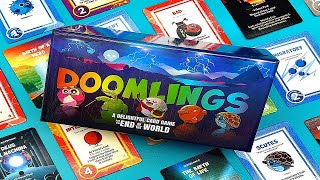

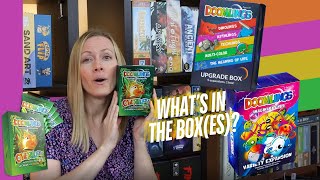






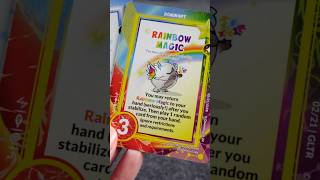

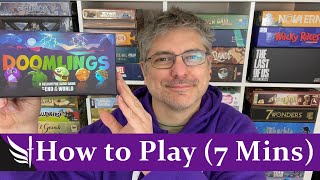







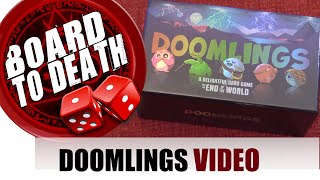
Somewhere on a doomed and distant planet, life has emerged, competing for supremacy until the world’s inevitable destruction. The object of the game is to score the most points by the time the world ends. Score points by playing Traits for your Doomlings’ species, making them more adaptable, resilient, and mischievous. As your Doomlings assert their dominance, Catastrophes will befall the planet, causing setbacks for each competing species. When the third Catastrophe inevitably strikes, the world ends, and the Doomlings with the strongest set of traits gets to look the Apocalypse in the eye and declare…“I scored the most points!”
Throughout the game, players draw Trait cards from a community pile, and then play them for points. Traits can also have special abilities and bonuses, allowing players to build a wide range of winning combinations. The game is played in rounds, using Age cards, which have different rules that players must follow. But be warned, hidden in the Ages are Catastrophes: special rounds with adverse effects that force players to adapt their strategy.
Doomlings adds a fun twist to hand management, by introducing the “Gene Pool” mechanic. Your Gene Pool is your hand size: it is unique to you, and it can increase or decrease through special Traits, or even Catastrophes. Doomlings includes 6 colorful Gene Pool counter cards, elegantly tracking how many cards you should hold at the end of your turn. There are opportunities to increase your Gene Pool (hand size), which can give your species a leg up by providing a larger pool of Traits to select from each turn.
A lightweight card game for 2-6 players, Doomlings can be played casually amongst friends, or competitively by the gaming enthusiast family. Because there are no duplicate cards, and Age cards are chosen randomly, no two games are ever the same. While the game itself can be learned in 5 minutes or less, don’t be fooled: with 100+ unique Traits—in Red, Blue, Green, Purple and Colorless—and rare, powerful Dominant Traits, there are countless combinations of play to be discovered.
A typical game takes between 20-45 minutes, depending on the number of players and sequence of events. Advanced-play expansion packs are also available, including a Hidden Objective expansion for a fun twist to the game. Doomlings requires no dice or additional pieces, just a jolly embrace of the inevitable end of the world!
—description from the designer
Doomlings in under 3 minutes
Doomlings Solo | Let’s Break Some Rules
- Lively and accessible for families
- Rich card interactions and strategies
- Some luck involved in draws
- Management can be fiddly with different decks
- Array
- Array
- End-of-world survival and trait-driven scoring; social interplay and light conflict
- Array
- An apocalyptic world where Doomlings survive and adapt through evolving traits.
- Array
- Array
- Array
- positive
Mechanics (from transcript analysis)
- catastrophes and end-game trigger — Catastrophe cards trigger global effects and end-game scoring.
- Dominant traits — Some cards grant extra power and have a limit of two per trait pile.
- hand management — Players draw and play cards to build a trait pile and manage hand size.
- set collection / scoring — Cards have point values and various synergy effects that boost scores.
Video topics + discussion points
Quotes (from this video)
- The kids loved playing this game and wanted to keep playing it over and over again.
- it's a goofy game, but it's not a game that doesn't lack strategy to win as well.
References (from this video)
- Quick to teach and accessible for families and new players
- High variability due to different age cards each game, which encourages replayability
- Vibrant, colorful components that are appealing to kids and casual players
- Box design supports many expansions, helping the game to grow over time
- Playtime can feel long with larger player counts or younger players
- Take-that interactions might be disliked by some players or families seeking lighter competition
- Endgame tracking and interplay between cards can be a bit complex for very young players
- Genetics and evolution packaged as a fast-paced card game where players curate traits to score points while managing threats and catastrophes. The theme is approachable and family-friendly, balancing whimsy with light strategy.
- A bright, colorful evolutionary world that traces life from its birth through a sequence of ages toward an eventual end-of-world event. The game presents a playful, fictional biosphere where traits influence outcomes and players navigate endgame scoring through evolving life forms.
- Playful, educational storytelling with a visual emphasis on color and life stages; narration is incidental through card text and on-board instructions, not a fixed story arc.
Mechanics (from transcript analysis)
- age_card_deck_drafting — The game uses a deck of age cards representing different life stages. In a typical round you draw and utilize nine age cards from a larger pool, providing variability from game to game and ensuring different trajectories each play.
- card drafting — The game uses a deck of age cards representing different life stages. In a typical round you draw and utilize nine age cards from a larger pool, providing variability from game to game and ensuring different trajectories each play.
- catastrophe_mechanic — There are catastrophe cards that are placed initially and revealed as the game progresses. The key tension mechanic is that the third catastrophe revealed ends the game, establishing a hidden-endgame trigger without a fixed round count.
- end game bonuses — Endgame scoring is based on the text on cards and special bonuses. Players tally points from their visible cards and any scoring bonuses revealed, which motivates careful long-term planning.
- end_game_scoring_and_traits — Endgame scoring is based on the text on cards and special bonuses. Players tally points from their visible cards and any scoring bonuses revealed, which motivates careful long-term planning.
- hand management — Each player has a hand limit (genepool) that affects how many cards they can hold. The game emphasizes managing this limit, as it increases or decreases with certain effects, and players stabilize at end of turn to restore or adjust their limit.
- hand_limit_and_gene_pool — Each player has a hand limit (genepool) that affects how many cards they can hold. The game emphasizes managing this limit, as it increases or decreases with certain effects, and players stabilize at end of turn to restore or adjust their limit.
- Tags — Card text and trait icons are color-coded; there are several colored trait cards plus a gray colorless category. This color system influences how cards interact with scoring or immediate effects during play.
- take that — Certain cards enable direct interactions like stealing from opponents or trading visible traits. These mechanics add a social dynamic that can shift the lead and create tension in family-friendly groups.
- take_that_and_interactions — Certain cards enable direct interactions like stealing from opponents or trading visible traits. These mechanics add a social dynamic that can shift the lead and create tension in family-friendly groups.
- traits_colors_and_gray — Card text and trait icons are color-coded; there are several colored trait cards plus a gray colorless category. This color system influences how cards interact with scoring or immediate effects during play.
Video topics + discussion points
Quotes (from this video)
- I like this game because it is quick to teach
- it's really straightforward
- this is a fun and silly game
- I would love to know have you played Doomlings what do you think about it
- there's dividers in there so these cards are not just rocking all around in there
- this box can grow with you
- I think there should be six in the game
References (from this video)
- humorous quotes on the cards
- quick, light-hearted play
- accessible for a party-style game
- humor may not appeal to everyone
- set-collection can feel repetitive over time
- doomsday optimism with humorous doom cards
- apocalyptic, tongue-in-cheek doom-ling world
- lighthearted, quirky, cartoonish end-of-world theme
- Exploding Kittens
Mechanics (from transcript analysis)
- card drafting — draft doomling cards and event cards to influence the score.
- hand management — manage hand to trigger optimal doom-card effects.
- set collection — collect doom tokens/cards to maximize scoring combos.
- take that — cards create chaotic, humorous interactions during play.
- take-that/chaos elements — cards create chaotic, humorous interactions during play.
Video topics + discussion points
Quotes (from this video)
- UKGE is the biggest board game convention in the United Kingdom.
- there is space upon space upon space it does get busy you might find that you haven't always the space for open gaming.
- there's always somewhere to go, there's loads of space.
- there will be a play testing area for people bringing games to market in the future.
References (from this video)
- Extremely high variety due to expansions and interchangeable components, which keeps gameplay fresh and customizable
- Treasure deck mechanic adds a new layer of strategic depth without altering the core base-game rhythm
- Clear player aids and references improve accessibility and reduce rule lookup time
- Mystery packs offer excitement, collectibility, and guaranteed holo foils, enhancing the collectible aspect
- Flexible integration: expansions can be added to the base game or kept separate, allowing tailored setups
- Collectible-style progression via trait cards, evolving through ages with reward-driven decisions; treasure mechanics introduce optional power boosts that alter strategy from round to round.
- A whimsical, cartoonish universe centered on tiny creatures called Doomlings, where traits, ages, and catastrophes drive the game’s evolving card interactions. The setting supports a playful, lighthearted tone while enabling a surprisingly rich and modular gameplay loop.
- Trait-driven, modular narrative that players assemble through deck-building-like choices. The game invites improvisation and replayability as new traits and ages continually reshape potential outcomes.
Mechanics (from transcript analysis)
- ages and catastrophes — Game progression occurs through defined ages, with catastrophic events injecting tension and forcing players to adapt their plans in response to evolving threats.
- Deck building — Treasures provide unique abilities and form a secondary deck. Players start with a treasure and acquire more as ages progress, creating a dynamic toolkit that shifts strategic options across ages.
- Holof foil cards — Holof foil cards provide collectible appeal and visual variety, often signifying rarer or standout cards within the Doomlings ecosystem.
- Multi-use cards — Holof foil cards provide collectible appeal and visual variety, often signifying rarer or standout cards within the Doomlings ecosystem.
- Mystery packs (expansion content) — Mystery packs introduce randomized trait cards and new ages, expanding replayability and offering additional collecting opportunities with guaranteed holo foils.
- Player aids / reference cards — Each player receives a reference card to assist with rules and quick decisions during play, reducing downtime and supporting accessibility for new players.
- Tags — Trait cards (including dino lings and other evolving creature types) drive interactions, synergies, and strategic combinations, enabling varied playstyles as traits attach or interact in different ways.
- Trait cards / myings — Trait cards (including dino lings and other evolving creature types) drive interactions, synergies, and strategic combinations, enabling varied playstyles as traits attach or interact in different ways.
- Treasure deck formation — Treasures provide unique abilities and form a secondary deck. Players start with a treasure and acquire more as ages progress, creating a dynamic toolkit that shifts strategic options across ages.
Video topics + discussion points
Quotes (from this video)
- there is a ton of different types of expansions in here.
- you cannot get bored with this game because there's always something to add.
- the holof foil... those are the best cards in the game.
- it's four mystery packs, and you are guaranteed to get in each pack seven common, five unusual, and then you will either get two scarce or endangered or legendary.
- nothing more fun than a mystery pack.
References (from this video)
- Clear procedural flow and rule presentation in the video
- Concise setup steps with concrete examples
- Thematic and accessible presentation suitable for new players
- Sponsorship/ad disclosure may affect perceived impartiality
- Some rule nuances may be easier to grasp with visuals beyond the transcript
- Evolution, survival, and catastrophic stakes with a light, humorous aesthetic.
- A post-apocalyptic scenario where players influence the world by evolving doomlings through trait cards across multiple ages, ending in a world-ending catastrophe.
- Competitive tableau-building with evolving traits and world-ending consequences.
Mechanics (from transcript analysis)
- Action cards (A symbol) — Some trait cards have A symbols that activate only when played from hand.
- Age cards and round flow — Ages determine per-round effects; a new age pile is created and catastrophes are allocated.
- Catastrophe and world end — Catastrophe cards trigger events; after the sequence ends, the world ends and scoring occurs.
- Color stacking — Stack traits of the same color to simplify information and enhance synergy.
- Discard-pile interactions and counters — Card abilities allow interaction with the discard pile, stealing or cancelling actions.
- Dominant traits — Gold-bordered traits that are limited to two in a trait pile and cannot be swapped or removed.
- gene pool management — Gene pool can be increased or decreased; tracked per turn with a range (min 1, max 8).
- Ongoing effects — Certain traits exhibit effects that persist while the card remains in the trait pile.
- Stabilize phase — At the end of a turn, players balance their hand size with their gene pool by drawing or discarding.
- Trait card play — Play one trait card from hand into your trait pile; colors and stacking drive strategy.
- Turn order dynamics — Turn order shifts with catastrophes, influencing who acts first in each round.
- World's End scoring — Final scoring uses world's end effects; trait values and special icons affect points; tie-breakers use pile manipulation.
Video topics + discussion points
Quotes (from this video)
- An apocalypse is coming.
- The player whose doomlings are worth the most at the end of the world will be the winner.
- This copy of Doomlings was very generously provided by Doomlings LLC, so thank you to them for that.
References (from this video)
- Flexible, rules-light foundation that accommodates house rules and solo variants.
- Cute, thematic artwork and humorous tone with light strategy
- Clear end-game mechanism via catastrophes and ages.
- Tracking gene pool and end-game scoring can be fiddly without pen and paper.
- Chaotic interactions and many effects may be overwhelming for new players.
- Some rules interactions require careful attention to avoid mis-scoring.
- endurance, catastrophe, evolution with a humorous tone
- Through the ages toward the end of the world, featuring cute doomling creatures
- light, abstract, humorous
Mechanics (from transcript analysis)
- ages and catastrophes — Each age introduces an age card; catastrophes push the game toward end; three catastrophes end game.
- end game bonuses — Points come from trait cards; end-game scoring includes color counts and penalties like blue trait penalties.
- end-game scoring with modifiers — Points come from trait cards; end-game scoring includes color counts and penalties like blue trait penalties.
- gene pool and stabilize — Start with a gene pool of five; stabilize to draw up to that many; gene pool can increase or decrease based on effects.
- hand management — On your turn, you play a trait card that stays in your play area, shaping your trait pile.
- hand management / trait drafting — On your turn, you play a trait card that stays in your play area, shaping your trait pile.
- interaction / trait pile manipulation — Players can swap, steal, discard, or impact opponents' trait piles via card effects.
Video topics + discussion points
Quotes (from this video)
- Welcome to an adorable card game for the end of the world.
- Thank you for cheating and having fun with me.
- We are breaking all kinds of rules here to try to at least finish the game with a difference of 10 so that I can cheat more on my next game.
- This is an adorable card game for the end of the world.
References (from this video)
- accessible for new players
- fun theme and art
- randomness can influence outcomes
- can be chaotic in larger groups
- cute, lighthearted doomsday humor
- a whimsical, pastel post-apocalyptic world
- playful satire
Mechanics (from transcript analysis)
- deck-building — Players curate a hand of cards to score points and trigger effects.
- Drafting / hand management — Players select and optimize cards to maximize doom-related scoring.
Video topics + discussion points
Quotes (from this video)
- it's a boat we created this event just to get people together
- the schedule is in flux
- please join us even if you can only join us for like 15 minutes
- if you share pictures and we highly encourage you to
References (from this video)
- Adorable Doomlings and charming art
- Accessible and quick to learn
- Good for casual play and families or teens
- Broad player count support (2-6)
- Not a deeply strategic game
- Clear influence from Exploding Kittens
- Narrow depth for longer play sessions
- Some players may outgrow it quickly
- Lighthearted evolution and survival; scoring through card sets and revealed catastrophes.
- A whimsical, cartoonish future where cute crisis-evolving critters (Doomlings) progress through eras while managing catastrophes.
- Playful, irreverent, accessible
- Exploding Kittens
Mechanics (from transcript analysis)
- card drafting/hand management — On each turn you play one card from your hand in front of you; hand size is constrained by the gene poll value and era effects.
- Dominant traits — Players can have up to two dominant trait cards, which grant powerful, but limited, ongoing effects.
- Endgame scoring — Points come from card values surviving on your Doomling critter at the end of the game.
- Era and catastrophe cycle — The game progresses through eras; catastrophes are drawn between eras and the third catastrophe ends the game.
- Gene poll and hand limit — A gene poll value sets the current hand limit; updating it changes how many cards you can hold.
- set collection — Score is driven by collecting and completing color-coded sets of cards and point-valuing cards.
Video topics + discussion points
Quotes (from this video)
- it's not a great game? no it's not
- it's a fun game, it's a silly game and it's a game I can play with practically anyone who doesn't take themselves too seriously
- the best thing about this game are the Doomlings themselves they're just adorable
- it may be incredibly influenced by exploding kittens but there's actually a better game here
- it's not that bad but I'd probably save it for playing with kids or teenagers
- it's light it's silly it's fun
References (from this video)
- quick, casual play
- diverting for casual sessions
- not likely to be a staple for heavier gamers
- lighthearted doom/good-versus-evil vibes
- mass-market card game universe
- humorous and chaotic
Mechanics (from transcript analysis)
- mass-market style card play — easy-to-learn card interactions with points and take-that elements
Video topics + discussion points
Quotes (from this video)
- newest release from fil that isn't a reprint
- it's a racing style game
- spoiler I did really like this one
- this one intrigued me
- the art style in this game is absolutely gorgeous
- Sandbox prison brawler for up to eight players
- complete reworking of Rum and Pirat
- wind tiles will direct your ships
References (from this video)
- Short, quick plays that fit into a long session
- Accessible and fun for a group in the mix
- Still a lighter game; may not satisfy heavier gamers
Mechanics (from transcript analysis)
- Card drafting / set collection — Players draw and manage a hand of cards to fulfill victory conditions.
Video topics + discussion points
Quotes (from this video)
- we had around 10,000 live views so people kind of dropping in and dropping out
- 1,282 challenge entries that's wild
- this is where we started to fall off of our schedule
- I will be staying up the full 24 hours again because it's just the best way to do it
- it's a food day
References (from this video)
- Accessible and breezy
- Lighthearted theme suitable for new players
- Mass market appeal and quick playtime
- May feel light for hobbyists seeking depth
- Humor can be hit-or-miss depending on group
- Satirical, light-hearted catastrophe card game
- End of the world as we know it
- Humorous, accessible with quick turns
Mechanics (from transcript analysis)
- card-drafting/deck-building — play trait cards with color values; build/run a hand
- catastrophe-end condition — three catastrophes trigger the world end and scoring
- gene pool management — hand size vs. gene pool constraints drive decisions
Video topics + discussion points
Quotes (from this video)
- I freaking love this game
- not too long, and the map layout is clear
- this game is not short
- AP inducing
- end of the world as we know it
- genuine gemstone dice
- it's a relatively lightweight game so really welcoming
- a good coffee game
References (from this video)
- Accessible and quick to teach, making it a good gateway game for new hobbyists
- Distinctive, whimsical art that captures the game’s playful tone
- Solid production quality and sleeved cards fit in the box
- Replay value is high, aided by different expansions and variants
- Pleasant components and clear, intuitive iconography that support quick setup
- Positive social experience with light bluffing and strategic decision-making
- Engaging mini-mechanics (A-icon actions, wing actions) that reward attention to what others are doing
- Luck factor can be a tangible influence on outcomes
- As a light game, some players may crave deeper strategic depth
- Primarily a filler/heavy family audience title; may not appeal to heavy strategy gamers
- The thematic bite-size nature can feel repetitive after many plays
- Some players might find the end-of-world modifiers occasionally feel non-intuitive
- Survival, evolution, and the quirky fate of a post-apocalyptic ecosystem; the doom-ling creatures offer lighthearted commentary on humanity’s attempt to endure an ending world.
- On a doomed planet where diverse species struggle to adapt as catastrophes unfold across three distinct eras.
- playful, accessible, and humorous; the game’s story thread is told through card art and patient exposition during setup and turns.
Mechanics (from transcript analysis)
- card drafting — Players draft trait cards from their hand and place them on their own tableau in color-coordinated stacks. The colors must stay grouped on a single stack, and each card contributes point values, potential effects, and sometimes immediate actions. This mechanic rewards long-term planning and careful organization.
- Card drafting and tableau building — Players draft trait cards from their hand and place them on their own tableau in color-coordinated stacks. The colors must stay grouped on a single stack, and each card contributes point values, potential effects, and sometimes immediate actions. This mechanic rewards long-term planning and careful organization.
- End-of-world scoring and bonuses — Final points are tallied from the bottom values on trait cards. There are also modifiers and bonus symbols that affect scoring, encouraging players to consider not only raw points but also timing and synergies.
- Era progression with catastrophes — The game is played in three eras. Each era is started by revealing an age card; catastrophe cards trigger effects that end the current era. Facilitates escalating tension and a predictable end-game sequence, as the third catastrophe ends the game.
- hand management — Each turn you adjust your hand to match your gan pool number. You draw or discard up to that number, which creates a steady drift of available options while keeping hand size manageable and decision-making meaningful.
- Hand management and gan pool — Each turn you adjust your hand to match your gan pool number. You draw or discard up to that number, which creates a steady drift of available options while keeping hand size manageable and decision-making meaningful.
- Mini deck optimization and luck element — The game has a curated small deck system with three piles and a top Birth of Life card. The randomness of which age and catastrophe cards appear introduces luck, which players must manage through planning and adaptability.
- On-turn actions and cross-player interactions — Some trait cards grant actions that trigger on your own turn or on other players’ turns (A-icon triggers and wing-icon actions). This creates interactive play where watching opponents matters for optimizing your own position.
Video topics + discussion points
Quotes (from this video)
- Doomlings is a great little card game that has some strategy and decision-making.
- The art is quirky and fun.
- Easy to teach and play with plenty of replay value.
- The production quality is really good, plus the cards fit in the box when sleeved.
- The only downside would probably be the luck factor.
- Don't forget, you only get to play one or two cards per turn.
References (from this video)
- family-friendly and chaotic fun
- great party game dynamics
- not for players seeking heavy euros
- cute monsters survive doom cards
- humorous post-apocalyptic world
- lighthearted, chaotic fun
- Monopoly
- Sushi Go
Mechanics (from transcript analysis)
- card_drafting — build a hand of doom cards and combos
- set_collection — collect doom cards to maximize points
Video topics + discussion points
Quotes (from this video)
- it's huge this unconscious mind box
- we're going to be at BGg con in Dallas
- pineapple on pizza is delicious
- the shelf of shame... we need an intervention