




















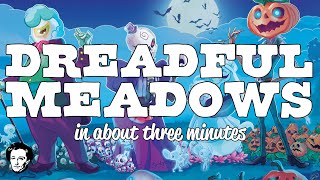

Dreadful Meadows Deep Dive
What the Community Thinks About Dreadful Meadows
Dreadful Meadows has captured the imagination of board gamers as one of the most charming Halloween-themed games available. Reviewers consistently praise the game for being much more strategic than its cute exterior suggests. While the candy-farming theme might appear whimsical at first glance, the game beneath offers meaningful decisions and tight engine-building gameplay that rewards thoughtful planning. The community views this as a standout title that delivers both thematic satisfaction and genuine gameplay depth, making it a natural fit for the spooky season while remaining engaging year-round.
Core Mechanics That Define Dreadful Meadows
Tile Placement and Patch Building
At its heart, Dreadful Meadows is a tile placement game where players construct their candy meadows by purchasing and arranging diamond-shaped patches. Each patch type grows different varieties of magical candy. The constraints of adjacency and the permanent nature of placement decisions create a satisfying puzzle. Reviewers note that building your meadow efficiently requires foresight, as patches cannot be moved once placed. This core mechanic, reminiscent of games like King Domino, feels fresh due to the game's specific resource economy and scoring systems.
Resource Management and Economic Efficiency
The candy economy forms the beating heart of Dreadful Meadows. Candy serves a dual purpose: it functions as currency for purchasing new patches from the market, with each candy type holding a specific monetary value, and it also fulfills concoction cards to score victory points. This creates an elegant tension that reviewers highlight as central to the game's strategy. Players must constantly decide whether to spend candy now to expand their meadow or save it to complete scoring objectives. The balance between these competing priorities, combined with the market's shifting prices based on demand, generates the kind of strategic puzzle that makes the game rewarding to master.
The Dreadful Meadows Experience
Charming Halloween Aesthetic
The game's spooky-but-cozy theme is one of its greatest strengths. Beautiful artwork depicts gummy globs, phantom mellows, pumpkin pops, and trickle teeth in a Halloween setting that evokes childhood nostalgia and the playful spirit of trick-or-treating. The wooden components and enamel pins add tactile charm. Reviewers emphasize that the game succeeds in being genuinely Halloweeny without sacrificing accessibility or fun. The distinct visual design of each patch type and the delightfully themed character names give the game personality that extends far beyond the mechanics. Many reviewers return to this game every Halloween, suggesting it has become a seasonal tradition for fans.
Satisfying Combo and Engine-Building Gameplay
What makes Dreadful Meadows especially engaging is the way its systems interact. Placing sugar sprites generates candy on adjacent patches. Retrieving sprites triggers powerful bonus abilities based on patch types. Harvesters amplify candy production and cascade when placed near other harvesters. Reviewers describe moments of building satisfying combo chains, where carefully planned actions produce multiple cascading effects. The game rewards players who can see several moves ahead and orchestrate their meadow to work together. This engine-building element appeals both to players seeking strategic depth and those who simply enjoy the satisfying feeling of a well-functioning system.
What Makes Dreadful Meadows Stand Out
Strategic Depth Masked by Accessibility
A consistent theme in reviewer commentary is surprise at the game's hidden complexity. The ruleset is genuinely simple, and turns move quickly, but beneath the surface lies a tightly designed puzzle. Reviewers who initially underestimated the game reported changing their view after learning the importance of concoction card fulfillment versus pure farm expansion. The game does not overwhelm new players with complexity, yet experienced players discover layers of optimization. This elegant design appeals to both families and serious gamers, explaining why it appears on multiple best-of-year lists alongside much heavier titles.
Variable Player Powers That Shape Strategy
Each player character brings asymmetric abilities that meaningfully alter approach. Some characters gain sprite bonuses when placing patches, others can place sprites on occupied spaces, and some ignore market costs entirely. Reviewers highlight how these powers create genuine variety between games. A player with Jack's ability to ignore market costs plays fundamentally differently from someone with Luna's power to treat patches as any type when retrieving sprites. This variability means repeated plays offer fresh strategic considerations without requiring expansions or supplementary content.
Potential Drawbacks
Component Concerns
Some reviewers note that the acrylic harvesters in the deluxe version feel out of place aesthetically compared to the charming wooden components elsewhere in the box. The retail version reportedly addresses this with a different material. Additionally, one reviewer mentioned that managing harvesters at lower player counts requires referencing tiny dots on tiles as a guide, a minor but occasionally frustrating detail in an otherwise well-produced game.
The Mathematical Dimension
While the strategy is accessible, the game can devolve into mathematical calculation. Players considering multiple patch purchases and economic scenarios may find themselves doing quick math to determine optimal spending. For some players this adds to the puzzle appeal, but for others seeking a faster, lighter experience, this analytical layer might occasionally slow momentum.
If You Enjoy Dreadful Meadows
Players drawn to Dreadful Meadows often appreciate King Domino for its tile-placement simplicity and cascade scoring, Splendor for its economical resource management without overwhelming rules, and Evergreen for another nature-themed puzzle. Those loving the Halloween theme specifically should explore Photosynthesis for beautiful production and puzzle-solving, while Cascadia offers similar serene, pastoral satisfaction. The game occupies a sweet spot between family accessibility and strategic engagement that resonates with fans of Everdell and similar recent releases.
What Reviewers Are Saying
"Dreadful Meadows looks cute and dinky but underneath the hood is a tight and fast-paced engine building game, and one that plays a little differently than you first might think. Your instinct is to build the biggest farm and make tons of money, but the real points in the game are the concoction cards. Completing those is what will win you the game."
— 3 Minute Board Games
"The best thing about this game is it's not just a cutesy Halloween game, it's a game of actual depth. There's a lot of different things in the game and it's just got such a cool look and such a cool theme and it's just so perfect for this time of year and we play it every single Halloween."
— BoardGameGeek
"I love it, I just think like, I love it. It's a combo city. Yeah and it's very pretty, very pretty. It definitely invokes like being a kid on Halloween with all the bright color candy."
— Foster the Meeple