



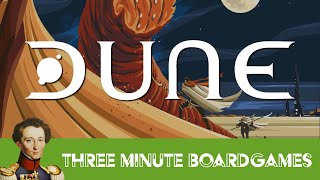















Dune box art

Dune

Game ID: GID0105540
Collection Status
Description

Imagine you can control the forces of a noble family, guild, or religious order on a barren planet which is the only source for the most valuable substance in the known universe.

Imagine you can rewrite the script for one of the most famous science fiction books of all time. Welcome to the acclaimed 40-year-old board game which allows you to recreate the incredible world of Frank Herbert’s DUNE.

In DUNE you will become the leader of one of six great factions. Each wishes to control the most valuable resource in the universe - melange, the mysterious spice only found at great cost on the planet DUNE. As Duke Leto Atreides says “All fades before melange. A handful of spice will buy a home on Tupile. It cannot be manufactured, it must be mined on Arrakis. It is unique and it has true geriatric properties.” And without melange space travel would be impossible. Only by ingesting the addictive drug can the Guild Steersman continue to experience visions of the future, enabling them to plot a safe path through hyperspace.

Who will control DUNE? Become one of the characters and their forces from the book and . . . You decide!

—description from the publisher

Year Published
2019
Transcript Analysis
Browse transcript mentions, sentiments, pros/cons, mechanics, topics, quotes, and references.
Total mentions: 22
This page: 22
Sentiment: pos 15 · mix 4 · neu 3 · neg 0
Mentions per page
Top
Showing 1–22 of 22
Video LhrSRCiRXiI Ryan and Bethany Board Game Reviews top_10_list at 18:14 sentiment: positive
video_pk 62225 · mention_pk 154739
Ryan and Bethany Board Game Reviews - Dune video thumbnail
Click to watch at 18:14 · YouTube ↗
Overall sentiment (raw)
positive
Pros
  • Universally approachable; ideal for mixed gamer/non-gamer groups.
  • Rapid rounds; high energy with frequent social interaction.
Cons
  • Rules can be controversial across editions (e.g., stacking +2s in some versions).
  • Susceptible to repetitive play in long sessions.
Thematic elements
  • Speed, chaos, and social interaction as players attempt to shed all cards first.
  • Casual family game night with a familiar and portable card shedder.
  • Light, fast-paced, party-friendly atmosphere with a strong sense of shared humor.
Comparison games
  • Monopoly
Mechanics (from transcript analysis)
  • hand management — Players try to discard cards by matching color or number while optimizing hand composition.
  • hand_management — Players try to discard cards by matching color or number while optimizing hand composition.
  • Multi-use cards — Action cards (skip, reverse, draw two, wilds) dramatically alter the flow and create momentum shifts.
  • real-time — Jump-in play and rapid reactions keep the pace lively and interactive.
  • real-time_response — Jump-in play and rapid reactions keep the pace lively and interactive.
  • special_cards — Action cards (skip, reverse, draw two, wilds) dramatically alter the flow and create momentum shifts.
Video topics + discussion points
No key topics recorded for this video.
Quotes (from this video)
  • The goal is the laughter. The goal is the fun. The goal is interaction around the table.
  • A card laid is a card played.
  • Jump in in real time as fast as possible and the gameplay continues in that direction.
  • Dirty Spades is like ... this is how we're playing the game. It's silly. It's fun. Adds a little level of chaos to the thing.
  • Bus rules. You could play it out and take a lot of time or it could just okay, now we know this what's going to happen.
  • If the game state hasn't changed, go ahead and pay for it now.
References (from this video)
No references stored for this video.
Video csnzB6DCIpo Unknown Channel game_review at 2:01 sentiment: positive
video_pk 60785 · mention_pk 153238
Unknown Channel - Dune video thumbnail
Click to watch at 2:01 · YouTube ↗
Overall sentiment (raw)
positive
Pros
  • strong thematic integration with the Dune universe (spice, houses, desert setting)
  • aesthetic appeal with a retro yet clean production look
  • flexibility to teach via QuickStart while offering deeper rules in the full book
  • optional alliance rules add strategic depth and replayability
  • compact packaging for a big, multi-component game with thoughtful insert and storage
Cons
  • dense amounts of text in rules and lore can be a barrier to entry
  • rulebook density may require careful reading and patience
  • some components/backside layouts could be confusing without guidance
  • the overall weight and scale may be intimidating to newcomers
Thematic elements
  • Array
  • Arrakis
  • Epic, lore-rich
Comparison games
none
Mechanics (from transcript analysis)
  • Area Control — Players deploy forces and resolve battles to gain influence and resources, with emphasis on force commitment mechanics.
  • Area control / combat — Players deploy forces and resolve battles to gain influence and resources, with emphasis on force commitment mechanics.
  • Asymmetric Faction Power — Six Houses provide faction-specific abilities shaping decisions and strategy.
  • asymmetric player powers — Six Houses provide faction-specific abilities shaping decisions and strategy.
  • Card-driven Intrigue — Treachery and Karma cards introduce events and influence strategic options during play.
  • Diplomacy / Alliances — Optional rules allow players to form alliances and negotiate terms during play.
  • Layered Rules (QuickStart vs Full Rulebook) — The game provides a QuickStart guide for a simpler entry and a full rulebook for deeper mechanics.
  • negotiation — Optional rules allow players to form alliances and negotiate terms during play.
  • Resource management — Spice is a central resource that drives actions and strategic planning across the game.
  • Resource management (spice) — Spice is a central resource that drives actions and strategic planning across the game.
Video topics + discussion points
No key topics recorded for this video.
Quotes (from this video)
  • this game oozes that dry aesthetic
  • this game looks very old-school; it reminds me a lot of the older games I played in the college board game clubs
  • the spice must flow
  • we've been through the rule book and a QuickStart guide for like it's way too long, so let's just move on
  • this is the strongest design aesthetic; it's old-school but clean
References (from this video)
No references stored for this video.
Video XfjIzg5Bh7c Shelf Side general_discussion at 1:09 sentiment: neutral
video_pk 60710 · mention_pk 153139
Shelf Side - Dune video thumbnail
Click to watch at 1:09 · YouTube ↗
Overall sentiment (raw)
neutral
Pros
  • Iconic theme with deep strategic potential
  • Large, immersive world
Cons
  • Complex rules
  • Long playtime
Thematic elements
  • Array
  • Science Fiction
  • Strategic, faction-based planning
Comparison games
none
Mechanics (from transcript analysis)
  • Area Control — Players compete to control map territories and gain influence and resources.
  • Rule-based gameplay — Turns, actions, and combat are governed by established rules.
Video topics + discussion points
No key topics recorded for this video.
Quotes (from this video)
  • dungeons and dragons yeah i got an entire campaign prepped
  • i set up dune while you're gone
  • what do you mean you're not available for rising sun
  • it's nice to have someone willing to play board games like this
  • let's play
References (from this video)
No references stored for this video.
Video jK162et5TK0 Unknown Channel general_discussion at 2:34 sentiment: neutral
video_pk 60695 · mention_pk 153110
Unknown Channel - Dune video thumbnail
Click to watch at 2:34 · YouTube ↗
Overall sentiment (raw)
neutral
Pros
none
Cons
none
Thematic elements
Comparison games
  • Duke
Mechanics (from transcript analysis)
Mechanics unknown.
Video topics + discussion points
No key topics recorded for this video.
Quotes (from this video)
  • it's really cheap
  • you can buy these at the dollar tree
  • it's so expensive to buy an answer i would rather carefully craft mine by hand so that it means something to me
  • it's super cheap once you have the right tools
  • this is the gaming chair i made myself
  • it's stable it's fine
  • thank you to our patrons
  • like comment subscribe
References (from this video)
No references stored for this video.
Video Bxqssquymjk Unknown Channel comparison at 0:00 sentiment: neutral
video_pk 37995 · mention_pk 150913
Unknown Channel - Dune video thumbnail
Click to watch at 0:00 · YouTube ↗
Overall sentiment (raw)
neutral
Pros
  • classic theme with nostalgic appeal for Dune fans
  • strong emphasis on negotiation and strategic planning
Cons
  • older design can be intimidating for new players
  • may offer less thematic depth than newer titles
Thematic elements
  • political intrigue, spice economy, desert power dynamics
  • Arrakis, the Dune universe
  • asymmetric negotiation-driven play with indirect conflict and shifting alliances
Comparison games
  • Dune: Imperium
Mechanics (from transcript analysis)
  • Area Control — players compete for territorial influence and control of key map areas.
  • asymmetric design — factions or roles have different abilities and win conditions.
  • economic/resource management — managing spice and influence resources to fuel actions and purchases.
  • negotiation — alliances, betrayals, and diplomatic maneuvering shape outcomes.
  • Resource management — managing spice and influence resources to fuel actions and purchases.
Video topics + discussion points
No key topics recorded for this video.
Quotes (from this video)
  • this one adds a couple of those extra thematic Elements which if you're a fan of Dune makes it even better
  • I will get Uprising uh if you need to buy a new one
  • you're fine with D Imperium it still stays one of the best greatest games last years
  • Dune is an amazing amazing
References (from this video)
No references stored for this video.
Video la3FWBoUxew Jonah's Channel rules teach at 0:00 sentiment: positive
video_pk 37784 · mention_pk 149637
Jonah's Channel - Dune video thumbnail
Click to watch at 0:00 · YouTube ↗
Overall sentiment (raw)
positive
Pros
  • engaging bidding mechanic that creates asymmetrical hero setup
  • clear, structured phases that provide a satisfying tactical loop
  • distinct color-coded resources create a tangible economy for actions
  • thematic flavor with frost/dungeon aesthetic and Viking motif
Cons
  • the presented demo is a prototype and omits enemy gameplay, which may obscure the full experience
  • the rule set appears complex and may have a steep learning curve for new players
  • some advanced mechanics require expansion content to realize full depth
Thematic elements
  • Viking conquest, dungeon exploration, artifact collection, and skirmish combat.
  • A frost-covered map where players command Viking teams exploring dungeons, collecting shards, and competing for control.
  • Educational, rule-focused presentation with step-by-step setup and explanation of phases and abilities.
Comparison games
none
Mechanics (from transcript analysis)
  • action card deck and activation order — Each player builds a deck from three hero cards; the action cards determine which character activates during the round, introducing variability and strategic planning.
  • action drafting — Each player builds a deck from three hero cards; the action cards determine which character activates during the round, introducing variability and strategic planning.
  • asymmetric hero selection via bidding — Players secretly bid three tokens (values 1, 2, and 3) to claim their three hero cards; the lowest bid takes the hero, ties are resolved by the Nemesis token, and the selected hero's token is discarded for that round.
  • combat resolution with defense and damage cards — Attacks require blue cubes and may be defended with yellow cubes and shield tokens. If defense is unavailable, the attacker may seize action cards from the defender's deck as points.
  • Cube tower — Attacks require blue cubes and may be defended with yellow cubes and shield tokens. If defense is unavailable, the attacker may seize action cards from the defender's deck as points.
  • destiny and magic phases with shards — The game progresses through Destiny and Magic phases, using shards and tokens to determine card draws, enemy spawns (in the full game), and bonuses on the map.
  • Modular board — The board is divided into four zones (one per player), each with nine spaces. Obstacles (chest piles, stones, shards) and tokens are placed according to a chosen layout to create varying tactical challenges.
  • modular board with zones and tokens — The board is divided into four zones (one per player), each with nine spaces. Obstacles (chest piles, stones, shards) and tokens are placed according to a chosen layout to create varying tactical challenges.
  • resource cubes for actions — Cubes of different colors (green, blue, yellow, white) are spent to perform actions (move, attack, defend, copy). The dice-like tokens at spaces indicate where and how actions can occur.
  • statue upgrades and memory zone — Players can upgrade their statue by stacking body parts on a base and then move it into a memory zone, gaining permanent cubes and unlocking future bonuses.
Video topics + discussion points
No key topics recorded for this video.
Quotes (from this video)
  • "I like this form because it's not obvious"
  • "each player bidding completes a Viking team consists of three asymmetrical Heroes"
  • "the game gameplay comes to end depending on the number of players"
  • "we will place various kinds of obstacles here"
  • "you can draw action card and discard the ones you have"
  • "advanced mode of the game you will use this expand site"
  • "green cubes are responsible for moving pushing and collecting any color shard"
  • "the destiny board the players will draw a card from the deck"
References (from this video)
No references stored for this video.
Video Cto65ZSE_Ts Unknown rules teach at 0:00 sentiment: positive
video_pk 34551 · mention_pk 149638
Unknown - Dune video thumbnail
Click to watch at 0:00 · YouTube ↗
Overall sentiment (raw)
positive
Pros
  • Rich and varied miniatures
  • Deep modular board with 3D components
  • Hero bidding creates strategic setup
  • Character specific decks enable diverse playstyles
  • Varied card types add strategic depth
Cons
  • Prototype version not final yet
  • Setup can be complex and lengthy
  • Rulebook and digital version may differ from final release
  • Potentially heavy for casual players
Thematic elements
  • mythic quest, building statues, shards collection
  • Nordic Viking myth inspired setting with heroes and statues
  • tutorial/demo overview with component walk-through
Comparison games
none
Mechanics (from transcript analysis)
  • Action cubes and resource tracking — Colored cubes represent attributes that power actions and track blue and yellow shards
  • Card economy and memory slot — Cards played enter a memory slot to draw new cubes and expand strategic options
  • Cube tower — Colored cubes represent attributes that power actions and track blue and yellow shards
  • Deck building — Each hero has a dedicated deck of 10 action cards and two sided character cards with special abilities
  • Deck building and hero cards — Each hero has a dedicated deck of 10 action cards and two sided character cards with special abilities
  • Destiny board and scoring — Destiny board on the bottom tracks victory points earned and the timing of scoring
  • Hero bidding — Players bid for three Viking Heroes using position tokens to allocate hero presence on the map
  • Inspiration and advantage cards — There are inspiration cards granting points and advantage cards providing powers
  • Modular map with tokens and statues — Map layout depends on assembling cairns and statue bases with attached components
  • Nemesis mode and enemy board — If used, Nemesis mode adds a board of enemies with different stats and behaviors
Video topics + discussion points
No key topics recorded for this video.
Quotes (from this video)
  • each hero is different with its own individual deck of cards and two sided character cards with special abilities
  • we will be bidding for these Heroes using position tokens
References (from this video)
No references stored for this video.
Video _484C74wUL8 Board Gaming Doctor analysis at 0:00 sentiment: positive
video_pk 31040 · mention_pk 149681
Board Gaming Doctor - Dune video thumbnail
Click to watch at 0:00 · YouTube ↗
Overall sentiment (raw)
positive
Pros
  • Standalone experience that captures the Feast for Odin feel with a Danes twist
  • Potential to support a fifth player
  • Significant expansion of occupations (reported ~200 cards)
  • New components (islands, ships, weapons, almanac) and the tax mechanism add depth
Cons
  • Kickstarter and price uncertainty
  • Increased complexity and production risk
  • Balancing asymmetrical home boards and new components could be challenging
Thematic elements
  • occupations-driven resource management, exploration, and taxation within a Viking setting
  • Viking Age / Norse world
  • historical-inspired, abstracted eurogame
Comparison games
  • A Feast for Odin
  • Norwegians
  • Terrammystica
  • Age of Innovation
Mechanics (from transcript analysis)
  • almanac-inspired thematic integration — historical context and thematic inspiration embedded into components and rules
  • home boards with asymmetry — starting resources and options differ by player, with potential variant mechanics
  • new islands and ships — exploration to additional island tiles and new ships providing bonuses
  • occupations (card-based) — a large pool of occupation cards shaping early and mid-game strategy
  • tax board — a double-sided home board introduces a tax mechanism that can lengthen the game and add pressure
Video topics + discussion points
No key topics recorded for this video.
Quotes (from this video)
  • I'm really excited to see what kind of integrations are and inspirations are included in this game
  • This game is going to be a standalone game that includes pretty much all of the components that you would need to play A Feast for Odin
  • Kickstarter since it's a very big project that they're working on in the first quarter of 2026
References (from this video)
No references stored for this video.
Video qwzUcm6jKwg Actual top_10_list at 6:25 sentiment: mixed
video_pk 29530 · mention_pk 151581
Actual - Dune video thumbnail
Click to watch at 6:25 · YouTube ↗
Overall sentiment (raw)
mixed
Pros
  • Highly accessible and widely recognized
  • Easy to shelf as a quick social game
Cons
  • Viewed as lightweight and not modern-genre enough by some
  • Lacks depth for serious hobbyists
Thematic elements
  • Casual, family-friendly party game
  • Classic color/number matching card game
  • Lightweight, accessible
Comparison games
  • The Mind
Mechanics (from transcript analysis)
  • Action cards — Skips, reverses, and wilds add variability.
  • Matching — Play a card that matches color or number; draw when unable.
  • Turn-taking and matching — Play a card that matches color or number; draw when unable.
Video topics + discussion points
No key topics recorded for this video.
Quotes (from this video)
  • Katan almost gives you like this bit of credos because it's like this German game
  • Wingspan does that well for me. It makes you want to be a board game ambassador
  • Werewolf could create upset or maybe not so much as like diplomacy or something
  • Code Names is my favorite game of all time
  • Pandemic Legacy that was one of the greatest board game experiences of my life
  • If you go to Golden Globes again and played a game after, I think it would be Wingspan
References (from this video)
No references stored for this video.
Video sTUZT9F-4MM Unknown Channel rules teach at 0:00 sentiment: positive
video_pk 28898 · mention_pk 152310
Unknown Channel - Dune video thumbnail
Click to watch at 0:00 · YouTube ↗
Overall sentiment (raw)
positive
Pros
  • Clear, approachable explanation of the Wild Draw Four rule
  • Illustrates the risk-reward of challenging a play
  • Accessible for new players and casual play
Cons
  • Challenging legality can be nuanced and easily misapplied
  • House rules vary and can complicate standard play
Thematic elements
  • Color matching with wild cards and draw penalties
  • Casual, family game night settings with simple, fast rounds
  • instructional, casual explanation of rules with concrete examples
Comparison games
none
Mechanics (from transcript analysis)
  • hand management — Players aim to shed all cards from their hand by playing compatible cards.
  • Matching — Play cards that match color or number/symbol on the discard pile.
  • Matching and sequencing — Play cards that match color or number/symbol on the discard pile.
  • Penalty draws — When unable to play, players draw cards as penalties.
  • Rule-enforcement and challenges — Possible challenge against a Wild Draw Four play to determine legality.
  • Wild cards — Wild and Wild Draw Four allow color changes and forcing draw penalties.
Video topics + discussion points
No key topics recorded for this video.
Quotes (from this video)
  • you're probably playing Uno wrong we all know about the reverse and Skip cards
  • the infamous wild draw four card
  • there is a caveat you may only play this card when you do not have another card in your hand that matches the color on the discard pile
  • if you suspect that a wild draw 4 card was played illegally you actually have the opportunity to challenge that player
  • however if you are wrong you must draw the four cards
References (from this video)
No references stored for this video.
Video Fil1dnS5pbg No Rolls Bard top_10_list at 12:25 sentiment: positive
video_pk 11912 · mention_pk 141757
No Rolls Bard - Dune video thumbnail
Click to watch at 12:25 · YouTube ↗
Overall sentiment (raw)
positive
Pros
  • rich thematic depth and crunch
  • strong replayability with different factions
  • spectacular production and components
Cons
  • rules and complexity can be intimidating
Thematic elements
  • factional politics, betrayal, and warfare
  • Arrakis with spice economy
  • crunchy, conflict-heavy
Comparison games
  • Cosmic Encounter
  • Twilight Imperium
Mechanics (from transcript analysis)
  • Area Control — factions vie for control across key territories
  • Area control and conflict — factions vie for control across key territories
  • hidden information and bid-based power — player powers disrupt rules and alliances
Video topics + discussion points
No key topics recorded for this video.
Quotes (from this video)
  • one of the cutest games i've ever seen
  • it's a great time for a movie nerd to cross those streams and get into board games
  • the thing infection outpost 31 or everything epic's awesome big trouble in little china aren't on here
  • the back in time is also one of the hardest games i've ever played
  • this is a license to print money but a hell of a game
  • it's not just the art style which is super evocative and cool
References (from this video)
No references stored for this video.
Video p_aD-bMitA8 Foster The Meatball Channel general_discussion at 10:24 sentiment: mixed
video_pk 11245 · mention_pk 145402
Foster The Meatball Channel - Dune video thumbnail
Click to watch at 10:24 · YouTube ↗
Overall sentiment (raw)
mixed
Pros
  • Cute, puzzly theme with satisfying cascading resource mechanics.
  • Engaging engine-building depth for a mid-weight game.
Cons
  • Resources can be visually similar, which can hinder quick scanning.
  • High cognitive load for players new to this style; analysis paralysis risk.
Thematic elements
  • Resource placement and augmentation through cascading actions
  • Confectionery shop and grid-based production
  • Puzzle-driven engine-building with culinary motif
Comparison games
none
Mechanics (from transcript analysis)
  • action_selection — Harvest, build cafe, or plant fields with cascading resource movement.
  • engine building — Cards provide production and cascading effects to generate resources.
  • engine_building — Cards provide production and cascading effects to generate resources.
  • grid_based_resource_management — Each player manages a grid of cafes and fields to produce resources.
  • Resource management — Each player manages a grid of cafes and fields to produce resources.
Video topics + discussion points
No key topics recorded for this video.
Quotes (from this video)
  • I really enjoyed it I loved it I thought it was just a really cool way to play wingspan differently
  • this adds just a little extra something for when you are playing it two player
  • the duet board... has all of the goals that you are both fighting over
  • it's a big box beautiful production
  • Burn Cycle is a big box beautiful production
  • it's not my type of game I would say this is something that even before playing I was already kind of like oh no it just seems like it's a lot
  • this game involves a lot of bluffing which is why I do think it would play best at higher player counts
  • it's unlike anything that we've played
  • I love Wingspan I want all of it it's been one of my favorite games since we got into the hobby
References (from this video)
No references stored for this video.
Video FjMMakwGbnU Unknown Channel analysis at 26:00 sentiment: positive
video_pk 10508 · mention_pk 146820
Unknown Channel - Dune video thumbnail
Click to watch at 26:00 · YouTube ↗
Overall sentiment (raw)
positive
Pros
  • theme and mechanics are inseparably interwoven
  • emergent narrative through rules and decisions
Cons
  • high complexity for new players
Thematic elements
  • Power struggles, betrayal, and alliance management
  • Dune universe; spice economy and political intrigue
  • Epic, world-integrated narrative
Comparison games
  • Rex Final Days of an Empire
Mechanics (from transcript analysis)
  • asymmetrical factions — factions have unique abilities and strategies
  • economy of spice — control and trade spice to influence power and resources
  • Narrative choice — narrative elements influence decisions and leverage
  • plot-driven interactions — narrative elements influence decisions and leverage
Video topics + discussion points
No key topics recorded for this video.
Quotes (from this video)
  • The theme is fundamentally pasted on to the gameplay loop.
  • the mechanisms flow from a theme in a very natural way.
  • the theme and the mechanics are so tightly interwoven that if you try to reimagine this game with a different narrative, it just wouldn't create the same emotional resonance.
  • You're not just moving pieces on a board. You're enacting the power struggles, the betrayals, the alliances of Herbert's universe.
  • Great theming isn't about fancy art or impressive miniatures. It's about creating an experience where every card played, every token moved, and every decision feels like a natural extension of the world you've temporarily inhabited.
  • The best themes don't just look good, they make you forget that you're playing a game at all.
References (from this video)
No references stored for this video.
Video kd7La4ewijc Unknown Channel analysis at 15:51 sentiment: positive
video_pk 7267 · mention_pk 146803
Unknown Channel - Dune video thumbnail
Click to watch at 15:51 · YouTube ↗
Overall sentiment (raw)
positive
Pros
  • Deep thematic embodiment of competing moral frameworks
  • Rich, politically flavored storytelling
Cons
  • Very complex rules and long playtime
  • Negotiation can lead to analysis paralysis
Thematic elements
  • Political intrigue and factional power struggles.
  • Futuristic feudal desert planet Arrakis with rival houses.
  • Asymmetric, faction-driven strategies with strong thematic flavor.
Comparison games
none
Mechanics (from transcript analysis)
  • Area Control — Control key territories and resources to gain victory.
  • area control / conquest — Control key territories and resources to gain victory.
  • asymmetric player powers — Each house possesses unique abilities and win conditions.
  • Diplomacy / negotiation — Alliances and betrayals shape the game state.
  • negotiation — Alliances and betrayals shape the game state.
Video topics + discussion points
No key topics recorded for this video.
Quotes (from this video)
  • Spirit Island creates a perfect laboratory where we can see the core principle in action.
  • Goodness is a tangible feature of this world.
  • When you make a move in Spirit Island, you can point to a real tangible outcome.
  • The game of go is the perfect game for this idea.
  • Aji is really fascinating for me.
  • In Dixit, the storyteller gives a clue based on one of their cards.
  • They're having an emotional reaction to the art.
  • The town's folk team to win, the town must vote to execute the storyteller.
  • colossal 20 lb box of adventure Gloom Haven.
  • The scenario book dictates reality. It tells you the objective of your quest, and that objective is good simply because the book has proclaimed it to be so.
  • Now, let's use a custombuilt script with the experimental roles to demonstrate and error theory.
References (from this video)
No references stored for this video.
Video vqb50cxe-T8 Unknown Channel top_10_list at 18:17 sentiment: positive
video_pk 5667 · mention_pk 146782
Unknown Channel - Dune video thumbnail
Click to watch at 18:17 · YouTube ↗
Overall sentiment (raw)
positive
Pros
  • Powerful thematic commitment that drives all mechanics
  • Social balance and reads of others' intentions create depth
  • Dune's ambition feels distinct and daring
Cons
  • Very heavy and long; not accessible to casual players
  • Themes and complexity can be a barrier to entry
Thematic elements
  • Noble houses, politics, and deception
  • Frank Herbert's Dune universe
  • Thematic, asymmetrical design anchored to fiction
Comparison games
  • other heavy negotiation/area-control games
  • thematic strategy games with strong social dynamics
Mechanics (from transcript analysis)
  • asymmetric player powers — Several factions with unique strengths and endgame goals.
  • Asymmetric powers — Several factions with unique strengths and endgame goals.
  • auction/market pressure — Market-like card interactions influence power dynamics.
  • negotiation and social deduction — Alliances and betrayals shape the flow; social balance matters.
Video topics + discussion points
No key topics recorded for this video.
Quotes (from this video)
  • Code Names did something that sounds impossible. It made a party game that's actually legitimately good.
  • Dune eroded everything around it to pure theme. It succeeded through the devotion to its fiction and the corresponding chaos that comes from that.
  • Diplomacy is all about perfect information and imperfect trust.
References (from this video)
No references stored for this video.
Video m7-_G0XHemY Adam in Wales general_discussion at 8:16 sentiment: positive
video_pk 4773 · mention_pk 143943
Adam in Wales - Dune video thumbnail
Click to watch at 8:16 · YouTube ↗
Overall sentiment (raw)
positive
Pros
  • Publisher with a track record of not letting players down
  • Caveman theme familiar to eurogame players
Cons
  • Preview notes vague about precise mechanics
Thematic elements
  • Caveman/adventure/settlement survival
  • Caveman theme
  • N/A
Comparison games
none
Mechanics (from transcript analysis)
  • Resource management — Caveman-themed resource and action resolution; balance between actions and risk
  • Resource/theme-management — Caveman-themed resource and action resolution; balance between actions and risk
Video topics + discussion points
No key topics recorded for this video.
Quotes (from this video)
  • "Kuzco is the remake of Java which is one of Keesling and Kramer's mask trilogy along with Tikal and Mexico which are brilliant games"
  • "I already know that I love the game Java so that is high on my list"
  • "gingerbread house this is from lookout Spieler look how free that is pretty big pretty mark of quality"
  • "Seven for the Queen competing to create a new necklace for the Queen and it won the best unpublished game competition"
  • "Coco is a trick-taking game ya fool or Papa is a classic trick-taking game with a twist"
  • "the game changes... it's basically an expansion that works for every game"
References (from this video)
No references stored for this video.
Video QT_xWS6q-hA Unknown Channel playthrough at 0:00 sentiment: positive
video_pk 4666 · mention_pk 141800
Unknown Channel - Dune video thumbnail
Click to watch at 0:00 · YouTube ↗
Overall sentiment (raw)
positive
Pros
  • highly entertaining and energetic
  • great social bonding during a long session
  • adds variety with house-rule twists
  • high tension and frequent laughter
Cons
  • can extend the game length dramatically
  • rules ambiguity and stacking can lead to confusion
  • unpredictable outcomes may frustrate some players
Thematic elements
  • color matching and hand management with chaos and humor
  • Living room game night during a casual party
  • lively, improvisational, banter-filled
Comparison games
none
Mechanics (from transcript analysis)
  • auto_play_on_draw (house rule) — Drawn cards are often automatically played under house rules
  • card_stacking — Players can stack certain cards (e.g., +2, +4) to pass penalties or escalate draws
  • Color and number matching — Play a card that matches either color or number/symbol on the previous card
  • draw_to_match_rule (house rule) — Players draw until they can play a card that matches the top card
  • hand_swapping — Seven rule allows the active player to swap hands with another player
  • special_cards — Skip, Reverse, Draw Two, Wild, Wild Draw Four influence play order and hand management
Video topics + discussion points
No key topics recorded for this video.
Quotes (from this video)
  • this game is wacky out but that's so insane
  • it's incredibly broken
  • absolute nightmare
  • in theory we'll all one day be dead so it's true
  • the game's never ending
  • stack it
References (from this video)
No references stored for this video.
Video 1CiaDFVaFF4 No Rolls Bard playthrough at 3:39 sentiment: mixed
video_pk 4398 · mention_pk 12846
No Rolls Bard - Dune video thumbnail
Click to watch at 3:39 · YouTube ↗
Overall sentiment (raw)
mixed
Pros
  • Lean, efficient rules that support a rich, thematic experience
  • High tension during battles with dramatic swings
  • Strong thematic integration of spice economy and faction dynamics
Cons
  • Hidden information and betrayal mechanics can be punishing or opaque
  • Lengthy turns and complex logistics can slow play and overwhelm new players
  • Traitor mechanic may disproportionately affect weaker players or slower tables
Thematic elements
  • Conquest, diplomacy, betrayal, and empire-building within a spice-driven economy
  • Arrakis, a harsh desert planet where control of spice determines power
  • Competitive, geopolitical warfare with hidden information and traitor dynamics
Comparison games
  • Cosmic Encounter
  • Chinatown
Mechanics (from transcript analysis)
  • Battle wheel — Battles are resolved on a battle wheel where players secretly assign forces and leaders, then reveal cards to determine outcomes.
  • Combat: Blind Bet — Battles are resolved on a battle wheel where players secretly assign forces and leaders, then reveal cards to determine outcomes.
  • Market cards — Special one-off cards purchasable with spice that grant powerful, game-altering effects.
  • spice economy — Spice is the currency used to pay for powerful cards, ship troops, revive units, and influence battles; spice flow drives strategic choices.
  • storm mechanics — A planet-wide storm moves around the board, destroying exposed troops and constraining movement; only certain spaces are storm-safe.
  • Territory control & strongholds — Victory requires controlling a subset of strongholds by certain turns; points are awarded for each stronghold and spice holdings.
  • Traitor cards — Hidden traitor cards that can sabotage battles; players may secretly possess traitors and face consequences when leading forces into combat.
  • Traitor Game — Hidden traitor cards that can sabotage battles; players may secretly possess traitors and face consequences when leading forces into combat.
Video topics + discussion points
No key topics recorded for this video.
Quotes (from this video)
  • Spice is the currency
  • Spice must flow
  • The spice is everything
  • You can't win the game in the first turn
References (from this video)
No references stored for this video.
Video aNxMVjT-7oE Unknown Channel general_discussion at 0:00 sentiment: mixed
video_pk 1506 · mention_pk 141643
Unknown Channel - Dune video thumbnail
Click to watch at 0:00 · YouTube ↗
Overall sentiment (raw)
mixed
Pros
  • Engaging banter and audience energy
  • Dynamic interpersonal tension during play
  • Accessible entry point for social deduction elements
Cons
  • Rule clarity and game guidance are not evident from transcript
  • Some remarks touch on sensitive or controversial topics
  • Limited objective clarity within the transcript alone
Thematic elements
  • trust, risk, bluffing, deception
  • Implied competitive setting with empire-building themes and abstract motif involving bets and social maneuvering
  • brief, interaction-driven with emphasis on player decisions and reactions
Comparison games
none
Mechanics (from transcript analysis)
  • Betting — Players place bets on outcomes applying social pressure and risk assessment.
  • Betting and bluffing — Players place bets on outcomes applying social pressure and risk assessment.
  • bluffing / deception — Players attempt to mislead others about their intentions or beliefs.
  • neighbor interaction — Direct verbal interaction affects decisions and perceived credibility.
  • social interaction — Direct verbal interaction affects decisions and perceived credibility.
  • turn_sequence — Turn structure includes movement or order changes (e.g., 'swerve left'), shaping play rhythm.
Video topics + discussion points
No key topics recorded for this video.
Quotes (from this video)
  • I have played this game before.
  • Dangle's never going to win.
  • you can't trust gang the right way
  • I'm breaking hearts.
References (from this video)
No references stored for this video.
Video 9AkxHFfRGr8 Board Game Prices top_10_list at 10:22 sentiment: positive
video_pk 1423 · mention_pk 144562
Board Game Prices - Dune video thumbnail
Click to watch at 10:22 · YouTube ↗
Overall sentiment (raw)
positive
Pros
  • Iconic theme and deep political play
  • strong six-player balance when fully set
Cons
  • combat mechanics may feel dated to some
  • requires a group committed to a long session
Thematic elements
  • asymmetric factions and grand strategic maneuvering
  • Dune universe with factional politics and spice economy
  • slow-burn, negotiation-driven with shifting allegiances
Comparison games
none
Mechanics (from transcript analysis)
  • asymmetric factions — distinct factions with unique abilities and win conditions
  • negotiation — deals shape the board state and victories
  • negotiation and alliance-building — deals shape the board state and victories
Video topics + discussion points
No key topics recorded for this video.
Quotes (from this video)
  • the trading element really comes into its own
  • there's something undeniably majestic about the game
  • six is the magic number for it
  • it's a hell of a lot easier to get six people together that it is to get eight
References (from this video)
No references stored for this video.
Video SEG8Nr973SA Before You Play general_discussion at 3:50 sentiment: positive
video_pk 973 · mention_pk 142229
Before You Play - Dune video thumbnail
Click to watch at 3:50 · YouTube ↗
Overall sentiment (raw)
positive
Pros
none
Cons
none
Thematic elements
Comparison games
  • Dune: Imperium
Mechanics (from transcript analysis)
Mechanics unknown.
Video topics + discussion points
No key topics recorded for this video.
Quotes (from this video)
  • this is like the pinnacle of board gaming awards that we know of
  • paleo is really really punishing
  • chaos pure chaos
  • not a game for first-timers
  • decrypto is so good
References (from this video)
No references stored for this video.
Video vBhj1YNetdw Unknown Channel general_discussion at 1:07 sentiment: positive
video_pk 219 · mention_pk 141807
Unknown Channel - Dune video thumbnail
Click to watch at 1:07 · YouTube ↗
Overall sentiment (raw)
positive
Pros
  • Easy to teach and learn
  • Accessible to players of all ages
  • Great for social gatherings and family game nights
  • Highly adaptable with many house-rule variants
Cons
  • Rule disagreements can cause arguments
  • Game length can be long with certain house rules
  • Heavy reliance on luck rather than strategy
Thematic elements
  • Simple luck-driven card play with social interaction
  • Casual social settings, family game nights
  • Humorous, conversational
Comparison games
  • Crazy Eights
  • Monopoly
  • Yahtzee
  • Go Fish
  • Ubongo
  • Bingo
  • Jumanji
Mechanics (from transcript analysis)
  • end game bonuses — Points are tallied from opponents' unplayed cards at round end.
  • End-game scoring — Points are tallied from opponents' unplayed cards at round end.
  • Matching — Play a card that matches top card by color or number; draw if unable.
  • Multi-use cards — Skip, Reverse, Wild, Draw Two, Draw Four modify play.
  • Rule variants — House rules and official rules differ; players often adopt variants.
  • Special cards — Skip, Reverse, Wild, Draw Two, Draw Four modify play.
  • Uno shout rule — When down to one card, players shout UNO; failure to do so risks penalty.
Video topics + discussion points
No key topics recorded for this video.
Quotes (from this video)
  • UNO is a game that everyone has played and everyone knows
  • it's an inoffensive game
  • house rules have overtaken the official rules
  • uno doesn't have the barriers to entry
  • is Uno actually good
References (from this video)
No references stored for this video.
Transcript Navigation
Top
Showing 1–22 of 22
View on BoardGameGeek