



Dungeon Alliance Deep Dive
What the Community Thinks About Dungeon Alliance
Dungeon Alliance draws a clear split between players who see it as a rare hybrid and players who find it demanding to learn. Reviewers commonly describe it as a euro-style game wrapped in a dungeon crawl theme, with miniatures, card drafting, and tile-based exploration combined into one experience. Commentators often compare its progression to Mage Knight, while noting that its deck building is not what players would expect from Dominion or Clank!.
Enthusiasm is strongest among solo players. Reviewers say the game's information is largely open, because the monster behavior is written on an AI card that can be read before a monster acts, which makes solo play workable. The rules also support solo, cooperative, and competitive play, along with quests and a full campaign mode, so different groups can find different ways to engage.
The learning curve is the main barrier. One solo reviewer calls the game brain-burning and says it can take a while to get used to, and recommends easing in by using pre-chosen heroes or the basic cards from the rules supplement. Opinions also diverge on cost, with some players treating the core box as a starting point and others considering the adventure packs essential to enjoying the game fully.
Core Mechanics That Define Dungeon Alliance
Deck Building Through Race and Class Icons
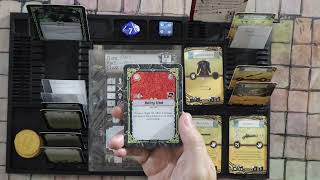
Each hero contributes three starting cards to a combined deck of twelve. Every card carries race and class icons, and a hero can only play a card when that hero has every icon printed on it, with a few exceptions. Elf cards need an elf, dwarf cards need a dwarf, and marshal or celestial cards need a hero with those classes. Experience gained from defeating monsters is spent to draft upgrade cards, and drafted cards go straight into hand, so every purchase becomes a question of which hero on the team can actually use it.
Deck building here works more like a level-up than a shuffle engine. The hand limit starts at six and grows as the upgrade deck improves, and the discard allowance grows alongside it, so a team that has invested in upgrades gains more flexibility each turn. Three experience pools also act as a pacing clock. When a pool empties, the upgrade deck advances to the next, stronger level, which gives the whole game a natural rhythm.
Dungeon Exploration Through Flipped Tiles
Exploration is built around a tile draft. A starting tile sits inside a frame, and on each hero's turn the hero moves through a door toward one of two face-up tiles, chooses which tile to place and how to rotate it, and then the monsters on the tile turn to face that hero. Monsters on the flipped tiles are visible, so players can plan against them, while traps and treasures stay hidden behind challenge tokens until the hero enters the room. A replacement tile refills the draft area so the next player can plan.
Doors and passages add a second layer of planning. A matched pair of doors counts as closed and costs one speed to open. A door paired with a wall is locked, and a hero can either spend speed and roll the dungeon die or spend enough speed to pass automatically. Wall-to-wall secret passages cost more speed and cannot be opened while a monster shares the hero's tile. A single die resolves both door opening and trap disarming, which adds a measure of luck that players can offset with speed. Ranged heroes also need to stand at least two spaces from their target, so tight positioning matters.
The Dungeon Alliance Experience
A Planning-Heavy Turn Cycle
Each round is organized around heroes activating one at a time, with a monster activation following each hero's turn according to the AI card. A hero moves, plays cards, attacks, and then drafts one card from the upgrade area before the player redraws to the hand limit and discards to the discard limit. The monster activation follows the card, which sometimes forces an unwelcome choice. Reviewers say this cycle keeps tension high because the next monster action is often dictated by whatever card is drawn.
The intensity comes from how many decisions stack up in a single turn. A hero can play several cards in one activation, so sequencing matters, since buffs, weapons, and speed-boosting items change what a hero can reach or do. Hungry Gamer calls the game intense and long, full of thinking and planning. Beyond Solitaire describes it as a puzzle that rewards careful turn planning. Combat follows the same rules throughout, so the complexity sits in choosing and sequencing actions rather than learning new procedures for each fight.
Campaign Continuity and Story Momentum
Campaign mode turns separate games into a continuing story. Players earn campaign tokens that can recruit new heroes or draft permanent upgrades, and those upgrades persist from one game to the next. Adventure packs add story cards that are shuffled into the upgrade decks, so narrative beats surface as players draft. Hungry Gamer describes the campaign as a loose story in which drafted cards reveal what happened to missing adventurers, though some story cards advance the plot without helping immediately.
A playthrough by Meet Me at the Table shows the same pattern in practice. The group pursued a Lost Alliance quest, gained campaign tokens as story objectives were completed, and rescued a trapped ally before building toward a boss fight. Because rewards carry forward, a session's gains remain useful later, which gives players a reason to keep working with the same team.
What Makes Dungeon Alliance Stand Out
Dungeon Alliance stands out for the way it reframes a dungeon crawl through euro design. Hungry Gamer calls it a purely Euro adventure dungeon crawl because players can see most of what is coming and puzzle out the best response instead of relying on surprise. Combat uses only a few dice, and most of the strategic weight falls on tile choice, card drafting, and positioning. Reviewers say this gives the game a puzzle-like feel that is more about planning than dice chucking.
The physical components add to its identity. Players draft four heroes in a snake draft from a pool of seventeen included options, and the game supports rival teams competing for experience. Meeple Mountain describes the blend of miniatures, deck building, and tile exploration as a hybrid that is difficult to find elsewhere. The snap-on figure bases, square wooden wound tokens, and draft tokens give the game a tactile character that suits its tabletop-first design.
Potential Drawbacks
The most consistent criticism concerns length and overhead. Hungry Gamer names Dungeon Alliance as the longest game in the reviewer's collection, and a campaign runs as a relatively small number of long sessions. Beyond Solitaire points to finicky setup parts, notably a frame that is easy to knock out of alignment, and to a rules supplement that sits outside the main rulebook, so new players must consult two documents to learn the basic game. The rules take a while to absorb, and many players will need several sessions before turns feel fluid.
Cost is the second concern. Hungry Gamer argues that without the adventure pack expansions the game does not belong near the top of a dungeon crawl list, and suggests that the character and deeper dungeon expansions are also worth owning, which makes the full experience a significant investment. Campaign decks are sold separately and occasionally turn up in secondhand bulk lots, which shows that the material has a resale market but also that buyers should expect to spend more than the core box price.
Finally, the puzzle-heavy design can be tiring. Beyond Solitaire describes the game as brain-burning, and pre-chosen heroes and basic cards exist mainly to lower the initial barrier. Players who want loose, lighter dungeon crawls may find the constant planning draining, especially when a turn offers many options and few obvious answers.
If You Enjoy Dungeon Alliance
Players who enjoy Dungeon Alliance tend to like tactical puzzles, euro-style planning, and progression systems that reward careful sequencing. Mage Knight is the most frequent point of comparison for the deck-building feel and the sense that heroes grow stronger over a session. One reviewer argues that the card-flip combat in Gloomhaven is still dice in disguise, while Dungeon Alliance is more purely puzzle-driven, which makes it a natural next step for players who want less randomness.
Campaign players may appreciate the story arc, the recruitable heroes, and the way upgrades persist, since those elements reward repeated play with the same team. Players who prefer puzzle-solving over dice swings may find that the tile draft, the card draft, and the monster AI cards produce satisfying lines of play across a full campaign. Those who prefer lighter, faster sessions may want to start with the basic game or pre-chosen heroes before committing to the full campaign.
What Reviewers Are Saying
"There is one die that is used for opening doors for disarming traps. This gives the game just a little bit of randomness that a dungeon crawl has, yet the game also gives you ways to plan for this by using more of your resources such as your speed to help with your odds."
— Meeple Mountain
"You have to plan your turns out correctly for maximum damage. What's the best hero to activate right now?"
— Beyond Solitaire
"Dungeon Alliance is a purely Euro adventure dungeon crawl. You're going in, you know exactly what's going to happen almost every single turn."
— Hungry Gamer