/pic184398.jpg)
/pic750582.jpg)
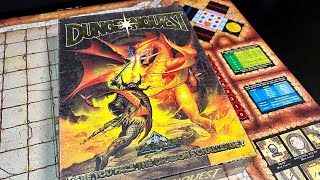
Players explore the ruins of Castle Dragonfire trying to reach the treasure chamber in the center of the dungeon and escape alive with as much treasure as possible. A limited number of turns before the game ends puts pressure on players to take risks and score rewards because anyone left in the dungeon when time runs out dies! A tile-laying system creates the maze-like dungeon and ensures that no two games are ever exactly the same.
Originally published in Sweden as Drakborgen (Dragon Keep) in 1985 by Alga, a subsidiary of BRIO AB. Sold in Norway (Skatten i borgen) and Denmark (Drageborgen). Licenced to Germany (Schmidt Spiele) as Drachenhort, to Great Britain (Games Workshop) as DungeonQuest. A 2nd edition named Drakborgen Legenden was released in 2002 (never released outside Sweden). The game was re-licensed to FFG in 2010, who released the 3rd edition the same year. See the family entry for more information.
Expanded by:
Drakborgen II (the Swedish expansion that upon Games Workshop's British release was split into the two below:)
Heroes for Dungeonquest
Dungeonquest: Catacombs
Re-implemented by:
Drakborgen Legenden
DungeonQuest (Third Edition)
DungeonQuest: Revised Edition
This page includes videos and mentions from the whole DungeonQuest family. Drill into a specific game below.
/pic184398.jpg)


- The host wants to do another video of it.
Mechanics (from transcript analysis)
Video topics + discussion points
Quotes (from this video)
- I don't want to do a whole auction and bore you guys with videos about auctions and this that and the other. So I reached out to a bunch of you, okay, that have been loyal and I don't think I hit all of you.
- I don't want to beg beg for money. I'm never that guy. Never that guy.
- This is my problem. But, you know, I I like to handle things.
- I'm not one of these woke guys that that you know, oh well this, you know, this group needs to be blah blah blah blah blah blah blah blah. I love all people. I really do. I really do.
- I think either you're a piece of garbage or you're a good person. That's the only way I judge people. Okay?
- Can you beat me? Can you outplay me? Probably. Can you have fun at it? Can we smile at each other and laugh?
- I've done some heavy thinking. Not heavy thinking, but now that Gen Con's over with and I know Shil's coming, but you know that that's overseas and I you know I can't get there and uh maybe I'll do one video to cover it.
- The host is shifting focus from new releases to revisiting older games, partly due to health issues affecting the ability to learn complex new games with iconography.
- I don't want to clog up this channel with a whole another auction this early. I'll do something towards the end of the year for Christmas so you guys can get some good Christmas gifts.
- So, there's been a lot of controversy and I talked about it yesterday, last week, and uh with this board game critique and a bunch of other people, whether she this this channel is AI or not, who cares?
- I wanted to try to help somebody. Honest to God, just wanted to help him and they took offense to it and they deleted my comment. So, I went, 'Okay, there's something fishy here then.'
- You don't help people because they burn you every single time.
- Stay in your lane. And that's what I'm doing. I'm staying in my lane. I tried to get out of it for a minute to try to maybe help somebody.
- Guilty on all but one of the charges. I think Man City needs a huge punishment.
- Pep has never been a great coach. He's never been a great coach.
- This is going to show the corruption in in soccer. This is they're gonna well, we all know it's there, but it's really gonna cause uproar and people are going to lose their stuff if if if this isn't handled correctly.
References (from this video)
- Fast setup
- Quick rounds
- Good solo experience
- Can be played with others
- Extremely difficult
- Often die within the first 15 minutes
- Requires starting over frequently
- dungeon crawl
Mechanics (from transcript analysis)
- Race — in a race to try to get to, you know, the where the dragon is and where all the treasure is and pick up the treasure and get what you need and get out.
- tile laying — lay out all the tiles real quick
- Treasure hunting — Just trying to get as much treasure as I can and get out.
Video topics + discussion points
Quotes (from this video)
- Now, not everybody has the time of time to sit there and and play games all the time. We have busy lives, we have families, we have grandchildren, and such and everything. And sometimes just getting away and being able to play a dungeon crawler and just have a nice solo experience just to break up your day a little bit.
- And uh they're in no particular order. Now, one of my all-time favorite games and one of the best games I've ever played,
- And usually if you can get to the hour mark, you're going to end up facing that dragon, and good luck with that because it is never ever ever easy to deal with.
- The reason I love this one so much is there are just 100 dungeons in here that you can play over and over with different types of characters. The replayability is ridiculous.
- Now, again, in a world full of I'm going to have to spend half a day dungeon crawls, especially ones with with with everything as complicated and intricate as it is today.
- Because you are going to be dying more than more than often. Usually within the first 15 minutes the game's over. And then you have to start again.
- this is a game I just love to set up, lay out all the tiles real quick, get going, die a few times, throw it in the box, and walk away.
References (from this video)

- Fun and enjoyable.
- Tile placement creates varied dungeon layouts.
- Very easy for players to be knocked out or eliminated.
- Can be difficult to navigate efficiently due to tile draws.
- Fantasy adventurers seeking treasure
- A dungeon
- Android: Infiltration
- Caverna
Mechanics (from transcript analysis)
- Dice Rolling — Dice are used for combat and determining events, especially towards the end of the game.
- Press Your Luck — Players must decide how deep to go into the dungeon and risk awakening the dragon.
- Tile Placement — Players reveal tiles representing rooms, corridors, and dangers as they explore the dungeon.
Video topics + discussion points
Quotes (from this video)
- Magic: The Gathering, the classic grandfather of the collectible card game genre.
- It's lots of fun seeing the people perform and seeing them do their best to to their teammates uh to guess the titles of these different things.
- So, it will become a bit repetitive, but at the same time, that's going to help you uh establish or cement these concepts in your brain so that in future rounds, when people give fewer clues because they're more limited as to what they can do and say, you're going to be able or more likely, you'll be more likely to guess these things cuz they're already in the back of your mind, hopefully, if you have good enough memory.
- And basically, it's kind of semi-cooperative cuz two to six players can play and they're all breaking into the same bank and they're not trying to stop one one another, but they are trying to be the player who basically comes back with the most money.
- So, it's not cooperative in that sense. We're all We all have kind of like the same goal and we're not necessarily directly interfering with one another, but indirectly, we're absolutely trying to be the one who gets the greatest advantage.
- Because, again, there's a little bit of a time track. And once that time track hits the end, uh there's some predictability to it, but there's also some unpredictability to it cuz there is some die dice rolling towards the end of the game, just kind of like I mentioned in uh Android Infiltration.
- But, there is some variants that allow for players to never be knocked out completely, just lose a whole bunch of their health, uh get set back as far as losing some of their treasure, but they're still in the game.
- But, it's a tile placement game where as the game goes on, you're revealing these different tiles that represent rooms and chambers and corridors along the dungeon.
- But I actually enjoy that unpredictable nature.
- Um, none of the pieces here are really impressive.
- But, mechanically speaking, I always enjoy this game.
- This game, such a fun game.
- I will say that these games all ranked higher on my list in previous years.
- But, Agricola has made the cut and is still very close to making it to the top 50 right here at number 52.
- And the fact that it's a little bit on the stingier side as opposed to Caverna, I actually prefer that.
- This game here is one of his more famous games.
- Um, it's a fun game.
- Simple deck building.
- And I find that to be really cool.
- It's a bit on the heavier end of some of the solo games that I play.
References (from this video)
- Easy to play
- Timeless
- Holds its weight
Mechanics (from transcript analysis)
- Bag Building/Drawing — Involves pulling chits from a bag and reacting.
- Dice Rolling — Players can choose to roll the dice.
- rock paper scissors — Players can also do the rock paper scissors thing.
Video topics + discussion points
Quotes (from this video)
- five timeless games I will still play in my 80s
- I always wondered, I go, you know, will I still be playing games when I'm in my 80s? and and will I have my faculties about me to be able to do such
- I found it that you know from from my 40s when I used to play things so complex because I you know more complex the better. Then I find that here in my in my mid60s that I'm I'm kind of like h you know something I just want to play something a lot simpler something just to get to the table quickly
- you know, your hands aren't as steady as they used to be. You're not you're not the the the same person and your attention span kind of goes, you know, with your memory as well.
- as my mind starts to kind of become pudding, you know, because it does happen to us all.
- And as I slow down and as life starts to creep in there and you're around that that corner of of the race and you're almost at the finish line, those were the games that I think I could sustain and still see myself playing in my 80s.
References (from this video)

Mechanics (from transcript analysis)
Video topics + discussion points
Quotes (from this video)
- So, baseball highlights 20 45. So, I kind of want to start testing some things and I think I'm going to try something real simple like a nice little playthrough with this game and um because you could play it solo and you know each game takes about four to seven minutes to play.
- And, you know, not the most high high high high quality game in the world, but as far as fun, I mean, isn't that what it's all about?
- I'll tell you, Stonemaier Games. Dear God, that guy just he's special. He really is. Really is special. Special dude. Just knows what he's doing.
- I can't even get rid of Star of Aaros because that piece of garbage is You got to have the 1.5. You know, they ruined they ruin any value of the the old game. If you ever want to get rid of the old game, it's it's completely useless because they had to come out with 1.5 version.
- All I want is just one more championship to make up for that because they were robbed with the Steelers which was the what they which they call the most crooked game ever.
References (from this video)

- Dungeons
Mechanics (from transcript analysis)
Video topics + discussion points
Quotes (from this video)
- Undaunted 2200 which is a very good game. Tactics II, very very good.
- I've got all the Killforths.
- Nemo's War, great game.
- Defenders of the Realm, love that game. Love it.
- I got some BattleTech on painting. Going to start painting again.
- Ogre, great game.
- We're going to be back in business, folks. We're going to be back in business.
- We're going to be back to full strength again. Just like the old days.
- People that want to work with me, great. People that don't want to work with me, great. Don't care.
- Getting hacked, man. It was very It took a lot of wind out of my sails.
- I'll get us there. All right, we got the other cable coming within the next month or so. Uh, they're going to be running that up here, so we're going to have fiber.
- I got 10 videos I got to get done. I got more stuff coming.
- We're turning the old game around.
- I don't think I've ever been this busy. And I'm pretty happy about it.
- We'll come back and uh, next week we'll start we'll start doing nice little short live play. Maybe we'll do uh, Val Petra.
- Everything feels better. You know, everything feels good.
- It is your old pal Earl.
- This has been a long time coming and it's showing the subscriptions have gone up.
- It's been a rough 2 days. But don't worry about it. I'll shake it off. I'll come back stronger than ever.
References (from this video)
Mechanics (from transcript analysis)
Video topics + discussion points
Quotes (from this video)
References (from this video)

Mechanics (from transcript analysis)
Video topics + discussion points
Quotes (from this video)
- I mean, you had ready, set, bet. Like, uh, The Last Kingdom was like a a fantastic game that just flew under the radar. Do you know what I mean? Nobody nobody played it at all, you know?
- They charged a hundred quid for a game that was made out of a bog roll.
- I think I compared my copy of War of the Ring to a Garen Hospital.
- I have 15 burner accounts just just tearing you down.
- It's all me. I've got 15 burner accounts just just tearing you down.
- I don't care whether AI has had a hand in designing it. If the game is good and I find it fun, then I'll play it.
- I don't care whether it's designed by a woman, by a man, by, you know, a capybara.
- The incentive system is totally broken.
- I honestly think like the whole board game review system in general is like is broke, especially if you are and we can't afford to get all these games. You do have to get some review.
- I think there's something to say for people um wanting to maintain publisher relationships.
- You know, my core audience are grumpy old white men that just want to hear somebody slag off a game.
References (from this video)

Mechanics (from transcript analysis)
Video topics + discussion points
Quotes (from this video)
- But very rarely do we have a chance where we can go Well, what are the top 10 dungeon crawls of all time? Okay? I mean we can always have our opinion, but I really wanted to put make a video where you, the public, helps makes the top 10 dungeon crawls of all time of all time.
- Spanning the history of dungeon crawls, which ones are your favorites? And I'm going to compile this massive spreadsheet, and then we're going to do another video, probably in a few weeks after we get enough entries, and decide what you guys decided are the top dungeon crawls of all time.
- We're talking dungeon crawlers of all time by the people.
- So, my dear friends, let's get right to it, and let's get going, and start compiling this list.
References (from this video)
- High drama and excitement
- Fun, quick gameplay
- Simple to learn and play
- Appreciates the randomness
- Good for laughs with the right crowd
- Great thematic feel of being lost and hopeless
- Beautiful components in the FFG version
- Clever catacombs mechanic
- Push your luck story generator
- Good box art and rulebooks from Games Workshop
- Interesting lore and history in GW rulebook
- FFG board organizes decks well
- High quality dungeon tiles in FFG version
- Determination mechanic adds choice in FFG version
- Good value for money despite being out of print
- Mercilessly abuses rock, paper, scissors mechanic
- Slow, tedious, cumbersome, plotting chore
- Massive randomness
- Decisions don't matter
- Game plays itself
- Stats aren't used much
- Combat is repetitive
- Player elimination
- Flimsy components in GW version
- Heroes expansion too long to fit in GW box
- Combat is a roadblock/speed bump
- Rock paper scissors combat is too random with no thought
- Wish dice combat was used instead of RPS
- FFG combat cards are not used
- FFG rulebooks are split into two
- Struggles to find components due to being out of print
- Expensive due to being out of print
- No new weapons or armor found, limited loot
- Torch going out can lead to missed turns
- Dungeon crawling
- Dragonfire Castle
- Talisman
- Escape the Dark Castle
- Escape the Dark Sector
- Galaxy Trucker
- Quest for the Lost Pixel
- Descent
- Runebound
Mechanics (from transcript analysis)
- Card Drafting — Used for various events, encounters, and combat.
- Catacombs — A dungeon within a dungeon, an expansion mechanic that was included in the revised edition.
- Determination — A new mechanic in the FFG version where characters gain points when they fail, which can be spent to overcome challenges.
- Player Elimination — A potential outcome of the game mentioned in reviews.
- Press Your Luck — A core element where players decide how far to push their luck before the dungeon kills them.
- rock paper scissors — Used for combat, described by one reviewer as an 'elegant' mechanic that this game 'mercilessly abuses'.
- Set Collection — Players collect treasure to win the game.
- Tile Placement — Players draw tiles and move into them, forming the dungeon as they go.
Video topics + discussion points
Quotes (from this video)
- Pointless, frustrating, and futile. Mercilessly abuses the elegant rock, paper, scissors mechanic.
- I think every gamer needs to die in Dungeon Quest at least once.
- The shockingly sudden unfairness of it is the game and makes winning, even if you only crawled out with a free sack of rope to show for your suffering, super sweet.
- At its core, Dungeon Quest is a push your luck story generator.
- This one's the Cohen brothers version where we are the stupid criminals and get exactly what we deserve.
- Almost a perfect game.
- It's really hard to beat this game.
References (from this video)
- Fast setup and quick-play sessions
- Fully themed dungeon crawl in a compact, portable form
- Filler-style gameplay that still feels adventurous
- High replay value due to randomized tiles and decks
- Accessible play experience suitable for casual sessions
- Extreme randomness can lead to brutal and unpredictable results
- Risk of dying on the very first turn or early in the game
- Feel of potential imbalance or unfairness due to luck of the draw
- Short sessions may disappoint players seeking deeper campaigns
- Treasure hunting, danger, traps, and monsters in a dungeon crawl setting
- Dungeon crawl through a dragonfire castle to pilfer treasure and escape
- Procedural, tile-and-deck driven exploration toward a dragon’s lair
Mechanics (from transcript analysis)
- combat resolution via rock-paper-scissors — Fights against monsters are resolved through a quick rock-paper-scissors mechanic.
- corpse deck and treasure deck — Certain cards from corpse decks or treasure decks alter risk/reward and augment loot opportunities.
- press-your-luck/race dynamic — Players race to collect treasure and exit while risking deadly consequences from the dragon’s lair.
- Push Your Luck — Players race to collect treasure and exit while risking deadly consequences from the dragon’s lair.
- Rock-Paper-Scissors — Fights against monsters are resolved through a quick rock-paper-scissors mechanic.
- room decks — Entering a room prompts drawing a card from a room deck, which can contain treasure, doors, or threats.
- tile-drawing — On each turn, draw a random interior tile to reveal the next area of the dungeon and determine available spaces.
- Traps and monsters — Rooms may house traps or monsters that deal damage or complicate progress.
Video topics + discussion points
Quotes (from this video)
- the game is hard damn hard probably
- it's super random downright brutal
- dungeon quest is at its core a race and press your luck game
- it's quick and light
- dungeon quest is kind of a filler game
- one that packs a fully themed adventure dungeon crawl punch
- it has everything needed for a fun exciting and dangerous romp through a dungeon filled with treasures traps and monsters
References (from this video)

- quirky charm
- early experimentation with random generation
- heavy randomness
- potentially punishing outcomes
- fantasy dungeon exploration
- dungeon crawl via drawn tiles
- quirky, chaotic
Mechanics (from transcript analysis)
- instant death hazards — pit traps and other sudden threats can derail a run
- random encounters — encounters resolved via cards/tiles with variable outcomes
- random tile/dungeon generation — draw and place tiles to form the dungeon as you play
Video topics + discussion points
Quotes (from this video)
- Railway Rivals is not going to win any prizes for its aesthetic beauty.
- it's an ugly pig of a game
- This is a really bizarre game.
- you don't know what you were drawing. It's going to be a completely random affair.
- insta death.
- the game would change every time you played it.
- Dark Future could have been a fantastic game had it been released a couple of years earlier.
- I still enjoy playing it today.