/pic1236119.jpg)







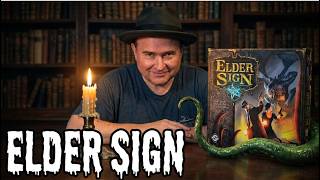

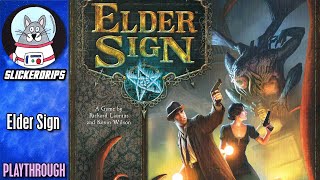

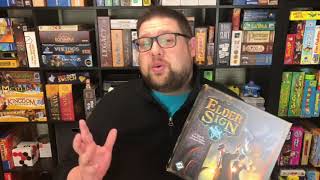



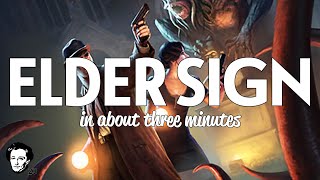


Elder Sign Deep Dive
What the Community Thinks About Elder Sign
Elder Sign occupies a unique position in the board gaming landscape. It draws from the rich Lovecraftian universe that Fantasy Flight Games has built across multiple titles, delivering the Arkham Horror experience in a lighter, more accessible package. Community reviewers consistently praise the game for its quick setup, straightforward dice mechanics, and thematic immersion, but opinions diverge sharply on its difficulty curve and long-term appeal. Some see it as an excellent entry point to cooperative gaming, while others find the core experience repetitive without expansions.
Core Mechanics That Define Elder Sign
Yahtzee-Inspired Dice Rolling
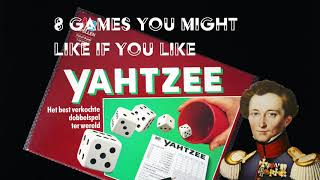
At its heart, Elder Sign is a modernized take on classic dice-chucking mechanics. Players roll pools of six-sided dice and re-roll to match symbols on encounter cards, completing tasks before the ancient threat awakens. The system is intentionally simple, what makes it engaging is the resource management layer. Yellow common item dice and red unique item dice expand your pool, while clue tokens earned from successful encounters grant re-rolls on failed checks. The elegance of the design means anyone who has played Yahtzee immediately grasps the core loop, making Elder Sign one of the more teachable cooperative games despite its thematic complexity.
Cooperative Adventure Card Encounters
Rather than fighting a single opponent, players collaboratively tackle encounter cards representing museum adventures and eldritch locations. Each card presents a series of objectives, investigation checks, terror resistance, peril management, that must be completed in sequence or simultaneously depending on card design. Success grants elder signs (the victory condition) and trophies that can be spent to buy more resources. Failure triggers doom tokens, advancing the clock toward the ancient one's awakening. This card-driven structure ensures that no two games follow the same narrative arc, creating a sense of discovery even across repeated plays.
The Elder Sign Experience
Tense Pacing and Push-Your-Luck Decisions
The midnight clock mechanism creates constant tension. Players must complete encounter cards or accumulate consequences before the night advances, triggering mythos effects that add doom tokens. This artificial time pressure forces meaningful choices, should you attempt an encounter now, knowing failure adds doom? Or should you work on easier cards first to build resources? The push-your-luck element becomes particularly intense late-game, where players racing to gather final elder signs know that each failed attempt brings the ancient one closer to awakening. Reviewers consistently highlight how this pacing keeps the game engaging despite its relatively short play sessions.
Cascading Difficulty and Mounting Dread
The game creates a powerful emotional experience through negative feedback loops. When players fail encounters, they roll fewer dice on the next turn, making subsequent encounters harder. Players can mitigate this by acquiring items and allies, but the path to power requires successful encounters, a classic cooperative game catch-22. This mechanical dread mirrors the Lovecraftian atmosphere perfectly; investigators feel increasingly desperate as the ancient one closes in. The horror theme isn't just window dressing; it's embedded in how the systems pressure players toward failure once momentum shifts.
What Makes Elder Sign Stand Out
Arkham Horror's Lighter, Faster Alternative
Elder Sign succeeds by stripping away the complexity that makes its heavier Arkham Horror siblings inaccessible to casual players. While Arkham Horror: The Card Game demands deck construction and offers asymmetrical investigator builds, Elder Sign uses a unified dice pool. Players with completely different character abilities still participate equally in encounter resolution, fostering genuine teamwork rather than solo problem-solving within a cooperative framework. This design choice makes Elder Sign ideal for family game nights or introducing new players to the Lovecraftian universe without overwhelming them with rules overhead.
Robust Expansions That Extend Play Value
The base game encounters can feel repetitive after 10–15 plays, a limitation reviewers frank about discussing. However, the expansions are considered genuinely transformative. Additional ancient ones with unique mechanics, new investigators with powerful abilities, and encounter cards that create entirely new scenarios keep the experience fresh. Unlike some games where expansions feel like padding, Elder Sign's expansions introduce meaningful mechanical variations that alter strategy. Players seeking long-term engagement are strongly encouraged to explore these additions rather than viewing expansion investment as optional.
Potential Drawbacks
Luck-Driven Outcomes and Variance Frustration
The fundamental reliance on dice rolls creates a double-edged sword. While rolling dice creates dramatic moments, bad luck can feel oppressive. A string of failed rolls doesn't just represent setback, it compounds, creating situations where victory becomes mathematically impossible. Reviewers noted scenarios where the game devolves into merely rolling dice for six months of in-game time, watching inevitable defeat unfold. This doesn't bother players who embrace push-your-luck games, but those preferring strategy over chance find Elder Sign deeply frustrating. The game walks a thin line between tension and tedium depending on dice outcomes.
Downtime at Higher Player Counts
While Elder Sign supports up to eight players, the clock-advance mechanism creates dead turns for waiting players. With each advancement triggering mythos cards and doom tokens, observing from the sideline becomes less engaging. Reviewers strongly recommend playing at two to four players, where decision-making remains tight and engagement constant. At higher counts, the "watch others roll" experience undermines the cooperative energy. The sweet spot appears to be solo play or pairs, configurations where players either control the experience fully or collaborate closely without downtime.
If You Enjoy Elder Sign
Players drawn to Elder Sign typically gravitate toward Arkham Horror: The Card Game for a more narrative, deckbuilding-heavy experience in the same universe. King of Tokyo offers similar push-your-luck mechanics with lighter themes and shorter play times. For those seeking deeper cooperative experiences, Dead of Winter and Summoner Wars provide stronger decision-making with less dice dependency. Spirit Island appeals to players wanting more strategic complexity alongside cooperation. The app version of Elder Sign, available on mobile devices, offers portability and excellent polish for those preferring digital implementation of the core mechanics.
What Reviewers Are Saying
"This game did give me a little bit of that control with those item cards, those common and unique items which gave you extra dice. Elder Sign has a lot going on for a dice game. I usually don't like a lot of dice rolling in my games, I like more control, and this game did give me a little bit of that."
— Ryan and Bethany
"Elder Sign is a Cooperative game, a dice Cooperative game set in sort of the Elder chore, Lovecraftian world. It's okay. It's mediocre. I don't like co-op games. We don't play a lot of co-op games. This is not a channel you're gonna find top 10 co-op games, because I can't, I don't like co-op games."
— Tabletop Turtle
"Elder Sign is one of the Arkham file games from Fantasy Flight games and it's one of the lighter and more accessible ones. The core gameplay loop of rolling dice, matching symbols, and solving encounter cards is very solid. It also has a great phone app. If you hate dice, you're really gonna hate this game, because some bad dice rolls can leave you in a downward spiral."
— 3 Minute Board Games