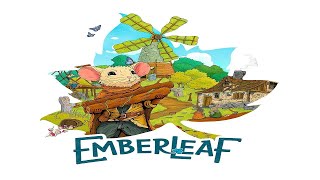











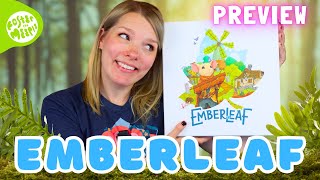













Emberleaf box art

Emberleaf

Game ID: GID0112545
Collection Status
Description

Emberleaf is a competitive card-dancing and tile-placement board game for 1-5 players.

As a brave Emberling, your mission is to rebuild your home in the heart of an ancient forest. To succeed, you'll explore the wilderness, gather resources, clear dangerous areas, and construct new homes for your kin. Along the way, you'll recruit heroes into your fellowship, each bringing unique skills that will help empower your team. But beware - space in the forest is limited, and other Emberlings have their own plans.

The game features:

Card Dancing: Place hero cards within your moving grid to activate skills and enhance your fellowship. Slide cards to trigger powerful combinations and charge them at the perfect moment for even greater effects.
Tile Placement: Build vibrant villages to address the diverse needs of your villagers.
Engine Building: Recruit heroes to acquire new skills and empower your existing fellowship.
Resource Management: Navigate the forest, clear dangerous areas, and collect essential resources.

Every decision you make shapes the destiny of your people. Can you rise to the challenge, guide your village to prosperity, and win the heart of your fellow Emberlings?

—description from the publisher

Year Published
2025
Transcript Analysis
Browse transcript mentions, sentiments, pros/cons, mechanics, topics, quotes, and references.
Total mentions: 15
This page: 15
Sentiment: pos 12 · mix 2 · neu 1 · neg 0
Mentions per page
Top
Showing 1–15 of 15
Video JsmEJzsu5oo Hungry Gamers top_5_list at 5:21 sentiment: positive
video_pk 62410 · mention_pk 154936
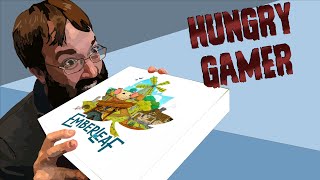
Hungry Gamers - Emberleaf video thumbnail
Click to watch at 5:21 · YouTube ↗
Overall sentiment (raw)
positive
Pros
  • Beautiful art and table presence
  • Clever left-slide interaction and edge-trigger mechanics
  • Enjoyable solo and multi-player experience
Cons
  • Not a traditional deck-builder
  • Can be challenging to learn
  • Pricing/availability may be a concern
Thematic elements
  • city-building and resource management with critters
  • fantasy city-building tableau
  • Array
Comparison games
  • Expeditions
Mechanics (from transcript analysis)
Mechanics unknown.
Video topics + discussion points
No key topics recorded for this video.
Quotes (from this video)
  • It's a delightful little game. Dice chucking, kind of push your luck kind of stuff. Very clever, very quick, very cute.
  • Ember Leaf from City of Games. This is a clever little game with awesome, awesome art, great table presence.
  • Tableau building. It's not really a deck builder, but you get a few new cards as you go.
  • Clever game. I've enjoyed it a lot.
References (from this video)
No references stored for this video.
Video 4abdDaKHvP4 Where There's a Will as There's a Play top_10_list at 12:28 sentiment: positive
video_pk 62375 · mention_pk 154910
Where There's a Will as There's a Play - Emberleaf video thumbnail
Click to watch at 12:28 · YouTube ↗
Overall sentiment (raw)
positive
Pros
  • intriguing card-dancing mechanic
  • engine-building depth with open-world exploration
Cons
none
Thematic elements
  • rebuild, exploration, and hero recruitment in a magical forest
  • Open-world fantasy forest, with a focus on rebuilding a home
  • epic, exploratory campaign vibe
Comparison games
none
Mechanics (from transcript analysis)
  • card dancing — a novel card mechanic where cards interact in a dancing-like sequence
  • engine building — combining cards/resources to optimize actions
  • Resource management — gathering and allocating resources for village expansion
  • tile placement — placing tiles to shape the forest and build spaces
Video topics + discussion points
No key topics recorded for this video.
Quotes (from this video)
  • The fate of creatures touched by the spark of intelligence hangs in the balance
  • This is a flip and roll and scratch and stamp and whatever else you want to do and write
  • open world Cooperative Adventure game even for solo
  • windmill valley was a big hit for me Solo in 2024
  • you start as a child and as such you will have limited sense of interest and skills that will determine your development
References (from this video)
No references stored for this video.
Video FbUP5sjBJXI Let's Table It top_5_list at 8:23 sentiment: positive
video_pk 61790 · mention_pk 154436
Let's Table It - Emberleaf video thumbnail
Click to watch at 8:23 · YouTube ↗
Overall sentiment (raw)
positive
Pros
  • unique moving tableau mechanic
  • multiple viable strategies
  • charming art and approachable feel
Cons
  • complexity may grow with play
  • not as straightforward as it first appears
Thematic elements
  • dynamic card interaction and shifting powers
  • fantasy world with shifting tableau
  • strategic with evolving mechanisms
Comparison games
none
Mechanics (from transcript analysis)
  • kitchen-sink deck interaction — cards interact in multiple ways (play, shift, or slide off) to trigger powers
  • tableau building — the tableau is not fixed; cards slide and shift to alter effects
  • tableau building with shifting cards — the tableau is not fixed; cards slide and shift to alter effects
  • tile placement and some deck-building — tiles and cards combine for scoring and placement options
Video topics + discussion points
No key topics recorded for this video.
Quotes (from this video)
  • this is my number one game of all time right now.
  • And the art is beautiful. The world building is so interesting.
  • Expeditions, however, from what I've heard, is one that you only want to play at lower player counts cuz it gets long.
  • the tableau isn't set in stone. It's constantly moving.
  • We love a co-op.
References (from this video)
No references stored for this video.
Video SEZ3pKBAieM Unknown Channel game_review at 0:03 sentiment: mixed
video_pk 60472 · mention_pk 152881
Unknown Channel - Emberleaf video thumbnail
Click to watch at 0:03 · YouTube ↗
Overall sentiment (raw)
mixed
Pros
  • The core idea—choosing between advancing on your own board or sliding the central board—creates interesting decision weight and replayability, with multiple forks that can lead to different outcomes in subsequent turns. The tension between private progress and communal board momentum gives players meaningful leverage to shape the flow of the game.
  • The sliding mechanic introduces a tactile and spatial component that makes planning feel tangible, giving players a sense of shaping the board in real time rather than relying solely on static card play. This contributes a memorable, physical dimension to the strategic experience.
  • Card-driven actions appear to interact with the board in a way that rewards foresight and planning of several turns ahead, encouraging players to think in sequences rather than single, isolated plays. This fosters a high ceiling for strategic depth among experienced players.
  • The range of potential combinations, particularly when mixing cards that grant movement with those that generate resources, can yield satisfying, chain-like effects when executed well. The sense of building toward a powerful turn feels rewarding when the pieces fall into place.
  • The game's emphasis on resource management and location access adds a layer of strategic depth and can support varied playstyles depending on which cards a player prioritizes. This flexibility invites experimentation and adaptation to opponents’ actions.
  • The thematic flavor comes through in tokens and card names, helping to anchor the abstract mechanics in a forest-spirits mood that can be evocative to players who enjoy thematic coherence. The atmosphere reinforces the strategic feel rather than fighting for attention.
Cons
  • The learning curve is not trivial; new players may need multiple iterations to understand how slides interact with personal board gains and how to optimize sequences across turns. Early sessions can feel like puzzle-solving in a learning phase rather than smooth, intuitive play.
  • Certain slides can feel brittle or finicky, with small misreads of how a particular action will cascade into future turns potentially leading to suboptimal setups. The fragility of some interactions may frustrate players who prefer clear, robust rules without edge-case surprises.
  • The pace can slow down if players over-focus on optimizing a single slide or a single card combo, reducing dynamic tension and potentially increasing downtime between turns. Executing complex sequences can be time-consuming for groups who enjoy brisk play.
  • The balance between private board progression and shared board manipulation may favor players who intuitively plan ahead; less experienced players could find themselves underpowered if they mismanage resources or misread upcoming slides. This can create a steeper entry barrier for newcomers.
  • The component quality and tactile feel matter; if the physical components fail to slide smoothly or if cards lock up, the core mechanic loses some of its intended impact. Durable components and refined manufacturing are important to maintain the intended game feel.
  • If the game emphasizes short sessions, some players may wish for shorter turns or faster resolution; the depth can verge on dense for players seeking lighter experiences. For players seeking tight, quick play, the experience may feel longer and more involved than desired.
Thematic elements
  • Emberleaf is set in a woodland realm where ancient trees and ember-lit embers guide the fortunes of its inhabitants. The game imagines a cyclical day-night cycle in a living forest where player's choices ripple through shifting paths and glowing runes. The setting evokes a fable tone, balancing quiet pastoral imagery with the tension of evolving board states. The forest is not a static backdrop but a responsive system that reshapes the player's options as hidden agendas, resource needs, and allegiance to different grove spirits come into play. The environment is designed to be both atmospheric and functional, giving players tangible cues (token colors, card art, and location icons) that signal which actions become more accessible as the session progresses. Themes of stewardship, risk, and careful allocation of scarce resources appear in the mechanics themselves, encouraging players to think about how small choices accumulate into a broader narrative arc. While the game doesn't rely on overt storytelling blocks, the setting provides a consistent frame that informs both the tone of decisions and the perceived consequences of those decisions.
Comparison games
none
Mechanics (from transcript analysis)
  • action_selection — At each turn players choose between committing a card to their personal board to unlock its ongoing effects, or sliding a sequence of cards on the central board to trigger ex-ante defined abilities. This creates a dynamic tension between private setup and shared board momentum, forcing players to weigh immediate gains against future flexibility. The decision point is designed to feel meaningful and separate, ensuring that even routine turns carry a sense of strategic consequence rather than routine repetition.
  • movement_and_location_changing — Certain cards grant movement or unlocking of new locations when activated. Players can reposition themselves or their pieces to reach otherwise inaccessible zones, opening up fresh sets of actions and potential synergistic combos with other cards. Movement options are not generic; they are tied to card identities and their slide-enabled effects, ensuring that choosing which location to pursue becomes a strategic lever rather than a mere geographic step.
  • player_board_synergy — There is a continuous interplay between a player’s own board and the shared board via slides and card plays. Building coherent sequences yields higher action density per turn and can unlock powerful chain effects as cards align to create a corridor of opportunities. This synergy encourages planning across turns and rewards players who can harmonize their personal development with the evolving board state, creating moments of satisfying synergistic payoff.
  • Resource management — As cards are activated or slides occur, players generate resources (e.g., wood, stone, food) and can trade between resources to access more powerful actions or to fulfill costs for location access, relocation, or advanced abilities. The economy evolves with the board state, creating emergent possibilities across turns. This mechanic rewards careful budgeting and timing, as expensive actions often hinge on precise resource timing and slide outcomes.
  • resource_and_trade — As cards are activated or slides occur, players generate resources (e.g., wood, stone, food) and can trade between resources to access more powerful actions or to fulfill costs for location access, relocation, or advanced abilities. The economy evolves with the board state, creating emergent possibilities across turns. This mechanic rewards careful budgeting and timing, as expensive actions often hinge on precise resource timing and slide outcomes.
  • tile_sliding/board_manipulation — A core spatial mechanic where sliding cards along the board reveals new actions, activates abilities tied to specific cards, and potentially alters the reach of other pieces. The design encourages players to think several moves ahead, anticipating how each slide will enable subsequent actions and influence resource flow. The tactile feedback of sliding cards and watching the board reconfigure contributes to a distinctive rhythm that blends puzzle-solving with tactical planning.
Video topics + discussion points
No key topics recorded for this video.
Quotes (from this video)
  • One decision, one skill.
  • tricky spatial planning exercise to maximize your actions.
  • Brack allows me to walk when I slide him.
  • Puck is going to give me a whole bunch of resources when I slide him off the board.
  • I can also gather some food when I slide ripple.
  • Milo is going to allow me to spend wood to get stone if I want to make that trade.
  • Luna doesn't have a slide action, but I can charge her up with wood in order to allow myself to move to a different location.
References (from this video)
No references stored for this video.
Video 09juPzZXu0U general_discussion at 0:21 sentiment: neutral
video_pk 60475 · mention_pk 152884
Emberleaf video thumbnail
Click to watch at 0:21 · YouTube ↗
Overall sentiment (raw)
neutral
Pros
none
Cons
none
Thematic elements
  • card dancing
  • modern/abstract board game context
Comparison games
none
Mechanics (from transcript analysis)
  • card dancing — cards are moved or arranged in a dance-like sequence as part of gameplay.
Video topics + discussion points
No key topics recorded for this video.
Quotes (from this video)
  • I've got the ultimate edition of Innovation.
  • This one is a card drafting game, a civilization builder where you're drafting cards and building an engine.
  • Ember Leaf, which is a card dancing game. I don't even know what that is.
  • Which one should I learn first?
References (from this video)
No references stored for this video.
Video qtHEhQS6YMo general_discussion at 0:05 sentiment: positive
video_pk 40367 · mention_pk 122204
Emberleaf video thumbnail
Click to watch at 0:05 · YouTube ↗
Overall sentiment (raw)
positive
Pros
  • innovative card-driven tableau with left-shift refresh
  • player board upgrades via removal create meaningful decisions
  • flexible card placement and planning space
Cons
  • requires in-person play or review to fully assess; not a completed product yet
  • kickstarter preview implies risk and unfinished production details
  • no completed playthrough provided in this discussion
Thematic elements
  • engine-building through card-driven tableau upgrades; resource gathering and map control
  • Map-based strategy with city-building flavor; tableau-driven play with map actions
  • mechanics-driven, lightly thematic
Comparison games
  • Concordia
  • Mombasa
  • Crusaders
Mechanics (from transcript analysis)
  • Area movement — move on map to build, attack, and gather resources
  • Card action selection — play cards from a hand to build a tableau that drives actions
  • Card sliding/refresh — each turn you slide cards left; two cards return to hand and trigger events
  • event triggering — as cards slide off or are played, events trigger affecting future turns
  • Map movement and actions — move on map to build, attack, and gather resources
  • tableau building — cards form a two-row by four-column grid; placement is flexible
  • Upgrading through removal — removing cards/pieces from your board upgrades abilities; not all cards refresh at once
Video topics + discussion points
No key topics recorded for this video.
Quotes (from this video)
  • that is the game Ember Leaf I think it's very exciting
  • I think I would go for this
  • this is something that I definitely want to review in person
References (from this video)
No references stored for this video.
Video Uq0vXXki-no Board Gaming Doctor game_review at 0:06 sentiment: positive
video_pk 38354 · mention_pk 115497
Board Gaming Doctor - Emberleaf video thumbnail
Click to watch at 0:06 · YouTube ↗
Overall sentiment (raw)
positive
Pros
  • Unique card-dancing mechanism that blends programming with tableau engine-building
  • Cozy, approachable euro feel with accessible rules
  • Turn-by-turn decisions stay quick and readable, enabling satisfying chains and engine-building
  • Strong positive interaction opportunities through shared events and resources
  • Solid solo mode with a clear, scalable scoring system and deck cycling
  • High replayability and asymmetry via diverse hero/favor drafting and expansion potential
Cons
  • Iconography and symbol naming can be obscure or small, leading to confusion for some players
  • Some players feel the game can become repetitive due to limited hero draft variety and a maximum draft of four heroes
  • Cards sometimes lack 'pizzazz' and hero abilities can be uneven in appeal
  • Variability in favors can swing outcomes, creating luck-driven variance that may undermine long-term strategy for some players
  • Analysis paralysis can arise from the ever-shifting markets and draft options, especially for newer players
Thematic elements
  • animal-themed, asymmetric tableau/engine-building with areas for neighborhood development and cooperative-leaning interactions.
  • A woodland magical setting where emberlings reclaim their fallen homeland after being vanquished by enemy forces.
  • puzzle-driven, thematic but primarily mechanical with a cozy Euro vibe.
Comparison games
  • Wingspan
  • Ancient Knowledge
  • Tapestry
  • Scythe
  • Agricola
  • New Spirit
  • Newford
  • Age of Innovation
Mechanics (from transcript analysis)
  • area majority — You place figures to expand on the board, building little neighborhoods, which contribute to end-game scoring and shape interactions.
  • area_majority_and_neighborhoods — You place figures to expand on the board, building little neighborhoods, which contribute to end-game scoring and shape interactions.
  • card_dancing_mechanism — A card-programming tableau where you slide cards to the left to activate their abilities in a programmed order. Cards have one-time top abilities, ongoing abilities, and some activate as they leave the board.
  • deck_building — Each player starts with six asymmetric animal cards, can acquire more throughout the game, and can chain together combinations to enhance efficiency and scoring.
  • favors_and_endgame_objectives — A market provides 'favor' cards and endgame objectives that influence scoring and strategic direction.
  • shared_events_and_positive_interaction — Certain actions from cards or events offer benefits that other players can access, creating positive interaction and shared resource opportunities.
  • solo_mode — A dedicated solo/bot system using a 'sister deck' that drives scoring and AI behavior, with scoring tied to the player’s actions and favours.
Video topics + discussion points
No key topics recorded for this video.
Quotes (from this video)
  • First, the card dancing mechanism as they have described it. Or in other words, it's more of a kind of card programming mechanism where you slide cards on your tableau.
  • as someone flies past certain areas on the victory point track, they offer an ability or a one-time event that everyone can participate in.
  • the solo mode in particular offers a deck of cards that is called your sister deck.
  • it's a midweight Euro that I think is quite enjoyable.
  • the turns are fairly quick and straightforward most of the time.
References (from this video)
No references stored for this video.
Video mVAko3B0lEU Board Game Garden general_discussion at 1:39 sentiment: positive
video_pk 30766 · mention_pk 90673
Board Game Garden - Emberleaf video thumbnail
Click to watch at 1:39 · YouTube ↗
Overall sentiment (raw)
positive
Pros
  • Distinct hero cards with charming, unique animal designs and varied abilities
  • Engaging hero-card dancing mechanic that creates strategic depth
  • Solid solo mode against AI with dedicated cards
  • Modular components and thematic synergy align with Isle of Cats lineage
  • Clear endgame structure with trophies that influence planning and pacing
Cons
  • Intrinsic complexity may present a steep learning curve for new players
  • Prototype components referenced in the preview; final product may differ slightly
  • Requires careful tracking of multiple resources and tokens during play
Thematic elements
  • rebuilding, exploration, community-building, resource management, and competing objectives around shelter and safety
  • Forest island home of emlings after a long recovery from a cataclysmic event; post-destruction rebuild era
  • lore-driven arc that follows the emling settlement recovering from conflict with Lord Ves and his forces; story unfolds through cards, buildings, and hero actions
Comparison games
  • Aisle of Cats
  • Aisle of Cats Explore and Draw
  • Race to the Raft
Mechanics (from transcript analysis)
  • Building and villager housing — Players may build general or fellowship buildings; after building, they home villagers (rats, owls, bunnies, frogs) to gain bonuses and victory points from neighborhood synergies
  • Card dancing on the fellowship board — Players place hero cards on an eight-slot fellowship board; on each turn, they slide cards left, resolving onplay, slide, drop-off, and charge abilities; the order and timing of actions matters
  • Compound Scoring — Upon homing villagers, players form neighborhoods of connected buildings; scoring yields VP/leaves for each unique building in a neighborhood, incentivizing spatial planning
  • Favorite cards and scoring phenom — Favorite cards provide endgame scoring bonuses; players count successful favorites to determine final leaf/VP totals
  • Hero cards and solo mode — Each hero card has unique stats and onplay/slide/drop-off/charge abilities; solo mode against sister AI uses teal-backed cards to provide a challenge
  • Neighborhood and building-based scoring — Upon homing villagers, players form neighborhoods of connected buildings; scoring yields VP/leaves for each unique building in a neighborhood, incentivizing spatial planning
  • Resource gathering and storage management — Resources include stone, wood, food, and beehives; players gather, store up to eight (expandable via buildings), and discard excess when needed
  • Resource management — Resources include stone, wood, food, and beehives; players gather, store up to eight (expandable via buildings), and discard excess when needed
  • Walking along paths with danger modifiers — Movement is along clearings connected by paths; dangerous areas add walk actions, and clearing dangers are removed via certain actions to enable easier traversal
  • War Banner track and endgame trophies — A war banner track moves downward by defeating dangerous areas; six trophies drive endgame, with refresh mechanics that repopulate danger tiles and ramp difficulty
Video topics + discussion points
No key topics recorded for this video.
Quotes (from this video)
  • Ember Leaf is the next in the series of the Isle of Cats
  • the hero cards are a huge part of this game
  • this game plays one to five players
  • the endgame triggers when the last trophy is claimed
  • walking along paths is affected by dangerous areas
  • the components... this is a prototype but final product will be the same quality
  • I would be able to gain two victory points or leaves by defeating dangerous areas
References (from this video)
No references stored for this video.
Video vCNCr9_acqA Stillmer Games analysis at 0:03 sentiment: positive
video_pk 11704 · mention_pk 34320
Stillmer Games - Emberleaf video thumbnail
Click to watch at 0:03 · YouTube ↗
Overall sentiment (raw)
positive
Pros
  • Card dancing mechanic is clever and satisfying with a tactile, spatial feel
  • The progression system (villages and bandits) provides organic and tangible game advancement
  • The order-of-operations aspect adds a puzzle-like depth to turns
  • Art and character design contribute to intrinsic motivation and appeal
  • Two main paths to victory allow flexible strategy and player choice
Cons
  • No explicit cons were stated in the excerpt; potential complexity for new players may exist due to multiple interacting systems
Thematic elements
  • village rebuilding and bandit management through evolving player actions
  • fantasy village restoration on a cooperative-looking board featuring bandit threats and character crews
  • commentary-driven, first-person analysis with emphasis on mechanism and progression
Comparison games
none
Mechanics (from transcript analysis)
  • Bandit combat as shared progress — Fighting bandits advances a shared token on a track; six increments by players collectively trigger a trophy, adding collaborative pressure to progress.
  • Card dancing / dynamic card mat — Players hold six character cards on a mat; on their turn they either play a card for an instant ability or shift all cards to the left, triggering abilities when cards are slid off and later rejoin hand.
  • cooperative actions — Abilities trigger based on the order in which cards slide and actions occur, creating a spatial/operational puzzle as Garrick’s ability interacts with leftward shifts.
  • Dual-path scoring with balanced tension — Players can pursue villages for points or bandit-related progress, with both paths contributing to the end conditions and trophy opportunities.
  • Order-of-operations puzzle through card interactions — Abilities trigger based on the order in which cards slide and actions occur, creating a spatial/operational puzzle as Garrick’s ability interacts with leftward shifts.
  • Track advancement — Players progress by completing villages or by fighting bandits, with a shared track that moves row by row and yields rewards as you reach trophy levels.
  • Trophy tokens with top/bottom benefits — When a trophy token is earned, players gain the top (most powerful) benefit, while other players gain the bottom benefit, creating evolving incentives for all players.
  • Turn-based progression without rounds — There is no fixed round structure; the game advances through player turns until the six trophy tiles are exhausted and the game ends.
  • Two progression tracks for endgame scoring — Players progress by completing villages or by fighting bandits, with a shared track that moves row by row and yields rewards as you reach trophy levels.
Video topics + discussion points
No key topics recorded for this video.
Quotes (from this video)
  • there's no round structure in the game
  • the order of operations really does matter
  • I think my favorite mechanism in the game, even over the card dancing mechanism
  • I really like the organic nature of advancing the game here
References (from this video)
No references stored for this video.
Video 0yIV-Wv5TlA Stonemire Games top_10_list at 16:22 sentiment: positive
video_pk 11179 · mention_pk 32863
Stonemire Games - Emberleaf video thumbnail
Click to watch at 16:22 · YouTube ↗
Overall sentiment (raw)
positive
Pros
  • Innovative dancing-card mechanic that creates dynamic sequencing
  • Two-ability-per-card design expands strategic space
  • Open-handed play for family-friendly interaction
Cons
  • Complex for first-time players due to multiple interlocking effects
  • Subtlety of timing may require careful teaching
Thematic elements
  • growth, balance, and seasonal engine-building
  • tableau-building landscape with a nature-forward fantasy theme
  • mutating engine through dancing cards
Comparison games
  • Everddale Duo
  • Finsspan
Mechanics (from transcript analysis)
  • dance/shift mechanic — on your turn you can shift cards on your mat to re-activate abilities
  • hand management — position cards on your map to control activations and timing
  • hand-management with placement — position cards on your map to control activations and timing
  • Multi-use cards — each card often has two activation modes or recurring effects
  • tableau building — build and optimize a tableau with shifting cards for recurring abilities
Video topics + discussion points
No key topics recorded for this video.
Quotes (from this video)
  • In the world of Vantage, nobody cares that I'm trans. I'm merely a passer by chatting with the Denizens, playing games, and participating in trials.
  • Dispatch is eight scenarios. It's a little bit like a superhero animated TV show where you are making story choices.
  • Inkorn is a deck builder in the style of Slay the Spire, but it adds a lot of things that aren't in Slay the Spire without overly complicating the game.
  • Here Lies is a cooperative mystery solving game that does a brilliant thing with limited communication and limited information where one player has all the answers.
References (from this video)
No references stored for this video.
Video a66rQr_23ys Stonemire Games general_discussion at 11:29 sentiment: positive
video_pk 8252 · mention_pk 24183
Stonemire Games - Emberleaf video thumbnail
Click to watch at 11:29 · YouTube ↗
Overall sentiment (raw)
positive
Pros
  • Engaging two-player experience
  • Interesting thematic flavor
Cons
  • Limited player count may reduce replayability for some groups
Thematic elements
  • Nature and forest spirits
  • Two-player strategic duel with mythical forest themes
  • Direct two-player duel with thematic flavor
Comparison games
none
Mechanics (from transcript analysis)
  • two-player competitive play — Head-to-head engagement with shared resources and strategic tension.
Video topics + discussion points
No key topics recorded for this video.
Quotes (from this video)
  • Origin Story and Vantage again this past weekend and they are so so great.
  • It was the best game of Flip Seven that I've ever had.
  • I played Dave the Diver for about an hour last night and had a lot of fun with it.
  • I've played Point Salad, but I have not played Point City.
  • I run a board gaming club at my school in which I have been playing Obsession and Brass Lancashire.
References (from this video)
No references stored for this video.
Video 4dBAH4__gVA The Dice Tower top_10_list at 1:04:50 sentiment: positive
video_pk 8099 · mention_pk 23836
The Dice Tower - Emberleaf video thumbnail
Click to watch at 1:04:50 · YouTube ↗
Overall sentiment (raw)
positive
Pros
  • Distinctive visual identity
  • Smart card interactions and unique twists
Cons
  • Theme may not click for everyone
  • Possibly heavy for casual players
Thematic elements
  • Card-driven engine-building with a strong thematic backdrop
  • Fantasy forest with mystical creatures and a shifting risk-reward engine
  • Story-lite with puzzle-forward progression
Comparison games
  • Resarcana
Mechanics (from transcript analysis)
  • Card-driven engine-building — Cards trigger abilities and unlock future options as the tableau grows.
  • Tableau growth with evolving interactions — As cards are added, new synergies emerge and scoring opportunities shift.
Video topics + discussion points
No key topics recorded for this video.
Quotes (from this video)
  • Would you say that the main message behind this game is that only suckers take the bus?
  • It's a masterpiece of a game.
  • This is a big game actually. A roll and write, Tend.
  • Aridia is a masterpiece of a game.
References (from this video)
No references stored for this video.
Video 4dBAH4__gVA The Dice Tower top_10_list at 1:04:54 sentiment: positive
video_pk 8099 · mention_pk 23832
The Dice Tower - Emberleaf video thumbnail
Click to watch at 1:04:54 · YouTube ↗
Overall sentiment (raw)
positive
Pros
  • Stylish visuals and distinctive look
  • Tight, puzzle-like play that rewards planning
Cons
  • Some players may find the look off-putting
  • Not universally accessible due to rules density
Thematic elements
  • Action-driven card play with a focus on building a tableau
  • Compact card-driven engine with a darker, fantasy mood
  • Story-light with a tactical puzzle element
Comparison games
  • Resarcana
Mechanics (from transcript analysis)
  • Baddies/encounters and cooperative storytelling elements — Foes and cards interact to create ongoing tension and narrative flavor.
  • Card-driven tableau building — Players place and trigger cards to build their boards and powers.
Video topics + discussion points
No key topics recorded for this video.
Quotes (from this video)
  • Would you say that the main message behind this game is that only suckers take the bus?
  • It's a masterpiece of a game.
  • This is a big game actually. A roll and write, Tend.
  • Aridia is a masterpiece of a game.
References (from this video)
No references stored for this video.
Video 7-xz0TV7doA Rolling Dice and Teching Games game_review at 16:50 sentiment: mixed
video_pk 1819 · mention_pk 5255
Rolling Dice and Teching Games - Emberleaf video thumbnail
Click to watch at 16:50 · YouTube ↗
Overall sentiment (raw)
mixed
Pros
  • Brilliant card-play engine-building concept with satisfying combos
  • Relatively clear rules and easy initial teach
  • Beautiful wood components and tactile build
  • Strong late-game payoff as you unlock card slots and engines
Cons
  • Momentum is slow in the early game, which can feel dull
  • Limited direct player interaction for a long stretch
  • Long playtime for 3–4 players (about 90–120 minutes)
  • Box art and presentation may not appeal to all players
Thematic elements
  • territory growth through card-driven actions and modules
  • anthropomorphic animals operating in forest clearings, building and connecting spaces
  • engine-building with modular map and developing chains
Comparison games
  • Concordia
Mechanics (from transcript analysis)
  • Area movement — move between hex clearings on a map to perform actions and build routes
  • Card-driven actions — cards determine actions and can trigger multi-step effects when placed and slid on the board
  • engine-building — sliding cards and chaining effects create increasingly powerful actions
  • hand management — players hold and choose from a hand of action cards each turn
  • trophy/points via danger tiles — combat and risk tiles yield victory points and drive endgame pacing
Video topics + discussion points
No key topics recorded for this video.
Quotes (from this video)
  • The card play of this game was a lot of fun.
  • I wish the momentum would pick up.
  • This is a really clever card game.
  • The art on this box is absolutely stunning.
References (from this video)
No references stored for this video.
Video _4IaP13DxoU Stillmmy Games top_3_list at 0:14 sentiment: positive
video_pk 1300 · mention_pk 3843
Stillmmy Games - Emberleaf video thumbnail
Click to watch at 0:14 · YouTube ↗
Overall sentiment (raw)
positive
Pros
  • Unique dancing-card mechanic adds spatial and sequencing depth
  • Adorable art and strong card design that convey personality
Cons
none
Thematic elements
  • Character-centric abilities and tableau-building
  • Whimsical fantasy world inhabited by anthropomorphic animals with magical abilities
  • Charming, light-hearted
Comparison games
none
Mechanics (from transcript analysis)
  • dancing cards — On a player's turn, cards can be shifted or danced to trigger new abilities; creates a spatial sequencing element and a new type of trigger.
  • on-mat ongoing abilities — Some abilities stay active while a card remains on the player's mat, providing persistent effects.
  • tableau-building — Players construct and manipulate a personal tableau of cards to optimize actions and outcomes.
Video topics + discussion points
No key topics recorded for this video.
Quotes (from this video)
  • The dancing cards mechanism in this game, which I think is one of the standout mechanisms, which is whenever you choose on your turn to instead of playing a card to to dance to shift your cards over, that's this arrow right here. That's when you get this ability.
  • I'm really excited to play Emberleaf again thanks largely due to this amazing card design.
  • The Mandalorian faction pack focuses on neutrality on the track; they don't want to have the force with them, they want it in the middle.
  • We haven't seen all the cards yet, there are a number of cards both in the deck and even the bases that want you to be in that neutral position.
  • I look forward to playing again to explore this faction pack against the other factions.
  • It's a card shedding game, which in general I like card shedding games, but it has a neat neat little tweak...
References (from this video)
No references stored for this video.
Transcript Navigation
Top
Showing 1–15 of 15
View on BoardGameGeek