


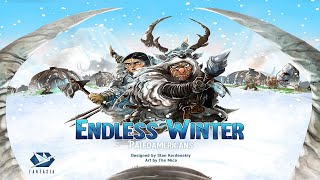










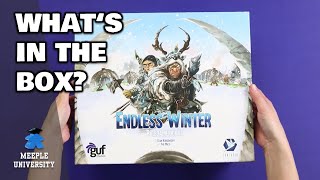





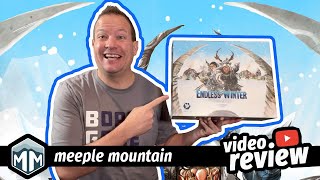














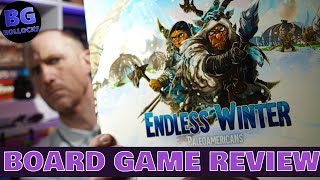
Designed by Stan Kordonskiy (Dice Hospital, Rurik, Lock Up), developed by Jonny Pac (Coloma, Sierra West, Lions of Lydia), solo mode by Drake Villareal (Solani, Spook Manor), and illustrated by The Mico (Raiders of the North Sea, Paladins of the West Kingdom, Valeria), Endless Winter: Paleoamericans takes place in North America, around 10,000 BCE. Players guide the development of their tribes across several generations—from nomadic hunter-gatherers to prosperous tribal societies. Over the course of the game, tribes migrate and settle new lands, establish cultural traditions, hunt paleolithic megafauna, and build everlasting megalithic structures.
Endless Winter is a euro-style game that combines worker placement and deck building in an innovative way. Each round, players send their tribe members to various action spaces, and pay for the actions by playing cards and spending resources. Tribe cards grant additional labor, while Culture cards provide a variety of unique effects. As an alternative, cards can be saved for an end-of-round Eclipse phase, where they are simultaneously revealed to determine the new player order, and trigger various bonus actions.
The game features a novel blend of interwoven systems and mechanisms, such as multi-use cards, area influence, tile placement, and set collection. Plus, there are many viable paths to victory. After four brisk rounds, scores are tallied, and the tribe with the most points wins!
—description from the publisher
- ambitious scope for a gateway-weight game
- surprisingly light for how much is going on
- can feel easy with house rules; needs tightening for two players
- multifaceted resource management with multiple boards
- ice-age/Celtic winter landscape
- puzzle-like yet approachable
Mechanics (from transcript analysis)
- deck-building and set collection — improve actions via cards and fulfill sets for resources.
- engine building — work across terrain, camps, animals, and monuments for synergy.
- multi-board engine building — work across terrain, camps, animals, and monuments for synergy.
Video topics + discussion points
Quotes (from this video)
- it's such a good Gateway game
- the art on the cards looks fantastic
- it's one of those simple flip and write games that you just want to play again and again
- the lazy Susan is genius
- Planet Unknown just knocks our socks off
References (from this video)
- Grounded but innovative blend of mechanics
- Rich theme and variability
- Rule complexity can be intimidating
- Heavy for casual players
- Worker placement meets engine-building
- Prehistoric North America with hunter-gatherer and farming themes
- Cooperative competition with scenario-like scoring
- Dune Imperium
- Concordia
- Gaia Project
Mechanics (from transcript analysis)
- Deck building — Develop a card-driven engine to generate actions and points
- Deck-building/engine-building — Develop a card-driven engine to generate actions and points
- worker placement — Place workers to gather resources and complete goals
Video topics + discussion points
Quotes (from this video)
- it's a wonderful starter game for nearly anyone.
- how have I not played dominion
- when I played Dominion I just felt like an absolute idiot
- the quintessential racing game out there
- it's an absolutely brilliant game
- the best network builder of all time
References (from this video)
- High-quality components, minis, and sturdy boards that cleanly convey roles and pieces
- Multiple viable strategies (animals, terrain, megaliths, deck refinement) with meaningful trade-offs
- Rules feel approachable for a heavy-medium game; intuitive flow once learned
- Strong production values from Fantasia Games and Kickstarter extras
- Clear, engaging engine with tangible goals and satisfying endgame scoring
- Iconography is dense; players may need to reference icons frequently early on
- Complexity is non-trivial and could be intimidating for casual gamers
- Endgame scoring can be lengthy to tally for some players or groups
- tribal development, resource management, area control, and monumental construction via megaliths
- Ancient tribal world during a prehistoric era where tribes compete for resources, use megaliths, and manage terrain and animal resources.
- mechanics-driven with light narrative framing and thematic flavor embedded in card and tab interactions
Mechanics (from transcript analysis)
- Area majority / terrain control — Terrain board controls villages and camps to gain influence and end-of-round bonuses; majority on hexes yields rewards.
- Deck building — Players start with five cards; playing culture cards adds actions; advancing tribes and burying cards affects future draws and endgame scoring.
- deck-building / hand management — Players start with five cards; playing culture cards adds actions; advancing tribes and burying cards affects future draws and endgame scoring.
- Eclipse phase (end-of-round scoring) — After the action phase, players reveal and total labor from cards; eclipse phase grants bonuses based on labor totals and tribal cards in Eclipse pile.
- Megalith tile placement and scoring — Megalith tiles placed on the Megalith board; placement decisions unlock rewards and endgame points, with interactions when four tiles form a square.
- Resource management — Labor and tools are spent to take actions; food is used to bury or recruit cards; tools fuel many actions and are highly valued for flexibility.
- Resource management (labor, tools, food) — Labor and tools are spent to take actions; food is used to bury or recruit cards; tools fuel many actions and are highly valued for flexibility.
- tile placement — Megalith tiles placed on the Megalith board; placement decisions unlock rewards and endgame points, with interactions when four tiles form a square.
- worker placement — Four action columns on the main board; players place chiefs/tribe members to perform actions. First player to take a bottom action gains the bottom bonus; multiple actions can be chained in a turn.
Video topics + discussion points
Quotes (from this video)
- it's The Sweet Spot it's that Medium heavy area where it's not too heavy that you get confused or need to invest a lot
- the rules are not simple nor too complex but they are easy enough to understand
- this is a medium to heavyweight worker placement game
- definitely lives up to its hype
- I like the look of the game including the art and the components
References (from this video)
- Wide breadth of decisions and engine-building potential
- Visually appealing and thematic
- Not as deep as some other big euros
- Rule complexity can feel diffuse
- resource management and tableau-building
- Ice-age survival and civilization building
- cooperative/competitive civilization development
- Gloomhaven
- El Grande
Mechanics (from transcript analysis)
- deck-building with open information — Decks build through actions and resources; open information on board.
- resource management and paced drafting — Collect and optimize resources to advance engines.
Video topics + discussion points
Quotes (from this video)
- Twilight Imperium is over four (weight) and a lot of people still find it rewarding.
- heavy doesn't mean good, and should never be assumed to be better.
- we should have a graph rather than just a chart for weight, depth, and breadth.
- mom threshold: anything below that is considered very simple.
- it's a messy but fun game—Nemesis is a mess with too many rules.
References (from this video)
- spectacular production
- heavy euro experience with rich thematic hooks
- hunter-gatherer society, psychological themes
- Paleo-American era
- heavy euro with thematic subtext about Freud's unconscious
Mechanics (from transcript analysis)
- contract completion / personal objectives — achieve contracts and personal goals tied to the theme
- contracts — achieve contracts and personal goals tied to the theme
- Point to Point Movement — map-based movement to complete actions
- point-to-point movement — map-based movement to complete actions
- worker placement — map-driven worker placement with multiple Run/Tasks
Video topics + discussion points
Quotes (from this video)
- Cascadia has been one of my favorite games lately it's so easy to put on the table and having more to play with is just great
- it's gonna add more way of scoring points and more tiles more cards yeah more end game bonuses
- you can add a fifth and a sixth player to your table that's just amazing because it's such one of those wonderful party games that even people that never play a board game will pick it up in seconds
- if you liked Cascadia this is Cascadia but with more and what's not to like about that absolutely more Cascadia more Cascadia
- it's a two-player Co-Op where you basically need to fly and land the plane
- every airport where you need to land is a different challenge
- the production looks magnificent
- Endless Winter Paleo-American ... absolutely spectacular
- it's going to be a heavy Euro
References (from this video)
- rich combination of mechanisms that cohere
- strong solo implementation
- smooth play for a heavy game
- Worker placement, deck-building, and multiple pathways to victory
- Frosty post-pandemic world with survival and exploration
Mechanics (from transcript analysis)
- Deck-building with multi-use cards — Cards provide actions when drafted and used for multiple purposes.
- Multi-use cards — Cards provide actions when drafted and used for multiple purposes.
- tile laying and building — Construct buildings and control regions for bonuses.
- worker placement — Place workers to take a variety of actions and advance on tracks.
Video topics + discussion points
Quotes (from this video)
- my number 10 is Woodcraft
- the zombies are represented by little cubes
- I love the voucher system here where when you take one of the actions you have to pay certain vouchers and then you also receive other ones
- Frostpunk has aspects of War of Mine it has aspects of Robinson Crusoe
References (from this video)
- Noted as a strong contender for the year
- Not fully explored in the transcript
Mechanics (from transcript analysis)
Video topics + discussion points
Quotes (from this video)
- I still absolutely love this design
- the AI system is so smart
- it's on the totally table Todo list
- Frost Punk is incredible
- I absolutely plan to get to the table this year
- the slide puzzle mechanism I love
- Weather Machine remains one of my favorites
- Sleeping Gods no reason to believe that I won't love this one as well
References (from this video)
- Noted as a strong game in the prior year
- Not on the top anticipated list; unsure why
Mechanics (from transcript analysis)
Video topics + discussion points
Quotes (from this video)
- I still absolutely love this design
- the AI system is so smart
- it's on the totally table Todo list
- Frost Punk is incredible
- I absolutely plan to get to the table this year
- the slide puzzle mechanism I love
- Weather Machine remains one of my favorites
- Sleeping Gods no reason to believe that I won't love this one as well
References (from this video)
- strong Euro-design feel with engaging decisions
- immersive setting that contrasts tropical island life
- complex and can be lengthy
- not ideal for quick island-style play sessions
- resource management and strategic settlement building
- endless winter, paleo-American civilization development
- euro-style, with moving parts and emphasis on systems
- Gloomhaven
- Stone Age
Mechanics (from transcript analysis)
- tile/part management — managing components that move and interact to create actions
- worker placement — allocate workers to gather resources and advance techs
Video topics + discussion points
Quotes (from this video)
- 10 out of 10 ideal Desert Island game
- the Cup's double is great rainwater collection devices
- you can't always get along with family
- it's solo only game
- the theme of the game is being the last survivor in a horror movie
- it's a great Euro game with a lot of moving parts
References (from this video)
- sharp, layered design with many moving parts
- strong production and components
- payoff can feel underwhelming for the complexity
- teaching and setup can be lengthy
- deck-building, area control, megolithic monuments
- prehistoric/early civilization map with exploration
- multi-path, Euro-style emergence
- Twilight Imperium
- Agricola
- Terraforming Mars
Mechanics (from transcript analysis)
- Area Control — control map regions to gain points and bonuses
- Deck building — build a hand of actions and synergy cards
- deck-building — build a hand of actions and synergy cards
- megalith/monolith development — special construction track with scoring implications
- worker placement — send workers to actions with limited uses and timing bonuses
Video topics + discussion points
Quotes (from this video)
- Cat in the Box is a fascinating Twist on trick taking
- the killer for me was I just don't think it was a game that was going to be an evergreen for me
- Endless Winter ... feels kind of like a kitchen sink Euro design
- it's not easy to teach
- I rate this an 8 out of 10
- Nemesis is one of my favorite games of all time
- the crew is a great game
- the new edition feels to me like the one that's going to be best for me
References (from this video)
- Unique blend of mechanics
- Robust design
- Thematic depth
- Player agency
- Multiple strategies
- Interesting eclipse mechanic
- Tribal expansion and civilization building
- North America, around 10,000 BC
- Generational tribal leadership
Mechanics (from transcript analysis)
- Deck building — Players acquire and manage tribe and culture cards
- set collection — Collecting animals and sacred stones for points
- worker placement — Players place figures to perform actions on the board
Video topics + discussion points
Quotes (from this video)
- You are a leader of a tribe and the game follows several generations towards building a more prosperous tribal society
References (from this video)
- great variety of options and strategic choices
- feels like multiple classic Euros in one game
- hidden scoring creates tense finishes
- allows a taste of many mechanics without being too brain-dead
- setup and teardown can be lengthy and fiddly
- production heft and space requirements are substantial
- balance can be off, leading to a sense of one player falling behind
- borrowing from other games may feel less original
- survival, resource management, community-building, monoliths
- Paleolithic era
- epic, multi-path strategy with hidden scoring
- Terra Mystica
- Dune Imperium
- Roads & Boats
Mechanics (from transcript analysis)
- Deck building — culture cards are drafted and used for actions; unused cards go to Clips and can be buried or played later
- deck-building — culture cards are drafted and used for actions; unused cards go to Clips and can be buried or played later
- Eclipse phase — reveal eclipse cards after actions; total labor values determine turn order for the next round
- hidden end-game scoring — final scoring is not fully visible until the end, increasing tension and unpredictability
- hunting/draw — hunt action draws animal cards; use them for eating benefits or form point-earning sets
- idols and tracks — move markers on idle tracks; end-game bonuses awarded to leaders on these tracks
- monolith/mega lift — place or move tiles to a mega lift; placement yields points and bonuses
- Phase structure — action phase, eclipse phase, preparation phase, and final scoring are used sequentially
- Resource management — manage food, labor, and tools to perform actions and fuel growth
- Track advancement — move markers on idle tracks; end-game bonuses awarded to leaders on these tracks
- Variable Phase Order — action phase, eclipse phase, preparation phase, and final scoring are used sequentially
- worker placement — place workers to take actions on the map; first player to go grants a bottom-list bonus
Video topics + discussion points
Quotes (from this video)
- there is an abundance of options not only when you're placing your workers out on a board but with the cards that you have there is loads of things to think about
- it's basically a bit of Catan with the roads and stuff
- hidden final scoring at the end and you're on tender hooks thinking have I done enough to get over the finish line
- it's a massive ball like here
- this game sits best with three players
- if you are into American games then you will want to avoid this like Ebola
- the setup is painful, there's so much stuff to set up
References (from this video)
- Thematic and deep strategic options
- Beautiful art and components
- Heavy for newcomers
- Can take several hours
- tribal development, foraging, and culture
- North America around 10,000 BCE
- epic survival storytelling
- Ark Nova
- Gaia Project
Mechanics (from transcript analysis)
- Deck building — Cards enable family actions and seasonal progression.
- deck-building — Cards enable family actions and seasonal progression.
- Evolution across generations — Build a tribe over multiple generations to optimize outcomes.
- worker placement — Assign family members to collect resources and progress through seasons.
- Worker placement + deck-building — Place workers to forage and build; use cards to enhance actions.
Video topics + discussion points
Quotes (from this video)
- I love worker placement games.
- The spice must flow.
- This stream is about the top 20 worker placement games and we love them all.