/pic8512516.png)





































Eternal Decks Deep Dive
What the Community Thinks About Eternal Decks
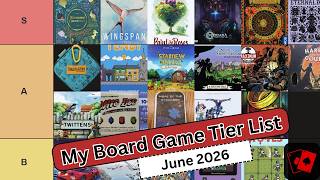
Eternal Decks has emerged as one of the most celebrated cooperative card games in recent years, earning enthusiastic praise from board game reviewers across multiple channels. The game consistently appears on top 10 lists and hotness charts, with reviewers highlighting its elegant design and compelling gameplay. Many reviewers specifically praise it as a standout entry in the limited communication cooperative card game genre, offering significantly more depth and content than typical offerings in this category.
Core Mechanics That Define Eternal Decks
Hand Management Through Card Play
At the heart of Eternal Decks lies a carefully balanced hand management system where players must play cards strategically each turn to maintain their deck size. Players face a critical constraint: if any player cannot play a card on their turn, the entire team loses immediately. This creates constant tension and forces meaningful decisions about card timing and placement. Players can play cards into different rows on the tableau, but they can also pass a card to a teammate when necessary, adding a layer of cooperative coordination that goes beyond typical competitive card play.
Deck Building Through Eternal Acquisition
The deck building mechanics emerge through the game's unique eternal system. When players complete a row by playing the final card against an eternal character, that player gains all the cards from that eternal's deck. This immediately strengthens the player's hand with new cards while introducing special action cards and powerful abilities. However, each eternal also carries a curse that affects the entire team, creating difficult trade-offs. Players must strategically decide when to unlock eternals and which ones to pursue, balancing card acquisition against the mounting challenges imposed by multiple active curses.
The Eternal Decks Experience
Collaborative Puzzle Solving
Eternal Decks delivers a deeply solitary yet shared puzzle experience where players must work together to navigate cascading constraints. Each turn presents a logic puzzle of which card to play in which row given the evolving restrictions. The limited communication rules prevent explicit card discussion, forcing players to speak strategically about game state and positioning without revealing hand contents. This creates moments of both brilliant coordination and frustrating near-misses, making every successful round feel genuinely earned and every loss feel like a shared puzzle failure rather than individual blame.
Intense Strategic Engagement
The game demands full mental engagement from all players throughout every turn. With six different stages offering distinct rule sets and win conditions, each scenario presents a unique puzzle to solve. The game never feels routine because objectives vary dramatically from stage to stage. Some scenarios focus on collecting points, others on surviving specific conditions like a ghost town or labyrinth, and the final scenario culminates in a boss battle. This variety combined with the escalating curse system creates mounting pressure that keeps tension high even in successful runs. The game does not allow autopilot play, making it ideal for gamers who enjoy complete strategic immersion.
What Makes Eternal Decks Stand Out
Exceptional Production Quality
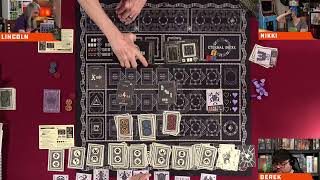
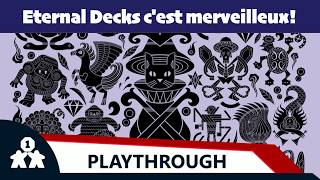
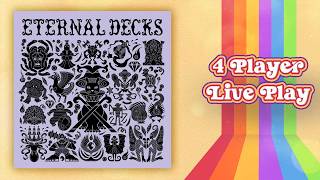
Eternal Decks impresses immediately through its striking visual presentation. The game features a cloth board with a primarily black and white aesthetic that creates dramatic contrast with the colorful cards players add during play. Each card features distinct artwork and color coding that helps players track information without explicit discussion. The production quality extends to component clarity and readability, ensuring that table communication remains possible despite the strict limitations on verbal exchange. The aesthetic design reinforces the game's elegant mechanics while enhancing the overall play experience.
Substantial Content Variation
Unlike many limited communication card games that offer 20 to 30 minutes of play time, Eternal Decks provides six completely different scenarios within a single box, each with its own rules, win conditions, and card selections. Players can replay scenarios indefinitely without exhausting the game's strategic depth because the card draws and player hands create unique challenges each time. This abundance of content means Eternal Decks satisfies players seeking both quick plays and extended gaming sessions. The replayability stems from genuine mechanical variety rather than simple shuffling, giving the game exceptional long-term appeal.
Potential Drawbacks
Demanding Communication Restrictions
The limited communication rules create difficulty for some players, particularly those who prefer straightforward cooperative games where teammates openly discuss tactics. The game's strict constraints on what players can discuss or signal require careful navigation, and poor communication can lead to cascading failures that feel like someone else's mistake. This may frustrate players unfamiliar with this style of cooperative challenge. Unlike some limited communication games where the rule set remains consistent throughout play, Eternal Decks changes its constraints scenario by scenario, requiring players to relearn communication possibilities with each new stage.
Accessibility for New Players
The base game, while mechanically elegant, introduces significant complexity through its tableau rules where different rows have different constraints (ascending numbers, descending numbers, odd values, no matching colors). Teaching the game to new players requires clear explanation of these layered restrictions and the eternal system's mechanics. Some groups may find the early scenarios sufficiently challenging that moving to later, harder scenarios becomes daunting. The game rewards repeated plays as teams learn to read each other's intentions and refine their communication strategies, but the initial learning curve can be steep compared to more straightforward cooperative games.
If You Enjoy Eternal Decks
Eternal Decks attracts players who also love other limited communication cooperative games. The Crew shares the same spirit of teams working together under communication constraints, though The Crew focuses on trick-taking rather than card placement. Take Time offers a lighter, quicker alternative with similar card placement mechanics but simpler rules and faster play. Beasts provides another limited communication cooperative experience with its own unique mechanical twist. The Mind delivers an even more minimalist approach to cooperation where players must play cards in sequence with virtually no communication allowed. For players seeking card games without the cooperative element, Lost Ruins of Varnac offers satisfying hand management and resource management mechanics, though without the collaborative puzzle-solving focus.
What Reviewers Are Saying
"This is such an outstanding card game, one of the best card games I've played over the last several years. This is a limited communication cooperative card game, and I don't always love that style of co-op game, but it's handled very well here. This is essentially a game of hand management with some deck building in there as well. A gorgeous production, but this is such a compelling game system."
— The Dice Tower
"It is just an amazing game. You're trying to stay alive strategically, achieve these goals to be able to get these points. There are all sorts of other content that increases the difficulty. But I like the simplicity of it, here's some basic rules, no colors touching, no numbers touching. But this has this particular rule, and how you manage that card play to stay alive, get people the cards they need and go for those goals, I think it's super cool. It's super pretty."
— BoardGameGeek
"It takes sort of the limited communication cooperative card games and adds a lot of things around it, a lot more mechanism. There's six different stages you can play which are essentially like six different scenarios that you can replay over and over again, but they all have different rules, different variants, different ways that you're trying to win. If you like limited communication card games but you wanted something that's a lot bigger with a lot more meat on the bone, but still extremely streamlined and elegant, Eternal Decks."
— TheGameBoyGeek