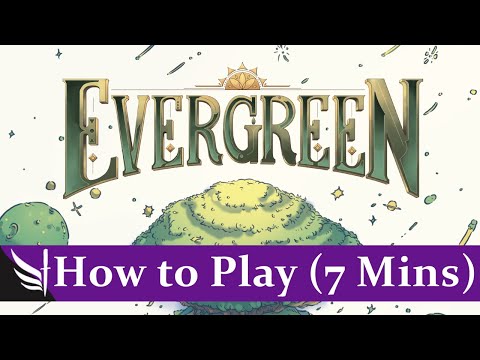














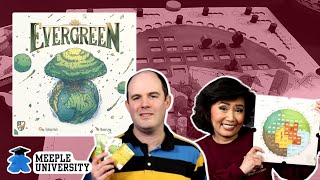

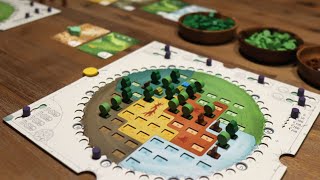















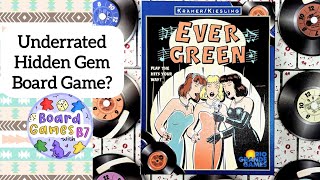
Evergreen box art

Evergreen

Game ID: GID0118223
Collection Status
Description

In Evergreen, your goal is to build a lush ecosystem by planting seeds, growing trees, and placing other natural elements on your planet, trying to make it the greenest and most fertile of all.

You choose biome cards from a common pool to determine which area of your planet you'll develop in a round. The cards not chosen make those regions more fertile, and thus more valuable. To create a huge forest, you want to grow trees, plant bushes, and place lakes, while using the power of nature to gain extra actions. Ideally you can concentrate your trees in the most fertile areas, but without them overshadowing one another as you also want them to collect as much light as possible.

Year Published
2022
Transcript Analysis
Browse transcript mentions, sentiments, pros/cons, mechanics, topics, quotes, and references.
Total mentions: 16
This page: 16
Sentiment: pos 15 · mix 1 · neu 0 · neg 0
Mentions per page
Top
Showing 1–16 of 16
Video 0sWsVu7uC1Q Allies Arene Enemies general_discussion at 0:30 sentiment: positive
video_pk 61020 · mention_pk 153430
Allies Arene Enemies - Evergreen video thumbnail
Click to watch at 0:30 · YouTube ↗
Overall sentiment (raw)
positive
Pros
  • tight, interactive puzzle around the aura-frame mechanic
  • high replayability due to tile drafting and variable board layouts
  • clear, chunky components that visually reinforce game state
  • solo mode presents a distinct, puzzle-focused challenge
Cons
  • components are subject to change in preview copies
  • two-player pacing can be cutthroat; tracking multiple frames at higher player counts can be challenging
  • endgame can feel abrupt if a player ends early and scores are lopsided
Thematic elements
  • ecology restoration, urban regeneration
  • abandoned city being rebuilt to restore ecosystems
  • puzzle-driven tile placement with aura frames
Comparison games
none
Mechanics (from transcript analysis)
  • aura frames — wooden frames that constrain which tiles can be taken and placed, influencing both your options and opponents'
  • ecosystem progression — collect earth, water, and sun tiles to upgrade to novel ecosystems, and then to flourishing ecosystems
  • End-condition and scoring — the game ends when a player cannot place both drafted tiles; scoring includes pollution, ecosystems, flourishing ecosystems, and wildlife tokens
  • Pollution management — pollution tiles accumulate and can be cleared to score points, but they also drive game danger as the board fills
  • tile placement — draft two tiles and place them on adjacent spaces in your city, then place your aura frame on corresponding spaces on the ether board
  • Token Pairing — place wildlife tokens to gain points, with interactions tied to ecosystems and tile placement
  • wildlife tokens — place wildlife tokens to gain points, with interactions tied to ecosystems and tile placement
Video topics + discussion points
No key topics recorded for this video.
Quotes (from this video)
  • the core interaction of this game is what you are doing with those aura frames
  • Overgrown is a tile placement game, and it is really built around that mechanic of the frames and the drafting with frames that are like these aura in the ether as you rebuild these abandoned cities
  • you draft the two tiles in any space in any aura frame
  • the game ends as soon as someone can't place both of the tiles that they drafted
References (from this video)
No references stored for this video.
Video tuSwoFrlmpo Danielle's Board Game Channel playthrough at 0:02 sentiment: positive
video_pk 60917 · mention_pk 153335
Danielle's Board Game Channel - Evergreen video thumbnail
Click to watch at 0:02 · YouTube ↗
Overall sentiment (raw)
positive
Pros
  • Relaxing and easy to learn
  • Beautiful and minimalistic design
  • Compact table presence
  • Good for solo play with AI
  • Family-friendly accessibility
Cons
  • Scoring rules can be tricky and easy to miss details (e.g., forest scoring)
  • Some moments of confusion with AI card choice during drafting
  • Not as tense or strategic as heavier games
Thematic elements
  • Growth and management of trees within biomes
  • Forest biomes across seasons with tree growth and ecology
  • Let's play with commentary and narration
Comparison games
none
Mechanics (from transcript analysis)
  • Biome-specific actions — actions can be performed in the chosen biome or via wild card enabling any biome
  • card drafting — draft a card each turn (fertility/aridity etc.), first-player token assignment
  • drafting / card selection — draft a card each turn (fertility/aridity etc.), first-player token assignment
  • First-player token dynamics — first-player token moves based on AI and card drafting
  • Forest scoring (end-game) — end-game scoring based on the largest forest area per biome
  • growth progression — sprouts grow into small trees, which may grow into big trees
  • Lake placement — place lakes to trigger growth, enhance scoring, and affect biomes
  • season scoring — score points at end of each season based on sun/shadow rules
  • token placement — place sprouts and growth tokens in biomes according to card actions
Video topics + discussion points
No key topics recorded for this video.
Quotes (from this video)
  • it really is such a pretty minimalistic type of design here
  • very very relaxing game, I love this game
  • table space does not take up much space at all
  • I love this game
  • this is such a relaxing and accessible game
References (from this video)
No references stored for this video.
Video dOZ0dvW4FlM Just to the Rogue rules teach at 0:00 sentiment: positive
video_pk 50974 · mention_pk 139915
Just to the Rogue - Evergreen video thumbnail
Click to watch at 0:00 · YouTube ↗
Overall sentiment (raw)
positive
Pros
  • Clear, thorough setup and rules explanation
  • Well-structured phase flow: drafting, actions, and cleanup
  • Solid 2–4 player design with an understandable solo variant reference
  • Strong thematic integration of sunlight, biomes, and forest growth
Cons
  • Relatively high rule complexity with many icons and tokens to track
  • Potential steep learning curve for new players without visual aids
  • Iconography can be confusing without board components displayed
Thematic elements
  • Ecosystem building, biodiversity, sunlight capture
  • Planetary forest ecosystems with biomes and seasons
  • Abstract/nature-themed
Comparison games
none
Mechanics (from transcript analysis)
  • action drafting — Drafted cards grant one of four actions (A-D) and may trigger the power effects or card-specific abilities.
  • action resolution — Drafted cards grant one of four actions (A-D) and may trigger the power effects or card-specific abilities.
  • Biomes and fertility/aridity — Biomes are represented by cards placed into fertility zones; fertility icons, aridity symbols and color coding drive placement and triggering effects.
  • Compound Scoring — At end of round, light propagates and trees are scored based on exposure; collecting light is a core mechanic.
  • drafting — Players draft one card per round and reveal it to set the draft order and place it next to their board.
  • End-game scoring — Final scoring uses the number of big trees per biome multiplied by fertility symbols on cards in that biome.
  • Power track and upgrades — Powers have levels; advancing a cylinder to the right upgrades power effects across biomes.
  • Resource progression — Sprouts can be grown into Small Trees and then Big Trees, occupying spaces on biomes.
  • Season cycle — The game runs over four seasons with a decreasing number of rounds each season, structured into phases.
  • Shadow and light interaction — Trees cast shadows that affect scoring in subsequent phases, adding a spatial strategy element.
  • Special structures and actions — Lakes, bushes, and other board elements provide additional scoring opportunities and forest expansion options.
  • Sunlight scoring / light collection — At end of round, light propagates and trees are scored based on exposure; collecting light is a core mechanic.
  • Track advancement — Powers have levels; advancing a cylinder to the right upgrades power effects across biomes.
  • Variable Phase Order — The game runs over four seasons with a decreasing number of rounds each season, structured into phases.
Video topics + discussion points
No key topics recorded for this video.
Quotes (from this video)
  • Grow Big Trees in the most fertile regions to score the most points and win the game.
  • In this first season the sun shines from top to bottom.
  • Look for the biggest area of orthogonally adjacent connected trees and bushes and score one point for each tree and Bush in it.
  • The game ends after four seasons and there is additional end game scoring.
References (from this video)
No references stored for this video.
Video DBsgTOd1O5o Unknown general_discussion at 1:37 sentiment: positive
video_pk 50915 · mention_pk 139830
Unknown - Evergreen video thumbnail
Click to watch at 1:37 · YouTube ↗
Overall sentiment (raw)
positive
Pros
  • Elegant replacement for Photosynthesis with a cleaner, more thematic flow
  • Beautiful components and modular expansions add variety
  • Strong sense of forest-building and light management
  • Low friction once rules are learned; good for people who like crunchy Euro mechanics
Cons
  • Requires a group to shine; less engaging with very few players
  • Higher initial learning curve for the drafting and biome interactions
Thematic elements
  • Forest ecology, light management, and ecological strategy
  • Planet board with six biomes and a forest-growth theme
  • Elegant, nature-forward, modular expansion-driven
Comparison games
  • Photosynthesis
Mechanics (from transcript analysis)
  • biome_based_actions — Powers grant actions usable only in the corresponding biome on your map
  • card drafting — Players draft biome-related cards each round to gain powers and actions specific to a region
  • card_drafting — Players draft biome-related cards each round to gain powers and actions specific to a region
  • expansion_modules — Pines and Cacti modules can replace some biomes or plant species, increasing variety
  • sun_and_light_flow — Sun movement around the board governs light gathering and scoring opportunities
  • tile_growth_and_scoring — Trees grow on the separate boards; fertility values determine end-game scoring
Video topics + discussion points
No key topics recorded for this video.
Quotes (from this video)
  • Evergreen replaces Photosynthesis, and not only does it feel more elegant, it looks super cool.
  • The Grid in the game is basically the outline for new Barcelona.
  • The turns are really Snappy they're short they're sharp and thinky.
  • This game is a table hog but it's such a satisfying and gratifying experience.
  • Every time you place a card out your deck gets thinner and thinner.
  • It's the most combo-tastic Point Salad Euro I've ever played.
  • This is such a tightly packed short, strong punching game that really gives you that feeling of deduction.
  • Expanding to Islands and tableau gives a powerful engine.
References (from this video)
No references stored for this video.
Video Xt3eoEaLuYc Chairman of the Board general_discussion at 0:36 sentiment: positive
video_pk 13178 · mention_pk 38549
Chairman of the Board - Evergreen video thumbnail
Click to watch at 0:36 · YouTube ↗
Overall sentiment (raw)
positive
Pros
  • Clear evolution of the photosynthesis concept with less cutthroat competition
  • enjoys the light-based scoring and zone-drafting mechanic
Cons
none
Thematic elements
  • Light-based growth and tree placement
  • Forest/woodland environment with solar movement
  • Strategic, forward-planning with visual tree growth
Comparison games
  • Photosynthesis
Mechanics (from transcript analysis)
  • drafting — Card-based drafting to determine zones of action and scoring opportunities
  • individual player boards — Each player manages their own board; different from the shared board of photosynthesis
  • sun/lighting factor — Sun direction affects scoring each round; introduces spatial planning and blocking/shading considerations
Video topics + discussion points
No key topics recorded for this video.
Quotes (from this video)
  • Evergreen is actually I suppose a spiritual successor to the famous photosynthesis board game.
  • this one has more focus on the light points and the way you actually take your actions is different as well because it does use this drafting system
  • this game was like gold dust for a long long time
  • the production of these games is absolutely stellar
  • these Magi 7 dice are absolutely gorgeous
References (from this video)
No references stored for this video.
Video cl3a1WZvJtE Going Analog top_10_list at 1:01:55 sentiment: positive
video_pk 10917 · mention_pk 32153
Going Analog - Evergreen video thumbnail
Click to watch at 1:01:55 · YouTube ↗
Overall sentiment (raw)
positive
Pros
  • Elegant, smooth scoring system
  • Beautiful, compact components and art
  • Fun, approachable evolution from Photosynthesis
Cons
  • Potential learning curve for new players beyond light intro
  • Maps can feel non-symmetrical, requiring adaptation
Thematic elements
  • Forest ecology and growth optimization
  • Forest grove with trees growing in a sunny biome
  • Cute, colorful, approachable
Comparison games
  • Photosynthesis
Mechanics (from transcript analysis)
  • Drafting to biomes — Draft cards to establish biomes; growth and secondary powers build a forest.
  • Fertility zones — End-game multipliers and endgame scoring based on biomes and fertility positions.
  • Sun movement and light scoring — Sun positions move around the board, affecting light capture and scoring.
  • Two sizes of trees and bushes — Seedlings, small trees, large trees, and bushes; bushes grant growth bonuses.
  • Two-phase actions — Main growth action and a secondary action, including a growth multiplier in fertility zones.
Video topics + discussion points
No key topics recorded for this video.
Quotes (from this video)
  • it's not terribly complicated but you get that same feel as more complicated games it's just really elegantly designed
  • the stone thing is so cool it's so weird is because it looks like a limitation and it almost feels initially like oh they didn't really think this through but then totally thought yeah
  • I absolutely love this game but if I had to pick something negative to say I think I've already played it a bunch and I'm starting to be familiar with the deck
  • the 3x3 grid like that alone ... that's a really cool idea of like having to pick which row and which column to trigger
  • it's a contender for my early game of the year
References (from this video)
No references stored for this video.
Video cEh4ujQIg0A Tabletop Turtle top_10_list at 3:38 sentiment: positive
video_pk 9485 · mention_pk 28051
Tabletop Turtle - Evergreen video thumbnail
Click to watch at 3:38 · YouTube ↗
Overall sentiment (raw)
positive
Pros
  • clever sun-shadow mechanic
  • strong thematic integration
  • engaging for conversation
Cons
none
Thematic elements
  • growth, ecology, sun-shadow scoring
  • A garden/ecosystem with a rotating sun track around a board
  • abstract, nature-inspired
Comparison games
none
Mechanics (from transcript analysis)
  • card drafting — Players select cards to plant trees or sprouts.
  • sun-shadow scoring — A rotating sun affects scoring by casting shadows.
  • tile/area placement — Players place cards to grow their ecosystem.
Video topics + discussion points
No key topics recorded for this video.
Quotes (from this video)
  • it's a very clever mechanic
  • I like this game a lot
  • the sun rotates around the board
  • it's the kind of game that also allows for strategy if you want to think that way
  • quilting is the sexiest of textiles
References (from this video)
No references stored for this video.
Video wwYEjnPNRso Unknown Channel game_discussion at 1:21 sentiment: positive
video_pk 9286 · mention_pk 27417
Unknown Channel - Evergreen video thumbnail
Click to watch at 1:21 · YouTube ↗
Overall sentiment (raw)
positive
Pros
  • Ideal for two players
  • Strategic depth in a lean package
Cons
none
Thematic elements
  • Calm, competitive tension with a nature-forward vibe
  • Two-player strategic duel in a cozy, natural theme
  • Elegant, minimalistic thematic storytelling through play
Comparison games
none
Mechanics (from transcript analysis)
  • positional/area control — Two-player tug-of-war style play with strategic positioning.
  • push-and-pull mechanic — Mechanics that create tension as control shifts between players.
Video topics + discussion points
No key topics recorded for this video.
Quotes (from this video)
  • And no other game does four players better than Black Rose War.
  • In Aridia, you read the character's encounter card and choose one of the available dialogue options.
  • There's even genuine character exploration here, which you almost never see in other board games.
  • The card you purchase or draft for the round comes straight to your hand.
  • This is the game that will push deck building to the next level.
  • The setup is a nightmare. The bookkeeping is tedious and the play time is insane.
  • Every decision here feels meaningful.
  • Nemo's War is exactly what I enjoy from a good solo board game.
  • The open seas feel ripped straight from a Jules Verne novel.
References (from this video)
No references stored for this video.
Video DxHuai-94pY John Gets Games general_discussion at 30:47 sentiment: positive
video_pk 9018 · mention_pk 26615
John Gets Games - Evergreen video thumbnail
Click to watch at 30:47 · YouTube ↗
Overall sentiment (raw)
positive
Pros
  • aesthetic appeal and approachable drafting
Cons
none
Thematic elements
  • card drafting to influence biomes and plant growth
  • river of cards and biomes; forest growth
Comparison games
none
Mechanics (from transcript analysis)
  • central tableau card drafting — draft from a river to influence planting and scoring areas
Video topics + discussion points
No key topics recorded for this video.
Quotes (from this video)
  • I'm actually going to split this into two parts today.
  • I'm going through the board game geek Pages for each one of them in alphabetical order.
  • I think it's time to start talking about these games.
References (from this video)
No references stored for this video.
Video wx6ntHNGwqk Board Game Ramblings general_discussion at 27:31 sentiment: positive
video_pk 6416 · mention_pk 18993
Board Game Ramblings - Evergreen video thumbnail
Click to watch at 27:31 · YouTube ↗
Overall sentiment (raw)
mixed/positive
Pros
  • Beautiful production; accessible entry; good card system
Cons
  • Feels derivative of Photosynthesis; theme can feel thin
Thematic elements
  • nature growth, ecological drafting
  • biomes with trees and sunlight in a forested world
  • abstract-eco puzzle
Comparison games
  • Photosynthesis
  • Canopy
Mechanics (from transcript analysis)
  • drafting forest cards to grow trees — draft from rows, place on biomes, and level up action tracks
  • track leveling via biome bonuses — selects actions heat up tracks; scoring hinges on biome values
Video topics + discussion points
No key topics recorded for this video.
Quotes (from this video)
  • these two Hannah Makoji and geisha's road are some of the best two-player games in existence
  • World Splitters was a nice cool filler
  • Evergreen was okay
  • 80 euros is not going to happen
  • this is potentially a seal of Distinction level game
References (from this video)
No references stored for this video.
Video -MWFtHPrM84 Board Game Coffee general_discussion at 0:05 sentiment: mixed
video_pk 5676 · mention_pk 88461
Board Game Coffee - Evergreen video thumbnail
Click to watch at 0:05 · YouTube ↗
Overall sentiment (raw)
mixed
Pros
  • Gorgeous art and nautical color palette
  • Distinctive, high-quality minis and ship/crew design
  • Strong thematic cohesion between art and mechanics
  • Rulebook and component design are clear and readable
Cons
  • Fragile board seams/packaging in the initial unboxing
  • Some text readability challenges on cards under certain viewing conditions
  • Packaging decisions (mats/box sizing) can be bulky or awkward
Thematic elements
  • Cooperative nautical exploration with monster threats
  • A flooded, rain-soaked world where ships sail the seas and monstrous threats loom.
  • Story-driven with branching outcomes via story cards
Comparison games
  • Sleeping Gods
  • Mosaic
  • Too Many Bones
Mechanics (from transcript analysis)
  • Cooperative Game — Players work together to survive and complete objectives.
  • cooperative play — Players work together to survive and complete objectives.
  • Crew hiring and ship customization — Players hire crew and customize their ship to improve capabilities.
  • Modular board — Map is built from land tiles and port locations to drive exploration.
  • Modular map / tile-based board — Map is built from land tiles and port locations to drive exploration.
  • Narrative choice — Story-driven cards provide choices that influence outcomes.
  • Resource management — Managing crew and resources to sustain expeditions.
  • Resource/crew management — Managing crew and resources to sustain expeditions.
  • Story cards / branching narrative — Story-driven cards provide choices that influence outcomes.
Video topics + discussion points
No key topics recorded for this video.
Quotes (from this video)
  • the art elements look very pretty
  • that's the prettiest packaging I've ever seen
  • I really like the Aesthetics of this game
  • the nautical color palette I enjoy that
  • she's got a tentacle on her shoulder
  • I really like the detail
References (from this video)
No references stored for this video.
Video kbFnjuJLfhk Unknown Channel top_5_list at 0:42 sentiment: positive
video_pk 5445 · mention_pk 16199
Unknown Channel - Evergreen video thumbnail
Click to watch at 0:42 · YouTube ↗
Overall sentiment (raw)
positive
Pros
  • Underrated and engaging family filler
  • Vibrant artwork and accessible design
  • Fast-paced with tactical depth
  • Good for teaching new players
Cons
  • Can be mean or cutthroat in play
  • Chaotic at higher player counts (4-6)
  • Not ideal for players who prefer slow, deliberative pacing
Thematic elements
  • Concert promotion, artist popularity, and record hits
  • Concert promotion and artist management in a competitive music scene
  • Thinky, strategic with shifting influence
Comparison games
  • Tal
Mechanics (from transcript analysis)
  • Compound Scoring — Artists with hits earn more revenue per performance.
  • Concert sequencing and final concert — Organize three concerts and participate in a final concert to maximize earnings.
  • Dynamic tension / changing records — Records shift among players creating tactical pressure.
  • Influence card management — Use influence cards to obligate artists to appear at concerts.
  • Record-based scoring — Artists with hits earn more revenue per performance.
  • time pressure — 1-minute sand timer per turn to force pre-planning.
Video topics + discussion points
No key topics recorded for this video.
Quotes (from this video)
  • Evergreen is seriously and criminally underrated
  • This game is a Hidden Gem and a fantastic choice for family game night
  • Volot is a delightful gem in the world of board games
  • Fantastics is an engaging family board game that truly stands out
  • Kabuki tricks is an awesome game that combines strategic elements with a unique theme
  • The Joker card allows players to perform predictive bids and adds a twist
  • Kabuki tricks is fast-paced, easy to learn, and highly engaging
References (from this video)
No references stored for this video.
Video 9LPSlgBtxvw Board Games Hitting My Table general_discussion at 8:40 sentiment: positive
video_pk 4956 · mention_pk 14750
Board Games Hitting My Table - Evergreen video thumbnail
Click to watch at 8:40 · YouTube ↗
Overall sentiment (raw)
positive
Pros
  • fast two-player play
  • innovative sun/light mechanic with drafting
Cons
  • some players feel it may be too similar to Photosynthesis without enough longevity
  • expansions may be needed to extend a longer playtime variety
Thematic elements
  • eco-systems and sunlight mechanics
  • forest/vegetation growth with sun-driven scoring
  • spiritual successor vibe to Photosynthesis
Comparison games
  • Photosynthesis
Mechanics (from transcript analysis)
  • card drafting — draft cards to manage trees and sun-light capture
  • sun/light movement — the sun path influences tree growth and scoring
Video topics + discussion points
No key topics recorded for this video.
Quotes (from this video)
  • this little Tableau building game is where you're building up this little engine of money creating cards as well as Point creating cards
  • it is aged very well
  • a gimmicky Style game that feels so distinct
  • the top row is worth negative points everything after it is worth positive
  • fascinating I think it is a wonderful deduction game
  • spiritual successor to photosynthesis
  • this Japanese game where you are trying to create these routes connect these passengers
  • Notre Dame cathedral in the center of the board
  • notredam cathedral and the rat threats
References (from this video)
No references stored for this video.
Video qpnnSSPqBZQ RPG Family top_20_list at 31:22 sentiment: positive
video_pk 3504 · mention_pk 10401
RPG Family - Evergreen video thumbnail
Click to watch at 31:22 · YouTube ↗
Overall sentiment (raw)
positive
Pros
  • Beautiful components and art style
  • Interesting ecosystem mechanics
Cons
  • Some find it similar to other nature-themed games
Thematic elements
  • Nature, ecology, and ecosystem dynamics
  • Ecological ecosystem development with cards and trees
  • Strategic tableau-building with nature themes
Comparison games
none
Mechanics (from transcript analysis)
  • Deck-building / card play — Play and draft cards to grow your ecosystem.
  • Victory-point optimization — Balance cards to maximize points via ecological synergy.
Video topics + discussion points
No key topics recorded for this video.
Quotes (from this video)
  • let's buckle up, get you some coffee, stay tuned
  • we're going to share 20 games from 2022 we missed
  • Black History Month—five authors you should know
  • we love you family
References (from this video)
No references stored for this video.
Video MJw_7_PQzM8 Chairman of the Board game_review at 0:32 sentiment: positive
video_pk 2353 · mention_pk 6898
Chairman of the Board - Evergreen video thumbnail
Click to watch at 0:32 · YouTube ↗
Overall sentiment (raw)
positive
Pros
  • Elegant, smooth engine-building and drafting.
  • Clear, approachable rules with a clean presentation.
  • Pleasant family-weight experience with satisfying pacing.
  • Sun/light mechanism is innovative and well-executed.
Cons
  • A bit forgiving and less confrontational than Photosynthesis.
  • May feel looser or less tense for some players; could benefit from tighter balance.
  • Some players with large hands might find components a touch fiddly.
Thematic elements
  • Forest growth, light vs. shadow dynamics, and environmental growth
  • A personal forest-building environment where players map and cultivate trees on their own boards to optimize light absorption.
  • Abstract engine-building with a nature-forward theme
Comparison games
  • Photosynthesis
Mechanics (from transcript analysis)
  • card drafting — Draft cards displayed equal to players plus one; cards determine where you can act and how you can grow.
  • card drafting and action selection — Draft cards displayed equal to players plus one; cards determine where you can act and how you can grow.
  • Endgame scoring by clusters and terrain bonuses — Points come from light on trees, with extra emphasis on the largest clusters and endgame cards that boost points in specific areas.
  • engine building — Drafting cards increases growth markers, enabling more actions and expansion (trees, bushes, rivers) and faster scoring growth.
  • Engine-building through growth markers — Drafting cards increases growth markers, enabling more actions and expansion (trees, bushes, rivers) and faster scoring growth.
  • Independent player boards and tree placement — Players map and grow their own forest on personal boards, optimizing tree placement for light gain.
  • Player Board | Main Board — Players map and grow their own forest on personal boards, optimizing tree placement for light gain.
  • Sun/light rotation — Each round the sun rotates around the board, deciding which trees receive light; bigger trees absorb more light but cast more shadow on others.
Video topics + discussion points
No key topics recorded for this video.
Quotes (from this video)
  • This is a Wonder to four player game.
  • I love everything about the way that mechanism works.
  • It's a really nice family game.
  • rating about a seven maybe even a 7 and a half out of 10.
  • I prefer Veil of Eternity quite a bit more.
References (from this video)
No references stored for this video.
Video 9ubRT4T2kP0 Unknown Channel game_review at 0:00 sentiment: positive
video_pk 1591 · mention_pk 4627
Unknown Channel - Evergreen video thumbnail
Click to watch at 0:00 · YouTube ↗
Overall sentiment (raw)
positive
Pros
  • dynamic and tactical gameplay with shifting records
  • accessible for families and new players
  • vibrant artwork and well-designed iconography
  • short playtime suitable for filler sessions
  • tight interaction and strategic depth when players optimize influence
Cons
  • not for everyone; can be chaotic and cutthroat
  • pre-planning is essential due to time pressure
  • best at 4 players; less balanced at 2-3 players
Thematic elements
  • influence over artists to maximize concert scores
  • concert circuit, managing artists and venues in a competitive market
  • mechanics-driven, competitive, time-pressured
Comparison games
  • Tal
Mechanics (from transcript analysis)
  • Artist discs and movement — discs are positioned on artists and moved as influence shifts occur
  • Concerts — players hold up to three concerts, with Gala concerts doubling points; there is a final concert
  • Hit Record and scoring — the hit record disc can double an artist's score when the artist currently has the hit
  • Influence cards — players play influence cards to move artist discs and influence which artists perform
  • Influence Points — players play influence cards to move artist discs and influence which artists perform
  • Score-and-Reset — the hit record disc can double an artist's score when the artist currently has the hit
  • Time pressure (sand timer) — a one-minute sand timer per turn forces quick planning and decisive action
Video topics + discussion points
No key topics recorded for this video.
Quotes (from this video)
  • Evergreen is seriously and criminally underrated
  • Evergreen is a charming and engaging family board game that masterfully combines tactical decision making with Dynamic and everchanging gameplay experience
  • it's a thinky game
  • I would only play this game at 4 to six player count and not at two or three player count
  • The game play is wild and chaotic with records constantly shifting
  • Evergreen stands out as a delightful filler game that constantly brings fun to the table
References (from this video)
No references stored for this video.
Transcript Navigation
Top
Showing 1–16 of 16
View on BoardGameGeek