/pic5320930.jpg)
Exit: The Game – Dead Man on the Orient Express is a puzzle game modeled after escape rooms.
One murder, eight suspects. By chance, the world-famous private detective Achilles Pussot happens to be on board the train - but he has been knocked out. Can you use his documents to solve the case before the Orient Express reaches Constantinople?
An unforgettable, unique gaming experience. Solve all of the puzzles as fast as you can! Can you solve the case before it's too late?
Starting with season 3, the Exit series is divided into difficulty levels. "Dead Man on the Orient Express" is categorized at hard level.
This game can only be played once. To solve the riddles, you will have to write on, fold, and cut the game materials. This makes it possible to have especially diverse riddles. The paper and cardboard components are recyclable!

Exit: Dead Man on the Orient Express Playthrough
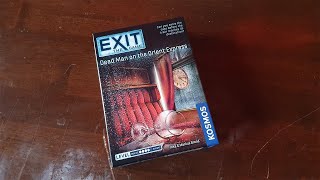
- Immersive, period-accurate theme with a strong detective vibe
- Diverse puzzle types keep the solving dynamic
- Clever integration of clues with the train setting
- Fairly self-contained gameplay without needing external material
- Puzzles can require significant trial-and-error and cross-referencing multiple clues
- One-use components limit replayability
- Solo play can be slower and mentally taxing
- Murder mystery / detective investigation aboard a luxury train
- Early 20th-century train journey from Paris to Constantinople on the Orient Express
- Investigative, puzzle-driven sleuthing with a fixed timeline and a disappeared lead detective
- The Lord of the Rings edition of Exit: The Game
Mechanics (from transcript analysis)
- card management — Clue cards, riddle cards, and answer cards must be organized and used in sequence
- Cooperative Game — Solitaire-style solving in a group, or single-player solo play with no external help
- Deduction — Players gather disparate clues and deduce who committed the crime
- Deduction and clue synthesis — Players gather disparate clues and deduce who committed the crime
- Non-cooperative/solitaire play within a shared objective — Solitaire-style solving in a group, or single-player solo play with no external help
- One-use components — Most physical components are single-use and cannot be reused on subsequent playthroughs
- Puzzle solving — Riddles, codes, ciphers, and physical puzzle elements drive progress
Video topics + discussion points
Quotes (from this video)
- I really enjoyed this one
- this you make a little bit of a mess with these things
- nine stars out of 12
- it's literally as simple as that
- I hope you followed along easy enough
- the puzzles can be tough but very rewarding when they click