/pic7388989.png)


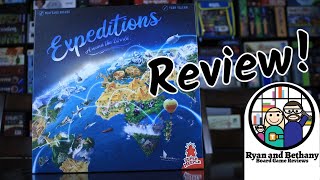







Expeditions: Around the World Deep Dive
What the Community Thinks About Expeditions: Around the World
Expeditions: Around the World stands as a route-building classic that captures the spirit of exploration without demanding the complexity of modern design. Originally published in 1996 and designed by Wolfgang Kramer, the game has endured as a lighter, more chaotic alternative to the well-worn path of route-building heavyweights. Channels like BoardGameBollocks, Board Stupid, and Board Games for One highlight its ability to deliver both engaging strategy and genuine laughs when expeditions veer off course.
Core Mechanics That Define Expeditions: Around the World
Directing Shared Routes and Claiming Destinations
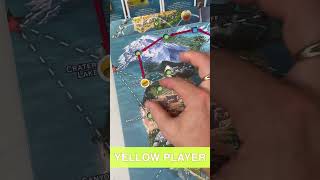
The game revolves around three color-coded expeditions that all players advance collectively on a shared board. On each turn, a player places an arrow connecting one location to another, moving one of the three expeditions forward along the map. When an expedition reaches a location matching a card in a player's hand or a public objective, that player claims the card for end-game scoring. This mechanism creates a tug-of-war where every player's turn nudges the world map toward someone else's advantage or away from it entirely. Cards left unclaimed in hand cost points, incentivizing players to pursue or discard their targets before the game ends.
Strategic Loops and Ticket Mechanics
The board includes wraparound locations that allow expeditions to form loops, creating multiple access routes to hard-to-reach regions. Players collect tickets through special locations, granting the power to advance a second expedition on a turn or to backtrack and remove an opponent's last move. These mechanics prevent the game from feeling like pure manipulation and reward forward planning. The loop strategy, in particular, transforms what could be simple geographical frustration into a genuine tactical layer where savvy players revisit earlier board areas to reach new destinations.
The Expeditions: Around the World Experience
A Game of Joyful Sabotage
The core appeal lies in the satisfying moment when you divert an expedition away from an opponent's carefully marked target location. The game thrives on table interaction and good-natured chaos. Players track each other's marker positions on the map, creating a constant dance of interference and counter-play. The best moments arise when an opponent groans in frustration as you deliberately route an expedition toward your own cards rather than theirs. This dynamic keeps all players engaged on every turn, even when it is not their moment at the table.
Pick-Up-and-Play Accessibility
The rules are straightforward enough to teach in minutes: place arrows, reach destinations, collect cards, score at the end. There is no deck management, no resource conversion chains, and no hidden information beyond player hand cards. This simplicity masks surprising depth. While a first game plays quickly and light, repeat plays reveal that location placement, marker positioning, and loop creation reward careful planning. The game scales from two to six players, though fewer players mean less collective route chaos and more direct control. New players can compete immediately, and experienced players find room for subtle strategizing without complexity overwhelming the experience.
What Makes Expeditions: Around the World Stand Out
Vintage Design with Modern Appeal
Expeditions wears its age proudly. The board features hand-painted artwork depicting famous world landmarks, and the artistic detail across continents is genuinely impressive. This aesthetic decision anchors the theme in a way many modern route-builders neglect. The vintage feel does not stem from obtuse rules or needless chrome; rather, it comes from a confidence in simple, elegant design. Players are not overwhelmed by flavor text that exists only for flavor. The experience feels both timeless and grounded in a particular era of game design.
A Distinct Place Among Route-Builders
The community frequently compares Expeditions to Ticket to Ride and Pandemic. Unlike Ticket to Ride, Expeditions embraces shared routes, replacing point-and-claim lanes with collaborative route advancement. Unlike Pandemic, there is no crisis escalation or cooperative win condition. Instead, Expeditions occupies a unique middle ground, more interactive than Ticket to Ride but lighter than Pandemic, offering a gateway path for non-gamers while rewarding players who appreciate route-building mechanics. This positioning makes it an ideal choice when the table wants engagement without overwhelming depth.
Potential Drawbacks
Geography as Friction
The far reaches of the map can feel artificially constrained. Placing markers on remote locations is viable but inefficient; the expeditions struggle to reach distant continents in reasonable time. Smart players learn to anchor markers in central regions. This geographical bias is not a rules error but rather an intended design choice that punishes overly ambitious card draws. First-time players may feel frustrated when they hold cards for far-flung destinations and watch the expeditions ignore them. Understanding this dynamic converts frustration into tactical positioning.
Expedition Momentum and the Third Route Problem
In practice, one or two expeditions typically dominate the game while the third lingers unmoved. This appears to stem from board geography rather than luck, but the result is that certain expeditions feel secondary. A clever player can resurrect a dormant route through loop strategy, but this requires advance planning and opportunity. Groups that accept this imbalance as part of the experience embrace the asymmetry; those seeking perfectly balanced deployment may find it frustrating that one expedition feels underutilized.
If You Enjoy Expeditions: Around the World
Consider Ticket to Ride if you want the same route-building satisfaction with more individual player agency and modular board variety; Expeditions works as a lighter, more interactive predecessor. Try Pandemic if the escalating tension and shared board appeal to you, though note that Expeditions shifts that interaction to competitive play. For players seeking interactive, lighter route-builders, Carcassonne offers tile-placement route-building with less geography friction. Those drawn to the vintage aesthetic and light complexity will find Expeditions retains a directness that many modern designs trade away.
What Reviewers Are Saying
"Expeditions around the world is a really fun light game that feels like a precursor to Ticket to Ride and all of that stuff, and it does have a whiff of 70s vintage about it and can be frustrating if you let the expeditions get away from you."
— BoardGameBollocks
"If I had a group that wanted to play something like Pandemic or Ticket to Ride, I would play this instead."
— Board Games for One
"It's this route building, picking up location cards, with a little bit of an educational piece, seeing all the facts about the different locations you have to get to. I think it's really really fun with a cool little combo element if you like to be a little bit more board gamey, creating loops to then split off and get different things."
— Board Stupid