/pic5950783.jpg)













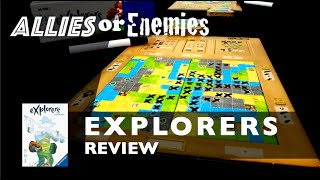






Explorers Deep Dive
What the Community Thinks About Explorers
Explorers is a 2021 flip-and-write from Phil Walker-Harding that has earned genuine enthusiasm from board game reviewers across multiple channels. Channels like The Broken Meeple, Board to Death TV, and Watch It Played highlight how the game delivers meaningful decisions and surprising depth in roughly 20 minutes, all while remaining accessible to players of any age or experience level. The consensus is that it punches well above its small footprint.
Core Mechanics That Define Explorers
Simultaneous Exploration and Map Building
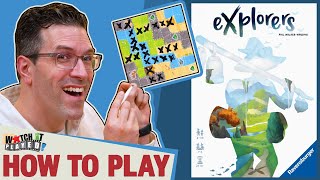
The heart of Explorers lies in its flip-and-write structure where players reveal terrain cards each turn and choose which region type to mark on their randomized maps. Each card shows different terrain types, and players cross off matching spaces on their maps, with the constraint that every mark must remain connected to previously marked squares. The active player marks more spaces of their chosen terrain, while other players either match that terrain with fewer marks or choose the opposite terrain. This elegant asymmetry keeps all players engaged simultaneously without downtime.
Layered Scoring with Icons and End-Game Bonuses
Beyond simple map completion, Explorers rewards players for uncovering specific icons scattered across their terrain. Collecting gems, provisions, keys to unlock temples, and special bonuses creates multiple scoring vectors. Players pursuing different scoring strategies can all find success, whether building gem engines, racing to unlock temples, or optimizing village multipliers. The addition of optional achievements in expert mode transforms familiar paths into new puzzles and gives the design real legs.
The Explorers Experience
A Smooth, Flowing Game That Respects Your Time
One of Explorers' strongest qualities is how quickly it moves without sacrificing decision weight. The short playtime holds even with four players because the game uses simultaneous action phases, eliminating turns spent waiting for opponents. Despite its brevity, every turn demands genuine thought about trade-offs: do you chase the terrain that unlocks a temple, or gather gems for steady scoring? Do you build toward a village multiplier, or diversify across different tracks? These decisions are never obvious, yet the game never punishes you severely for a wrong call, making it feel rewarding rather than stressful.
Beautiful Production That Rewards Replay
The physical presentation of Explorers enhances the experience beyond its elegant mechanics. The game uses double-sided terrain tiles arranged in random orientations, creating an enormous number of possible map combinations. The dry-erase components are premium quality, the artwork is vibrant and immediately readable, and the entire package encourages multiple plays in a single session. Players consistently find themselves reshuffling tiles and starting another game to chase different layouts or scoring combinations.
What Makes Explorers Stand Out
Phil Walker-Harding's Signature Economy of Design
Phil Walker-Harding has built a reputation for extracting maximum gameplay from minimal components, and Explorers exemplifies this philosophy. The player boards contain clever slots that hold terrain and scoring tiles perfectly, everything fits into a small footprint, and the rulebook is concise yet complete. The game avoids unnecessary chrome while delivering the strategic depth players want. This restraint keeps the price reasonable and the setup quick, making Explorers accessible to families and experienced hobbyists alike.
Depth Beneath a Simple Surface
For players familiar with heavier games, Explorers offers surprising strategic depth through its interaction between drawn cards and resource adjacency. While simpler than traditional Euro systems, the choices around terrain selection and token economy create situations that feel fresh each round. Players must manage the constraints of their active map state, creating interconnected decisions rather than isolated choices, which is why reviewers keep returning to it as a quick but genuinely thoughtful filler.
Potential Drawbacks
Luck in Tile Draws and Variable Map Difficulty
The randomness of terrain tiles is a feature, not a bug, but it does mean some map configurations are naturally easier or harder to score on. Players cannot control which terrain appears each round, only how they respond. Similarly, a player pursuing a specific temple unlock might see the needed terrain bypass them entirely. This luck element keeps the game accessible to casual players but means competitive players occasionally feel the sting of unfavorable card sequencing.
Limited Player Interaction
Explorers is fundamentally a simultaneous puzzle where each player solves their own map problem. Beyond the tension of seeing which terrain option opponents will choose each turn, direct interaction is minimal. Players cannot block each other or force unfavorable draws the way they can in competitive worker placement games. For players seeking confrontational gameplay, Explorers may feel somewhat isolated despite taking place around the same table.
If You Enjoy Explorers
Players drawn to Explorers will likely appreciate other Phil Walker-Harding designs, particularly Silver and Gold, which shares the flip-and-write structure with a treasure-map twist. Cartographers is another excellent flip-and-write that focuses more heavily on map optimization and puzzle solving. For those who love simultaneous play with lightweight Euro mechanics, Lords of Waterdeep offers similar accessible strategy in a slightly heavier package. If the appeal is the quick sweet spot combined with surprising depth, Welcome To delivers card-driven flip-and-write decisions in roughly the same timeframe.
What Reviewers Are Saying
"Jesus tap dancing Christ is this game well produced."
— The Broken Meeple
"Phil Walker-Harding is a master at doing a lot with a little, which tends to make his games as affordable as they are approachable."
— Allies or Enemies
"20 minutes is actually accurate for the play time. The solo game is about a 20 minute game, but you're laying out a little map that's different every time, so you've got varied levels of difficulty and replayability as well."
— Board Games for One