


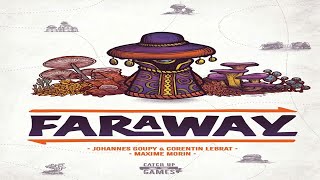






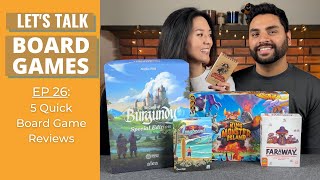





























Welcome to Alula, a mysterious continent with ever-changing geography, shaped after the rhythm of the seasons. Beyond the Sea of Mists lies the mysterious continent of Alula. Roam across the land in search of its secrets, meet its inhabitants and list its wonders in order to gain more fame than your opponents.
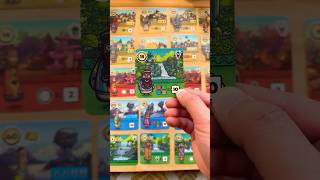
Throughout a game of Faraway, you will play a row of 8 cards in front of you, from left to right. These cards represent the regions you will come across while exploring the lands. Characters on these cards will grant you victory points if you later fulfil the conditions they demand. At the end of the game, you walk back the same way, scoring cards in the opposite order you played them. There lies the heart of the gameplay. Throughout the game, the cards you play will serve both to set new objectives, and to meet the ones you played previously.
Each turn, you play a card from a hand of 3. Then you pick a new card from a face-up river. As play is simultaneous in Faraway, you must take into account a clever priority system in all of your choices – being last to pick a card leaves you with fewer options and often less profitable choices for the next turns.
—description from the publisher
Related Microbadges
Fly-A-Way Review!
Faraway Playthrough
Mechanics (from transcript analysis)
Video topics + discussion points
Quotes (from this video)
- Small box games can sometimes get a bad rap because there's so many board games that release every year.
- Flip Tunes is a really small box clearly.
- it's such an easy game to teach
- Scout is one of the best card games I've played in the last little bit.
- Cascadia Rolling Rivers is a really satisfying game to manage the habitat cards.
- Take Time is a cooperative game that boils down to two sets of cards, 1 to 12.
- The Crew Mission Deep Sea is a cooperative trick-taking game for three to five players.
- Stellar is a really great smallbox game that left my collection.
References (from this video)
- Educational content about birds and conservation
- Engaging route-building mechanic with a distinct bird focus
- Beautiful artwork that complements the learning aspect
- Bird cards provide varied abilities and strategic choices
- Balanced interplay with foul play and squawk mechanics
- Early game can feel slow or sloggy as players establish routes
- Rules can be confusing at first due to placement/route interactions
- Some luck with card draws can impact pacing
- Conservation and endangered species
- Migratory bird routes across Asia
- educational, nature documentary feel
- Train games
- Route-building strategy games
Mechanics (from transcript analysis)
- Bird placement and scoring — Completing a bird's route scores points; some birds grant bonus scoring or abilities.
- Catastrophe cards — Board-wide events that affect all players and adjust strategy.
- Compound Scoring — Completing a bird's route scores points; some birds grant bonus scoring or abilities.
- Conservation/funds cards — Provide points or bonuses based on conservation themes and endangered species.
- end game bonuses — Open country links and bird-related bonuses contribute to final scoring.
- End-game bonuses and open country scoring — Open country links and bird-related bonuses contribute to final scoring.
- Events — Board-wide events that affect all players and adjust strategy.
- Foul play cards — Events that hinder routing; countered by Squawk cards or other mitigation.
- Multi-use cards — Provide points or bonuses based on conservation themes and endangered species.
- Network/route building — Players connect starting habitats to ending habitats along defined paths, with rules about placement and overlap.
- Route Building — Players connect starting habitats to ending habitats along defined paths, with rules about placement and overlap.
- Squawk cards — Countering tools to mitigate foul play effects.
- Winget cards (special abilities) — Drawn to grant special abilities that aid routing or scoring.
Video topics + discussion points
Quotes (from this video)
- This game introduced me to so many different types of birds. I learned through my daughter and through the game.
- The educational part complemented with the gameplay; it worked well together.
- I actually really enjoyed this one.
- We both thought that we're like, is this interesting? This is the train game—it’s a bird game, but route-building at heart.
References (from this video)
- Simple core mechanic (set collection) with interesting scoring decisions
- Expansion adds two new scoring mechanics for variety
- Asymmetric sanctuary-cards combos allow strategic planning
- Late-game scoring can become complex and dense
- Some players may find the expansion adds cognitive load
- Set collection and sanctuary-style scoring with expansion elements
- Abstract, tactical card drafting with ritual scoring
Mechanics (from transcript analysis)
- Compound Scoring — People from Below adds two scoring mechanics that modify end-game scoring.
- Expansion-driven scoring — People from Below adds two scoring mechanics that modify end-game scoring.
- Market drafting with scoring center — Cards are drafted from a shared market with central scoring implications.
- Score from right to left — Scoring runs in the reverse direction of play, requiring forward planning.
- set collection — Players collect cards to form scoring sets.
- Simultaneous action selection — Players act at the same time, not in a strict turn order.
- Simultaneous Actions — Players act at the same time, not in a strict turn order.
Video topics + discussion points
Quotes (from this video)
- Expansion adds two scoring mechanics to Far Away.
- This is basically a set collection game.
- Score from right to left.
- We shuffle everything together, including the expansion.
- This is going to score last because it scores for each set.
References (from this video)
- Expansion content increases variability and replayability with new scoring paths (gray cards, mystic havens, meteorites).
- Backwards scoring mechanic creates engaging strategic tension and planning.
- Clue-driven sanctuary system adds a thematic hook and additional decision space.
- End-of-round market drafting provides a dynamic, competitive tempo.
- Rule complexity and frequent rule-checking may hinder accessibility and slow down play.
- Early rounds can feel chaotic or confusing as players learn new interactions and new expansions.
- Some scoring conditions require multiple prerequisites that may be difficult to track mid-game.
- The need to consult English rules for specific counting (for example whether seven counts for 70s or not) indicates potential ambiguities.
- set collection and exploration with evolving scoring paths driven by clues, sanctuaries, and expansions.
- A modular, region exploration and scoring world where players uncover sanctuaries, clues, and regional developments as they build a line of cards.
- procedural, rules-driven progression with expansion-driven variability
- Let's Go to Japan
Mechanics (from transcript analysis)
- backwards scoring — Scores are tallied from the end of the row toward the start, creating forward-looking decisions about how to build the line.
- card drafting — Each round, players select a card from their hand and place it in a line in front of them; placement triggers scoring opportunities and sanctuary access.
- card drafting and placement — Each round, players select a card from their hand and place it in a line in front of them; placement triggers scoring opportunities and sanctuary access.
- clues and sanctuary system — Clues unlock sanctuary cards, which provide bonus scoring and special abilities; players balance clue collection with sanctuary acquisition.
- Compound Scoring — Some cards require earlier prerequisites, such as having a specific card before you can score a later card, adding planning constraints.
- end-of-round market draft — The player with the lowest duration picks first from the market, creating strategic tempo shifts across rounds.
- endgame sanctuary destruction — Certain sanctuary cards can be destroyed to adjust final scoring, creating deliberate trade-offs between stability and potential points.
- expansion integration — Base game expansions introduce gray cards, mystic havens, and meteorites, expanding scoring paths and card types.
- meteorite behavior (expansion) — Meteorites introduced by expansions stay face-up during scoring and influence endgame expectations and decisions.
- prerequisite-based scoring — Some cards require earlier prerequisites, such as having a specific card before you can score a later card, adding planning constraints.
- region exploration and duration — Players explore a region by placing cards and tracking a duration value for timing and market advantage in the endgame.
- set collection — Players assemble a hand of cards and lay out a row of cards to score based on their attributes and collected bonuses.
Video topics + discussion points
Quotes (from this video)
- Far Away. It is a programming set collection game basically.
- We are going to drop all them like I lay out of cards into a row but we're going to score them backwards.
- The meteorites will not flip over when we go to score.
- I printed the English rules because I need to know if the seven counts for 70s or not.
- I never play this game before and now I have three expansion.
References (from this video)
- compact, quick play with interesting decisions
- replayable and tight scoring
- easy to teach to new players
- reverse scoring can be tricky to grasp at first
- may feel limited to some players
- order of play and end-game scoring
- abstract, small-box card game
- compact and clever
- Welcome To...
- Ganz Schon Clever
Mechanics (from transcript analysis)
- reverse scoring at end — cards are scored in reverse order to create anticipation
- set-up and play order — you must sequence cards to maximize scoring and plan ahead
Video topics + discussion points
Quotes (from this video)
- it's a race to points when someone breaks through that point barrier they win the game so it's really fast it's really tight
- it's a game about magic that feels a little bit like magic
- the tension of when do I take a dice to actually move a camel thus giving other people information
- one of the smartest ways dice are used in any game at all
- it's so mean but it's still so lovely
References (from this video)
- Backwards scoring is clever and drives forward-thinking decisions
- Thematic landscapes and strange creatures reinforce exploration
- Visually appealing with strong table presence
- Short playtime makes it a good filler or lighter strategic option
- Potential hidden gem for the right gaming group
- Not the easiest game to teach
- Backward scoring can confuse first-time players
- Some card interactions may not click immediately
- May require a couple of plays to fully grasp
- Exploration and observation of an alien environment through strategic card management
- A mysterious alien world with landscapes and creatures explored through card play
- Atmospheric and abstract exploration, driven by card interactions and forward planning
Mechanics (from transcript analysis)
- backwards scoring — End-of-game points are tallied from right to left, so earlier cards influence later scores.
- card row progression — A single line of eight cards is played across rounds from left to right, creating a evolving tableau.
- compact tableau in a small box — A tight, stylish package delivering a thinker in roughly 30 minutes for 2-6 players.
- resource and objective cards — Cards grant resources and/or objectives; players must combine them to maximize end-game points.
- risk management — Players balance immediate points with future payoff due to reverse scoring.
- risk/decision tension — Players balance immediate points with future payoff due to reverse scoring.
Video topics + discussion points
Quotes (from this video)
- The backwards scoring is clever.
- Far Away is weird, smart, and stylish.
- It's a thinker in a small box.
- It might confuse first- timers, but if it's your group's kind of thing, this could be a hidden gem.
- For me, it's staying on the radar.
References (from this video)
- Engaging puzzle with interlocking prerequisites and treasure maps
- Clear iconography and strong thematic coherence
- Companion to Castle Combo adds complementary pacing
- Complex to optimize; heavy cognitive load for some players
- Requires careful timing to trigger prereqs and sanctuary bonuses
- exploration and resource management across landscapes
- A world of regions, treasure maps, and sanctuary-card scoring with terrain variety
- instructional and descriptive
- Castle Combo
Mechanics (from transcript analysis)
- card drafting — Players draft cards representing terrain and resources, building a tableau to maximize scoring.
- Compound Scoring — Certain score cards require specific symbol prerequisites from previously flipped cards.
- prerequisite-driven scoring — Certain score cards require specific symbol prerequisites from previously flipped cards.
- reverse scoring with hidden cards — Score is tallied in reverse order to reveal the final sixteen or more points.
- set collection — Cards provide terrain types and symbols; matching sets yield bonuses and prerequisites for higher scores.
- set collection / resource management — Cards provide terrain types and symbols; matching sets yield bonuses and prerequisites for higher scores.
- treasure maps mechanic — Treasure map symbols grant additional draws and choices when you go higher in value.
Video topics + discussion points
Quotes (from this video)
- this is a real mindbend in my opinion
- Far Away really blew me away
- it's wild. And what they actually tell you to do is let's say I put all these cards out in my game play
- the puzzle of figuring out your tableau and how you can score the best
- you've got to think through. Okay. So then this card is going to get discarded
References (from this video)
- Engaging and varied optimization due to card/tokens combinations
- Three thematic pathways and strong majority dynamics
- Tactical battle component adds tension beyond deck-building
- Stunning illustration by Sha Andrew Murray and integration with Gateway universe
- Prototype components and rules may change; current rules are not final
- Complexity can be intimidating for new players
- Setup and organization of three districts/alleys could be time-consuming
- Underground infamy and factional power struggles, with magic and governance through influence.
- A Victorian-inspired city of Gateway, organized into three districts and alleys, featuring factions vying for control.
- Faction-driven deck-building with thematic flavor cards and evolving threats; expressed through urban confrontation and intrigue.
Mechanics (from transcript analysis)
- Action-cost and empowerment — Play a card of an action color, pay its resource cost, and empower with other cards or resource tokens to start the action.
- area majority — Maj orities in alleys/districts earn infamy; endgame scoring adds infamy from cards, defeated enemies, bribes, and on-board majority.
- Area majority and endgame scoring — Maj orities in alleys/districts earn infamy; endgame scoring adds infamy from cards, defeated enemies, bribes, and on-board majority.
- Bribe and recruitment — Recruit merchants to generate cash, wizards to control runestones, and insurgents to gain combat power; bribes grant bonuses.
- card crafting — Craft runestones from Arca and activate them for free actions; runestones level up to grant stronger effects or shorter cooldowns.
- Combat and control — Engage in combat with city guards and monsters; control alleys and districts through majority and benefit from infamy.
- Deck building — Players build their hand by recruiting cards from recruitable decks and their discard piles to improve options.
- deck-building — Players build their hand by recruiting cards from recruitable decks and their discard piles to improve options.
- Resource management — Three resources (Gold, Arca, Power) are spent to perform actions and recruit cards; tokens track progress.
- Runestone crafting — Craft runestones from Arca and activate them for free actions; runestones level up to grant stronger effects or shorter cooldowns.
Video topics + discussion points
Quotes (from this video)
- Gateway is a deck building game in which players compete to assemble the most infamous crew battling for influence in the Victorian inspired city of Gateway.
- As you can see, Gateway is more than just a straight deck builder.
- Players are exploring three different strategic pathways and resources and consistently fighting for the critical majorities that can swing the final scores.
- The game is marvelously illustrated by famed fantasy illustrator Sha Andrew Murray and it is set in the universe of his 2012 fantasy book Gateway: The Book of Wizards.
References (from this video)
Mechanics (from transcript analysis)
Video topics + discussion points
Quotes (from this video)
- I'm Alex Radcliff from Board Gameco. I hope you enjoyed this video.
- I logged 1374 games last year.
- I want to end 2026 by getting backlog down to at least 100 red or fewer.
- I dropped 40 lbs this year instead of the 10 I was aiming for.
- There were 738 videos added to the channel in 2025.
References (from this video)
- tight, elegant drafting
- short playtime into 20-30 minutes
- scales well with two players
- some might find scoring backwards non-intuitive at first
- card drafting and tableau development
- Abstract tableau-building setting
- tight, introspective drafting with backwards scoring
Mechanics (from transcript analysis)
- backwards scoring — At the end, cards are scored from right to left, making early choices less obvious until later.
- Bonus Cards — Bonus cards provide extra scoring opportunities and strategic options.
- card drafting — Draft cards to build a personal tableau.
Video topics + discussion points
Quotes (from this video)
- it's a nice little puzzle
- two players, it's head-to-head and dualistic
- escape room in a box, except it's puzzles
- it's a euro and in that kind of element there's not so much interaction
- excellent at two players
- the stock market element is tricky if others take the cards you want
References (from this video)
- Innovative mechanics that light up the eyes
- Interesting decision space balancing current rewards and future tableau quality
- Multiple viable strategies
- Solid card game design
- Nice colorful artwork despite weird style
- Play time estimates optimistic at 15-30 minutes, actually 45 minutes
- Chaotic with 5-6 players
- Complex graphic design requires double-checking rules
- Journey or passage through terrain
- Building tableau of cards with journey mechanics
- Abstract card-based journey
Mechanics (from transcript analysis)
- Draw condition — Card values determine draw opportunities from bonus card deck
- Reverse scoring — After round completion cards flip and players score by working backwards through tableau
- tableau building — Players build a row of eight cards from left to right with different values
- turn order selection — Card values affect which players pick from available cards next round
Video topics + discussion points
Quotes (from this video)
- You're listening to the Broken Meeple show, a podcast that speaks passionately about board games for the benefit of those who play them
- This is probably one of the most interesting and possibly one of my favorite trick-taking games I've played now
- My eyes lit up you know and it's kind of like the first time I saw that typewriter mechanic for civilization of New Dawn
- People crying that this is like a nearly Flawless game are seriously downplaying the luck problem in this
- This is the Pinnacle of Bland
- There is no excitement in this game, this game just doesn't generate an emotional response
- It generates a lot of fun banter, a lot of cool thinking
References (from this video)
- crunchy, thinky filler
- punchy for a ~30 minute game
- replayable with different scoring goals
- may be too brain-burning for some during a filler slot
- reverse thinking and drafting for scoring
- puzzle-driven, thinky
Mechanics (from transcript analysis)
- card drafting — Draft cards to line up scoring goals that will be executed in reverse order at the end.
- Card drafting with reverse scoring — Draft cards to line up scoring goals that will be executed in reverse order at the end.
Video topics + discussion points
Quotes (from this video)
- it's just it is that quick card drafting. You know, the simultaneous play keeps everyone engaged.
- scouting, which is taking one of the outermost cards on the set that's currently out and taking it into your hand and slotting it anywhere.
- you can't communicate what each of you have outside of in between rounds.
- it's all around, you know, you're rolling these dice behind your little map and then using, you know, dice placement out on kind of a shared board to ultimately try to fly the plane successfully.
- Tumbling Dice had a way of getting to his heart.
- Sausage Sizzle is just absolutely knocked it out of the park in that regard.
- This is the definitive filler game.
- Escape the temple for 10 minutes of excitement and fun.
References (from this video)
- Short playtime (under an hour) and accommodates 2-6 players
- Clear phase structure and relatively approachable rules
- Deep scoring interactions via prerequisites and Sanctuary cards
- Relies on careful tracking of multiple prerequisites and scoring conditions
- Complex scoring sequences can be challenging for new players
- Thematic elements may be light for players seeking a strongly thematic narrative
- Exploration, tableau-building, and sanctuary-driven scoring in a mythical setting
- Fantasy world of regions and sanctuaries explored over eight rounds
- Thematic but mechanically driven with emphasis on card interactions and scoring prerequisites
Mechanics (from transcript analysis)
- End-of-round replenishment — At the end of each round, new region cards are dealt to the middle deck to replenish options
- Phase structure — Game consists of eight rounds with three phases: exploring, sanctuary discovery, and final scoring
- Resource-based scoring and icons — Cards feature resource icons (e.g., Chimera, stones) that influence scoring potential
- Sanctuary acquisition — If the revealed region card is higher than the previous round, players gain Sanctuary cards and possibly extra rewards for clue icons
- Scoring with prerequisites — Many cards provide points only if prerequisites (stones, icons, etc.) are satisfied by the player's current play area
- Secret card draft / tableau placement — Each round players secretly select a region card to place in their leftmost empty region slot of their Tableau, then reveal simultaneously
- Simultaneous reveal and order-based scoring — Region cards are revealed one at a time from right to left to score and check prerequisites
Video topics + discussion points
Quotes (from this video)
- this little game is for two to six players and plays in under an hour it will certainly burn your brain but in the most delightful and relaxing way
- Shuffle the region and Sanctuary cards and form two separate face down stacks at one side of the table
- let's start by saying that each player will play cards on a personal Tableau
References (from this video)
- Engaging drafting, solid rule set, and variety in scoring strategies
- Some players may need more plays to solidify preferences
- card drafting and engine optimization with increasing complexity
- engine-building card game with progressive scoring
- methodical, strategic
Mechanics (from transcript analysis)
- card drafting — First rounds give fewer cards; later rounds increase draw and decision depth.
- Drafting with increasing card plays — First rounds give fewer cards; later rounds increase draw and decision depth.
- engine building — Play cards left-to-right; score from right-to-left with prerequisites.
- Engine-building, left-to-right scoring — Play cards left-to-right; score from right-to-left with prerequisites.
Video topics + discussion points
Quotes (from this video)
- I think out of all of these videos that I've done this is probably the highest quality list that I've done in terms of game recommendations
- gorgeous production I mean the pieces here are absolutely lovely on the table
- one of my favorite deduction games of all time if not my favorite game
- I like how pure and simple it is
- it's criminally underrated
- this one is an absolute absolute belter
- I could not recommend it enough
References (from this video)
- Eight-round structure provides clear pacing
- Multiple scoring avenues via objectives and prerequisites
- Inclusion of sanctuary cards adds additional scoring flexibility
- Relies on flipping cards for scoring, which may affect transparency during play
- Prerequisites can add complexity and potential confusion for new players
- Limited information available from the transcript about game depth
- Unknown
- Unknown
- instructional
Mechanics (from transcript analysis)
- card tableau building — Players add a region or sanctuary card to a personal tableau each round.
- end-of-round and end-of-game scoring — Scoring occurs after the eighth round and determines the winner.
- objectives-based scoring — Scoring depends on whether cards meet predefined objectives.
- prerequisite-based scoring — Some cards score only if prerequisites are met by the end of scoring.
- revealing for scoring — Region cards are flipped and revealed from right to left during scoring.
Video topics + discussion points
Quotes (from this video)
- farway is played over a series of eight rounds
- cards have a scoring potential based on objectives
- some of these cards have prerequisites so that their scoring is effectuated at the end of the eighth round
- all players will have a row of eight region cards which they flip facing downwards and scoring commences
- the player with the most victory points will win
References (from this video)
- Engaging reverse-resolution mechanic creates a unique puzzle
- High tension and strategic depth
- Replayability through variable opening ambitions and timing
- Powerful relics add variety and scoring options
- Steep learning curve for new players
- Complexity may overwhelm casual gamers
- Balancing of relics/icons could be inconsistent
- Ambition, timing, planning under time pressure
- Abstract puzzle world, card drafting with reverse resolution
- Strategic, brain-teasing puzzle with escalating ambition and time constraints
- Catacombs
Mechanics (from transcript analysis)
- card drafting — Players select cards into a line that will be resolved in reverse order.
- Compound Scoring — The effects of cards are evaluated from last played to first, shaping scoring dynamics.
- icon/resource collection — Resources and icons on cards contribute to scoring and trigger additional draws.
- progression/tempo management — Players try to push for ambitious plays while balancing time to execute them.
- relics/bonus cards — Relic cards grant powerful bonuses and influence early scoring depending on when drawn.
- reverse-resolution scoring — The effects of cards are evaluated from last played to first, shaping scoring dynamics.
Video topics + discussion points
Quotes (from this video)
- Far Away is definitely more in the category of what I would say gamers filler.
- It's a lot of fun.
- It's a lot of fun. It's got a huge push your luck thing.
- definitely have demonstrated how to do very poorly in this game.
- Nice.