/pic6362475.jpg)























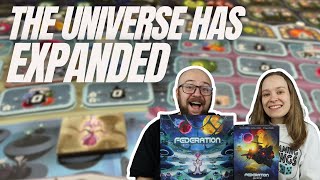

Federation Deep Dive
What the Community Thinks About Federation
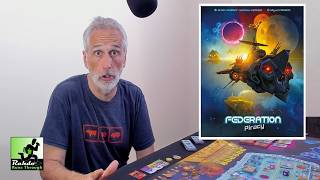
Federation has emerged as one of the standout worker placement games of recent years, earning enthusiastic praise from the board gaming community. Reviewers consistently highlight the game's intricate decision-making and elegant design. The consensus is clear: Federation delivers a compelling experience that rewards both careful planning and tactical adaptation, though it demands engagement and multiple plays to fully unlock its strategic depth.
Core Mechanics That Define Federation
Double-Sided Worker Placement with Area Majority
At its heart, Federation uses an innovative worker placement system where each token can be deployed in two distinct ways. Players flip tokens to the influence side, earning voting power in rows on the Senate board, or to the funding side, contributing resources to planetary projects. This dual-purpose placement creates meaningful tension with every decision. The area majority system adds another layer: controlling specific rows and the left or right halves of the Senate board unlocks bonuses tied to different planets each round. This constant interplay between worker positioning and majority control means that placement location matters as much as the action itself, making each placement spot a weighty choice.
Interconnected Track Advancement
Federation features five planet tracks that serve as the game's core engine. Each planet offers unique mechanisms and progression pathways, from resource conversion to asymmetric player powers. What makes these tracks special is how they feed into one another. Advancing on one planet can unexpectedly benefit progress on another, creating a web of interdependencies. Players cannot max out every track due to limited resources and worker counts, forcing specialization. The influence tokens earned by leading on planet tracks become massive end-game point multipliers, creating long-term strategic arcs that span the entire game. This interconnectedness means success requires understanding not just individual track mechanics, but how they amplify each other.
The Federation Experience
Brain-Burning Decisions Under Tight Constraints
Reviewers consistently describe Federation as mentally demanding in the best way. The game presents multiple viable paths to victory, but resources are scarce enough that you cannot accomplish everything you want. Every round, players must make tough choices about which planets to advance, which majorities to pursue, and how to position workers to enable future turns. The laws that emerge each round create tactical pivots that require immediate adaptation. The complexity comes not from fiddly rules, but from the sheer depth of strategic options and the need to balance immediate gains against long-term positioning. Players accustomed to optimization-heavy euro games will find the decision space rewarding.
Negotiation and Political Maneuvering
Federation invites table presence through negotiation and influence. The worker placement board creates natural opportunities for players to discuss potential blocking, discuss which majorities matter most, and coordinate (or deliberately miscoordinate) their plans. The competitive tension emerges from action placement rather than direct negative effects, allowing conversations that enhance rather than sour the social experience. Players noted that in-person play particularly shines because negotiation becomes easier and more natural. The game encourages players to read opponents' strategies and react accordingly, creating a satisfying back-and-forth dynamic that rewards attention and communication skills alongside pure calculation.
What Makes Federation Stand Out
Meticulous Integration of Mechanics
Federation's greatest strength is how its parts fit together. The planet tracks do not feel isolated; they form a cohesive system where your advances on one world naturally create pressure or opportunity on another. The Senate board voting interacts meaningfully with personal development on the planets. The law cards that flip each round force genuine strategic recalibration rather than mere flavor. Reviewers praised the game for feeling like a carefully tuned machine where every component serves a purpose and enhances the experience. This integration means the game feels like an intentional whole rather than a collection of borrowed mechanisms, giving it a sense of elegance and design that resonates with players who value craft in their games.
Replayability Through Variability and Emergent Strategy
The combination of different planet track configurations, randomized law cards each round, and the variable strengths of different paths create different games. While some reviewers expressed concern about whether the decision space remains fresh after five to ten plays, the interconnected nature of the mechanics means emergent strategies can surprise even experienced players. New players often discover winning approaches they had not considered on first play, suggesting depth that persists across multiple sessions. The game rewards studying specific planet combinations, finding synergies, and developing new openings.
Potential Drawbacks
High Complexity and Teaching Burden
Federation does not teach easily. The interaction between the Senate board, the dual-purpose tokens, the planet tracks, and the law cards creates a web of mechanics that can overwhelm new players. Reviewers noted that the game requires genuine understanding to play well, not just following rule steps. The first play can feel like exploring a maze without a map. Online implementations like Board Game Arena have helped some players learn through repeated play, but the teaching experience remains demanding. Groups should expect that introducing Federation requires patient explanation and acceptance that the first game will be more about learning than enjoying the full strategic experience.
Online Play Limitations
While Federation works mechanically on digital platforms, reviewers agreed that in-person play delivers the fuller experience. The negotiation opportunities that make Federation special lose some potency online, where casual discussion and table dynamics carry less weight. The cognitive load also feels heavier when players cannot see all pieces easily or must manage interface complexity. Some players found that the interactive nature of the worker placement felt less impactful online because managing expectations and reading opponents requires physical presence. Though playable and worthwhile on Board Game Arena, the game truly shines around a table where players can speak freely, bluff about their intentions, and feel the social dynamics of the competition.
If You Enjoy Federation
Players who love Federation often gravitate toward other games featuring similar strategic depth and tactical adaptation. Barrage shares Federation's medium-to-heavyweight profile, offering interaction through area majority and competition for shared resources, with changing objectives that force continuous pivoting. Tapestry likewise emphasizes tracks that players advance with rich interactions across those tracks and resource management pressure at higher player counts. Those drawn to the negotiation aspect of Federation often appreciate games that invite table talk and coalition-building. For players seeking mechanical elegance, games that integrate their systems as cleanly as Federation does will resonate deeply.
What Reviewers Are Saying
"People love how complex the decisions are in this game with many rounds to get what you want perhaps in clever ways. The interconnectivity of the different planet tracks is intriguing. They don't feel very sterile or separated. Interaction is pretty high in this game without it being too punishing or negative with the opportunity to make negotiations over the table."
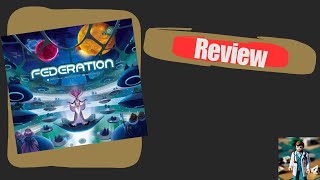
— The Board Gaming Doctor
"Federation is almost a perfect game for me. It does not need fixing. So when we have an expansion, I don't see a reason to not play with it. It is still Federation, and Federation is fantastic."
— Board Gaming Ramblings
"The worker placement in this game is so unique and it really makes each worker placement action so important because you are placing a worker down to do a specific action, but you are also placing a worker down and paying attention to the row and column of where you are placing that action. Just so good. Absolutely love it."
— The Board Game Garden