/pic7019514.jpg)
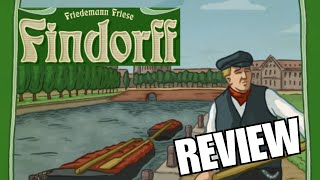
Findorff is one of the 23 districts of Bremen, the hometown of Friedemann Friese. Findorff has three “F”s and is named after Jürgen Christian Findorff (1720-1792), who was responsible for draining and surveying the bog in the north of Bremen, for extracting the peat, and for populating the bog with residents.
In Findorff, the game, you build up the district of Findorff in the period from 1803 to 1916. Historically, six major railway stations stood in Findorff during this period to connect to Hannover, Hamburg, Oldenburg, and Bremerhaven. While they were all later replaced by a single big main train station, you raise another three new rail stations at one of the two main roadbeds. Besides using boats on the peat canal, this small railway helped to transport even more peat from the bog in the north of Bremen to Findorff. During the first half of the 19th Century, peat was the most important commodity for heating the houses and for supplying energy to the industry. In the late 19th century (and in the game), peat lost its importance once when replaced by the energy-rich coal.
Findorff offers an economic engine builder with a resource market for peat known from Power Grid and an innovative resource management required when building rail tracks and houses in Findorff. Your focus is on raising the right combination of the 25 historical structures from the period of 1803-1916. Do you raise the Chair Pipes Factory or the Slaughterhouse to gain a lot of thalers, or smaller structures like Schools, the Beer Hall, or the Peat Skipper Shelter to win the game in small steps. You can even profit from the high mortality rate of this period by running a Cemetery.
Only by adapting your strategy to your structures you honor Mr. Findorff, and win the game when the roadbed to Hamburg is finished.
Findorff offers a challenging solo game as well.

- Dave appreciated the theme more than anyone.
- Glad to play it again to refresh rules.
- Reminded reviewer why they enjoy it.
- Not recommended for two players; drags and scores inflate.
- Can be a tough sell if the theme/location isn't known.
- The reviewer felt it was much better with three players.
- A love letter to the designer's hometown.
- Hometown of the designer
- Power Grid
Mechanics (from transcript analysis)
- Card Drafting — Players acquire cards to build their engine.
- Engine Building — Players build an engine to generate resources and points.
- Resource market — Fluctuating resource market similar to Power Grid.
Video topics + discussion points
Quotes (from this video)
- I think I might have reached my ceiling on how much I enjoy it, which is probably like a solid eight out of 10, but we'll see.
- I tend to like these shedding games more with more players.
- It's sort of like a mind sweep. Imagine like mind sweeper or sudoku style kind of it's a logic deduction puzzle that you can play solo or cooperatively.
- Ingenious was the definite highlight in terms of new games.
- Least favorite if I had to pick would probably be Lawyer Up. Not a bad game by any means, but just in a sea of like really excellent games, it was one that stood out as just kind of okay.
- Ultimately we're making the content that we'd like to watch and hear and that's something that we've always made clear.
- We're not making any grand declarations here of like what we think is right or wrong for other people.
- I don't have anything against paid content and in fact like anyone who does whether it's board game media or like any kind of media um as either like a journalist as a content creator as a reviewer whatever the case may be.
- You should never be getting paid for reviews and and and that's something I can say like across the board.
- If you are doing reviews of games and you're being paid like money for that, I just think that's ethically irresponsible.
- I just I personally I don't see the value in it. I understand why it exists.
- I just think it gets to the point where like if you as a content creator, and again I I want to stress I don't think you're doing anything wrong by taking paid previews.
- And so that that's sort of where I um landed on it.
- The amount of h usefulness that they that how useful they are to people, how many people watch how to play videos, how many people like swear by watching videos instead of reading rule books.
- I just did that because I wanted to know how to play for it.
- But I just think that from the perspective of like I'm a content creator, I'm doing my best to provide content for my audience, and I'm also trying to make a living. Like you're doing their marketing work that should be coming out of their marketing budget for free for them.
- It's it's it's it's tough. Like I from as someone who now was trying to like sort of do this full-time for like you know half a year for 6 months.
- There are a lot of different types of sources and there's creators out there who have done videos uh going into detail about this kind of stuff.
- I agree with you 100% that the review copy is there to provide access to the game.
- Previews weren't fun or enjoyable to make. They just weren't rewarding uh in the same way as most other videos.
- It felt like me just uh freelancing as uh on the marketing team of that company or for that game.
- You realize like I'm basically watching a commercial.
- It's not about that. It's not this isn't supposed to be an opportunity for us to like throw people under the bus or put a spotlight on people that might not want a spotlight on them.
- The other thing is just like a podcast is a better space to have this type of discussion.
- We've never actually paid ourselves yet. Um, in the six and a half years that we've been doing this.
- Quantity content a large part of the time usually means like much less effort content.
- I'm sick of like a news item comes out and it's like something that's really worth discussing, really worth like talking about.
- Rather than it being about like people putting out stuff to discuss it, it's like a 10-minute video of someone summarizing all the things I already know with barely any other insight.
- The quality content takes longer and in a board in a space like board games where you could do quality content and get like you know 5,000 6,000 views and that that's like good for the board game space but that is not good for your wallet.
- It's almost like there's even if I don't threaten it, it's almost like there is a perpetual threat because I made it known, well, we're only here because of Patreon.
- It's just not that there's anything maybe inherently like um disreputable necessarily about someone asking for that. I just I feel like it reminds me a little bit of like relying on customer tips at a restaurant to supplement low wages.
References (from this video)
Mechanics (from transcript analysis)
Video topics + discussion points
Quotes (from this video)
References (from this video)
- Can achieve very high scores (e.g., 900+ in a two-player game).
- Scores can be significantly lower in higher player count games (e.g., 500+ in a three or four player game).
Mechanics (from transcript analysis)
- Compound Scoring — Scores vary significantly with player count.
- Player Count Dependent Scoring — Scores vary significantly with player count.
Video topics + discussion points
Quotes (from this video)
- So, it sounds like you know, we all like a little bit of foreplay when it comes to our board games.
- It really made those rules feel concrete to me though by watching them.
- And he barely needed a refresher. It was his first time playing and he won.
- the disappointment is just because when you're getting into a game like that you're expecting to be like okay well I'm getting into this for like 15 sessions like a year of casual play whenever people can get together and it was like we did two sessions and and I'm the one leading those sessions and I'm no longer compelled to gather people for it because I'm realizing I'm not having a good time
References (from this video)
- easy to learn with a short rulebook (4-5 pages)
- quick play sessions with variable but reasonable length
- strong thematic integration through board and components
- solid solo mode with challenging puzzles
- puzzle-like design and strategic depth derived from a limited build set
- components can feel fiddly or excessive for the game's scale
- board size is large with little end-game benefit to justify it for some players
- bureaucracy step can interrupt flow
- limited building variety reduces replayability compared to similar Rosenberg titles
- some players find variability lacking (compared to Glass Road)
- autobiographical portrayal of a small town's growth
- Bremen, Germany (1900s) district-building and urban development
- historical, autobiographical
- Glass Road
- Fields of Arl
- Power Grid
- Praa Kaput Ragna
- Ada (Adi)
Mechanics (from transcript analysis)
- action upgrading — upgrade actions to gain more efficiency and production tiles
- Building placement — place huts and historical markers; some placements trigger end variably
- Compound Scoring — beat-your-own-score over a fixed number of rounds (25)
- End-game trigger — end condition triggered when track spaces fill (multiplayer) or via solo score target
- market dynamics (Pete) — Pete market fluctuates with use; affects pricing and end condition
- Market Pricing/Manipulation — Pete market fluctuates with use; affects pricing and end condition
- opening moves / scripted starts — initial openings are somewhat scripted with four initial actions
- personal rondelle (action rondelle) — cycle through four actions and move along a personal rondelle, choosing execution and progression
- production tiles vs buildings — balance between upgrading production tiles and constructing buildings
- Resource Management — produce resources and convert them into buildings and markers
- resource production and conversion — produce resources and convert them into buildings and markers
- Rondel — cycle through four actions and move along a personal rondelle, choosing execution and progression
- solo mode scoring — beat-your-own-score over a fixed number of rounds (25)
Video topics + discussion points
Quotes (from this video)
- the rules book is only about four to five pages long
- the thematic integration I think is nearly perfect
- the solo mode is very challenging
- diamond in the rough to me from a few years back
References (from this video)
- Solid solo experience with challenging card selection
- Accessible entry point to a more complex Power Grid-inspired design
- Unclear multiplayer balance until tested more
- Solo-focused design may not translate perfectly to groups
- Power Grid
- La Granja
Mechanics (from transcript analysis)
- autobiographical / Power Grid-inspired — Solo and looped card-building in a setting inspired by the designer's hometown.
- Rondel — A rotating action selection mechanism that scales with turns.
- round-based rondelle action selection — A rotating action selection mechanism that scales with turns.
Video topics + discussion points
Quotes (from this video)
- The Bloody Inn. This is on this was a play on a couple of plays on Board Game Arena, and I think the theme and mechanisms aren't as deep and complex and the theme isn't as enticing to me per se.
- Age of Steam is definitely a top-tier experience that I really want to play again.
- Power Grid is a fascinating game where you balance money, plants, and city growth.