/pic4081152.jpg)













Fire Tower Deep Dive
What the Community Thinks About Fire Tower
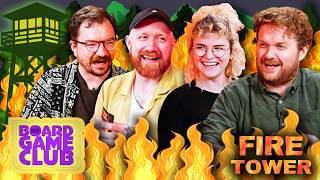
Fire Tower has struck a chord with board game enthusiasts across multiple channels, earning consistent praise as a fresh take on the competitive firefighting concept. Rather than the cooperative firefighting experiences that dominate the genre, Fire Tower inverts expectations entirely, positioning players as competing fire departments engaged in a thrilling battle for survival. Reviewers consistently highlight the game's elegant theme-mechanics integration, beautiful components, and remarkable replayability that keeps players coming back for multiple sessions in a row.
Core Mechanics That Define Fire Tower
Wind-Driven Fire Spread and Area Control
At Fire Tower's heart lies a deceptively simple yet strategically rich system: fire spreads across the board based on wind direction, and players compete to protect their own tower while pushing flames toward opponents. The wind dial serves as the game's central forcing mechanism, preventing any single player from controlling the entire board state. Each turn, players decide which direction the wind blows, fundamentally shaping how fire will move across the forest. This shared environmental pressure creates dynamic gameplay where players must balance offensive aggression with defensive preparation. The area control elements emerge naturally from this wind mechanic, as players vie to establish presence in geographic regions that protect their tower while making progress against rivals. What makes this particularly elegant is that players cannot stop the fire from spreading, only influence its path, making the game feel like everyone is fighting a shared phenomenon while simultaneously battling each other.
Card-Driven Actions and Risk Management
Players shape their strategy through action cards that allow either offensive or defensive plays. Defensive options include dispatching fire engines to protect tower areas and ordering air drops to clear fire in a line. Offensive cards push the blaze toward opponents' towers, creating constant tension between protecting what matters most and seizing opportunities to damage rivals. This card layer transforms Fire Tower from a pure spatial puzzle into a meaningful decision-making game where players must manage limited resources. The system creates moments where players face genuine choices: invest heavily in defense to survive this round, or take calculated risks to press an advantage knowing that defense is available if needed. Reviewers note that nothing feels arbitrary in these decisions because both aggression and caution remain viable paths to victory.
The Fire Tower Experience
Accessibility Wrapped in Strategic Depth
Fire Tower combines exceptional accessibility with substantive strategic choices. New players learn the rules quickly because the core loop is intuitive, yet experienced players find meaningful tactical depth worth exploring across repeated plays. One reviewer who taught the game multiple times noted that players naturally gravitated toward understanding both aggressive and defensive strategies, making the learning curve feel smooth rather than punishing. The game plays quickly, typically concluding within 30 to 60 minutes, which allows players to immediately commit to another round if the experience resonates. This pace proves crucial to Fire Tower's appeal, as it invites the kind of back-to-back gaming that reveals strategic nuances without requiring marathon sessions.
Beautiful Presentation That Draws Crowds
Fire Tower has become known as an aesthetic achievement on the table. The flame pieces are transparent plastic components that look stunning from every angle, catching light beautifully and immediately drawing attention from passersby. Multiple reviewers emphasized that the visual presentation alone sells the game to interested onlookers, with comments that casual observers stop to ask about the game simply because it looks so striking. The physical components feel good in hand, and the overall presentation reinforces the theme without ever feeling overwrought. This combination of function and beauty means Fire Tower works equally well as a serious competitive experience and as a showstopper game that brings joy to broader gaming spaces.
What Makes Fire Tower Stand Out
Innovative Competitive Firefighting Design
Firefighting games often embrace cooperation, treating the blaze as a shared enemy to contain together. Fire Tower rejected this well-worn path and instead created a genuinely competitive experience where being a firefighter means strategically using flames as weapons. Designers achieved this by making the fire an inevitable natural force that all players must manage while simultaneously sabotaging each other's defensive efforts. The competitive element never feels tacked on because the theme supports every mechanical choice. Players are defending fire towers, not generic victory points, and the wind becomes a shared villain that everyone must navigate while pursuing opposing objectives. This thematic coherence makes Fire Tower feel like the game it claims to be, rather than a mechanical puzzle wearing a firefighter skin.
Sophisticated Player Elimination Mitigation
Traditional competitive games with area control can suffer from player elimination, leaving defeated players watching from the sidelines while others finish. Fire Tower addresses this through elegant design that accelerates the end game precisely when one player falls. When a player is eliminated, they get revenge by spinning the wind dial, and subsequently removed players get to play additional cards with reduced hand size restrictions, making the board more chaotic and hastening conclusion. This design ensures that no one sits idle and that the game maintains tension until the final turn. The psychological effect matters as much as the mechanical effect: defeated players remain engaged contributors rather than spectators, and the increased chaos at the end prevents runaway leaders from converting early advantages into insurmountable dominance.
Potential Drawbacks
Wind Randomness and Perceived Lack of Control
Fire Tower's greatest strength occasionally becomes a source of frustration. Because wind direction significantly impacts fire spread, players sometimes feel their carefully laid plans evaporate due to chance. While multiple reviewers acknowledged this element, they noted that the balance between skill and randomness actually enhances the experience rather than diminishing it. The randomness prevents the game from becoming a solved puzzle where optimal strategy determines every outcome, but it never becomes so dominant that player decisions feel irrelevant. One experienced player explicitly stated they do not feel Fire Tower is too random because skilled players can influence outcomes through card selection and strategic positioning. Still, players seeking pure optimization games with minimal randomness should approach with expectations adjusted.
Wind Mechanic Learning Curve and Play Variations
The wind mechanism creates exactly the dynamic challenge that makes Fire Tower compelling, but it also generates the most teaching moments for new players. Understanding how wind direction influences fire spread takes a few turns to internalize, and some players initially struggle with visualizing diagonal fire patterns. One reviewer mentioned exploring slightly different interpretations of how fire spreads in relation to wind, discovering that consistent application matters more than perfect rules precision. While the rules are straightforward, the spatial reasoning required to predict fire paths can temporarily slow early plays. Players who prefer games where board states remain immediately obvious at a glance may find themselves re-checking fire spread patterns during their first few sessions.
If You Enjoy Fire Tower
Players drawn to Fire Tower typically appreciate competitive games with environmental mechanics that create shared challenges alongside player-versus-player conflict. The Crew, another game featuring cooperative pressure mixed with individual objectives, appeals to similar audiences. Fire Tower players often gravitate toward games offering rapid play cycles that invite multiple plays in succession, suggesting titles where 30 to 60 minutes of engaging gameplay can lead seamlessly into another round. Those captivated by Fire Tower's beautiful components and visual presentation may seek other games where production quality enhances thematic immersion. Finally, players who love the tension of managing scarce resources while sabotaging opponents will find deep satisfaction in Fire Tower's card economy and the constant push-pull of defense versus offense.
What Reviewers Are Saying
"It's so much fun, very easy to play. The flames are these little plastic see-through almost like loose sight looking pieces that are beautiful, and people even in my household who are not that interested would be like, 'What is that? That looks really cool.' You know, it's great. Looks great on the table. Attracts a crowd. So much fun to play."
— Stonemaier Games
"The replayability there is a certain element of skill mixed with randomness that make it a lot of fun. If something is too random, you feel like, well, it's not even up to me anymore. But I don't feel that way about Fire Tower at all."
— Stonemaier Games
"There is a lot of really interesting stuff going on in this game. It is one of the most interesting games that we've got a chance to check out. Component quality is off the chain. These components are amazingly simple fire pieces they feel awesome in your hands and look even cooler."
— The Cardboard Herald