













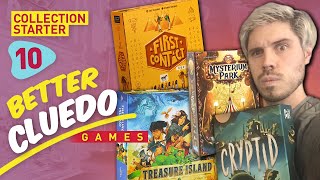
First Contact Deep Dive
What the Community Thinks About First Contact
Reviewers mostly agree that First Contact is a fresh take on the communication-deduction genre, and that its alien-versus-human premise carries most of the charm. Tom Vasel of The Dice Tower frames it as a hidden movement game in the spirit of Scotland Yard, where one alien slips around a map while agents hunt it down, and stresses that each agent brings a unique ability to the chase. Danny of Board Game Sanctuary approaches it from the puzzle side, describing an Egyptian-themed deduction game built on a symbol cipher and comparing its premise to the film The Arrival.
The genre label is where opinions split. Actualol treats the game as a party title, ranking it among the favorite party games of its year and praising how it sets itself apart from its inspirations. Johannes of Board Gaming Ramblings presents it as a cat-and-mouse hidden movement game, and the video is more about tracking a moving target than about language. The shared verdict is that the game is clever and unusual, but its appeal depends heavily on the group at the table.
Enthusiasm is not universal, and reviewers note that the game's appeal may depend on how much a group enjoys puzzling over the alien side. The UndeadVikingVideos weekly livestream touched on First Contact only in passing, recalling it as a Hobby World title built around guessing what another player is trying to convey, which fits the communication focus that most reviewers emphasize.
Core Mechanics That Define First Contact
Cipher Deduction Between Aliens and Humans
The heart of the game is a two-way language puzzle. Actualol explains that the aliens start with a whiteboard showing how common concepts such as alive, big, food, danger, or metal are written as symbols, while the humans face a grid of 25 items similar to Codenames. Each round, the humans rotate up to five item cards they believe share a concept, and the aliens must draw the symbol they think matches. Danny describes the same cipher, noting that the alien side holds a key pairing the 25 words with 25 symbols. Because the humans never learn which word was meant, the table builds a shared vocabulary through trial, error, and misinterpretation. Aliens then ask for items by stacking symbols, and the humans secretly offer one, scoring when they choose correctly.
Hidden Movement and Detection
The second core layer is the cat-and-mouse chase, which reviewers separate from a classic hidden movement game. Tom Vasel explains that the alien moves in secret with five movement points per turn, where open ground costs one point, trees cost two, and cities cost three. The agents move by footprints, and most carry a detection template that asks the alien a simple yes or no question about whether they are inside it. Johannes adds that the alien cannot end a move on the same spot twice, and that the agents must reason about every position the alien could have reached, which makes the game harder than a standard deduction title. Detections advance a track that decides the day-five rewards: if the alien has never been found, the agents get a one-use question, while heavy detection gives the alien a card that forces an agent to reveal where or when it will move.
The First Contact Experience
Learning an Alien Language Under Pressure
The language-learning feel is what reviewers remember most. Danny calls the game a study of language understanding, where humans tap item cards to communicate and then interpret symbols, and where the nuance of vocabulary acquisition is the real draw. Actualol says the premise makes sense in a way few party games do, borrowing the feel of linguistics and the difficulty of communicating across different languages. Actualol also finds the process tricky but not as hard as expected, with the table gradually building a working dictionary of symbols. The puzzle is also social, since every guess invites debate about what a symbol might mean.
Cat-and-Mouse Tension at a Small Table
The other experience is the tense pursuit, which Johannes plays up with obvious delight. The alien player has to remember a route, while the agents mark their searches with Xs and markers, so each turn feels like a fresh gamble. Tom Vasel notes that the game feels closer to a family-weight title and that it is fun for everyone to take turns as both alien and agent. Johannes also points out that a smaller map is easier for the agents to cover, which keeps the chase brisk and the table laughing.
What Makes First Contact Stand Out
A Theme That Drives the Rules
Reviewers consistently praise the way the premise and the mechanics support each other. Actualol highlights that a language idea this coherent is rare in a party game, and that the thematic fit makes the rules feel natural rather than arbitrary. Danny contrasts the game with other deduction titles, valuing how its layered cipher turns vocabulary into the puzzle itself. The result is a game that feels distinctive on the shelf and in conversation.
Asymmetric Agents and Scenario Variety
Tom Vasel values the variety built into the agents. Each agent has its own movement speed, detection template, or special power, so the hunt changes depending on which agents are in play. The scenarios add further variety, such as one file in which the alien must reach a marked spaceship on a set turn while the agents try to form a perimeter. Johannes adds that the scenario files scale in difficulty, so a group can make the game easier or harder depending on who is playing.
Potential Drawbacks
Prototype Components and Clunky Setup
Johannes is careful to note that the copy played is a prototype, and that the art, components, and layout may change before release. Tom Vasel raises a related concern about setup. Tom would have preferred a small booklet of scenarios over the envelopes, since sorting through them slows the start of a session. Tom also found that some pieces, such as a token placed in the starting city, rarely matter in practice. Both reviewers see these issues as fixable, but they affect how smoothly a first game runs.
Balance Tilts Toward One Side
Balance is the more substantive concern. Tom Vasel feels the game usually favors the agents, and suggests an informal time limit on how long the agents deliberate, since a long pause lets them eliminate almost every possible hiding spot. Johannes reports that the simpler scenario was hard for the alien, partly because the smaller map leaves less room to hide. Both accounts point to the alien as the more demanding role, so groups should choose scenarios and equipment with that in mind.
If You Enjoy First Contact
Scotland Yard is the natural next step for players who like the hidden movement chase, since Tom Vasel uses it as the benchmark for the pursuit. Codenames is the closest comparison for the grid of words and the sense of collaborative guessing, and Danny and Actualol both name it when describing the setup. Mysterium suits players who enjoy communicating through indirect clues, a quality No Rolls Barred praised when featuring that game. For a more cinematic take on the premise, Danny and Actualol both point to the film The Arrival as the reference point for the language theme.
What Reviewers Are Saying
"This game is everyone's hunting down the aliens a little bit like, you know, Scotland Yard and games of that ilk, but each person has that unique thing that they can do."
— Tom Vasel, The Dice Tower
"The thing that I love about it is that even though it appears to borrow things from stuff like Code Names, it's so different to anything you could play, and you can take it to someone and they're just so impressed by what they're doing."
— Actualol
"This is like even harder than a deduction game because the thing you're trying to find is moving around."
— Johannes, Board Gaming Ramblings