/pic8706498.png)




























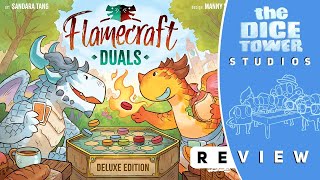


Flamecraft Duals Deep Dive
What the Community Thinks About Flamecraft Duals
Flamecraft Duals arrives as a bold reinterpretation of its cozy predecessor, trading the original's relaxed shopkeeping for a competitive two-player puzzle duel. Reviewers like The Dice Tower and Tantrum House praise the beautiful components and art, though they diverge on the game's strategic depth. The consensus acknowledges it as a casual, accessible game that works well for specific audiences while understanding it will disappoint anyone seeking the full charm of the original Flamecraft.
Core Mechanics That Define Flamecraft Duals
Tile Placement and Bag Building
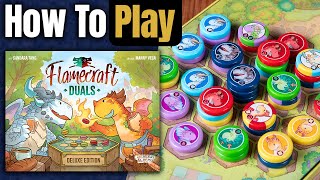
At its heart, Flamecraft Duals is a game about drawing dragon tokens from a bag and placing them strategically on a shared board. Each turn, a player pulls an unmarked token, discovering which of several dragon colors they will work with. From there, placement matters: tokens can stack on empty spaces or on existing piles, giving the board a growing vertical landscape. The randomness from the bag creates natural tension, forcing players to adapt around what emerges rather than executing a predetermined plan.
Dragon Abilities and Activation
The real puzzle emerges when you activate each dragon's unique power. One dragon lets you draw and place another token immediately. Another offers a choice of options and lets you select one. Some dragons move adjacent tokens around the board, while others swap positions or nudge neighbors one space. A plant dragon can even trigger an adjacent dragon's ability. This web of chaining powers creates satisfying moments where a single placement cascades into multiple board transformations, letting you set up the patterns you need to score.
The Flamecraft Duals Experience
Pattern Building as the Puzzle
You win by matching patterns on secret shop cards. These cards show specific arrangements of colored dragons, perhaps three in a line or a particular cluster. The puzzle comes from working backward: you hold cards and must position tokens to match them before your opponent does. This creates a satisfying solve moment when a pattern clicks into place. Reviewers noted that after the opening turns, most players can usually complete one pattern per turn if they focus, so completing both cards in a single turn becomes the real skill expression and pacing challenge of the mid-game.
The Cozy Duel
Despite being competitive, Flamecraft Duals retains the charming aesthetic and gentle vibe of its predecessor. The lovely discs, deluxe production, and warm art create an experience that feels inviting rather than cutthroat. You are trying to beat your opponent, but you do it while placing adorable dragons and chaining spells. The game plays quickly, around twenty minutes, making it approachable for players who want a light head-to-head experience without heavy confrontation or extended analysis.
What Makes Flamecraft Duals Stand Out
Exceptional Component Design
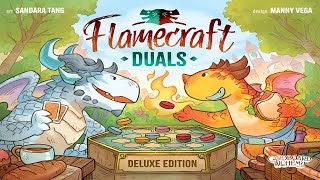
The deluxe version features wooden dragon discs with clear ability icons, acrylic tokens, and a board that lives inside the box lid itself, allowing the whole game to pack down into a portable footprint. The art carries over much of the original Flamecraft's imagery, which reviewers found appropriate for a spiritual successor set in the same world. Even reviewers less enthusiastic about the gameplay singled out the production as world-class and genuinely gift-worthy.
Flexibility Through Variants
The game ships with multiple play modes that meaningfully alter the experience. A "fancy" mode introduces special dragon cards that grant both active and passive abilities, letting players tweak coin usage or bend the core rules each game. A fountain variant adds new scoring patterns and a movable fountain piece that blocks spaces and creates contested dynamics between players. There is also a solo mode where you race to complete cards before resources run out, giving the game genuine solo utility.
Potential Drawbacks
Simplicity Becomes a Ceiling
The patterns are intentionally easy to complete. Reviewers noted that if you cannot score at least one card on your turn after the opening rounds, you are not trying hard enough. This accessibility is deliberate design for a broad audience, but it means there is little mental friction once players understand the system. Some reviewers found this leads to a mismatch between the time spent thinking and the payoff, creating a sense of overanalysis for straightforward outcomes rather than elegant puzzle-solving.
Minimal Player Interaction
Because you do not know which cards your opponent holds, direct blocking is limited to chance rather than informed strategy. Players move tokens around the board, and you might accidentally finish an opponent's pattern or spoil their setup, but you have no reliable way to target them. The fountain variant improves this by exposing some scoring opportunities, yet the base game can feel like two puzzles happening in parallel rather than a true duel.
If You Enjoy Flamecraft Duals
Try Harmonies, a pattern-building game with deeper puzzle variety. Fans of quick, beautiful two-player games should explore Seven Wonders Duel, which offers similar compact gameplay with richer interactive decisions. If you came to Flamecraft Duals from the original, Flamecraft itself remains the better pick for a cozy, multiplayer shopkeeping experience. For broader civilization-flavored drafting, Seven Wonders scales the same tableau-building satisfaction up to larger groups.
What Reviewers Are Saying
"It's simple to play. But with so many pattern games out there, it's hard for this one to stand above the rest in that regard, or even stand equal to them."
— The Dice Tower
"It's a very simple abstract strategy game, and like I like to say, the dragons tricked me into thinking it's a whole lot more."
— Tantrum House
"It's beautiful. The components, the art, I love. I love the world of Flamecraft. It's just fun, it's quick, and I think this would make an excellent Christmas gift."
— Foster the Meeple