








The call comes in... "911, what is your emergency?" On the other end is a panicked response of "FIRE!" Moments later you don the protective suits that will keep you alive, gather your equipment and rush to the scene of a blazing inferno. The team has only seconds to assess the situation and devise a plan of attack – then you spring into action like the trained professionals that you are. You must face your fears, never give up, and above all else work as a team because the fire is raging, the building is threatening to collapse, and lives are in danger.
You must succeed. You are the brave men and women of fire rescue; people are depending on you. This is what you do every day.
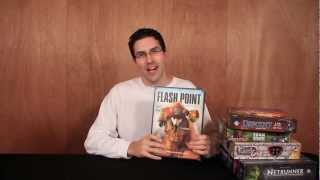
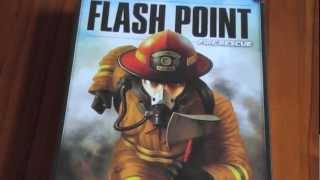
Flash Point: Fire Rescue is a cooperative game of fire rescue.
There are two versions of game play in Flash Point, a basic game and expert game.
In both variants, players are attempting to rescue 7 of 10 victims from a raging building fire.
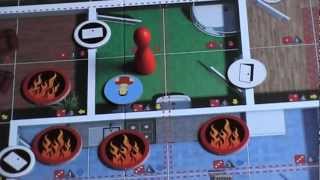
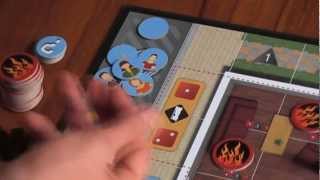
As the players attempt to rescue the victims, the fire spreads to other parts of the building, causing structural damage and possibly blocking off pathways through the building. Each turn a player may spend action points to try to extinguish fires, move through the building, move victims out of the building or perform various special actions such as moving emergency vehicles. If 4 victims perish in the blaze or the building collapses from taking too much structural damage, the players lose. Otherwise, the players win instantly when they rescue a 7th victim.
The expert variant included in the game adds thematic elements such as flash over, combustible materials, random setup, and variations on game difficulty from novice to heroic. The game includes a double sided board with two different building plans and several expansion maps are available.
- Engaging teamwork and shared problem solving; good for family gaming nights.
- Scenarios provide variability and replayability.
- Potential downtime and learning curve for new players.
- As with many co-ops, sloppy play can reduce tension and excitement.
- Emergency response teamwork, time pressure, and scenario-based challenges.
- A perilous multi-room rescue environment where fires threaten civilians and structures.
- Cooperative, tense, with escalating danger and the need for coordinated actions.
- Pandemic
Mechanics (from transcript analysis)
- Cooperative Game — Players work together as a team rather than competing against each other to achieve mission goals.
- cooperative_play — Players work together as a team rather than competing against each other to achieve mission goals.
- Modular board — The board changes with each scenario, creating varied layouts and risk distributions.
- modular_board — The board changes with each scenario, creating varied layouts and risk distributions.
- role_based_actions — Different roles grant access to special actions and can alter the team’s strategic options.
Video topics + discussion points
Quotes (from this video)
- The goal is the laughter. The goal is the fun. The goal is interaction around the table.
- A card laid is a card played.
- Jump in in real time as fast as possible and the gameplay continues in that direction.
- Dirty Spades is like ... this is how we're playing the game. It's silly. It's fun. Adds a little level of chaos to the thing.
- Bus rules. You could play it out and take a lot of time or it could just okay, now we know this what's going to happen.
- If the game state hasn't changed, go ahead and pay for it now.
References (from this video)
- Fun cooperative gameplay
- Realistic theme
- Engaging puzzle of managing fires and rescues
- Rule clarity can be confusing during a solo run
- Tracking explosion/shockwave interactions and wall rules can be tricky
- Occasional misplacements due to interpretive rules
- Array
- Indoor urban firefighting scenarios
- Procedural/Simulation
Mechanics (from transcript analysis)
- Action Point Allowance System — Each turn, players have a set number of action points to spend on actions like move, extinguish, rescue
- Action points — Each turn, players have a set number of action points to spend on actions like move, extinguish, rescue
- Cooperative Game — Multiple players work together to rescue victims and control fires
- cooperative play — Multiple players work together to rescue victims and control fires
- Fire spreading and explosions (shock waves/flashovers) — Fire expands to adjacent areas and explosive events can radiate damage and spread
- Open doors / pass through doors — Open doors to access rooms and progress the rescue
- Rescuing victims — Move victims to safety to score or progress toward victory
- Wall/chop through walls — Walls can be chopped through to create new routes; damage markers indicate destroyed segments
Video topics + discussion points
Quotes (from this video)
- Definitely a very fun Cooperative game
- The theme is very um realistic so I do enjoy that aspect of it
- I have to reread the rules it's not too clear
- The most tricky part about this game is figuring out the explosions shock waves and flashovers
- I definitely put down a fire when it should have been smoke in some turns
References (from this video)
- Cooperative
- Accessible concept
- Firefighting disaster response
Mechanics (from transcript analysis)
- Cooperative
Video topics + discussion points
Quotes (from this video)
- I'm intimidated to get started with it.
- You're building outposts and in order to increase your trade routes.
- the artwork here is quite lovely
- I'm not super into Political themes.
- it's a dexterity game where you are building up power towers on the island of nikima
- Arctic scavengers I picked this up because I know nothing about it
References (from this video)
Mechanics (from transcript analysis)
Video topics + discussion points
Quotes (from this video)
- gaming is for everybody
- Black history is American history
- If it happened on American soil it's American history
- History is not a priority in this country; comfort is the preeminent american value
- we're here we're here we're here
References (from this video)
- emergency response
- firefighting in a burning building
- casual, cooperative
- Forbidden Island
- Spirit Island
Mechanics (from transcript analysis)
- cooperative play — players work together to extinguish fires and rescue victims
- state-mymove puzzle — managing the evolving fire layout and objectives
Video topics + discussion points
Quotes (from this video)
- it's a good one I like it a little bit better than Welcome to the Jungle or Welcome to the dungeon because of just like it's because the form factor in the box and the it's cute
- they're like dungeon delving games
- they are Coop games so well done
- the common bond for a bonus point is that they're all Coop games
References (from this video)
- Engaging cooperative tension with a clear rescue objective and a tangible sense of urgency.
- Dynamic interplay between opening routes (walls) and managing fire/smoke spread creates meaningful strategic choices.
- Diverse tactical options for both players, including movement, door/chapter manipulation, and victim handling.
- POIs provide information asymmetry and scenario variability, increasing replayability and depth.
- Ruleset supports quick turns and fits a two-player experience well, with a readable flow despite occasional complexity.
- Rule complexity can be steep for newcomers, especially around wall-chopping tokens, adjacency rules, and end-of-turn effects.
- Dice-driven randomness can produce uneven hazard progression, potentially leading to frustrating outcomes despite good planning.
- Some players may wish for more explicit guidance on optimal two-player coordination beyond general encouragement; learning curve can hinder early play sessions.
- Heroic firefighter rescue under intense time pressure, balancing life-saving objectives with structural risk.
- A burning multi-room building with victims, doors, corridors, and various POIs; dynamic smoke and fire behavior modeled through dice and markers.
- Tactical, emergent, simulation-flavored gameplay driven by dice-driven fire spread and player-driven actions.
Mechanics (from transcript analysis)
- Action points — Each player has a limited number of actions per turn to perform tasks such as moving, rescuing victims, opening doors, extinguishing smoke, or interacting with POIs. Decision-making centers on prioritizing immediate dangers versus longer-term objectives.
- action_points — Each player has a limited number of actions per turn to perform tasks such as moving, rescuing victims, opening doors, extinguishing smoke, or interacting with POIs. Decision-making centers on prioritizing immediate dangers versus longer-term objectives.
- fire and smoke markers with dice — Fires and smoke spread and intensify based on dice rolls at the end of actions. Smoke can be removed using firefighting gear, but lingering smoke adjacent to fire can reignite unless managed. Randomness drives risk management and planning.
- open doors and wall modification — Doors can be opened to create passage; walls can be chopped to create new routes. Once a wall is opened (two damage tokens required to create a passage), it behaves like an open doorway for subsequent turns.
- points of interest (POI) — Flipping POIs reveals new information about the environment or scenario, potentially altering priorities and enabling safer routes or alternate exits.
- secondary effects / flashover — After each turn, roll for secondary effects that can modify the board state (e.g., additional fires, altered smoke patterns). If smoke remains adjacent to fire at the end of a turn, flashover mechanics may trigger, escalating danger and forcing adaptive play.
- Victim rescue — Carrying a victim requires action points and movement through spaces toward exits. Rescue objectives provide clear progress pressure and moral motivation amid the evolving hazard landscape.
Video topics + discussion points
Quotes (from this video)
- two-player solo campaign on flashpoint fire rescue
- walls stop things being adjacent
- we need to flip over any smoke which is adjacent to a fire marker
- the opportunity for my final action to remove that smoke
- we're ready for next turn
- this smoke is right next to the fire and that complicates our exit
- we've got two victims on the board and need to plan a safe extraction
- doors open and walls chopped create a path to safety
References (from this video)
- Clear cooperative feel and accessible entry point
- Base tension comes from board state and fire dynamics
- Modular board setups provide variety even without expansions
- Coordination discipline is required, can be punishing if poorly executed
- Some players may find base setup less varied without expansions
- Disaster response and cooperative firefighting
- Urban residential district; firefighting response across a neighborhood
- Cooperative, emergent storytelling through the evolving board state
Mechanics (from transcript analysis)
- Action points / action economy — Players allocate actions to move, search, and interact with the board.
- cooperative play — Players work together to extinguish fires and rescue victims.
- Fire spread and board state — Fire dynamics drive board deterioration and increase danger.
- Structural integrity and damage — Damage accumulates and buildings can collapse, altering goals.
- Victim rescue and ambulance transport — Rescued victims must be moved to ambulances and safely removed.
Video topics + discussion points
Quotes (from this video)
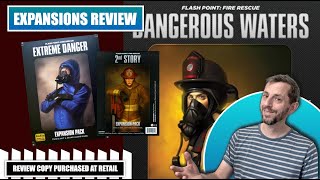
- This is the most challenging of all the Flash Point expansion so far.
- The promos add a lot to the game and the components are fantastic.
- Dangerous Waters is probably the most different expansion yet.
References (from this video)
- great cooperative game
- everyone stays involved
- many legitimate action choices
- thematic and immersive
- unique firefighting theme
- simple rules but engaging gameplay
- many location expansions add variety
- ranks 490 on BoardGameGeek
- has accumulated expansions that bloated it
- requires time to relearn rules if not played recently
- firefighting
- emergency response
- Pandemic
Mechanics (from transcript analysis)
Video topics + discussion points
Quotes (from this video)
- it's only a game
- you're listening to the broken meeple show a podcast that speaks passionately about board games
- I am very much a cold blooded I'm a cold blooded lizard I need cold
- the top 50 has finally finished finally it's done
- there is nothing apart from it being bright and sunny there is nothing about the summer that really gets me like you know excited or interested because it's just too hot
- I look at these top 50s uh they certainly increase a bit
- there's a lot of good feedback in terms of what's up next hard to say really
- I would give it at least a seven out of 10 right now and say it's good
- the Arkham Horror games are still pretty solid and you know they're fun to play but they are definitely getting to a point where I don't think I can uh like really say that they're practical
- my tastes were new at that point you know I respected terroriser for its thiness
- I have definitely developed to want more theme in my games
References (from this video)
- cooperative appeal
- scales with player count
- expansions add variety
- rules can be dense for newcomers
- cooperative disaster response
- burning building; firefighters rescue occupants
- cooperative, emergent
- Pandemic
Mechanics (from transcript analysis)
- Action points — limited actions per turn; coordinate to fight fires and save people
- Cooperative Game — players collaborate to fight fires and perform rescues
- cooperative play — players collaborate to fight fires and perform rescues
Video topics + discussion points
Quotes (from this video)
- it's a really neat competitive game with a really fun theme
- another run would be nice
- the art style put me off but the game is good
- I raved about this game on my videos when this channel was new
- this is a co-op game similar to Pandemic
- it's a gambling game where no money changes hands
- feels like you're watching a horse race and you're betting on it
- it's the time pressure
References (from this video)
- tangible, tangible theme of rescue
- accessible cooperative action
- can feel repetitive over long campaigns
- heroic cooperative rescue
- saving people from a raging building fire
- action-focused, narrative-risk management
- Pandemic
- Resistance events
Mechanics (from transcript analysis)
- action selection and area effects — players coordinate to move units, fight fires, and rescue civilians
Video topics + discussion points
Quotes (from this video)
- pure cooperative where everybody wins or loses together
- we're in this together it's okay you know i'm not working against you
- macro level adventure
- this is the gloomhaven that should have been the first gloomhaven to come out now
References (from this video)
- Strong cooperative experience
- Good replayability with expansions
- Components can be bulky
- Rescuing victims from a spreading fire
- Emergency response and firefighting
- Cooperative, action-driven
- Pandemic
- Forbidden Island
Mechanics (from transcript analysis)
- cooperative play — Players work together to save victims and manage fires
- Hazard/timer-driven events — Randomized hazards require team coordination
Video topics + discussion points
Quotes (from this video)
- I like co-ops sometimes it's nice to not have bad blood between players and work together
- everything just rewards you gently little rewards that remind you you're doing well
- Underwater Cities really sings with the card system
References (from this video)
- strong teamwork feel
- tension remains high without direct player attack
- dice luck can dominate near the end
- learning curve for new players
- cooperative emergency response
- burning building rescue
- tense, teamwork-focused
Mechanics (from transcript analysis)
- Action points — Players have a limited pool of actions per turn.
- action-point management — Players have a limited pool of actions per turn.
- Cooperative Game — All players work together to save victims.
- cooperative play — All players work together to save victims.
- random spread of fire — Dice determine fire spread and escalating danger.
Video topics + discussion points
Quotes (from this video)
- the interaction essentially comes from sitting around a table and working on this puzzle together and then comparing your relative skill
- it's interesting to see where Cooperative games are going now
- these are the true solo games you could play by yourself with no problems at all
References (from this video)
Mechanics (from transcript analysis)
Video topics + discussion points
Quotes (from this video)
- Twilight Struggle is one of my all-time favorite games.
- Tabletop Simulator is one of the best ways to be able to play a whole bunch of board games on your computer.
- Terraforming Mars is my evening unwind game.
- Slay the Spire is a really clever deck-building dungeon-crawler.
References (from this video)
- Thematically sound with great fire mechanics
- Great social player interaction
- Family variant available for simplified play
- Base set is simple and elegant
- Cool new maps in expansions
- Expansion adds too much bloat with fiddly rules
- Doesn't hit the table as much anymore
- Luke hasn't played it in a while
- Firefighters fighting fires and rescuing people
- Urban fire emergency scenarios
- Cooperative gameplay with rescue decisions
Mechanics (from transcript analysis)
- Cooperative Game — Players work together as firefighters
- cooperative gameplay — Players work together as firefighters
- Fire spread — Fire spreads chaotically requiring tactical response
- Rescue mechanics — Players must decide who to rescue - civilians, pets, each other
Video topics + discussion points
Quotes (from this video)
- It's that great banter game that's just great for like a good party setting
- The game needs to be quick and snappy and that's the way it should work
- When I got the game myself and finally got it out and played it with fellow gamers it was brilliant
- I don't see this really rising further up the top 100 though I think this is going to be its peak
- If there's a slight flaw at this game it's that the card system needs a little bit of tweaking it can get quite swingy
- The fans recommended this game and the fans were right
- It's kind of like that awesome experience that you only get to experience every now and again in a blue moon
- I found brian board to be a big surprise one of those big exceptions to the rule
- It's that great sort of climactic tension where throughout the game you're trying to figure out who is not on our side here
- It's a really clever system there's a decent amount of dice mitigation you know every time you roll those dice you are there racking your brains
References (from this video)
- classic core game with accessible rules
- expansion integrations offer new tactical depth
- not a focus of this review; general overview only
- Emergency response and disaster containment
- Urban firefighting rescue scenarios in a city
- Procedural/cooperative realism
- Urban Structures expansion
- Extreme Danger expansion
Mechanics (from transcript analysis)
- Action points — players spend AP to move, extinguish, or perform tasks
- cooperative play — players work together to rescue civilians and extinguish fires
- door and structural elements — doors can be opened/closed; doors interact with hazards
- fire spread and hazard management — fires spread and threaten rooms, requiring strategy to contain
- hazmat handling — hazmats introduced; limits on removal and containment
Video topics + discussion points
Quotes (from this video)
- the walls here can take as many damage markers as it takes so you can end up with explosions that knock multiple damage markers onto the walls
- these are fire doors they can be opened and closed as normal but if an explosion happens next to them the door will become jammed
- there are multiple jam tokens on here because they can stack up as more and more explosions
- the engine is destroyed which is this section here
- this is the dangerous waters board
- it's extremely tough
- if you're looking for something different something new and something challenging then you could do a lot worse than look at the dangerous waters expansion
- this board is made up of two half size boards put side by side like this