








Flock Together Deep Dive
What the Community Thinks About Flock Together
Reviewers almost always start with how Flock Together looks and feels before they get to the rules. The Board Game Garden praised the Andrew Bosley art spread across a very large board and called the eggs absolutely gorgeous, with a flat bottom that lets them stand up on the table. Tabletoptiktok admitted that a game built around defeating bosses is not usually their thing, but the artwork, the puns, and the high quality components won them over anyway. Hungry Gamer pointed to the story written on the back of each character card as proof of how much love went into the lore.
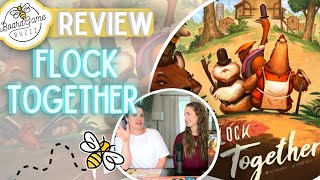
Accessibility is the second point of agreement. Board Game Buzzz, the channel run by Carly and Kim, called the game one they would recommend for families with young kids, and reported that their daughter, who had been obsessed with Trio that year, said Flock Together might become a new favorite game. Tom Vasel of The Dice Tower described it as a cooperative family game with a bunch of birds that is worth checking out, and credited designer Matt Mundy with putting it together well.
Depth is where opinions split. Board Game Buzzz came away wanting more tension and more meaningful decisions, while Board Game Hangover argued that the game works well for children but feels thin at an adult table. The Board Game Hangover host summed up the concern by noting that nearly every action comes back to food. Hungry Gamer and The Board Game Garden were more comfortable with the escalating predators, with the Garden stressing that unbeaten predators grow stronger each season and that striking early is important. Hungry Gamer, though, said they had never come close to losing, which suggests the challenge may be lighter than the theme implies.
Core Mechanics That Define Flock Together
Cooperative Play Against a Ticking Calendar
Flock Together is a cooperative game in which every chicken shares a single outcome. Paula Deming lays out the win condition plainly: defeat all four predators before the third season ends, and make sure every chicken is still alive when the final predator falls. A dead chicken loses its food, eggs, bonus cards, and progress, so losing a player is punishing. Recovering that player requires a teammate to spend an egg on the Brood action and forfeit their next turn, which keeps the group invested in one another's survival.
The asymmetry lives in the chicken books. Each chicken has its own starting health, attack strength, and production, and Hungry Gamer described the asymmetry as mild, with abilities similar enough that anyone can pick up any chicken and join in. Tabletoptiktok noted that predator health is simply multiplied by the number of players, so solo play needs no adjustment. The calendar adds pressure: the three seasons of spring, summer, and fall each last seven days, and an egg exchange with a new weather card happens on certain days.
Damage-Based Combat Against Predators and Grubs
Combat is the engine of the game. A chicken's attack equals the number of chicken fists on its book, and every point of damage costs one food from the reservoir. Paula Deming explains that each predator has a health total equal to the player count multiplied by a number on its card, and that every attack earns a return strike that wounds the attacking chicken. Those wounds are tracked with heart tokens that must later be healed by spending food, so each fight pulls resources in two directions at once.
Predators also level up at the end of every season they survive. Their health grows, the page in their book changes their ability, and damage already dealt stays on the card, so an early strike is worth far more than a late one. Grubs offer an optional side route: defeating one grants either an immediate effect or an upgrade that stays in play. Board Game Garden gave the example of a caterpillar that adds one to egg production rolls. Defeating a predator hands the final blow player its book and loot, which Hungry Gamer praised as clever because the loot can be single use, reusable, or permanent.
The Flock Together Experience
Whimsical Chickens and Pun-Filled Predators
The tone is playful from the first page. Tabletoptiktok highlighted the puns, including a Sherlock Holmes chicken and a Madam Chikovski predator that riffs on a well-known Morardi-style villain, and called the game adorable and fun. Board Game Buzzz delighted in how defeated predators leave behind loot that ties back to their character, such as a raccoon's Bandit mask. The Board Game Garden described Salmonella, a mouse predator, as a favorite, and noted that the egg-themed predator Eggs Morelda drops a stash of eggs that can be shared with nearby players. The result is a game that feels like a storybook with a boss battle running through the middle.
Tension That Some Players Wanted More Of
The mood is not uniformly cozy, and the reviewers who wanted danger were direct about it. Board Game Buzzz felt that the predators sit on the board and wait to be attacked, so the chickens are the ones starting every fight. The host described the result as feeling like the chickens are the bad guys and said they wanted to fear for their lives. Hungry Gamer agreed that the weather cards can be crushing when they land badly, and that the luck of the draw can throw a plan off course. Those moments of swing give some tension, but the reviewers wanted predators that act on their own turns.
What Makes Flock Together Stand Out
Production and the Andrew Bosley Art
Production value is the most consistent praise across the videos. Board Game Buzzz gave the components a perfect score and highlighted the double layered boards, the sturdy game trays, and the first player marker, which is a metal egg. The chicken dice are a standout too: the six shows a chicken face, the three and four show wings, the five shows the coxcomb, the two shows feet, and the one shows a tail. Hungry Gamer described the box as packed full of material and the art as stunning across the whole board, while Board Game Garden praised the eggs for their weight and presentation. Hungry Gamer also wished the action cards carried art, since they currently display text only, and argued that the art on them would be worth the cost.
Flip Books and Readable Progression
The flip books are the feature reviewers returned to most often. Each chicken and predator has a book that shows the current stage on the page and the next abilities on later pages, so players can see where their chicken is heading. Board Game Buzzz loved that the child in their household could flip the predator book to its next page when a boss leveled up, and that the chicken pages show all future abilities at a glance. Paula Deming walked through the same process, explaining that when a predator survives a season you simply turn to the next page to see its new effect and health. The result is a game that players of any age can track without referring back to the rulebook.
Potential Drawbacks
Predators That Feel Passive
The most detailed critique comes from Board Game Buzzz, which argued that the predators do nothing to the players and simply level up while the chickens go out and start fights. The hosts suggested replacing the weather deck with a predator deck that would act each round, such as stealing eggs or dealing damage to whoever shares a location with them. They believed this would give the attacks more reason and urgency. Board Game Buzzz also noted that the egg mechanic feels underused, since eggs mostly convert to food and rarely create interesting choices. Board Game Buzzz also reported that a prototype of the Birds of a Feather expansion includes predators designed to hit back.
A Food Loop With Uneven Characters
Board Game Hangover framed the game as a simple, repetitive loop in which food is the central resource for everything from healing to attacking. The host felt the eggs convert to food eventually, so there is little variety in how turns unfold, and said that some characters are simply stronger than others. Hungry Gamer raised a related concern, describing a pattern where each turn comes down to the cheapest way to gain a level and that the game can feel the same from session to session. Hungry Gamer added that the difference from game to game comes mainly from the mix of predators on the board, which supplies the variety that the basic loop otherwise lacks.
If You Enjoy Flock Together
Players who like the fire token in Flock Together will recognize its rhythm from Parks, where the Board Game Garden noted the same kind of refresh at the start of each season. That pairing makes sense for anyone who enjoys a game that rewards careful timing without asking for heavy rules. For families looking for a lighter option with lively theming, Trio is the natural comparison. Board Game Buzzz described their family's love for Trio and how easily their daughter moved from Trio to Flock Together, which suggests the two appeal to similar younger players. Both titles reward simple turns and quick teaching, making them good starting points before moving on to heavier cooperative games.
What Reviewers Are Saying
"I think the variety of the bad guys is pretty darn good the things that they do when you attack them are always going to keep you on your toes. At the same time when you beat one you're going to get some kind of loot which might be usable once it might be permanent upgrade usable a few times it's really really clever the way that works."
— Hungry Gamer
"For whatever reason in my brain it really messes with me that the bad guys don't actually do anything they just kind of sit on the board and we are the ones that are actually going out and initiating fighting with them."
— Board Game Buzzz
"Now it's just a very simple thing, obviously you're a little chicken, what can you do. All of us enjoyed it. I think it's very accessible for kids. The cuteness of it helps a lot."
— Board Game Hangover