
Game Info
Year
2025
Players
2-4
Collection
Ratings
Creator Score
Mechanic profile
Not enough video data yet
Vibe profile
Not enough video data yet
Description
Coming from noble families, you are ready to do anything to accede to the throne...except that the competition between the pretenders is fierce!
For a Crown is a single-deck, deck-building game. Players recruit new characters, such as mercenaries, then place these cards within a sleeve of their own color. All cards — individual player cards and common event cards — are shuffled into a single deck, which is then drawn card by card, with the relevant player resolving the effect of their card when it's revealed.
After four rounds, the player with the most rubies wins.
Featured Videos

Rules Teach

How to play For a Crown
Ask a Rules Question
Images
GID0131299.jpg

GID0131299_thumb.jpg
All mentions
Browse transcript mentions, sentiments, pros/cons, mechanics, topics, quotes, and references.
Total mentions: 5
This page: 5
Sentiment:
pos 4 ·
mix 0 ·
neu 1 ·
neg 0
Showing 1–5 of 5
Video dUpNU-xvo1Y
kovray Haul Video at 36:02 sentiment: positive
video_pk 86656 · mention_pk 225037

Click to watch at 36:02 · YouTube ↗
Overall sentiment (raw)
highly positive
Pros
- Unique mechanic of a collectively built deck
- Visually appealing cover
Cons
none
Thematic elements
- animal roles, kingdom building
- animal kingdom
- anthropomorphic animals
Comparison games
none
Mechanics (from transcript analysis)
- Deck Building — it's a deck builder where you're collectively building one deck
- Shared deck — collectively building one deck one deck but they're sleeved differently so you know whose cards are going to be coming up next
Video topics + discussion points
No key topics recorded for this video.
Quotes (from this video)
- This game is literally you draw a card it's kind of like twister with your hands it is it's not kind of like twister with your hands it's twisted with your hands and sticks yeah
- Combo is a good way to understand rankings of poker hands or of hands in general
- The Gang was a game that came out and there are some really memorable hands and I feel like that game just always makes me filled with joy
- it's important now that we're especially now that we're working in the hobby that we take some time to enjoy the hobby because we never want that fire to burn or the fire to continue to burn we don't want it to dim
- Do you want to see me and Tyler go head-to-head in yellow house do you want a how to playay video of Cascadia Jr do you want to see a tether competition
References (from this video)
No references stored for this video.
Video BkKi3uY6jaY
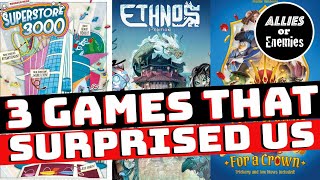
Allies or Enemies Review at 0:35 sentiment: positive
video_pk 72604 · mention_pk 171911
Click to watch at 0:35 · YouTube ↗
Overall sentiment (raw)
positive
Pros
- Fast, quick-to-learn gameplay with short rounds
- Mean-spirited interaction creates tense, fun competition
- Innovative card sleeve mechanic that tracks ownership and streamlines play
- The treasure chest component and thematic flavor feel well realized
- Catch-up mechanic helps keep the game close and engaging
Cons
- The mean-spirited design may be off-putting to casual players
- Hidden wealth and scoring can be opaque at first until players acclimate
- High interaction can be punishing for some players
Thematic elements
- Mean-spirited negotiation and mercenary competition around rubies
- Mercenary-themed card drafting with hidden wealth and rivalries
- Cartoonish, lighthearted take on mercenary intrigue
Comparison games
none
Mechanics (from transcript analysis)
- Card Drafting — Mercenary cards are drafted and then resolved in reveal order, driving player actions.
- Catch-Up — Selling heirlooms and targeted effects create a shifting balance that can end the game earlier if someone grabs the lead.
- catch-up dynamics — Selling heirlooms and targeted effects create a shifting balance that can end the game earlier if someone grabs the lead.
- hidden wealth management — Rubies and coins start in a chest; wealth is spent or spent to influence the market while remaining hidden.
- influence track and effects — An influence track and raccoon-related effects drive penalties and interactions that affect all players.
- secret final scoring and heirlooms — End-game scoring hinges on remaining gems; selling a family heirloom reveals treasure and alters the lead.
Video topics + discussion points
No key topics recorded for this video.
Quotes (from this video)
- it's a very mean card drafting game where you're drafting mercenaries.
- the meanness, I think, is the most fun part.
- the treasure chests. You can just close it all the way down, which is great.
- This is a very light game.
- Jetsons references.
- The race for the goals is the most important thing because that is how you're getting your points.
References (from this video)
No references stored for this video.
Video 91jke4-F40s
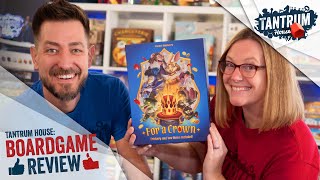
Review at 0:32 sentiment: positive
video_pk 69319 · mention_pk 165766
Click to watch at 0:32 · YouTube ↗
Overall sentiment (raw)
positive
Pros
- Quick setup
- Components are very good, with a sturdy cardboard chest that effectively hides valuables
- Rules are simple once understood
- Iconography is clear and makes sense
- The game is enjoyable for groups that like mean games and push-your-luck mechanics
Cons
- Artwork style is not the reviewer's favorite
- Player elimination can be stressful for some players
- The game can be 'mean'
Thematic elements
- Vying for the crown and forming a single kingdom
Comparison games
none
Mechanics (from transcript analysis)
- Area Majority/Influence — There is an "influence track" that determines turn order for purchasing cards, creating a strategic element.
- Deck Building — The game is described as a deck building game where mercenaries are added to a common deck.
- Drafting — Players are involved in a drafting game.
- Hand Management — Players manage cards acquired into their personal deck (sleeved mercenaries).
- Player Elimination — The game features player elimination if a player runs out of rubies.
- Push Your Luck — The game involves elements of pushing your luck, especially concerning resource management and surviving until the end.
- Set Collection — Players aim to collect rubies as the victory condition.
- Take That — The game features 'take that' elements where players can negatively impact each other, such as causing opponents to lose rubies.
Video topics + discussion points
No key topics recorded for this video.
Quotes (from this video)
- all of the wooden creatures have decided that it's time to form a single Kingdom
- if you're up for some backstabber and some take that then stick around for it's a crown
- The nailbiter part of this game is when we reveal all the cards that have been put into that common deck.
- This is a take that type of game so you'll need to make sure your group or family is good with that type of game.
- This game has the potential to be really mean actually.
- The components are very good for this.
- The setup is quick and because everybody gets their own box we always already stick the sleeves in the box so you just hand them the box and they have everything they need.
- The rules for it are pretty simple.
- There is player elimination so if you run out of rubies you're out of the game.
- If you do enjoy mean games where you can have a lot of fun push your luck push other people then you should definitely check out Four Crown.
References (from this video)
No references stored for this video.
Video Y4nJc-0ZwOM
Top List at 3:59 sentiment: positive
video_pk 67594 · mention_pk 163736

Click to watch at 3:59 · YouTube ↗
Overall sentiment (raw)
positive
Pros
- Shared deck building system is unique
- Very silly and fun
- Highly social with lots of player interaction
Cons
- Can be cutthroat and meanish
Thematic elements
Comparison games
none
Mechanics (from transcript analysis)
- auto battler — that deck will get shuffled up and then it's just kind of an auto battle game after that point where we're just flipping over cards from the deck and it's like, "Oh, blue, you get to steal a gem from somebody else."
- Deck Building — It is a shared deck building game. We are all buying cards, sle them with our own player color, and then adding them to one central deck.
Video topics + discussion points
No key topics recorded for this video.
Quotes (from this video)
- These are lighter strategy games.
- I love strategy games that have interesting decisions but still play in an hour or less.
- if I have four hours to play games, I would rather play three games than one single game.
- it has a little bit of everything in it.
- The dice battle system is really clean and fun in this game.
- it makes for those big emotional moments
- This is a really silly and unique game.
- you will build a bunch of cards and be feeling pretty good about your engine. And then all of a sudden, a lot of bad cards are going to get added to the deck.
- It makes me laugh every time I play it.
References (from this video)
No references stored for this video.
Video WDCntno_Pw8
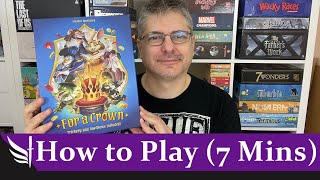
JestaThaRogue Rules Teach at 0:10 sentiment: neutral
video_pk 27769 · mention_pk 81097
Click to watch at 0:10 · YouTube ↗
Overall sentiment (raw)
neutral
Pros
none
Cons
none
Thematic elements
- royal intrigue, mercenary recruitment, and bandit disruption
- medieval kingdoms vying for the crown
- strategy-driven political intrigue with asymmetric player powers
Comparison games
none
Mechanics (from transcript analysis)
- deck organization and hire into sleeves — Chosen mercenaries are placed face-down in the player's card sleeves, representing hired forces for the round.
- end-of-round flow and elimination — Rounds proceed through recruit, reveal, and end phases; players can be eliminated, ending the game early or triggering final scoring after four rounds.
- magic die with special symbols — Roll a die with five core symbols plus a special result that awards rubies; symbols trigger individual effects or event outcomes.
- mass bandits and tokens — Mass bandits and bandit tokens are used in interactions and events, affecting wealth and strategic positions.
- portrait gallery influence — Players move portraits within a gallery; most influential (furthest right) gains bonuses and wins ties by influence.
- recruitment from column-based decks — Pay recruitment costs (coins and rubies) to hire mercenaries from dynamically refilled decks; one ruby can substitute for one coin, but not vice versa.
- shared event deck and resolution — A separate event deck is drawn and resolved, affecting all players per its effects.
Video topics + discussion points
No key topics recorded for this video.
Quotes (from this video)
- This is a game for three to five players, plays in about 45 minutes.
- One ruby can be spent as one coin, but one coin can never be spent as one ruby.
- The most influential player, the one whose portrait is further right in the gallery, gains one ruby from the supply.
- Ties are broken by the player with the highest influence.
- The player with the most rubies wins.
- If you run out of rubies and must pay one, you sell your heirloom which is worth 10 rubies.
References (from this video)
No references stored for this video.
Transcript Navigation
Showing 1–5 of 5