/pic8676846.jpg)
/pic7578350.jpg)

/pic8676846.jpg)










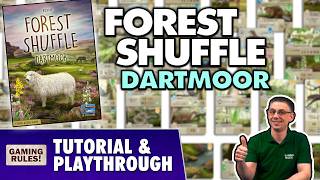







Forest Shuffle: Dartmoor Deep Dive
What the Community Thinks About Forest Shuffle: Dartmoor
Forest Shuffle: Dartmoor has arrived as a thoughtful refinement of its acclaimed predecessor, and reviewers are embracing it as a complete, standalone experience. The game succeeds because it distills everything learned from Forest Shuffle's expansions while introducing fresh mechanics, particularly terrain cards, that deepen the strategic landscape. For players already familiar with Forest Shuffle, Dartmoor feels like a natural evolution. For newcomers, it's an elegant introduction to engine-building through elegant card drafting and tableau construction. The consensus is clear: this isn't a remake, it's an improvement.
Core Mechanics That Define Forest Shuffle: Dartmoor
Building Your Moorish Landscape
At its heart, Forest Shuffle: Dartmoor is about constructing a personalized ecosystem on Dartmoor, a hilly region of England. You create your forest by placing tree, shrub, and terrain cards as the foundation of your ecosystem. Once established, these cards become slots where you attach fauna, flora, and plant life, each with unique placement rules and scoring opportunities. The terrain cards are the standout mechanical addition: unlike trees and shrubs that accept fauna on all four sides, terrain cards only allow placements on top and bottom, creating distinct tactical territory within your landscape. This creates a spatial puzzle that feels organic and thematic.
Drafting Through the Clearing
The action economy is beautifully simple: each turn you either draw two cards or play one card from your hand and check the clearing. Cards are paid for by discarding other cards from your hand, a flexible resource system that encourages meaningful decision-making. When you play a tree, you immediately draw a card from the deck to fill the clearing, creating a cascade of opportunity for other players. The cards themselves are split, showing different creatures or plants on top and bottom, or left and right, allowing you to choose which side to play based on your engine's needs. This modular approach means the same card can serve multiple strategies, and discovering synergies between cards becomes the driving pleasure of the game.
The Forest Shuffle: Dartmoor Experience
Satisfying Engine-Building Without Luck Dependency
Reviewers consistently highlight the joy of building synergistic engines, where placing the right cards together creates satisfying point-scoring chains. Barn owls score three points for every bat you place, buzzards multiply your mouse count, ferns double your points from specific creatures, these cascades feel rewarding not because you got lucky, but because you anticipated the right cards and positioned them cleverly. The beauty is that you don't need to win to feel accomplished; simply constructing a cool landscape with efficient synergies delivers the satisfaction. One reviewer noted scoring "five different dragonflies" felt like a personal victory even in the context of the full game, because the system itself celebrates these personal engine moments.
Caves Introduce Meaningful Asymmetry
The cave mechanic, unique to Dartmoor, adds asymmetrical starting powers that players draft before the game begins. Some caves offer immediate card draws, others provide end-game points, and still others trigger special abilities. This creates divergent opening strategies without feeling oppressive; players can pivot mid-game if the cards available in the clearing call for a shift. The cave system transforms what could feel like pure luck into strategic positioning, as you decide whether to build toward your cave's advantage or adapt if better opportunities emerge in the clearing.
What Makes Forest Shuffle: Dartmoor Stand Out
A Cleaner, More Balanced Game
Dartmoor benefits from lessons learned through Forest Shuffle's expansions. The terrain cards address spacing issues and create more varied habitat types, making each forest feel distinct. Reviewers appreciated that this standalone version doesn't require familiarity with the original, the rulebook explicitly highlights what's new, and the base rules remain elegantly streamlined even with the additions. The balance is notably tighter; creatures feel less overpowered in isolation because the ecosystem rewards varied placement and thoughtful composition rather than greedy point-grabbing.
Accessible Depth for All Player Levels
New players can enjoy Forest Shuffle: Dartmoor by picking a starting strategy and rolling with whatever cards emerge from the clearing. Experienced players will recognize the hidden depths: timing when to play trees (which cycle the clearing), understanding which cards to use as payment currency versus which to save, reading opponent strategies to predict what cards might benefit them. This scalability means a casual game group and a competitive gaming club can both find genuine engagement with the same box. The game doesn't punish beginners but rewards study and play frequency without requiring broken engine combinations.
Potential Drawbacks
Decision Paralysis at Game Start
With so many cards in hand and diverse drafting strategies possible, early turns can feel overwhelming. You don't yet know which cards are in the game (30 cards are removed in a 2-4 player game), so committing to a specific animal or plant strategy can feel premature. Some players might feel paralyzed choosing between "start building toward bats" versus "collect dragonflies" versus "focus on moors", especially since the clearing offers no guarantees. However, the game accommodates this: you can absolutely play reactively, building around whatever cards emerge, rather than locking into a rigid plan.
Similarity to the Original Forest Shuffle
For players who own and frequently play the original Forest Shuffle, Dartmoor can feel like "more of the same." The core loop is virtually identical; you're still drafting cards, paying costs, and building forests. The terrain cards and cave system inject freshness, but if you're already saturated with Forest Shuffle, Dartmoor might not feel like essential purchase, you can pick one or the other. Reviewers noted you likely don't need both versions, though Dartmoor's improved balance might make it the stronger choice for new players entering the family.
If You Enjoy Forest Shuffle: Dartmoor
You'll likely love Lost Cities, Kingdom Crossing, and the original Forest Shuffle itself. If you're drawn to games where landscape building and tableau composition matter more than luck or direct conflict, nature-themed card games like Cascadia and Calico offer similar vibes. For deeper engine-building with even more mechanical complexity, Splendor and Everdell scale that experience in different directions. If it's the animal theme that captures you, look toward games celebrating flora and fauna like Ark Nova and Ecosystem.
What Reviewers Are Saying
I really enjoy that you have any engine that you can build. You can tuck whatever cards you want around those trees and they all score differently and they all have a different purpose. And so I think my only negative is probably just that at the beginning you don't know what you're doing because you have so many cards and they could lead to so many different engines but you don't really have a lot of one thing or a lot of another thing. But I do just really enjoy building up that landscape, building up the cool synergies of the engine, and whether or not I win, it doesn't matter because I built something cool.
— The Dice Tower
It's one that I've heard from a lot of people is that they are like you can kind of just pick one. You don't need both. Um, but I've also heard that it's very balancing. And so a lot of the stuff that was learned from all the expansions in regular Forest Shuffle, this one kind of creates that balance and fixes some of the stuff that needed to be fixed.
— The Dice Tower
In Forest Shuffle Dartmore, you'll be creating a unique moorish landscape in front of you in the hilly region of Dartmore. You'll be collecting points by considering the preferences of animals and insects and placing them in the spots they want to be in or next to the other animals or insects that they want to be next to.
— All You Can Board