

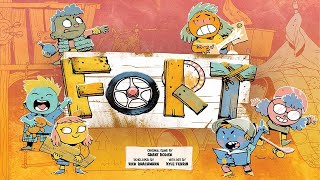
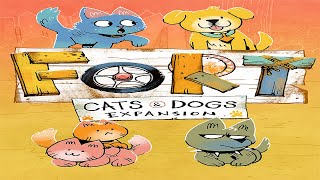
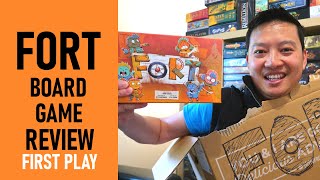













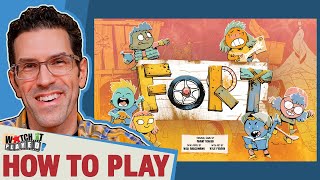
Fort is a 2-4 player card game about building forts and following friends.
In Fort, you're a kid! And like many kids, you want to grow your circle of friends, collect pizza and toys, and build the coolest fort.
By doing this cool stuff, you'll score victory points, and at the end of the game, the player with the most victory points wins! Your cards not only let you take actions on your own turn, but also let you follow the other players' actions on their turns. Will you devote yourself to your own posse, or copy what the other kids are doing?
But be careful as your carefully constructed deck might start losing cards if you don't actually use them. After all, if you don't play with your friends, why should they hang out with you anymore?
—description from the publisher
Fort in about 3 minutes
Fort - Playthrough & Review
- Impressive modular map with variable setups
- Asymmetry via leader cards and alliance tracks
- Engaging bluffing in combat adds depth
- Clear movement and supply-line planning provides strategic depth
- Beacons and alliance upgrades create dynamic VP opportunities
- Prototype status means rules/content may change before release
- Gold economy can be tight and constrain early decisions
- Solo and some component details not available yet during preview
- Two-player rules require minor adjustments and may feel edge-case heavy
- Array
- Norway during the Norwegian Civil War (1130-1240)
- Strategic, alliance-driven with bluffing elements
Mechanics (from transcript analysis)
- Alliance / Influence System — Four color-aligned alliances interact with an influence track; advancing influence upgrades alliances via overlay tokens.
- Area Control — Players move units to claim territories on a modular map, with valuable map features like ships, beacons, forests, and churches determining control.
- Bluffing / hidden information — Combat involves secretly choosing cards to play and guessing the opponent's card, creating bluffing tension.
- card drafting — A mini draft is used to select leader cards, introducing asymmetric starts for players.
- end game bonuses — Victory points determine endgame; players can earn VP from multiple sources, with potential endgame scoring.
- Endgame Scoring / VP Economy — Victory points determine endgame; players can earn VP from multiple sources, with potential endgame scoring.
- Event Cards / Tile-Triggered Effects — Event cards are drawn as VP markers pass event tokens, adding dynamic effects during play.
- Events — Event cards are drawn as VP markers pass event tokens, adding dynamic effects during play.
- hand management — Players manage and play cards from their hand to move units and perform actions with varying effects.
- Influence Points — Four color-aligned alliances interact with an influence track; advancing influence upgrades alliances via overlay tokens.
- Movement points — Movement is governed by movement cards that generate move points; players can overlay cards for more movement at a cost.
- Movement Points / Card-Driven Movement — Movement is governed by movement cards that generate move points; players can overlay cards for more movement at a cost.
- Resource management — Gold is a tight resource essential for paying to play actions and maintaining play area; can require resets.
- Resource Management / Gold Economy — Gold is a tight resource essential for paying to play actions and maintaining play area; can require resets.
- Ships / Sea Travel — Ships allow bridging gaps at sea and enable movement across sea spaces when controlled by units.
- Terrain Levels / Multi-Level Map — The map features multiple terrain levels that affect movement costs and route planning.
- Terrain Modification / Resource Transforms — Forests can be cut to produce resources (churches, villages, boats) and later burned for gold or VP.
Video topics + discussion points
Quotes (from this video)
- Fiora is a one to four player strategy game played on a modular map with area control and some handbuilding elements.
- The map is an impressive set of modular tiles of various sizes that stack to create up to four terrain levels from the sea and lowlands to snowcap mountains.
- The game plays out in rounds where during your turn you'll play a card, move units, and take actions, all in a particular order.
- On your turn you'll play one of your movement cards to your play area, and these will generate move points.
- With one movement point, your unit can follow your supply line any distances, ignoring all terrain costs.
- If you move into enemy controlled territories, you just swap the control cubes and watch smugly as you destroy an important supply line of another player.
- Beacons are lit, and these not only allow you to muster again, but give ongoing VPs every round for each one you control.
- The game ends when one player reaches 50 VP points, and there could be some sneaky endgame points from collecting sets of leader cards and alliance tiles.
- This is why you need to keep track of what influence you have, as well as other players from controlled locations and leader cards in play.
- For two players, there are only a few minor changes with how leaders are drafted in games during the air action.
- The rest of the leader cards are tiered as level two to six, and these are stacked where you'll claim them to hand throughout play.
- Event cards are drawn when VP markers pass over event tokens.
References (from this video)
- Compact and portable
- Accessible for players of many ages
- Flexible strategy with shifting goals
- Solo mode is not highly regarded
- Takes up table space
- pattern building and area majority scoring with evolving objectives
- A garden environment where players overlay cards to build overlapping garden areas
- abstract/strategic card placement with changing scoring objectives
Mechanics (from transcript analysis)
- area_majority_scoring — Complete objective cards by having the most of a color in a connected area to score points.
- end game bonuses — Game ends when the draw pile is depleted.
- endgame_trigger — Game ends when the draw pile is depleted.
- hand management — Start with three cards and draw back up to three after taking actions.
- hand_management_and_draw — Start with three cards and draw back up to three after taking actions.
- overlaying placement — Play cards that must cover at least two spaces by overlapping existing cards to form garden areas.
- task_cards_and_scoring — Draw and claim task cards that specify scoring conditions; points are earned throughout the game and at end.
- tile placement — Play cards that must cover at least two spaces by overlapping existing cards to form garden areas.
Video topics + discussion points
Quotes (from this video)
- This is a really fun game where you are overlaying your cards to try and make area majorities of flowers in order to score the most points.
- I really enjoy Floral.
- It's a small box, so it's easy to take with you, but it does take up some table space.
- I think it's great for a lot of ages because all you're doing is overlapping cards and trying to make the biggest spaces.
References (from this video)
- strong, cohesive theme and artwork
- high-quality components and storage feel
- replayability and evolving strategies across games
- engaging two-player dynamic and rivalry
- new-player complexity requires a solid explanation or rulebook consultation
- learning curve can be steep before the aids fully cover rules
- kids building forts with friends using toys and pizza
- playground/yards during kids’ playtime
- nostalgic, lighthearted, kid-centered
Mechanics (from transcript analysis)
- card play with top/bottom actions — Each card has a top action that can often be copied by others via following the leader, and a bottom action for your own gang.
- Deck building — Players assemble a personal deck of action cards as the game progresses.
- deck-building — Players assemble a personal deck of action cards as the game progresses.
- endgame variability via rules cards — Made-up rules cards provide end-game bonuses and in-game perks.
- recruitment and area dynamics — Recruit friends from the park or other yards; unused characters may linger and be scooped up later.
- suit-based play and follower mechanic — You choose a suit (e.g., shovels, water guns, glue, etc.) and play one card; top actions can be copied by players who follow the same suit.
- variable player count effects — Designed around 2-4 players, with a strong emphasis on the 2-player rivalry.
Video topics + discussion points
Quotes (from this video)
- it's a card game with a great theme
- some hidden depth
- it's the only way we have played
- it's basically impossible not to become attached
- fort is a light to medium card game but it has enough complexity
- the art which brings to mind peanuts in all of the best ways
- please let us know in the comments if you've tried for it yet
- this one is probably for you
References (from this video)
- surprisingly complex gameplay in a small box
- two actions on each card with interesting follow mechanics
- priceier than some other titles on the list
Mechanics (from transcript analysis)
Video topics + discussion points
Quotes (from this video)
- this time on allies or enemies we are counting down our top 10 small box games for two players
- these are great games at low cost that don't take up too much room
References (from this video)
- nostalgic theme and strong visual design
- fun drafting and interaction
- may be lightweight for some players
- drafting and neighborhood interactions
- childhood fort-building with themes of pizza and toys
- lighthearted, thematic play with family appeal
Mechanics (from transcript analysis)
- drafting — pick characters from other players' yards to draft into your own fort
- set collection — collect toys and treats to progress the fort
Video topics + discussion points
Quotes (from this video)
- it's the long game versus the short game
- it's a really fun dice puzzle
- the depth grows the more you play
- it's a legacy you can actually finish in a campaign
References (from this video)
- Accessible solo variant via official/unofficial mode
- Robo Kid turns are fast and easy to run solo
- Fun and engaging alternative when playing solo
- Resource generation can be slow or challenging in solo mode
- Deck can become large and turns lengthy
- Some rule clarifications encountered (coin/suit interactions)
- Array
- Neighborhood / kids' play environment
- Casual, first-person playthrough
Mechanics (from transcript analysis)
- Deck building — Players acquire cards and add to discard to shape future draws.
- hand management — Choices about which cards to play, discard, or trash for effects.
- Resource management — Players collect and spend resources (pizza, skateboards, toys) to gain points and perform actions.
- Scoring on Fort / End game scoring — Points come from fort levels, specific cards (macaroni sculptures), and other end-game bonuses.
- Trash / Eject — Some cards are removed from the game or moved to yard.
- Turn-based Action Phases — Turns progress through deploy, recruit, fortify, and other actions with scoring at deploy.
Video topics + discussion points
Quotes (from this video)
- hey everybody it's Danielle I'm doing a solo playthrough of Fort using the robo kid solo mode
- unofficial solo mode developed by Adam Prentice
- I will be playing on difficulty of one
- I lost terribly against the easiest level of Robo kid
- it's a really good alternative to scratch that edge to play this game
- let me know what you guys think have you guys tried it
References (from this video)
- Vibrant card artwork and color palette
- Rulebook includes helpful examples
- Replayability via scoring cards
- Includes multiplayer rules per box and platform availability (Board Game Arena)
- Array
- Harvest-themed solitaire
- Orchard
- Grove
Mechanics (from transcript analysis)
- Card-based scoring — Backs of cards are used to display scoring cards to drive scoring goals
- Compound Scoring — Backs of cards are used to display scoring cards to drive scoring goals
- Replayability through scoring cards — Multiple scoring cards are included to create replayability
- Solitaire — Single-player/puzzle play focused on optimizing scoring with a small deck
Video topics + discussion points
Quotes (from this video)
- this is the final installment of the harvesting Trilogy
- these are all the backers and you do see my name here which is awesome
- I like that they added this in Grove and this game I'm or sure they did not but this definitely gives an element of replayability and just really gives you that um you know that scoring goal when you play the game
- it's worthy I'd say for a rule book
- I'll be doing a playthrough or two of forage on my channel
References (from this video)
- Offers a unique twist on deck-building by tying card flow to a neighborhood/fort-building theme
- High level of player interaction through cards that can help or hamper others
- Thematic coherence with family-friendly, colorfully imagined neighborhood life
- Mechanics imply potential unintended advantages for certain players when cards benefit others
- No explicit numeric rating or official score provided within the transcript
- Building forts as a communal social activity, with competitive and cooperative moments among friends
- Neighborhood with yards, parks, and local kid-friendly spaces; suburban/informal forts building
- Playful, neighborhood-centered, family-friendly storytelling that frames card effects around shared spaces
Mechanics (from transcript analysis)
- Deck building — Players acquire cards from parks or from other players' yards to form and improve their deck.
- deck-building — Players acquire cards from parks or from other players' yards to form and improve their deck.
- Icon collection and multipliers — Icons collected provide point multipliers and influence scoring along the victory point track.
- Player interaction through card play — A card you play may benefit another player later on, creating dynamic interplayer dependencies.
- Thematic action sequencing — Theme drives how and where cards are used (parks, yards) within a neighborhood setting.
Video topics + discussion points
Quotes (from this video)
- this one has a very unique twist
- centered around the theme of playing around in the local neighborhood with your friends who each have their very own special interests
- a deck building game where you'll be building a deck by acquiring cards from park or from other players' yards
- a card that you play now may actually benefit another player later on
- you'll be collecting different icons getting point multipliers and moving up the victory Point track
- the theme Here is copy what everyone else does and we very tight race to build your very own fort
References (from this video)
- Strong, engaging theme with nostalgic art and vibe
- Solid fusion of abstract puzzle with dice combat
- Compact 15-20 minute playtime ideal for two players
- Balanced two-player design without asymmetric powers
- Catch-up potential via cousin/jerk tokens adds tension without overpowering
- Prototype components (board and cards) are not final in pre-release copy
- Dice-driven luck can influence outcomes, though rerolls mitigate this
- Limited to two players in the current design; may limit long-term replayability
- Neighborhood water-balloon warfare with playful competitiveness
- A sunny suburban backyard where kids defend forts with cardboard boxes and water balloons.
- nostalgic, cartoonish, summer-epic vibe
Mechanics (from transcript analysis)
- Card-driven fort construction — Players draft and place fort cards to build enclosed areas and connect edges for strategic territory control.
- Color-damage allocation — Hits of a color can be allocated to specific pieces or entire color-connected sections to minimize damage.
- Dice rolling — In combat rounds, players roll a pool of dice tied to their fort's pieces to score direct hits on the opponent.
- Dice rolling combat — In combat rounds, players roll a pool of dice tied to their fort's pieces to score direct hits on the opponent.
- Enclosure and edge-connection — Edges must connect to existing structures to form enclosed spaces that unlock additional options.
- Speed-timed rounds — A speed mechanic incentivizes finishing rounds quickly to gain extra dice and advantage.
- Token-based tempo and rewards — Cousin and jerk tokens grant extra dice or rerolls, introducing a push-your-luck element and recovery options.
Video topics + discussion points
Quotes (from this video)
- "the thing i like about two-player games is that any discrepancies and balance comes out really really quickly"
- "it's not complicated it's not hard but it is made competitive by the timed aspect"
- "the art style is really appealing and evokes a nostalgic cartoon network vibe"
- "two-player balance comes out quickly"
- "mitigated luck-based game"
References (from this video)
- Accessible, light-hearted theme that works for casual play and bonding
- Fast-paced action with a clear, tactile components setup
- Good visual quality for a prototype (art, sturdy boxes, distinct token design)
- Solid entry point for two players and an approachable route to solo practice
- Prototype may still undergo tweaks before release
- Intense timer pressure may be stressful for some players
- The hybrid of fort-building, card management, and real-time dice adds complexity that may require explicit rule clarifications
- Fort building and water balloon skirmishes
- At-home fort-building duels
- Light-hearted, family-friendly
Mechanics (from transcript analysis)
- Combat: Dice — Balloon dice determine offense and defense, with umbrellas acting as defensive symbols and balloons as attack indicators.
- Dice-driven combat — Balloon dice determine offense and defense, with umbrellas acting as defensive symbols and balloons as attack indicators.
- Fort-building / area enclosure — Fort cards and boxes are used to enclose areas, which can grant resources and enable more intense play as the round progresses.
- Jerk token risk mechanic — A punishment/reward mechanic tied to timing and dice results, influencing control of the pace and who gains advantages mid-round.
- Real-time placement — Players place dice and resolve actions within a constrained time window (12 seconds in the solo and base game flow).
- Resource/cards management — Cards reveal fort-building options and actions; players manage a hand and draw four cards per round in standard play.
- Two-player emphasis with solo variant — Designed as a two-player game but the video documents a fan-created solo mode and a quick practice variant.
Video topics + discussion points
Quotes (from this video)
- this is fortify by barrel aged games
- it's a game where you're building a fort
- it's a real time strategy game
- the true fun is the bonding experience you and your buddy going at it with each other
- I panicked
- solo mode look this is a two-player game but this is for if you want to grab the strategy for yourself
References (from this video)
- weird deconstruction of deck-building norms
- ability to draft from other players' yards
- set-collection and potential for chaining combos
- deck evolves over time rather than only improving
- feels empty and hollow; mechanic salad of icons
- no solo mode
- art style criticized as creepy
- Friendship, play, neighborhood dynamics
- Neighborhoods where kids build forts and socialize
- Deconstructive deck-building theme around childhood play
- Root
- 51st State
Mechanics (from transcript analysis)
- card_management — managing cards in hand, discard, and lookouts/fort storage
- drafting — draft cards from a central display or from other players' yards
- Resource management — track resources (pizza, toys) to upgrade your fort and conduct actions
- resource_management — track resources (pizza, toys) to upgrade your fort and conduct actions
- scoring_and_progression — points from cards in lookout and advancing fort levels
- set collection — cards come in sets that can be used together for bonuses
- set_collection — cards come in sets that can be used together for bonuses
Video topics + discussion points
Quotes (from this video)
- Fort has a silly theme of kids playing around the neighborhood where building a fort is a goal
- the best thing about this game is its weird deconstruction of the deck building norms
- you can't hold every card each turn and you can draft from other players
- it's a mechanics salad loaded with icons until someone tells me it's game over
- Fort is transactional childhood friendship simulator the card game
- the art style the kids are creepy looking
- groups of kids have different themes and cards abilities and you'll want to be able to chain cards of matching sets together
- zeroing in on what combination of set collection versus opportunistic card collection works for you is the key to enjoying fort
- and that's who the game is for people who like the idea of a deck builder where your deck is constantly changing and evolving rather than consistently improving
- despite all that fort feels a little empty and hollow to me
- is he playing lotion with another kid trapped in that well
References (from this video)
- family-friendly and approachable
- fantasy motif is appealing to many players
- component quality is sometimes criticized
- some players may prefer a deeper weight
- city-building and adolescent social dynamics
- Card-driven, build-your-own fantasy/fairytale town
- light, family-friendly
Mechanics (from transcript analysis)
- deck-building — Players build a personal deck to perform actions and develop their fortifications.
- set collection / variable player powers — Acquiring cards that grant diverse benefits and combos.
Video topics + discussion points
Quotes (from this video)
- every game deserves a second chance
- it's a good game, it's a middleweight game
- the components are cheap
- we're not fans of real time games though but you know what we're going to try it
- we always have fun and try to play with family
References (from this video)
- Fun theme
- Great card mechanics
- Replayable
- Jamie struggles to win
- Kids building forts
- Childhood/Playing
- Lighthearted
Mechanics (from transcript analysis)
- Card Play — Playing cards to build your fort
- hand management — Drafting cards and managing hand
Video topics + discussion points
Quotes (from this video)
- Foster the Meeple - a channel all about board games
- we have our team jeff team jamie patreons who are going to be voting on what the loser has to do
- i love res arcana res arcana is quickly becoming one of my favorite games
- adult where's waldo
- knocked our socks off
- i love it
- so much fun
- winter is coming
- board game city up in here
References (from this video)
- fast, quick to learn
- bright components and engaging decisions
- can be ruthless in two-player tight play
- not deeply strategic for some
- childhood ambition and building a fort
- fort-building as kids in an imaginary world
- playful, family-friendly
Mechanics (from transcript analysis)
- dice worker placement — draft dice to take actions and upgrade your fort
- set collection — collect cards/resources to upgrade objects
Video topics + discussion points
Quotes (from this video)
- it's a heavy boy
- we played this one tons in May
- I love this game, I love it, I love it
- we're learning
- this is a party game that you could play virtually
References (from this video)
- thematic and approachable for mixed ages
- social and interactive
- could be less appealing to players seeking heavy strategy
- Calico
- The Crew
Mechanics (from transcript analysis)
- card-driven player interaction — Players manage a pretend backyard with houses, buildings, and actions driven by cards.
Video topics + discussion points
Quotes (from this video)
- diversity is extremely important especially for even our older community who may not be tech savvy
- it's the atmosphere at the table
- representation really matters
- we're the products of that student
- we want to keep their brain active and engaged; brain activity is important
- three big ones is Calico, Fort and The Crew
References (from this video)
- compact and portable
- interesting scoring tension
- math-heavy for some players
- Trick-taking with a light fantasy scoring layer
- Compact card-drafting with leaves and skulls imagery
- subtle, abstract
- Seas of Strife
Mechanics (from transcript analysis)
- card drafting — Players draft and play cards with scoring implications.
- Compound Scoring — Skulls on high-number cards and leaves on other cards influence scoring.
- skulls vs. leaves scoring — Skulls on high-number cards and leaves on other cards influence scoring.
Video topics + discussion points
Quotes (from this video)
- the minis are outstanding
- it's a fun fighting game
- it's kind of like a tableau building game and set collection game
- the box feels quality
- Ticket to Ride now they've got trains and then they have other Ticket to Ride with boats and all that stuff
- Lost Cities will make you mad all day long
- Salt and Sea is interesting
- the expedition system
- you kind of do cards and things
- circle the wagons... two-player game
- two-player game good
- Push... push your luck
- we're going to roll straight into the heart of this episode
- Terraforming Mars is the best game
- the art and packaging of Let's go to Japan is beautiful
References (from this video)
- Inspires creativity
- Encourages self-expression
- Emotionally engaging
- Creativity/Self-expression
- Abstract
Mechanics (from transcript analysis)
- card drafting — Battle of pizza popularity and true expression
Video topics + discussion points
Quotes (from this video)
- This is a definitive list based on inarguable data - Board Game Geek lists 5000 games as having been released in 2020
- I haven't actually played forgotten waters but I did look at a lot of Instagram photos of it - 10 out of 10
- I just moved one piece on the board and I just knew it - about learning Barbary Wars history through The Shores of Tripoli
- Meeples but they're bees, so they call them peeples
- I really like this game called Tell Stones, you've probably never heard of it
- Board games are made out of cardboard, it's actually hard for your digestive system to handle cardboard
References (from this video)
- Art and presentation noted as appealing/cute
- Considered approachable with potential for satisfying play
- Strong theme that may invite family and solo play alignment
- Weight and depth relative to family play could vary by group
- Smartphone Inc.
- Villagers
Mechanics (from transcript analysis)
- card drafting / hand management — Players draft and play cards to build their strategy, leveraging actions and resources to maximize scoring potential.
- Resource optimization — Players optimize a limited set of resources to gain advantages and progress toward victory.
Video topics + discussion points
Quotes (from this video)
- "five about five games from our shelf of shame that we are going to play and put on the table"
- "we're going to go that is the goal"
- "we're swimming because you know no family... we are a family first"
- "learn the rules"
- "we are going to do this because we're telling family"
References (from this video)
- strong thematic integration
- unique mechanic where unplayed cards are recruited by others
- dogs and cats mini expansion enhances theme
- mechanics work thematically and mechanically
- clever card effects
- satisfying 'aha' moments when teaching
- can be long with four players due to AP
- no official solo mode
- best at 2-3 players
- kids building a fort
- recess
- South Park
- theme-driven
Mechanics (from transcript analysis)
Video topics + discussion points
Quotes (from this video)
- all these factors that go into this list and the games that I enjoy at any particular time
- I like deck builders, it's a good fun mechanic
- watch their brains click and then you're like yes got you hook line and singer
- it's only a game
- these people should not touch card games - hate those people
References (from this video)
- Interesting artwork direction
- Disappointing execution
- Didn't feel like building a fort
- Resource abstraction confusing
- Pizza and toys don't feel thematic
- Missing physical defense elements
- Compared unfavorably to Root
- Players questioned what they were doing
- Childhood fort-building competition
- Kids building forts
- Whimsical kid aesthetic
- Root
- Code Name Kids Next Door
Mechanics (from transcript analysis)
- Card Play — Play cards to build fort
- progression — Build up fort defenses
- resource collection — Collect pizza and toy boxes
Video topics + discussion points
Quotes (from this video)
- love it love it love it
- that's gonna be a real big part of our collection
- Lost Cities is a two-player game it's evil y'all
- happy frustration
- it's kind of funny funny
- i like it better this time
- games have to grow on me
- beautiful game loved it oh man omg
- i love the artwork diverse
- this may be one of our favorites
- we are disappointed
- we didn't build a fort
- what are we doing
- if you ain't have fun what you doing
References (from this video)
- Great comfort game
- Go-to game for Jeff
- Fun childhood theme
- Has expansion with cats and dogs
- Jeff can't win at it
- Fallen slightly lower on list due to repeated losses
- Nostalgic childhood gameplay
- Childhood - building forts with toys
- Lighthearted childhood adventure
Mechanics (from transcript analysis)
- Deck building — Building deck as you play
- direct interaction — Stealing friends from other players
- neighbor interaction — Stealing friends from other players
- set collection — Collecting toys, pizza, and friends
- Toy Collection — Collecting toys, pizza, and friends
Video topics + discussion points
Quotes (from this video)
- Azul is just a classic classic game
- I will always want to play this game it's a staple
- Racing is my favorite game mechanic
- I love watching everything kind of like waterfall off of each other
- Castles of Burgundy is incredible I love Castle's birdie
- I love this game so basically like the world is dying
- The best part about Black Angel the little robot guys
- Bet on yourself always always I don't even care if I lose the game believe in yourself
- Dice Throne is an incredible 1v1 battle Yahtzee game
- Wingspan I am almost always in a game of Wingspan on BGA
- This game is beautifully designed it just feels good when you play it
- I can't win and I am getting freaking sick of it
- It's always a great time when it hits the table
- Paint the Roses is a Cooperative deduction game
- I've fallen back in love with it
- Some of the best gaming experiences I've had is playing that game
- I really really love Flamme Rouge it is an excellent game
- I will fall in love with this game it's got the recipe for it to be like a top 10 game
References (from this video)
- Elegant, straightforward rules
- Strong two-player engagement
- Less player interaction with fewer players
- Rule-specific contingencies
- tile-laying and set-collection
- two-player competitive card-tile drafting
Mechanics (from transcript analysis)
- set collection — collect patterns to fulfill scoring tasks
- tile laying — lay cards to form shapes and patterns
- tile placement — lay cards to form shapes and patterns
Video topics + discussion points
Quotes (from this video)
- you're going to rewrite your fate with every pull
- the ninth game in the Simply Solo line
- Color Quest — a limited edition coloring book and 48 marker set
- This is a sport. This is better than sports
References (from this video)
- pure_fun
- excellent_take_that_at_two
- childhood_theme_resonates
- friend_stealing_mechanic
- toys_pizza_fun
- great_at_two_players
- childhood
- fort_building
- friend_making
- toy_collecting
- pizza
Mechanics (from transcript analysis)
Video topics + discussion points
Quotes (from this video)
- no guilt no shame no mercy
- it is pure magic pure gold
- build like a mortal win like a god
- tiny box biggest table presence experience
- this is a game i wouldn't want to play at higher than two
- jamie knows when she's one and i can see it in her face
- i have a very difficult time comparing games that are that drastically different
- castles of burgundy is heavier therefore i put castles of burgundy at one
- i know myself well enough by now you know i've got 34 years into this body i know i know what i'm into
- don't be a meanie or weenie it's okay to hate things
References (from this video)
- Fresh take on the deck-building framework with a one-card-per-turn cadence that heightens tension and decision-making
- Distinct public/personal abilities layer that increases player interaction and strategic depth
- Strong thematic integration and charming artwork by Kyle Ferran
- Compact, elegant components and high-quality player boards that support fast setup
- Multiple viable endgame paths and adaptable strategies keep the game engaging
- Divisive design: some players may miss the absolute control found in heavier deck-builders
- Turn disruptions and the display/recruitment mechanic can lead to moments of downtime or feel chaotic for some players
- tribal rivalries, alliances, and betrayal among children as they build and defend their fort
- Kids in a park creating and upgrading a fort, using a whimsical, playground-politics backdrop.
- whimsical, playful, with a strategic undercurrent that respects the deck-building genre
Mechanics (from transcript analysis)
- discard_to_amplify — Some abilities can be amplified by discarding other cards that share a matching suit.
- end game bonuses — Endgame can be triggered in multiple ways, providing several routes to scoring and preventing premature stagnation.
- endgame_and_scaling — Endgame can be triggered in multiple ways, providing several routes to scoring and preventing premature stagnation.
- lookout_and_persistence — Kids in the lookout act as persistent resources that persist between turns, influencing future plays and opportunities.
- one_card_per_turn — On each turn, a player plays exactly one card and resolves its abilities.
- public_vs_personal_abilities — Most kids have two boxes for abilities—public and personal. Players may resolve either or both, and others can discard a card of the same suit to take the public action as well.
- recruitment_and_display — After playing a card, you recruit a new kid to your deck. Unplayed cards left in your hand go on display for others to recruit; if unclaimed, they return to discard on your next turn.
- resources_and_backpack — Resources come as pizza and toys; collecting them upgrades actions and increases backpack capacity, enabling more efficient engine-building.
- symbol_network — Each card features a network of symbols that determines which effects are activated and how they interact with other cards.
Video topics + discussion points
Quotes (from this video)
- this is a box of utter joy blending whimsy with total authenticity
- fort feels like a strategic attempt to dismantle deck-building games
- there's loads of choices and how to resolve your own turn
- beautifully adorned with some of the most creative illustrations from Kyle Ferran today
- the Spartan design in a small classy box which barely wastes any space
- if you're looking for a concise and approachable game that playfully breathes new life into one of the most stale and overdone mechanics
References (from this video)
- Strong, approachable theme with broad appeal
- Expansion-friendly (e.g., Cats & Dogs) that adds variety without bloating the base game
- May be perceived as lighter than other Leader titles
- Depth relies on expansions and player creativity
- Playful childhood exploration; social play in a modular environment
- Backyard world where kids build forts and explore imaginative play
- Whimsical, lighthearted with a nostalgic feel
Mechanics (from transcript analysis)
- card-driven actions / simple engine-building — Action selection and progression driven by cards; supports easy entry with depth via expansions.
- pathways to scoring and exploration — Different scoring avenues and routes to victory via fort-building and neighborhood play.
Video topics + discussion points
Quotes (from this video)
- "Fantasy by way of like Rich Jim Hensen; everything's a little Muppet"
- "every card should be good"
- "I want somebody to open Leader Games stuff and say this is my favorite game"
- "colorblind friendly with the actual components"
- "you could tell that the people who made this absolutely were fully bought into this concept"
- "the art style is the trust; it's important to visually solve the game's questions"
References (from this video)
- New streamlined version of SPQF; development involvement discussed.
- Only a single play described; lacks long-term data.
- family/board-game-cards
Mechanics (from transcript analysis)
- unknown — Not described in transcript.
Video topics + discussion points
Quotes (from this video)
- I'm not doing great
- this is my entire income right now
- I miss doing the work I miss the people that I've worked with
References (from this video)
- Charmingly thematic with strong, appealing artwork and personality in every card
- Innovative twist on deck-building that emphasizes one-card-per-turn decision making
- Excellent production quality and a well-thought-out player aid; compact but sturdy components
- Can incur analysis paralysis at higher player counts due to many private/public decisions
- Park draw deck cycling can slow the pace in 2-player games
- Some perks balance could feel uneven, requiring careful balancing in different player counts
- Childhood adventures, social interaction, resource management and fort-building
- Kids building forts in a neighborhood, collecting pizza and toys as they play with friends
- Whimsical, lighthearted, kid-centered with personal endgame objectives
- Root
- Oath
- The Crew
- Boy Rome
Mechanics (from transcript analysis)
- deck-building — Players start with a hand of cards representing kids and best friends; they draw up to five cards, but only play one card per turn.
- follow and boost actions — Most top actions can be followed by other players by matching suit or using a wild; private bottom actions are restricted to the active player.
- fort construction and scoring — Fort levels require discarding resources; higher levels yield increasingly more endgame points, with a macaroni sculpture awarded to the first level-five forter.
- hand/yard/lookout management — Discards go to the yard; best friends stay in discard unless recruited; lookouts provide ongoing boosts and can be improved.
- perks and lookout — Perk cards and lookout cards modify actions and provide ongoing bonuses or one-time effects; some perks enable extra turns or hand management tricks.
- private/public actions — Each card shows two actions; the bottom private action stays with the active player, while the top public action can be followed by others.
- Resource management — Resources come in as pizza and toys; resources are stored in a player's stuff area and can be moved to a pack for points.
Video topics + discussion points
Quotes (from this video)
- This game is a refreshing design
- It's a card game but it's quite thinky
- The theme of this game is we are kids and we are doing what kids do
- Sticky fingers is awesome
- Replayability is high due to made-up rules and perks
References (from this video)
- beloved by the speaker
- great with friends
- solo mode not available yet
- nostalgia / friendship
- childhood fort-building with imaginative play
- story-like social play
Mechanics (from transcript analysis)
- set collection / action drafting — build a fort by recruiting friends and planning activities
Video topics + discussion points
Quotes (from this video)
- none of these games have like an official solo mode but I really wish that they did
- I would play it way more if I could just play it by myself
- I would love a solo mode for Fort
- Hookie is one of my all-time favorite games
References (from this video)
Mechanics (from transcript analysis)
Video topics + discussion points
Quotes (from this video)
- it's an experience
- it's incredibly mean in Cutthroat
- I would never stop playing it on BGA
- this is the best game one of the best games ever in my opinion
- it's crazy chaos I love this game
- it's not overly light racing game
- I love this game I wish so badly was on BGA
- it's an engine builder
References (from this video)
- Unique twist on deck-building
- Fun social interaction
- Accessible theme
- Heavier deck-building for some players
- Imaginative play, social interaction
- Kids building forts and playing in the park
- light, social strategy
Mechanics (from transcript analysis)
- deck-building — play and manage a deck of action cards
- exposure/hand-off — give unplayed cards to opponent for use
- hand management — discard unused cards to effect opponents
Video topics + discussion points
Quotes (from this video)
- we hear ofpg voices our goal is to make this world a better place one board gamer at a time
- being playful has power it is infectious unifying and gratifying
- humanity is a co-op we are co-opting together to make this world a better place
- treat people the way you want to be treated
References (from this video)
- Wonderful artwork
- Engaging theme
- Cats and Dogs expansion available
- Jamie's favorite choice
- Jeff's go-to game with Jamie
- Strong replayability
- Jeff prefers 2 players only
Mechanics (from transcript analysis)
Video topics + discussion points
Quotes (from this video)
- These games are games that we enjoy playing at two
- Easy to learn hard to master
- Every game is different
- This game is awesome the artwork is incredible
- If you're a couple and you're looking to get a significant other into board games, that is one to check out
- It's a game that's either your thing or it's not
- The more and more I play unmatched more and more I appreciate how good that game is designed
- I love this game I do not like to play it at more than two players
- It might be a masterpiece of two-player game
- Very mean and I just think at two player it just becomes so much more tight
- This is one of the most chaotic games I've ever played
- I love dueling games like I love any game where you are just like Head to Head playing out cards
- Every time where I have the opportunity to play it I want to play it
- I think it's my favorite two-player game