

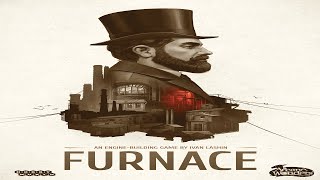









































Furnace is an engine-building Eurogame in which players take on the roles of 19th-century capitalists building their industrial corporations and aspiring to make as much money as they can by purchasing companies, extracting resources, and processing them in the best combinations possible.
Each player starts the game with a random start-up card, the resources depicted at the top of that card, and four colored discs valued 1-4.
The game is played over four rounds, and each round consists of two phases: Auction and Production. During the auction, 6-8 company cards are laid out with their basic sides face up. Players take turns placing one of their discs on one of these cards, but you cannot place a disc on a card if a disc of the same value or color is already present. Thus, you'll place discs on four cards.
Once all the discs are placed, the cards are resolved from left to right. Whoever placed the highest-valued disc will claim this card, but first anyone with a lower-valued disc on this card will gain compensation, either the resources depicted multiplied by the value of their disc or a processing ability (exchange X for Y) up to as many times as the value of their disc.
Once all the cards have been claimed or discarded, players enter the production phase, using their cards in the order of their choice. Each company card has one action — either production or processing — on its basic side and two actions on its upgraded side. During the production phase, you can use each of your cards once to gain resources, process those resources into other resources or money, and upgrade your cards.
At the end of four rounds, whoever has the most money wins.
Furnace also includes capitalist cards that contain unique effects, and if you want, you can choose to deal one out to each player at the start of the game. For an additional challenge, you can require players to create a "production chain", with each newly acquired company card being placed somewhere in that chain and locked in position for the remainder of the game.
- Engaging engine-building arc that scales with more factories
- Tense auction phase that rewards smart risk and information tracking
- High variability due to evolving factory cards and optional automa
- Accessible for families, quick play sessions with depth
- Strong art and table presence
- Component quality could be improved (coin and marker aesthetics)
- Some powers are complex and rarely used by first-time players
- Early rounds can feel slow while engines develop
- Rule checks during auctions can be fiddly
- Engine-building through resource conversion and strategic auctions
- Industrial factory network during a competitive production cycle
- Procedural optimization with evolving engine and card-driven actions
- Atoma
Mechanics (from transcript analysis)
- Auction — Players bid chips to acquire factory cards; legal configurations, color-imposed restrictions, and payout calculations shape bidding strategy.
- Auction / Bidding — Players bid chips to acquire factory cards; legal configurations, color-imposed restrictions, and payout calculations shape bidding strategy.
- Automa/dummy player — An optional dummy bidding player for two-player games to add variability and maintain tension.
- engine building — Factories can be upgraded to unlock better production and convert resources into money and, ultimately, points.
- engine-building — Factories can be upgraded to unlock better production and convert resources into money and, ultimately, points.
- Production Phase — In each round, players must resolve all actions on a card before moving to the next; it is an all-or-nothing progression per card.
- Resource management — Core resources include coal, iron, oil, and money, which are produced, traded, and transformed through upgrades.
- upgrade tokens — Upgrades allow converting specific resources into money, driving end-game scoring and engine efficiency.
- Variable Phase Order — In each round, players must resolve all actions on a card before moving to the next; it is an all-or-nothing progression per card.
Video topics + discussion points
Quotes (from this video)
- it's a well done and really a pretty elegant one; you don't have to think too much about the automa and you still get to run your own game
- it's a really fun puzzle trying to figure out the best way to make the most money
- you will get something no matter what even if you lose the bid you won't get the card but you will get some resources which sometimes is actually what you wanted out of the card
- I thought it was a good game because you just got to like build your engine right from the start and pay attention to what you can get
- it's definitely become a big hit in our households
- it's a great light to medium weight engine-building game that really plays quick
References (from this video)
- Engaging bidding mechanic that drives decisions
- Expansion Interbellum adds depth and competition
- Art and components are appealing; good table presence
- Interesting interplay between resources and money
- Base game at two players is a simplified experience without expansion
- Box is large for the volume of components
- Engine-building, resource conversion, bidding
- Industrial Revolution factory setting
- It's a Wonderful World
Mechanics (from transcript analysis)
- Auction / Bidding — you bid tokens to gain cards and resources; losing bids yields resources.
- bidding — you bid tokens to gain cards and resources; losing bids yields resources.
- card drafting — you draft cards that represent machines/factories and their effects.
- card_drafting — you draft cards that represent machines/factories and their effects.
- engine building — you build an engine of factories that convert resources into money and points.
- engine_building — you build an engine of factories that convert resources into money and points.
- resource_conversion — you convert inputs to outputs and ultimately money.
- set_collection/tableau_building — you build a personal tableau of factories that persist between rounds.
- tableau building — you build a personal tableau of factories that persist between rounds.
Video topics + discussion points
Quotes (from this video)
- I really like engine building games and ones where you're just trying to set up like the best conversions with the cards that you have
- the expansion makes it a lot better and more competitive
- the bidding Market you have to do it in order from left to right
- it's depressingly gray
- it's a pretty clever system actually how you play the rooms
- this is a Button Shy dual game
- you could play this anywhere… in the back of a car
References (from this video)
- Snappy and deep; strong puzzle feel
- Delightful bidding mechanic
- Simultaneous play reduces downtime and keeps momentum
- Theme aligns well with gameplay and decision space
- Sharp edges; newcomers can fall behind early
- Base game lacks a solo mode (solo variant exists in community/expansion)
- Capitalist race to build factories and maximize profits
- Early industrial era: coal, iron, and oil production
- Procedural puzzle; optimization without a narrative arc
- Nitlier
Mechanics (from transcript analysis)
- Auction / Bidding — Players bid tokens (1–4) on face-down cards placed in the middle; highest bid wins the card for their factory.
- bidding — Players bid tokens (1–4) on face-down cards placed in the middle; highest bid wins the card for their factory.
- Card sequencing and optimization — Players must fully resolve one card before moving to the next, encouraging strategic synergy between cards.
- One-time bid penalties — Losing a bid yields a one-time benefit based on the bid amount; bidding 2 on another player's card can double that card's payoff.
- resource upgrading — Goods can be upgraded through a factory line (coal → iron → oil) to improve value.
- simultaneous action — All players execute their factory-building actions concurrently, reducing downtime.
- Simultaneous Actions — All players execute their factory-building actions concurrently, reducing downtime.
Video topics + discussion points
Quotes (from this video)
- It is snappy and it is deep and it just works.
- The bidding mechanic is delightful.
- This is the perfect puzzle for my brain.
- I wholeheartedly recommend Furnace.
References (from this video)
- Tight, elegant bidding with meaningful consolation prizes that keep players engaged
- Phase separation creates a satisfying crunch: planning in phase 1 and execution in phase 2
- Rich inter-card synergies and upgrade pathways encourage optimization and experimentation
- Variants add depth and replayability without breaking the core loop
- Humorous, self-aware tone that reinforces the satirical capitalist theme
- Rounds can feel inconsistent in engagement level depending on card draws and disk placements
- Some powers may feel unbalanced or less impactful in certain player counts
- Two-player mode relies on a die-driven surrogate for bidding, which can feel fiddly or unsatisfying
- Price point may be high for some buyers and the theme may not land for all players
- Capitalist expansion, strategic resource manipulation, and market dynamics
- Industrial capitalism competition across a multi-round bidding and resource-conversion landscape
- Satirical, tongue-in-cheek critique wrapped in abstract engine-building
- Sidereal Confluence
- Century: Spice Road
- Splendor
- Brass
- Kanban
Mechanics (from transcript analysis)
- Auction / Bidding — Players place colored disks on cards; the card goes to the highest-value disk; losers receive consolation prizes and the game escalates auction tension throughout a round.
- Auction / bidding with ownership disks — Players place colored disks on cards; the card goes to the highest-value disk; losers receive consolation prizes and the game escalates auction tension throughout a round.
- Card diversity and synergy — A mix of card effects creates numerous synergy opportunities; players must learn which combos unlock the best value.
- Card ownership and order of resolution — The bottom actions on cards drive later conversions; timing of using a card’s ability is core to strategy.
- Consolation-prize rewards — Even if you don’t win a card, you may gain a payoff proportional to your bid, adding a layer of risk vs. reward.
- Phase-based gameplay — Phase 1 centers on acquiring factory cards via bidding; Phase 2 focuses on converting owned cards' resources into other resources or money.
- Player count dependent card layout — The number of cards available and the number of disks shift with player count, altering auction dynamics.
- Resource conversion engine — Cards grant conversion effects; players chain conversions (coal to oil, oil to money, etc.) across multiple cards to optimize outputs.
- Upgrade tokens and starting factory — Every player starts with a factory that generates upgrade tokens and enables enhanced coin output, plus upgrades to cards over time.
- Variable Phase Order — Phase 1 centers on acquiring factory cards via bidding; Phase 2 focuses on converting owned cards' resources into other resources or money.
- Variant rules integration — Different rule variants add or modify powers, affecting bidding, order, or duplication allowances to alter pacing.
Video topics + discussion points
Quotes (from this video)
- this is excellent game design you've already crunched the crunch here is where you just indulge yourself
- furnace will let you pour your sweat and tears doing absolutely nothing and still having a grand time winning capitalism
- it's cleaner leaner and more fun than century or splendor or any other game where you collect resources to convert into other resources to convert into other resources
- capitalism is only fun when others play along
- capitalist superpowers right tony stark
- three and four players are much of a muchness but the free player game introduces a funky quirk
- it's almost like having a real job is there anything in this game to make my wealth acquisition more palatable
- phase two is purely about taking one type of cube and converting it into another type of cube
References (from this video)
- Strong art on cards that shifts as revealed
- Elegant balance between bidding for cards and resources gained when you lose bets
- Some players may find the balance delicate or less accessible on first play
- tableau-building Euro games
Mechanics (from transcript analysis)
- Auction / Bidding — Bid for cards; higher bets yield cards while risking resources.
- Bidding/Auctioning — Bid for cards; higher bets yield cards while risking resources.
- Resource management — Management of resources generated by cards for future turns.
- tableau building — Players reveal and place cards to build their personal tableau and gain resources.
Video topics + discussion points
Quotes (from this video)
- I love Wizards of the Grimoire if you guys haven't checked it out yet I definitely recommend trying it at least on BGA
- this is the first game from Eerie Idol games
- Barcelona is oh such a fantastic game
- I'm so so happy I now have it in the collection
- I am not the hugest fan of Cooperative games
- oh my goodness I love the way it looks
- you are going to be killing the guests in order to get money from them
References (from this video)
- Interesting mechanics
- Beautiful artwork
- Good theme
- Not a cute game
- Building in furnace
- Industrial
- Strategy
Mechanics (from transcript analysis)
- Auction — Auction without back and forth
- engine building — Building resources into furnace
Video topics + discussion points
Quotes (from this video)
- Foster the Meeple - a channel all about board games
- we have our team jeff team jamie patreons who are going to be voting on what the loser has to do
- i love res arcana res arcana is quickly becoming one of my favorite games
- adult where's waldo
- knocked our socks off
- i love it
- so much fun
- winter is coming
- board game city up in here
References (from this video)
- pure engine building
- beautiful theme
- Jeff loves the theme
- not a love for Jamie
- requires enjoyment of engine builders
- industrial revolution
- industrial
- simulation
- Res Arcana
Mechanics (from transcript analysis)
- bidding — minor bidding/auction component
- engine building — pure engine builder based on fuel types - coal, oil, etc
Video topics + discussion points
Quotes (from this video)
- we have a problem
- it's a beast you need a table to play a table
- it's freaking fantastic it's super good
- i've said a million times how much i love res arcana
- the art is stunning
- ford is one of my favorite games
- this is just a super fun halloween time game
- shipping in canada at night it's so exciting everywhere is a bit of a nightmare right now to be honest
References (from this video)
- engaging engine-building with a streamlined feel
- clear path to victory when the engine lines up
- crunchiness can feel tight at higher player counts
- ordering matters; missteps can derail flow
- industrial production and resource transmutation
- Engine-building with resource transformation
- crisp, streamlined economic engine.
Mechanics (from transcript analysis)
- bidding/auction — auction for cards to expand the engine
- engine_building — build an engine of cards that transmute resources into points
Video topics + discussion points
Quotes (from this video)
- this is going to be one of the coolest examples of a programming game that you will see out there
- Wallenstein has become one of my favorite games of all time
- it's beyond genius
- Tower Up is fantastic
- it's pure system
- this is one of the most overlooked games from the Oink brand
References (from this video)
- Clear example of engine-building through card chaining
- Demonstrates an explicit feedback loop where one card enables another
- Implicit definitions may vary by player, causing debate
- Steamworks
- Gizmos
Mechanics (from transcript analysis)
Video topics + discussion points
Quotes (from this video)
- furnace hits the my definition of an engine builder.
- it's a feeling not a mechanism.
- Terraforming Mars as being like a quintessential engine building game to me.
- Concordia... your hand in and of itself is an engine that you are building towards.
- Steampunk Rally matches your definition and it also matches mine in that it is you're making this frankenstein's monster of a racing machine.
- Golem is where you stack the cards and then you keep reactivating them.
- Darwin's Journey comes to mind.
- Dominion is deck builders but can build engines; it sits in a spectrum.
- Villages, vineyards, and aging workers can feel engine-like but not always.
- income is not an engine.
References (from this video)
- strong production loop
- replayability
- resource management and factory output
- industrial furnace/production-themed Euro
Mechanics (from transcript analysis)
- engine-building — develop systems to optimize production efficiency
Video topics + discussion points
Quotes (from this video)
- If this was just a job if i was just doing this for money well first of all the channel would be a lot different
- it's been a real problem you know i mentioned that these playing with friends videos have been taking a lot longer to make
- these update vlogs are about me being transparent about stuff
- two cameras that work
- i'm tinkering around hitting a bunch of things with a hammer to see if things get better
References (from this video)
Mechanics (from transcript analysis)
- Auction / Bidding — Players bid and manage a tableau in an auction-driven engine-building framework.
Video topics + discussion points
Quotes (from this video)
- "Adam experience at The Gamers Ranch"
- "we played 18 games this weekend"
- "it's heavy but we loved it"
- "I won Vienna; I love this game"
References (from this video)
- dense engine-building with many interactions
- high cognitive load from many cards and effects
- industrial efficiency with semiconductor-like resource flow
- engine-building with resource manipulation
- mechanical, systems-driven crafting of engines
- Vinhos do Brasil
- Viticulture
Mechanics (from transcript analysis)
- auction / bidding lite — surface-level bidding influences selection and resource flow
- engine-building — players build an engine of cards in front of them to generate resources and scoring opportunities
Video topics + discussion points
Quotes (from this video)
- Calico is cute and it hurts my brain
- the big thing with the coin games is the cascading decisions
- every decision feels like it is most important
- it's like playing Root and being mindful of everything going on around you
- you have to watch where Directorio and Government tracks are moving
- mind management has a lot of dialogue back and forth for sure
References (from this video)
- Pure engine building mechanics
- Unique auction mechanic with discs
- Resource management adds depth
- Weak theme integration
- Theme doesn't match mechanics
- Industrial/Economic (weak thematic connection)
- Abstract
Mechanics (from transcript analysis)
- Auction mechanic — Using numbered discs (1-4) to bid on cards, sometimes for resources rather than winning the card
- engine building — Building production chains and converting resources
- Resource management — Managing resources from card effects
Video topics + discussion points
Quotes (from this video)
- do those things that's going to keep us safe yeah so that we don't get overcome again
- the games from 2021 that we loved and we picked our top 10 games from that
- board games that bring the fun to the table
- i used to read yes you did when we first got married i would read yes i loved uh books
- i can do so much more yeah with board gaming than with golf
- they want to be known as the steam platform for board gaming
- embracer is becoming that you know so big that they're gonna be so diversified for geek culture
- we want to be that one-stop shop where if you're looking for people of color you want to hear what they have to say
- diversity inclusion that's what we're shooting for
- it's a beautiful game and you know the market you know because you gotta always look at the market
- i ain't mad at you
- the dice ain't nice
- we love you guys we we we're just glad you're still with us and keep on coming back
References (from this video)
- Engaging mix of auction and engine-building
- Asymmetry via character abilities and expansion components
- Solid theme support and attractive components
- Expansion adds depth (solar mode) and more strategic options
- Solo mode is very challenging to win; punishing
- Rulebook clarity for solo/expansion content is lacking
- AI behavior is deterministic and can feel unfair without optimal play
- Setup and space requirements can be extensive
- Resource generation, engine-building, and auction-style card selection
- Industrial-era production with coal, steel, oil, and a production chain in a factory setting
- Thematic flavor is conveyed through asymmetrical character abilities and compensation rules
- Expeditions
Mechanics (from transcript analysis)
- Asymmetric automas and AI — two starter automas with distinct behaviors; AI cards influence bidding and outcomes
- auction/bidding — players bid on production cards using bidding tokens; AI opponents also place bids
- Card upgrading and manager tokens — upgrade cards to improve production; manager tokens grant ongoing bonuses
- engine building — producing and chaining resources to unlock card effects and upgrades
- Resource conversion and selling — convert coal, oil, or steel into other resources or coins via conversion effects
Video topics + discussion points
Quotes (from this video)
- this is furnace and this is the solo game
- the solo game is not that much different from the multiplayer game
- I really like the bidding mechanism and the idea with the compensation effects is really good
- the rules in the rule book are not very clear especially in the development expansion regarding solo content
- this is not a teach right this is just a playthrough
- the expansion solar mode makes the game a lot better in my opinion
- solo mode does work
References (from this video)
- Clever bidding mechanism with resource pressure
- Intuitive and clever hybrid design
Mechanics (from transcript analysis)
- Auction / Bidding — Allocate desks to cards; highest bid claims a card and others gain resources.
- Bidding/resource allocation — Allocate desks to cards; highest bid claims a card and others gain resources.
- engine building — Run an engine of cards converting resources and driving scoring.
- Engine-building mix — Run an engine of cards converting resources and driving scoring.
Video topics + discussion points
Quotes (from this video)
- I love how streamlined this game is.
- it's a drafting style game as you're trying to build up the civilization of cards
- one world worthy of all the hype
- this engine builder
- it's the crunchiness
- this is widely considered to be one of the best if not the best economic style board game of all time
- it's a joy to play
- you are destined to love it
References (from this video)
- Tense, fast, and elegant auction gameplay
- Shorter playtime with deep decision points
- Interbellum expansion adds variety and flavor
- Two player duels like Furnace Duel might eclipse base game for some
- Auction heaviness can be punishing for new players
- Auction driven engine building and development
- Industrial era with factories and engines
- Mechanics driven rather than thematic storytelling
- Furnace Duel
- Furnace
Mechanics (from transcript analysis)
- auction bidding — Players bid on buildings that expand their engine and production capabilities.
- engine building — Cards add to your engine and improve your production loop.
- goods conversion — Turn resources into points via a producing engine with strategic choices.
Video topics + discussion points
Quotes (from this video)
- Nations is the civilization game to beat quite frankly.
- Two great two player games in one countdown; the golden age of two player gaming.
- Isle of Cats Explore and Draw is the second greatest roll and write of all time.
- The Rival Networks is fast, tight, and makes you sweat from start to finish.
References (from this video)
Mechanics (from transcript analysis)
Video topics + discussion points
Quotes (from this video)
- I think five shorts in the can is a momentum, it's going to be a priority.
- The YouTube algorithm is fickle because we don't want to tailor our content to it, but we have to consider it.
- PAX Unplugged could be a great place to do interviews, but we have to be mindful of publishers' time and not be overly intrusive.
- Yokohama is a really interesting game with an interesting history, and I wanted to capture that in the review.
- Desperate Oasis is a small game and the Shorts performed reasonably well for it.
References (from this video)
- Clever and intricate strategic bidding mechanism
- Character special abilities add variety
- Good engine building gameplay
- Well-balanced risk-reward system
- Steam trains and industrial era
- Industrial Age
- Resource management
Mechanics (from transcript analysis)
- bidding — Players bid with tokens to acquire cards, but everyone must bid higher than previous bid
- engine building — Lay cards to generate resources that generate other resources
- worker placement — Resource generation based on placement
Video topics + discussion points
Quotes (from this video)
- it's getting our board game coffee seal of approval that's how good
- baby's first deck builder it's super simple and then it gets gradually harder
- King of New York I find personally is the better version
- Aquatica from Arcane wonders is a fabulous game
- foundations of Rome is one of my like favorite games of the year
- we just need a name for it
- thanks for joining us if you like this video and you want to see more subscribe to our channel
References (from this video)
- interactive play
- strong social dynamic
- rule clarity and potential for disputes
Mechanics (from transcript analysis)
- Resource management — players move and allocate resources while managing scoring flow, with occasional social dynamics noted during play
Video topics + discussion points
Quotes (from this video)
- it's a time travel chest and it's really well done
- i dug it
- i'm sold so i want to play the game that lights up
- blue clues with benedict cumberbatch
- I got 84 gold
- this is gamma so far gamma's been
References (from this video)
- Interactive bidding phase followed by solo engine activation
- Excellent compensation system for losing bids
- Balance between interactive and solitary play
- Some players dislike transition from interactive to solo play
- Bidding and resource management
- Industrial/economic game
- Light strategic card game
- Gizmos
Mechanics (from transcript analysis)
- auction/bidding — Place tokens to bid for cards, win with bigger number
- Card activation — Activate cards in tableau like Gizmos mechanism
- Compensation for Losing — Losing bid gives resources times the number of chip used
Video topics + discussion points
Quotes (from this video)
- It's like a gumbo. You want to have a little bit of worker placement? Cool. You want to have a little bit of interesting card play? Cool.
- You're trying to colonize the moon, baby.
- I love that there's just positive interaction that is people trigger the incomes.
- When do I kill my people? Like when do I use them for such a strong action and then reset them down to one?
- This game is stupid good.
- Don't be an alpha player. Done. This game is fantastic.
- Look what we all made.
- I'm so sorry I'm over here. (Said repeatedly in Project Elite)
References (from this video)
- snappy play; potential with expansions
- tight resource economy
- could be thinner without expansions
- engine-building with bidding
- industrial revolution and resource networks
- tight, fast-paced engine construction
- Power Grid
Mechanics (from transcript analysis)
- bidding — outbid other players to claim industry cards
- engine-building — convert resources into more resource-generating actions
- Resource conversion — turn gathered goods into engine outputs
Video topics + discussion points
Quotes (from this video)
- this game is poo
- it does as i said just take that edge off the randomness
- one of the best card games i've ever played
- it's almost like a eurofied Ticket to Ride
- the ambition of this game is absolutely mind-blowing
- a game that rewards repeated plays
- the board is always flux and alive
References (from this video)
- crunchy and thinky but plays quickly
- strong engine-building core
- can feel dense for casual players
- money, production, and card-driven engine development
- industrial engine-building
- crunchy, thinky Euro with fast progression
Mechanics (from transcript analysis)
- Card drafting / hand-management — select cards that fit your engine and economy
- engine-building — build an engine by acquiring cards for your tableau to generate money
Video topics + discussion points
Quotes (from this video)
- we wanted to put together this new show that was gonna spotlight you know people of color women lgbtq you know all of those underrepresented voices
- these are the kinds of comments that i got in the survey
- this is what i was looking for
- we love talking to you too and then one more thing family always know always remember we love you
References (from this video)
- Wonderful tension every round
- Tense bidding
- Fast play time
- 45-minute plays
- Four turns only
- Great with family
- High play count
- Clever bidding mechanics
- resource management
- auction
- industrial
Mechanics (from transcript analysis)
Video topics + discussion points
Quotes (from this video)
- it's a full day of gaming you got a plan for snack breaks you need to plan for nap breaks
- this cool game about sliding these things around the board and it's so stinking satisfying
- we really enjoy unfair but i don't enjoy all the mean stuff so every single piece so fun fair just really fixes that problem
- this one completely changed what a roll and write can do
- my brain turned to much like i literally need to power down for a little while and let my brain reset
- there's something special about it you know that really makes it stick out amongst everybody else
- this replaces terraforming mars for me
- it is just such a smart idea that is so simple
- orange nebula designs just incredibly unique incredible experiences
- the way that you use your hand management and the resource management it all just sings together really well
- they're there this isn't like a we're just going to reskin something
- it does a really great job of letting those last two players have the opportunity to really challenge the people that are in first and second
- it's quacks of quinlenberg the dice version
- i'm a sucker from dice i love the tactical sensation of just chuck and dice
- you really are paying attention to what's going to fill up each cauldron
- the best hidden movement game that i've played ever
- if you like the crew to begin with you can literally throw it in the trash and get this version
- it's brilliant from a design standpoint it's absolutely brilliant
- it's that wonderful tension right every round where am i gonna place where am i going to you know place my bid
- it's so relaxing it's so satisfying it's gorgeous
- i've needed my board gaming to be a warm thumpy blanket
References (from this video)
- Fast-paced auction with meaningful choices
- Depth from upgrades and card interactions
- Clear, simultaneous production phase
- Multiple play variants add replayability
- Thematic components and VP scoring
- Complex rules may be intimidating for newcomers
- Rule interactions can be dense for beginners
- Engine-building and bidding-driven production
- Industrial era resource production with coal, iron, and oil
Mechanics (from transcript analysis)
- auction/bidding — Players place discs on cards to bid; resolve in a fixed order with compensation for non-winning bidders
- card_drafting_and_upgrading — Startup and company cards upgrade to upgraded sides, unlocking bonuses
- compensation — Bonus/resource transfers when resolving bids and card bonuses
- dummy_player_and_two_player_rules — In 2-player games a dummy player can be used; advanced rules adjust placement and timing
- engine-building — Upgrade tokens and company cards upgrade production capabilities over rounds
- production_phase — Simultaneous actions to generate resources and coins; bonuses activated per card
- resource_management — Coal, iron, and oil resources with bonuses and processing via card effects
- round_based_structure — Four rounds, each with auction and production phases
- scoring_and_capitalists — Coins act as victory points; some capitalist cards alter how resources or bonuses are spent or scored
- Variants — Two-player and advanced variants with different rules and setup
Video topics + discussion points
Quotes (from this video)
- Furnace is a fast-paced engine building game for two to four players that plays in about an hour
- The game is played in four rounds
- Production phase all players act simultaneously
- Coins is victory points in the game
- You can never place one of your discs on top of a card which already contains one of your discs
- Advanced game differences add planning and placement rules
- In 2-player games there is a dummy player to adjust pacing and tension
- If you have this capitalist you can use iron instead of upgrade tokens whenever you're upgrading your cards