
Following Inis, Galactic Renaissance is the second installment of the "Political Trilogy" by designer Christian Martinez and publisher Matagot.
Throughout Galactic Renaissance, you build your team, adding new specialists — each one unique — to the core in your deck of cards. With this team, you discover new planets and systems, reconnect with lost civilizations, expand your influence, build embassies, and sow disorder in opposing factions — all in an effort to score victory points faster than your opponents. Sending emissaries to new planets, for example, allows you to discover new civilizations or cement relationships on known planets. Opponents may try to convince a planet to join them instead with their own emissaries, causing disorder in the process.


Images


- Offers strategic depth and tactical possibilities.
- Enjoyable exploration of its sci-fi theme.
- Can be polarizing, potentially due to marketing as a follow-up to a beloved game.
- Sci-fi
- Inis
Mechanics (from transcript analysis)
- Area Control — Features area control driven by card effects.
- Card Drafting — Players draft cards.
- deck cycling — Players are cycling through their decks.
- Race — Players are racing to score 30 points first.
Video topics + discussion points
Quotes (from this video)
- My number 77 game is galactic Renaissance this sibling designed to inish turned out to be far more polarizing than I ever would have guessed
- The Simplicity and speed of Luna combined with the unique abstract Challenge and Perfect Production make this one of the most fresh two-player games in years
- bitewing games is launching the most epic Riner Kia Kickstarter project ever and yes currently it is a secret but not for long
References (from this video)

- Enjoyed the game, easy teach.
- Cards have actions written on them for straightforward play.
- Learned once, easy to pick up again.
- Clever warp gate mechanic for movement.
- Ability to plan the order of cards in the deck.
- The dual-action cards offer strategic depth.
- The disorder mechanic provides interesting player interaction.
- The endgame condition requiring a minimum score on the final turn prevents cheap wins.
- Felt like a race to the end at times.
- Player missed opportunities with the disorder mechanic.
- Planet powers were not always utilized effectively.
- Some planets were not as beneficial as others.
- The game can be a table hog, especially with more players.
- Exploring and deploying people to planets for control and abilities
- Sci-fi
- Concordia
- Small World
Mechanics (from transcript analysis)
- action selection — Players choose which cards to play on their turn to take actions.
- Area Majority — Players compete for influence over planets to gain control and special abilities.
- Card Play — Players draw cards from their deck and play them to take actions, with the option to play additional cards if the card allows.
- Deck Building — There is a small amount of deck building involved as players can modify their decks by drawing from another stack of cards.
- Dice Placement — Dice are used as workers that are placed on a central board to collect resources or perform actions.
- Set Collection — Players collect sets of influence on planets or achieve scoring objectives to earn victory points.
- Variable player powers — Controlling planets can grant players planet tokens that provide additional abilities.
Video topics + discussion points
Quotes (from this video)
- It's like we're back in pandemic times speaking of more depressing news tonight could be the night that the port union workers start on strike which will shut down ports on the East Coast.
- The rule book is not very good.
- I'm not a fan of deduction games like this.
- If you don't like deduction games, you're not going to like this.
- It does add a little bit of planning mechanics to it.
- I agree with all that I do like the fact that I stay engaged the entire time cuz I possibly get something on somebody else's turn I appreciate that the game move pretty quick.
References (from this video)

- Best area control game you haven't played
- Pure area control
- Tight
- Stinky
- Incredibly clever systems
- Finally delivering from Kickstarter
- area control
Mechanics (from transcript analysis)
- Area Control — Still the best area control game you haven't played.
Video topics + discussion points
Quotes (from this video)
References (from this video)

- Second installment in a political trilogy
- High anticipation based on praise for the first game (Ennis)
- Intriguing concept for the hosts
- Not much information known about the game yet
- Creating dominance and changing the world for the better
- The Galaxy
- Ennis
Mechanics (from transcript analysis)
- Area Control — The goal is to be the first to win by creating dominance, likely in the galaxy.
- civilization building — The theme suggests changing the world, potentially through building or development.
Video topics + discussion points
Quotes (from this video)
- we love deduction Games Social deduction not so much but deduction games yeah specifically like logic puzzles logic puzzles they are brilliant and the Search for Planet X why can't I get the title is such a clever game it is one of our favorite deduction games so when we heard that there is going to be a spin on that mechanic of deduction and trying to figure out a lost species yeah hello we need this game
- it looks gorgeous
- it's essentially a worker placement at the heart of a lot of what UE Rosenberg games look like it looks gorgeous I'm excited to play it I love always games so this is gonna be great
- the pictures of this game look absolutely poor
- I'm excited for my brain to be a little bit
- brain burner I guess when you play metallic certain games your brain goes yeah like that
- I loved my city yep that was such tremendous experience
- the tile placement was like super smooth super quick
- thundergrip does is all their games are just the quality in them is remarkable
- building your own coven yeah and there's a little bit of Witchcraft but essentially you want to be the Septima which is like the High witch
- it's a brain burn similar to like calico-esque
- I love that throw away those victory points I don't want any of those Point trackers victory points are happiness no they are switch victory points to happiness points
- the board games were moving into a golden age so Golden Age so if the Washington Post says it must be they're not Liars are they
References (from this video)

- Tight, tension-filled decisions
- Interesting portal mechanic
- Strong flow and meta play
- influence on planets with space exploration flavor
- space exploration with a council-style influence system
Mechanics (from transcript analysis)
- area/planet influence with portals — influence and travel between planets influenced by portals on planets.
- cascading scoring and building effects — cards play to trigger cascades that affect scoring and buildings.
- deck-building — recruit cards that enable scoring and cascading effects.
Video topics + discussion points
Quotes (from this video)
- this first game is an absolute home run
- as soon as you play this game you always want to play the other side
- I want to continue playing it again and again
- it's a spatial bidding game where you'll take turns bidding on this terrain
- planning your vacation and energy levels ... balance
References (from this video)

- Lots of opportunity for clever play.
- The synergies can feel really good when they come together.
- Dynamic objectives that change throughout the game.
- Visually appealing with good art and colorful pieces.
- High player interaction.
- The game rewards playing it multiple times, with different objectives and specialists leading to different experiences.
- The rolling objective system is interesting.
- The ability to tailor the game by choosing objectives (though not in this playthrough) is a plus.
- The art is good, with some pieces being unsettling in a cool way.
- Taking planets that retain their regions visually is a fun mechanic.
- The game is fast enough to be played multiple times in a session.
- Feels like there are cards for every situation, and if you don't draw the right ones, you can't do much.
- Some players felt like they had nothing to do.
- The objectives can feel random and sometimes don't synergize with a player's strategy.
- The randomness of the objective flips can be frustrating.
- The 'stability' mechanic can be particularly awful (e.g., a stability of 5 can be like a 3).
- Difficulty in sorting out minority objectives.
- Protecting institutes can be tricky if players are inclined to disrupt early.
- A lot of planets and little rule-breakers can feel unnecessary and overwhelming.
- This specific play experience didn't hit well for one player.
- It makes players want to play Inish instead, which is considered a superior game by one reviewer.
- The portals can sometimes be hard to track.
- The muted board art contrasts with the colorful player pieces.
- assembly establishing policy through objectives
- distant stars in a time of hope and rebirth
- Inish
Mechanics (from transcript analysis)
- Area Majority — Scoring objectives often depend on having the most emissaries or institutes on planets, or being in the minority.
- Card Drafting — Players draft specialist cards at the start and can draw more throughout the game.
- Drafting — Players draft specialist cards at the beginning of the game. There are also drafts for home planets and advisors.
- Hand Management — Players must manage their hand of cards, deciding when to play them for their actions or abilities.
- Set Collection — Some objectives reward players for having specific types of planets or configurations.
- Tableau Building — Players build up their player board by placing institutes, which unlock abilities and contribute to scoring.
- Variable objectives — Objectives change throughout the game based on player progression and can be flipped or replaced.
Video topics + discussion points
Quotes (from this video)
- The hook in this game is when you're at 20 on your turn you either score 10 points or you reset back to 20.
- You do not shuffle your deck except at the very beginning of the game.
- I'm not kidding that's the whole game.
- It's a game where the Synergy either comes or it doesn't come when it comes it feels really good when it doesn't come it's a little frustrating.
- The objectives can feel random and I'll before we get out of here I'll actually go through what the others are to show everybody.
- Inish is a top 10er I probably just want to play that and then I'll go if I'm going to commit the time I'll just play that they are different enough that I like them both and I don't think like one crowds the other one out but I there's not a question in my mind that Ines I think it's a superior game.
References (from this video)
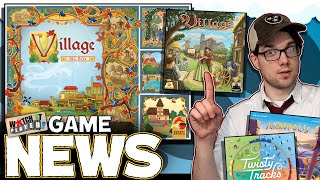
- Second game in a political trilogy.
- Discover new planets and systems.
- Reconnect with lost civilizations.
- Build embassies.
- Sow disorder in opposing factions.
- Space exploration and political maneuvering
- Inis
Mechanics (from transcript analysis)
- Area Control — Expanding influence, building embassies, and dealing with opposing factions.
- Deck Building — Players add new specialists to their deck of cards.
- Race — Aiming to race opponents to victory by claiming planets and cementing relations.
Video topics + discussion points
Quotes (from this video)
- you know it just wouldn't be uh every other friday without some board game news
- millennials of mystery not on my watch
- so if you wanted to pick something up then now is a great time to grab a bargain
- i was very excited to see that his previously polish game was getting an english language reimplementation
References (from this video)
- No discard piles allow deck-order strategy
- Diverse card types enable varied strategies
- Peaceful political theme aligns with the channel's vibe
- Clear core concepts and setup explained
- peaceful coexistence through diplomacy and governance
- a new planet forming a Galactic Senate to influence the federation peacefully
- abstract political strategy focusing on emissaries, institutes, and foundations
Mechanics (from transcript analysis)
- build_institutes_foundations — Construct institutes and foundations to gain more card play flexibility and options.
- deck_discard_ordering — No discard piles; cards discarded go to the bottom of the deck in order, enabling deck-order strategy.
- disorder_resolution — Resolve disorders when planetary stability thresholds are exceeded.
- emissaries_move_between_planets — Move emissaries to explore and influence planets through portals.
- operation_cards — Play operation cards during turns, with possible chain plays indicated by a play again symbol.
- portals_hub_dynamics — Hub planet with three portals governs movement and access across planets.
- victory_point_scoring — Score points from objective cards and sometimes core team and specialist cards; reach 30 points and 10 in a churn.
Video topics + discussion points
Quotes (from this video)
- Galactic Renaissance is a two to four player game designed by Christian Martinez and published by madigo who helped sponsor this video
- there are no discard piles your discarded cards will always go to the bottom of your deck in the order that they were played
- well you'll score various victory points primarily from the objective cards and sometimes your core team and specialist cards as well in order to win you must reach 30 points and score 10 points in the same churn
- peaceful coexistence
References (from this video)
- Deep deck-building and engine-building potential
- Non-violent, strategy-driven area control with thematic coherence
- Cascading growth and tempo shifts that feel exciting
- Clear teaching path with growth after several plays
- Not ideal for one-off playthroughs; rewards longer engagement
- Steep learning curve for new players and need for baseline familiarity
- Runaway leader risk and reliance on group level alignment
- Peaceful diplomacy and cultural exchange to achieve governance goals
- Spacefaring civilizations vying for influence to form a peaceful Galactic Senate
- Deck-building driven by planetary influence and objective fulfillment
Mechanics (from transcript analysis)
- Card sequencing / draw order control — Finished cards are placed on the bottom of the deck in the order they were played, enabling strategic draw sequencing.
- Compound Scoring — Score points by fulfilling Galactic Senate objectives and advancing influence across planets.
- Deck Building — Players acquire Specialists to their deck and use them to perform actions.
- Deck Manipulation — Finished cards are placed on the bottom of the deck in the order they were played, enabling strategic draw sequencing.
- deck-building — Players acquire Specialists to their deck and use them to perform actions.
- Non-violent area influence / disorder mechanics — Planets have stability thresholds; disorders trigger peaceful resolutions affecting play without combat.
- Objective-based scoring — Score points by fulfilling Galactic Senate objectives and advancing influence across planets.
- Specialists with unique abilities — Specialist cards grant distinct powers that shape deck strategies.
Video topics + discussion points
Quotes (from this video)
- my favorite part about this game is actually the deck manipulation where you're picking up Specialists adding them to your deck and then utilizing them how you see fit
- no combat in this game
- area control here is non-aggressive
- the pacing of this game is really interesting as well
- there's no Discord piles when you finish playing your card or cards you'll place them on the bottom of your deck in the order that they were played
- you'll essentially plan the order of your deck
- it's very cool when you can utilize your Specialists and then all of a sudden be like no I think I can win here so I'm just going to discard my Specialists if I draw another
References (from this video)
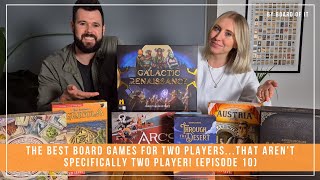
- Novel blend of Euro mechanics with space theming
- Engaging timing and hand-management puzzles
- Strong two-player snappiness similar to tighter Euro titles
- May rely on luck of card draw at times
- Some players may prefer more direct interaction
- Hand management and area control in a space setting
- Space exploration and empire building
- Euro-influenced, strategic
- Race for the Galaxy
- Eclipse-style planning games
Mechanics (from transcript analysis)
- Area Control — Control of planets and scoring zones determined by the cards played and timing.
- Area control via card effects — Control of planets and scoring zones determined by the cards played and timing.
- Deck Building — Play cards to score objectives and control areas while timing allows for efficient chains.
- Deck-building and card timing — Play cards to score objectives and control areas while timing allows for efficient chains.
Video topics + discussion points
Quotes (from this video)
- we absolutely loved it
- it's very tense and very mean
- it's a really brilliant game at any player count from two to five players
- it's a terrific game to play at two players basically
References (from this video)

- highly strategic card play with a unique cadence
- strong feel of planning and pre-empting opponents
- deep, different vibe from typical area-control games
- long learning curve; requires reading and cross-referencing many cards
- initially non-intuitive UI/iconography can hinder early learns
- influence, culture-building, empire-like growth
- spacefaring civilization across planets with portals and planetary sites
- deck-driven actions with cadence/turn timing
- Inish
- Gaia Project
- Beyond the Sun
- Terra Mystica
Mechanics (from transcript analysis)
- Area Control — each planet/place track scores influence; players vie for dominance on multiple locations
- area influence / area control — each planet/place track scores influence; players vie for dominance on multiple locations
- Card-driven actions — actions are driven by a shared deck of cards; timing and cadence control what's possible this turn
- deck cycling without frequent shuffles — draws from a personal deck; cards cycle back to bottom; timing constraints matter
- Deck Manipulation — draws from a personal deck; cards cycle back to bottom; timing constraints matter
Video topics + discussion points
Quotes (from this video)
- the card play is just so uh different, it's so strategic; every move feels super important
- it's a longer game, but the cadence is really neat; you have to time everything to that cadence
- I love Obsession that game
- it's very mean, but in a fun, game-ifying way
References (from this video)

- tactically rich with a unique deck cycling twist
- compact box with a lot of strategic depth for a space-themed title
- mechanics can be opaque on first play; benefits from repeated play
- some players may find it less thematic than other space epics
- deck cycling and area-majority on planets
- space exploration and planetary colonization
- space opera with evolving scoring objectives
- Inish
- Arco Society
- Rising Sun
Mechanics (from transcript analysis)
- area majority with planets — control majority on planets to score; colonies and emissaries spread across the map
- deck cycling — cycle through scoring objectives and powerful cards; speed determines scoring opportunities
- variable scoring objectives — scoring cards are different each game, driving varied strategy
Video topics + discussion points
Quotes (from this video)
- Silos is all about area majority and being in the right spot at the right time because the UFO is moving around the board and you have to predict where it's going.
- It's basically a meeting of a strategy game and a pure party game; it's hilarious.
- The Cosmic Silos Trilogy—Silos, Ego, Orbits—launched as a bundled Kickstarter with big box content.
- El Grande is a classic; Silos flips the idea by making the card actions feel like a slot machine, more frequent and dynamic.
- I love the retro Quan Moria art; it's quirky and visually striking.