/pic1798823.jpg)
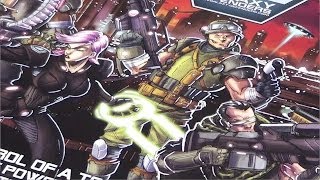
Galaxy Defenders is a sci-fi cooperative, tactical battle wargame in which 1-5 players fight together against an oncoming alien menace. Each player takes control of one or more agents with unique powers to defend the planet from the alien invasion. Gameplay revolves around a tactical combat system, using custom ten-sided dice. Each player sequentially plays his Agent turn and then one Aliens turn. Players carry out their turns [agent and aliens] in clockwise order until the last player finishes his Aliens turn. Once done, the game passes to the Event phase that will bring the players to the next round. Players may choose up to five agents:
Marine: Coming from U.S. Special Forces, the Marine is an excellent soldier who can manage different combat situations, especially multiple enemies.
Biotech: The Biotech is the most technologically adept agent in service. He can use Nano-Technology to heal wounds or control war drones.
Infiltrator: A deadly and stealthy agent. This lethal specialist prefers hiding in the shadows. She has fast movement and good short-range combat ability.
Sniper: A silent sharpshooter and expert in camouflage and ranged combat. The sniper has average movement and excellent long-range firepower.
Hulk: The Hulk was a successful mercenary and now is one of the best agents; although slow, he enjoys an extraordinary resistance to damage and has high firepower.
There is no "Alien player" in Galaxy Defenders; instead, the aliens are controlled by the game system itself, through an artificial intelligence system based on two types of cards:
Alien cards, which define the behavior of each different alien and detail its skills and combat abilities.
Close Encounter cards, which are used at the beginning of each alien turn to determine which aliens activate.
The combination of a unique AI for each alien species and the uncertainty about alien activation in a turn provides a realistic simulation of the chaos of battle and a sophisticated challenge for the players. Since having more agents brings more alien activations for the aliens, the turn structure allows the level of difficulty to scale dynamically based on the number of agents in play. If agents die during the game, the system "recalibrates" the difficulty to a reasonable and enjoyable level, so you still have a chance to complete the mission.
The battle for Earth will be carried out in a series of twelve missions organized in a completely story-driven campaign. Mission events influence future games in two different ways:
Each mission has multiple endings, and the outcome of any mission will change the flow of the story.
The agents gain experience during the missions. This experience transforms a good soldier into a perfect Galaxy Defender agent with multiple skills, basic and improved tactics, and the ability to use new devices, improved human weapons, and Alien technology.
With the downloadable Galaxy Defenders: Alien Mind variant, you can transform the game into a competitive affair, with one player becoming the alien mastermind and controlling the alien army and the card in play, attempting to thwart each mission undertaken by the Agents. To do this, the alien player completes his own game objectives, obtaining new "alien signals" that can be teleported onto the battlefield. This variant, which allows for play with up to six players, can be used in a single mission or for a whole campaign of Galaxy Defenders. Using Alien Mind may increase the game difficulty and is suggested only for expert players.

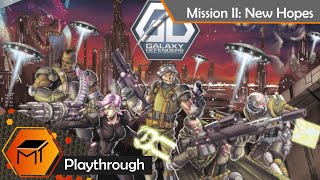
Galaxy Defenders | Mission II | New Hopes

- fun early dungeon crawl with solid AI
- character progression is engaging
- base game is quick to set up and play
- team-cooperative defense with progression
- aliens invading Earth; space-based dungeon crawl
- campaign-like progression with evolving characters
- Sword & Sorcery
Mechanics (from transcript analysis)
- Character progression — progression of characters through upgrades and campaigns
- cooperative dungeon crawl — players work together to stop alien threats
- Dungeon Crawl — players work together to stop alien threats
Video topics + discussion points
Quotes (from this video)
- this is a list that is purely subjective and what i mean by that is this is purely the games that i like to play the most
- the numbers 5 through 10 or maybe even 4 through 10 might change on any given day
- one and two are really really close
- it's light-hearted it has a strong story
- the dice are fun
- the real joy of gloomhaven is just the card play
- i love exploding dice
- the artwork and minis look really good
References (from this video)

- really fun
- arguably a better design than those
- a little bit tighter
- got a little bit more going on a little bit more crunch
- heroes' abilities are really slick
- a lot of fun
- nice little co-op
- fantasy version was kind of a mess
- really over the top
- sci-fi dungeon crawl
- alien terrains and sci-fi terrains
- Dungeons & Dragons Adventure Games
- Legend of Drizzt
- Wrath of Ashardalon
- Castle Ravenloft
- Sword and Sorcery
Mechanics (from transcript analysis)
- cooperative play — Players are playing cooperatively.
- deck-driven AI — It's got a sort of deck driven i ai driven sort of overlord that players are playing cooperatively.
- loadouts — You can kind of play around with loadouts and stuff like that of your heroes.
Video topics + discussion points
Quotes (from this video)
- this one yeah this is in my top 10 games of all time
- it's just really really fun like a pure ameritrash fun lots of dice rolling lots of just crazy stuff that happens
- it was too much at once for legacy game and it was just like you can find this in the bargain bins i've seen it there
- i would recommend showers brimstone one million percent over this
- the miniatures are just enormous and just massive
- my group and i did not like it whatsoever it has a lot of random stuff in it and to me it was just like just over the line on the randomness
- it's like i feel like i wasted my time
References (from this video)

- Very tactical gameplay.
- High-pressure feel due to movement and activation differences.
- Unique alien actions and dice system.
- Plenty of missions.
- Dice system is on the older side.
- Agents stopping aliens from taking over the world
- XCOM
Mechanics (from transcript analysis)
- custom dice — Uses unique 10-sided dice with symbols that can trigger special abilities for players and aliens.
- Mission-Based Scenarios — Comes with 12 unique missions, with some requiring specific numbers of agents.
- Tactical combat — Players activate abilities, manage resources like ammo, and consider line of sight to defeat aliens. The alien activation after each agent's turn adds pressure.
- Unique Alien Actions — Each alien type has unique actions, such as melee attacks, ranged attacks, or harassing agents.
Video topics + discussion points
Quotes (from this video)
- I find that when I play games solo, I really enjoy having a reason to come back to them over and over again. And those campaigns are one of the best ways to get me to come back and play a game.
- Almost every single concern I had with the original Sleeping Gods was fixed in Distant Skies.
- As of this recording, I've yet to find a game that provides a better sandbox adventure.
- I just love how this game makes you feel clever as you find ways to defeat multiple threats in one turn.
- Although the game may look cute, the puzzles in the scenarios are no joke.
- Each scenario takes less than 20 minutes, so it's easy to get to the table as a solo player.
- Arkham Horror, the card game, is by far the best narrative driven campaign on this list.
- So many scenarios, I chuckle to myself on how clever a mechanic they used or a thematic tying that worked so well.
- With the revised boxes coming out now, it is easier than ever to pick this one up and give it a try.
- All of a sudden, Awaken Realms designed Dragon Eclipse, and now my dreams have come true.
- I cannot get enough of the puzzly and tactical combat, which is the backbone of this game.
- When you have the embers of a forsaken star expansion for Zia Legends of a drift system, this game becomes an epitome of a campaign sandbox game.
- The joy of leveling up your ship, running away from the scoundrel and racing the merchant for fame never gets old in a universe that's always changing in an unexpected ways.
- With the theme Lord of the Rings, the first thing that comes to mind is working together to defeat a common goal. That is exactly what Lord of the Rings the card game is about.
- I will never tire with finding synergies between different heroes or different cards and continuously appreciating the scenario design and how it challenges the players.
References (from this video)

- Clean and simple gameplay
- Enough story to engage players
- Fun emergent gameplay with AI movement
- Satisfying to play
- Worth rebuying if sold previously
- Has some 'warts' that require house rules
- Aliens
Mechanics (from transcript analysis)
- Area Movement — it has, you know, the bad guy area movement and so you have to be very specific of your movement, but they move huge like the each hex big hex is like, I don't know, nine little hex's in it. Bad guys just move area to area for ease and you got to deal with them.
- Campaign play — Not a ton of story, but enough story to get me into each one.
- house rules — It's got some warts to it. And I just house rule those warts away and it's okay.
Video topics + discussion points
Quotes (from this video)
- It's one of those games that's greater than the sum of its parts.
- The way you explore the dungeon is so unique.
- It's focused on strong female characters, which most games aren't.
- The only huge downside right now is it's nearly impossible to get in the United States because of uh trade wars and shipping is insane...
- Make sure whatever you're doing, make sure you're having fun.
- We are so blessed with variety.
References (from this video)
- includes two unopened expansions: Extinction Protocol and Operation Strike Back
- includes Elite Alien Army Final Countdown
Mechanics (from transcript analysis)
Video topics + discussion points
Quotes (from this video)
- This video is brought to you by Miniature Market. Thousands of board games, miniatures, and paints. Discount prices at miniaturemarket.com.
- Hey everybody. Today's going to start an auction that we're clearing some stuff out. A lot of stuff.
- So, I want to make sure that I make plenty of room for uh everything uh that we are going to be doing here.
- Okay, these have been really popular and the reason being is people usually are paying maybe 200 bucks for them and there's easily $800 worth of stuff in here.
- Make sure you put your address and what you're going to bid.
- Lot number two is going to be a surprise box of war games. And I guarantee you uh that there will be over $500 worth of of of war games in there.
- Good luck trying to find this stuff.
- All these guys are taken care of.
- Some of it's painted um and put together. Uh a lot of it is not. The treasure chest has not even been touched.
- This is a game that I mostly painted. Um and it is right over there.
- You can't find this. There was a very short run of it.
- So, there you have it. everything that you can possibly want.
- Lot of painted stuff, too, so you can't go wrong there.
- On Sunday, this will end on Sunday.
- Until next time, my dear friends. It is your old pal around. We'll see you soon.
- We're trying to clear out so we can make more room. And boy, do we need the room.
References (from this video)

- has a bid of $86 for all that stuff plus expansions
- over $400 worth of stuff
- Sam bid 150
- only has a bid of $86 initially
Mechanics (from transcript analysis)
Video topics + discussion points
Quotes (from this video)
- I know people have a hard on for for AI, but hey, Zabick, thank you for the 10 bucks, my brother.
- I don't care if it looks nice. I don't care. I get freaked out when I see videos of of, you know, a girl or a guy or something and they look so real until you look at the background and it starts glitching a little bit.
- My subscriptions have gone up. They've gone up almost like 400 people this month, which is unheard of.
- And all the games we went to. So, for me and her, it is a very special thing to do.
- What is this this thing going for? Shopping. Oh, here we go. I said board game. Someone's selling it for 12 or $1,300. That's unpainted.
- This paint job sucks.
- All three games I give you 150 bucks. Smack right in the face.
- I'm going to step away from uh the board game community as a whole and just just concentrate on on games and have fun and stuff and comics and all that other stuff that that I like to cover.
- I think the convention scene is toxic. I think it's stupid.
- I think the only con I think I would go to is next year's Tantrum Con because Richard and my friend Pete are going to be there and we're going to try to make that a yearly thing.
References (from this video)

Mechanics (from transcript analysis)
Video topics + discussion points
Quotes (from this video)
- I think my... I got to clean off that thing.
- Number one, I have no talent.
- All right? I cannot create art or anything like that.
- So it was it was like burning $400.
- But now, at least... and just looking here, you know, I got new covers and stuff like that. And I've been putting new covers to the video and it actually helped. I've gotten more subscribers.
- I did a follow-up with Sam that did 2,000.
- So, I'm doing better things. Yeah. 10,000 for Sam.
- The thing that kills me though, I'm going to tell I'm going to tell you this. Like you're going to see uh LA 1 tomorrow, okay? I take a look at it, all right? It says review, huh? Uh Riftbound, League of Legends. I I take a look at that game. Really, really nice uh um um thing.
- And with the help of AI, I'm able to create things that make sense.
- I don't see the problem why people are crying about this.
- Um and the problem is is that everybody thinks their art is the greatest art in the world. So, they really charge people a lot of money.
- Well, I get that, okay? I get that.
- Um is AI perfect? No, but for somebody that has no talent, all right, and really can't afford to spend the money, if I can put something in there and make my channel look decent.
- Yeah, it's AI, but I have the ability to compete.
- I don't have the time to learn how to do all this other crazy editing and video stuff. I just want to put something in, get something that catches my eye and spice up the channel a bit and it seems to be working and I'm I'm very happy about it.
- I mean, who has time for a lot of stuff? I mean, really, honest to God.
- Canfire is at 150.
- Kingdom Death Monster 475
- video game lot which is really good because it it it's worth about 700 800 bucks.
- I love this game. This is such a good game.
- I mean, I started listing them out of all all the the the people that cheat and are dirty and are scummy, um, and do sleazy things. And I came up with 25.
- I think these people crying over AI are the same people trying to hold us down. They're scared because they're losing their grip around our necks.
- Um Yeah, you'd rather pay a person. You know, you hate taking money out of somebody's mouth, but there comes a point where hey, you want to know something? I'm taking money out of my family's mouth and if I can save money, I'm going to do it.
- Each person for themselves.
- They got killed.
- And we had to sit there. We had to sit there while all the the the Tampa fans losing their minds.
- So, I don't think we have much of a chance. I think we're done.
- We're going to mail it in.
- So, let me see. It would be the top five here, which would be 71 cuz they're top three 69. Yeah, 71. Uh, we are eight points out. There's no way.
- This is This is horrible. This is heartbreaking.
- And if we play anything like we played there's no chance. No chance.
- Oh, this team this team is horrible. Probably maybe the worst team in in in in hockey.
- Month and a half left of hockey.
- Giant comic lot, zero. No bids.
- Uh lot number two, the war game lot. Uh huge lot of stuff that that'll go out. No bids.
- Uh and the Neuroshima Hex, the Lord of the Rings, the Cor- Corolius is at 250.
- No love. No love. None. Godzilla has no love for anyone. Amazing.
- My teams have not been good over the last couple years, but hey.
- You you follow them through thick and thin. That's what That's the beauty of sports, isn't it?
- All right, my dear friends. I hope you all have a wonderful Sunday.
References (from this video)

Mechanics (from transcript analysis)
Video topics + discussion points
Quotes (from this video)
- This is a fundraiser for us.
- Please bid with some decency and help us out.
- We could really use your help.
- It's your old pal Rob.
References (from this video)
Mechanics (from transcript analysis)
Video topics + discussion points
Quotes (from this video)
- This is a fundraiser for us.
- Please bid with some decency and help us out.
- We could really use your help.
- It's your old pal Rob.
References (from this video)

Mechanics (from transcript analysis)
Video topics + discussion points
Quotes (from this video)
- It's just an up and down thing.
- FedEx is the worst company in the world. The worst.
- Life is life.
- It's your old pal, Rob.
- I'm looking forward to going to the doctors tomorrow.
References (from this video)

- Feels better about the bid
Mechanics (from transcript analysis)
Video topics + discussion points
Quotes (from this video)
- The hard thing is I can't do it. I've got to rely on my wife to do it. So that's why we're kind of juggling things and it's kind of hard to get everything together.
- I added more stuff to the mystery lots. So, we're going to go over it here and make sure that you understand what's going on here.
- When you make a bid, it is for lots two and three. Okay.
- I can't show you the games because I just can't move on this thing.
- It is what it is. Um
- It's been like a machine but with this ankle completely torn up. It is really really hard. Okay.
- The rules don't take that much. They really don't take that much.
- I think it's a really really special game. And I can't believe I missed it for this long.
- We're going to end it this Thursday. So um this Thursday 12 noon it's the last time you can get your bids in.
- And lot 11, don't forget that Neuroscape game. That thing that that game is hot and expensive and, uh, good luck because it'
- Big time hockey. Big time boxing. I'll take a look at it. I'll write him if he'll bring he'll send it to us. I'm a big- time hockey guy. You know that. Very painful. Very painful.
- If you want to bid, email me novarapime860@hotmail.com.
- Galaxy Defender. Okay, at 250. We combined the two lots, two and three. Okay, they are going to be one lot now.
- Uh, Lot number four has no bids on it. That's the Memoir 44, Ace Armor, Flames of War starter set, uh, coin game, um, uh, D, uh, D-Day, uh, solo game from Decision Games. A great, great, great lot. Expensive lot, too.
- Lot number 11, Last Night on Earth, Darkest Night, the miniature expansion for it, Naroscape, and Risk. I threw that in there. Brand new copy. Nobody can ever have enough uh Risk.
- That thing that that game is hot and expensive and, uh, good luck because it's a low print run, so the cards are worth cash, but we need the cash.
- See, I got to talk more about that Dynasty baseball game. this there's certain games that just get get me a certain way and I go, "Yeah, that's that's gonna be a classic."
- Schnickel Fritz is if you just want to donate money. Snickler Fritz64@yahoo uh.com. If you don't want to bid on anything, you just want to send five bucks to help us out. Uh, we would appreciate that. You can do that, too.
References (from this video)

Mechanics (from transcript analysis)
Video topics + discussion points
Quotes (from this video)
- I've been trying to walk with the boot. Well, I not walk, but I I I have a boot that I put on, but I keep it off most of the time because I'll be honest with you, it is bigger and bulkier than the cast.
- The lots that we do have, okay, everybody's waiting to find out what what's been bid on and and you know, it's been not that bad, but
- This may be probably the best baseball game I've ever played and I can't believe I didn't know about it.
- It is the most realistic, fast-paced, easy to learn baseball game I've I've ever played.
- This is a game that has everything except cold beer and hot dogs.
- I'm really on the fence with keeping Chronicles of Drungore.
- I think I'm going to more talk about the expansion than show it because the quality of the prototype isn't good.
- This game feels like you're playing Sidmer Pirate and nothing better than finding treasure, going through life, taking people down, you know, sinking ships, taking them.
References (from this video)
Mechanics (from transcript analysis)
Video topics + discussion points
Quotes (from this video)
- The hard thing is I can't do it. I've got to rely on my wife to do it. So that's why we're kind of juggling things and it's kind of hard to get everything together.
- I added more stuff to the mystery lots. So, we're going to go over it here and make sure that you understand what's going on here.
- When you make a bid, it is for lots two and three. Okay.
- I can't show you the games because I just can't move on this thing.
- It is what it is. Um
- It's been like a machine but with this ankle completely torn up. It is really really hard. Okay.
- The rules don't take that much. They really don't take that much.
- I think it's a really really special game. And I can't believe I missed it for this long.
- We're going to end it this Thursday. So um this Thursday 12 noon it's the last time you can get your bids in.
- And lot 11, don't forget that Neuroscape game. That thing that that game is hot and expensive and, uh, good luck because it'
- Big time hockey. Big time boxing. I'll take a look at it. I'll write him if he'll bring he'll send it to us. I'm a big- time hockey guy. You know that. Very painful. Very painful.
- If you want to bid, email me novarapime860@hotmail.com.
- Galaxy Defender. Okay, at 250. We combined the two lots, two and three. Okay, they are going to be one lot now.
- Uh, Lot number four has no bids on it. That's the Memoir 44, Ace Armor, Flames of War starter set, uh, coin game, um, uh, D, uh, D-Day, uh, solo game from Decision Games. A great, great, great lot. Expensive lot, too.
- Lot number 11, Last Night on Earth, Darkest Night, the miniature expansion for it, Naroscape, and Risk. I threw that in there. Brand new copy. Nobody can ever have enough uh Risk.
- That thing that that game is hot and expensive and, uh, good luck because it's a low print run, so the cards are worth cash, but we need the cash.
- See, I got to talk more about that Dynasty baseball game. this there's certain games that just get get me a certain way and I go, "Yeah, that's that's gonna be a classic."
- Schnickel Fritz is if you just want to donate money. Snickler Fritz64@yahoo uh.com. If you don't want to bid on anything, you just want to send five bucks to help us out. Uh, we would appreciate that. You can do that, too.
References (from this video)
- campaign progression with tangible leveling and upgrades between missions
- weapons upgrades and tactical depth via devices and choices
- deck-driven variety for alien spawns and event timing
- solitaire-friendly, with the aliens' AI handled within the same session
- clear, scenario-based setup that scales with the campaign
- creature differentiation can be confusing due to color and artwork flips
- rule complexity may feel heavy for newcomers to cooperative sci-fi games
- deck setup and management steps can be verbose and meticulous
- cooperative sci-fi defense against alien invasion with progression between missions
- Space opera campaign where a lone agent defends against alien Zenos using teleport devices on a battle map.
- campaign-driven storytelling with character leveling and mission-based twists
Mechanics (from transcript analysis)
- Area Control — in solo play, a single player manages all alien AI turns to keep aliens active and engaged
- Campaign progression — characters level up between missions, gaining new weapons and devices and improving capabilities
- Combat: Dice — attack rolls use red and blue dice; weapon stats and range influence dice results; ammo tokens limit usage
- deck-driven encounters — alien deck, event deck, and close-encounter deck determine enemies, events, and timing per scenario
- Dice-based combat — attack rolls use red and blue dice; weapon stats and range influence dice results; ammo tokens limit usage
- equipment and resource management — weapons, sidearms, devices, and ammo tokens are managed and upgraded across missions
- Resource Management — weapons, sidearms, devices, and ammo tokens are managed and upgraded across missions
- scenario-based setup — each mission provides specific setup steps, including card decks and starting agent location
- solo/AI control — in solo play, a single player manages all alien AI turns to keep aliens active and engaged
- Track Advancement — characters level up between missions, gaining new weapons and devices and improving capabilities
Video topics + discussion points
Quotes (from this video)
- This is a campaign game. I'm choosing mission one, which is the introductory mission.
- as you play each mission, your character is going to level up.
- Our objective on mission one is to take out these teleports.
- Join me next time as we start the first turn of Galaxy Defenders Mission One, Clone Encounters.
- The scenario will set up each of the decks in the game, events, close encounter, alien decks
- We're going to start the game in play.
- You start with a Zeno bitter and a spine critter.
- Oh, it matters what color they are as well.
- This is solitaire play, I'm going to control all the aliens.
- Load up our weapon. Galaxy Defender 4 A1 rifle comes with four ammo.
- The Galaxy Defender 4 A1 rifle has three red dice that we roll to attack.
- The sidearm eagle one here has two blue dice and an infinite amount of ammo.
- The scenario will show us exactly where the agent starting area is.
References (from this video)
- Tactical gameplay
- Interesting line of sight mechanics
- Unique enemy types
- Campaign mode with mission variety
- Dice can be very swingy
- Complex rules with many nuanced interactions
- Tactical alien combat
- Sci-fi alien invasion scenario
- Mission-based campaign
Mechanics (from transcript analysis)
- Campaign progression — Missions with branching paths based on success or failure
- Combat: Dice — Rolling red and blue dice for attacks and defense
- Dice-based combat — Rolling red and blue dice for attacks and defense
- Tactical movement — Hex-based movement with line of sight rules
Video topics + discussion points
Quotes (from this video)
- Galaxy Defenders HQ speaking: Return to base immediately with all the rescued scientists
- I love this game so much
References (from this video)

- Strong cooperative emphasis that requires real teamwork and strategic coordination
- Campaign system with persistent upgrades adds lasting value and continuity between missions
- Modular maps and varied missions create high replayability and dynamic problem solving
- Deep tactical options with multiple character specializations (e.g., drone support, healing, and heavy weaponry)
- High engagement and memorable moments fueled by team planning and in-the-mroon actions
- Excitement around upgrading weapons and abilities during play sessions
- Steep learning curve for new players due to many interacting rules and symbols on cards and sheets
- Long play sessions (the featured game ran over three hours) can be demanding for casual sessions
- Rules density can lead to occasional rule-checks or misplays if not all players stay engaged
- As a co-op with a lot of moving parts, individual turns can feel overwhelming in the heat of the moment
- cooperation under pressure, tactical combat against aliens, and mission-driven progression
- Earth is defended from an alien invasion in a near-future sci-fi setting with a Secret Agency and elite soldiers.
- storybook missions linked together in a campaign with persistent upgrades between scenarios
- Trinity system
Mechanics (from transcript analysis)
- ai_activation_and_close_encounters — After each round, aliens activate via close encounter cards, spawning or advancing threats and applying mission-specific effects based on individual alien cards.
- ammo_tokens_and_jamming — Weapon ammunition is tracked with tokens; some dice faces can discard ammo. Jams require spending actions to unjam, adding a tense resource-management layer.
- Campaign — The campaign system provides persistent character upgrades and weapons that carry over between missions, affecting replay and strategic choices across the campaign.
- campaign_and_persistent_upgrades — The campaign system provides persistent character upgrades and weapons that carry over between missions, affecting replay and strategic choices across the campaign.
- Combat: Dice — Attack resolution uses red attack dice with symbols that can grant extra hits, ammo costs, or jamming risks; defense dice mitigate damage.
- Cooperative Game — Players work together as a team of elite soldiers to defend Earth, share information, and coordinate actions to complete mission objectives.
- cooperative_play — Players work together as a team of elite soldiers to defend Earth, share information, and coordinate actions to complete mission objectives.
- dice_combat — Attack resolution uses red attack dice with symbols that can grant extra hits, ammo costs, or jamming risks; defense dice mitigate damage.
- items_actions_and_weapons — Weapons, items, and upgrades are used as actions; items can grant temporary effects or replenish resources, and weapons can gain synergistic bonuses with character powers.
- leveling_up_and_upgrade_paths — Based on performance, agents may level up by rolling red dice to acquire Galaxy Defender symbols, unlocking stronger capabilities as the campaign progresses.
- Line of Sight — Combat relies on line of sight across a hex-based map; range and visibility determine which enemies can be targeted.
- line_of_sight_and_range — Combat relies on line of sight across a hex-based map; range and visibility determine which enemies can be targeted.
- modular_maps — The game provides multiple double-sided boards forming different layouts; maps are reconfigured per mission to vary scenarios and objectives.
- Movement Points — Character movement is governed by a pool of movement points on each hero’s board, with tactical positioning important for line of sight and cover.
- movement_points — Character movement is governed by a pool of movement points on each hero’s board, with tactical positioning important for line of sight and cover.
- signals_and_spawns — Signals on the board determine alien spawns and objective pressure; signals move toward the alpha agent and can reveal alien cards when seen.
Video topics + discussion points
Quotes (from this video)
- replay value is huge
- the campaign system and the persistent character upgrades
- the interaction is pretty spectacular
- it's cool to have your own powers like a variable player power in a cooperative game
- everyone's contribution felt substantial to the win
References (from this video)
- Tactical upgrade path and choice of basic tactics
- Thematic threat and dynamic alien encounters
- Weather and artifact systems add variability and strategic depth
- Frequent dice jams can hinder progression and feel punishing
- Rule interactions are dense and prone to misinterpretation without careful reference
- Kickstarter-specific cards/variants add complexity not present in base rules
- Cooperative tactical defense against waves of alien foes with upgrade-driven progression
- Space opera in a sci-fi setting where agents defend against alien threats
- Live playthrough commentary with real-time rule clarifications and tactical choices
Mechanics (from transcript analysis)
- Aliens, artifacts and upgrades — Alien enemies are spawned and agents may collect artifacts to upgrade and gain new basic tactics.
- Ammo management and equipment — Ammo tokens constrain firing; running out prevents weapon use unless mitigated by tactics.
- Campaign progression and strategy phase — Artifact rewards, upgrades, and a strategy phase that tunes endgame progression and capabilities.
- Close encounters and danger cards — Close encounter/danger cards add difficulty; the Kickstarter variant expands these with more options.
- Combat: Dice — Red and blue attack/defense dice with shields and lightning bolt icons driving special effects and outcomes on hits or defenses.
- Dice-based combat — Red and blue attack/defense dice with shields and lightning bolt icons driving special effects and outcomes on hits or defenses.
- Environmental effects and weather — Weather cards (e.g., EMP storm, Tempest) alter movement, signals, and combat in various ways.
- Terrain, LOS and movement — Hex-based movement with terrain features affecting line of sight and engagement; cover and positioning matter.
- Weapon jams and mitigation — Weapons can jam during play; upgrading and learning weapon skills can ignore jams or reduce their impact.
Video topics + discussion points
Quotes (from this video)
- I got one rules error to clear up and a couple of questions to answer
- these problems are more inherent in the beginning as you go through the game and your agent upgrades then you can learn these these uh weapon skills that allows you to to mitigate those uh those jams
- the kickstarter version you get 14 more cards and an expansion that adds more of these danger cards
- there's a good selection we got a free choice over what we want to do
- we're playing one player so this means teleport one
References (from this video)
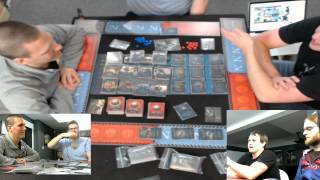
- Solid co-op feel with teamwork emphasis
- If you like co-ops, it scratches that itch well
- Possibly heavy on setup and teach time
- Tactical defense of a star fortress
- Cooperative sci-fi combat against alien threats
- Co-op shooter-in-board-game format
- Descent
- Shadows of Brimstone
- Descent
Mechanics (from transcript analysis)
- Cooperative squad-based fighting — Players combine abilities to defend lanes or fortifications.
Video topics + discussion points
Quotes (from this video)
- it's definitely a well-designed game
- this game feeds you money every turn
- I would totally mix all this in because it's just more items
- the thematic element of this game like it's pretty damn cruel