/pic2608713.png)
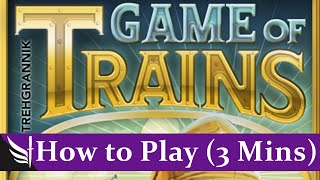
In Game of Trains, each player is in charge of their line of trains. At the beginning of the game, the train cars in the player's train line — each with their own number — are sorted in descending order. The aim of the game is to be the first one to rearrange your train line so that the cards are in ascending order. Each card has a train car with a number and also a special power depicted on it.
On a turn, the player can do one of two things: draw a card from the draw pile and replace one of the cards in their train line with the newly drawn card, or take a face-up card from the middle of the table and use it as a special power. Cards that are replaced from a player's train line are put in the middle to be used as special powers, and the cards that are used as special powers are discarded. Special powers include such actions as swapping two cards, moving a card, destroying everyone's cards, and so on. The players keep taking turns until one has their train line in ascending order and wins.

GTS 2016 - Game Of Trains
- beautiful art aesthetic mentioned
- details of gameplay not fully known in transcript
- train logistics; pick-up and delivery
- Age of Steam
- Steam
Mechanics (from transcript analysis)
- Pick up and deliver — cubes are moved around the board to fulfill scoring conditions.
- train-themed logistics — players move cubes along tracks laid on the board, likely to score victory points or money.
Video topics + discussion points
Quotes (from this video)
- i'll be discussing 32 games that i have learned about over the last eight weeks
- gen con is happening
- arc nova it says you design a modern zoo and you run a successful park and you support conservation projects
References (from this video)

- Very simple game
- Quick to play (15-20 minutes)
- Organizing trains so that the cargo is in the correct order.
Mechanics (from transcript analysis)
- Discard pile — Cards are discarded if they are the second of the same power, and removed cards also go to the available card pile.
- Hand Management — Players are given seven cards and must arrange them in descending order, drawing new cards to replace existing ones or using special abilities.
- Set Collection — The goal is to arrange cards in ascending order, implying a form of set collection or sequence building.
- special abilities — Players can use special abilities on available cards to manipulate their train (e.g., move a car two to the right, protect a card with a lock).
Video topics + discussion points
Quotes (from this video)
- hey everyone welcome to watch it played
- Well you brought something with you a game I hope I did good game of trains oh it's a game indeed has game in the title
References (from this video)
- short play time (~30 minutes) makes it a quick, approachable puzzle
- supports 2-4 players, which fits casual and family game nights
- clear, rule-based engine centered on ordering and rail-car manipulation
- padlock mechanic adds a protective strategic option that can alter discard flow
- the rule text and card interactions can be a bit fiddly to explain clearly in a single sitting
- some players may find the discipline of maintaining a strict numerical order as the sole end condition limiting
- the balance between randomness (draws) and deterministic planning may feel uneven for some groups
- order, optimization, and strategic card manipulation
- Railway network management and locomotive operation
- abstract puzzle-like railway ordering
Mechanics (from transcript analysis)
- card abilities and face-down activation — Players may select a face-down card from the middle as an ability activator, then resolve its effect (the card itself remains facedown).
- card replacement and draw — On a turn, a player draws a card from the deck and replaces a rail card in their row, placing the replaced card into the middle discard zone.
- discard and refresh — If two rail cards in the middle share the same ability, those two are discarded while any other same-ability cards remain; discarded cards are replenished from the deck.
- End condition — The game ends immediately when a player arranges their rail cars in numerical order, regardless of turn order.
- movement across spaces — Certain cards let players move a rail car two spaces to the left or right, provided there is space to move into.
- padlock protection — Padlock cards can be placed on a rail card (first, last, or middle) to protect it from discard effects; if a padlock is replaced, it is also discarded.
- swap adjacent rail cars — A swap action lets players swap any two adjacent rail cars, moving them one position at a time toward a desired order.
- swap with one-card gap — An alternate swap action lets players swap two rail cars that are exactly one card apart.
Video topics + discussion points
Quotes (from this video)
- you in charge of a train you need to manipulate the rail cars to make them go from descending to ascending order
- the rail cars are placed in the line behind the locomotive in descending order
- the discard power remains face down that cannot be looked through by any player
- these padlock cards can be placed on the first last or middle rail card to protect them from this discard ability
- swap ability lets you swap any two adjacent rail cars
- the other swap icon lets you swap two rail cars exactly one card apart
- these let you move a rail car right or left two spaces
- all players remove the right or middle rail car from their rail in turn order
- it's a quick cut and building game