/pic1013640.jpg)








Glen More Deep Dive
What the Community Thinks About Glen More
Glen More has earned a devoted following among modern board gamers for its elegant core mechanism and satisfying tile-placement gameplay. Discussions from channels like Stonemaier Games and Adam in Wales reveal consistent praise for the game's ability to balance player agency with meaningful resource management, creating an experience that feels both strategic and thematic. From casual players who appreciate the peaceful Scottish estate-building fantasy to serious gamers who love the tight optimization puzzle, Glen More resonates across a wide range of preferences and experience levels.
Core Mechanics That Define Glen More
The One-Way Track Movement System
At Glen More's heart is a deceptively simple yet brilliant mechanic: players move a figure along a track and may stop at any point to claim a tile. The player furthest back on the track always moves next. This creates immediate tension, because taking a high-value tile near the front means other players get extra turns picking up cheaper options. Conversely, slow-rolling through cheaper tiles grants more total turns but leaves stronger tiles available to opponents. Reviewers highlight how this mechanism elegantly solves the classic racing-game problem of preventing one player from dominating turn order. The answer is ingenious: the winner in turn efficiency becomes the loser in tile quality, and balancing those two pressures is the whole game.
Adjacent-Tile Activation and Cascading Effects
Every tile placed into a player's personal estate activates immediately and also triggers the activation of adjacent tiles, creating a satisfying chain reaction. Some tiles generate resources like wheat, sheep, and cattle; others convert resources into victory points; and special locations unlock unique abilities. The adjacency rule means a cleverly placed tile can set off a cascade of effects, so players spend time visualizing future placements to maximize these chains. The mechanism transforms Glen More from a simple tile picker into a spatial puzzle where positioning matters as much as selection. Reviewers consistently cite this feedback loop as deeply satisfying, especially as estates grow more sophisticated in their production chains. The clan-member requirement, where you can only place tiles adjacent to land holding your clansmen, adds another layer of careful planning.
The Glen More Experience
Building a Living Scottish Highland Estate
Glen More asks players to represent Scottish clan leaders developing their Highland territories. The theme translates beautifully into mechanics: players plant forests, breed livestock, distill whisky, recruit chieftains, and ultimately score points by converting their land holdings into prestige. There is a meditative quality to the game despite its strategic depth; placing a sheep pasture next to a forest feels thematic even as it sets up future resource production. The art and component quality reinforce this atmosphere, and players report that watching their personal tableau grow from an empty board into a thriving estate creates genuine engagement. The mechanisms and theme fuse seamlessly, so the game never feels like executing abstract puzzles divorced from its setting.
The Tension Between Greed and Pacing
A fascinating dynamic emerges during play: every decision carries weight, because jumping far ahead on the track locks you out of good tiles the other players will now access. This creates continuous tension where greed must be tempered by pacing awareness. Players constantly ask whether to chase one more turn's worth of tiles or settle and activate a cascade immediately. The game rewards this internal conflict by allowing multiple valid strategies. Some players favor aggressive estate development early, others prefer steady resource production, and still others pursue specific chieftain combinations for end-game scoring. Unlike many euros where the optimal path narrows quickly, Glen More remains genuinely open-ended, and reviewers praise this breadth of viable approaches.
What Makes Glen More Stand Out
Elegant Simplicity Hiding Strategic Depth
Glen More belongs to a lineage of games informed by classics like Tigris and Euphrates and El Grande, yet it synthesizes those influences into something distinctly its own. The core rules can be taught in minutes, yet full mastery takes dozens of plays. The track mechanism is immediately intuitive, but its implications ripple throughout the game; a tile available now will not exist if someone takes it first, so players must constantly reassess not just personal opportunities but opponent intentions. Reviewers repeatedly mention how the game achieves complexity without complicated rules. The fact that the same mechanism, moving the furthest-back player first, elegantly solves both the turn-order problem and the tile-value balancing act demonstrates exceptional design economy.
Replayability Through Modular Variety
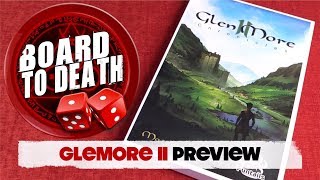
Glen More II: Chronicles introduced numbered chronicle modules that add new mechanics to the base game without imposing a campaign structure. Players can tackle any chronicle in any order, and each one significantly shifts the game's feel. Some add new tile types, others introduce special actions or alternative scoring paths. The beauty of this approach is that it keeps the core mechanism from growing stale. Every play can introduce novel wrinkles while the fundamental tile-track system remains satisfying. Reviewers highlight this modularity as exceptional design: rather than diluting the base game with endless expansions, the designers gave players tools to refresh the experience on demand, which keeps Glen More feeling fresh even after many plays.
Potential Drawbacks
Downtime at Higher Player Counts
As with many track-driven games, Glen More can experience scaling challenges. With four players, the game can suffer from slowdown during turn planning, especially as players calculate cascading tile activations. The track mechanism means each player's decision directly affects the options available to the next player, raising the decision weight per turn. While this creates tension, it can also create downtime if players overthink their moves. Some reviewers note that the game shines brightest at two or three players, where the reduced count keeps decision chains manageable and rounds move at a brisk pace.
Divergent Strategies Can Skew a Game
Glen More supports multiple win conditions: victory-point accumulation through end-game scoring, chieftain majorities, and whisky-production chains all present valid paths. However, if players diverge dramatically in their chosen strategies, the game can feel lopsided. A player focused on a tight resource loop may generate such strong output that others struggle to catch up. Unlike games with explicit catch-up mechanics, Glen More relies on the track system's inherent pacing to keep things close, which works beautifully when players make roughly similar strategic choices but can falter if one player identifies and executes a dominant line early. Experienced groups handle this through informal meta-awareness; newer groups might see a few games where one approach overshadows the rest.
If You Enjoy Glen More
If Glen More resonates with you, explore Patchwork for an accessible two-player take on the one-way track mechanism, focused on spatial puzzle-solving without resource production. Tigris and Euphrates offers a heavier area-control experience with the same designer mastery of elegant rules producing deep strategic play, though with more direct conflict. El Grande provides similar area-majority scoring and hand-management tension in a historical Spanish-kingdom setting. And for players who love the modular, season-driven feel of Glen More's chronicles, Parks shares a track-movement structure while offering a lighter, more accessible experience centered on outdoor exploration rather than economic optimization.
What Reviewers Are Saying
"When you pick up a tile far ahead on the track, the other players can kind of slow-roll and pick up a bunch of tiles along the way. There are costs for the tiles though, so certain tiles you can afford and certain tiles you cannot. And the track repopulates on an ongoing basis."
— Stonemaier Games
"Each player is building their own individual map, so they have their own individual set of tiles as opposed to one big shared group. This game is about building forests and herding sheep and cows and brewing whisky."
— Adam in Wales
"In Glen More, the tiles activate immediately, and all adjacent tiles activate as well. When you place another tile alongside them, they activate again and again. There are tiles that give you resources, some exchange resources for victory points, some give you clan members, and you can only place tiles adjacent to tiles with clan members on them."
— Adam in Wales