/pic4943733.jpg)
Elements gather energy in unique patterns, challenging you with finding the ideal route to balance and harmony. Earth digs deep, Water flows wide, Fire rises high, Wind blows freely, and Void slips between the rest. Can you gain the understanding you need to uncover true elemental wisdom?
A Gorinto is a type of Japanese pagoda of the five elements: earth (cube), water (sphere), fire (pyramid), air (crescent), and void (lotus). It often housed the relic of a Buddha or saint, and together represent the realm of perfect understanding.
In Gorinto, players take turns selecting element tiles from the Path (perimeter) and moving them onto the Mountain (game board). Each element collects in a unique pattern. The elements collected each turn will allow you to collect more elements over the turns and rounds.
Points are scored at the end of each round based on goals selected at the start of the game, as well as the elements chosen at the end of the game. The player with the most points at the end of the game wins.
Will you achieve perfect understanding?
—description from the publisher
- Unique theme based on an ancient concept.
- Building a traditional temple or statue in Buddhism using the five elements.
Mechanics (from transcript analysis)
- Set Collection — Players use different plastic pieces to create statues to achieve harmonies.
Video topics + discussion points
Quotes (from this video)
- But I love when you find something unique that is not your everyday theme and that maybe you learn something new from.
- Let me know, give me a like and a follow, and I'll keep bringing you more board game content.
References (from this video)
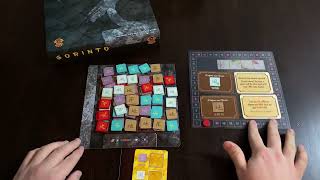
- Innovative push-and-take tile mechanic that creates dynamic decisions
- Deep strategic options due to per-element stacks and scaling capacity
- Beautiful components and graphic design (prototype mentioned as thicker in final product)
- Strong replayability with multiple setup variations and strategic depth
- Setup can be tedious in prototype form
- Final component quality may differ from current prototype
- Element collection and area control
- Abstract strategy with elemental themes (Earth, Water, Fire, Wind, Void)
- Abstract
- Azul
- Dragon Castle
Mechanics (from transcript analysis)
- Area Majority — End-of-turn scoring awards points for the tallest stacks per element (3 points per element you lead).
- Area majority scoring — End-of-turn scoring awards points for the tallest stacks per element (3 points per element you lead).
- Compound Scoring — An additional scoring phase awards points based on twice the difference between your tallest and shortest stacks.
- Difference-based scoring — An additional scoring phase awards points based on twice the difference between your tallest and shortest stacks.
- Knowledge/understanding capacity — Your ability to take tiles from a line is limited by your current 'understanding' (tiles collected in an element plus one).
- Set collection and placement on Guerintos — Placed tiles become part of your personal board, filling elemental tracks (Earth, Water, Fire, Wind, Void).
- Tile Placement — Outside element tiles are selected and pushed into the inner play area; the orientation of a bar must face downward, guiding the push.
- Tile placement and push — Outside element tiles are selected and pushed into the inner play area; the orientation of a bar must face downward, guiding the push.
Video topics + discussion points
Quotes (from this video)
- I can't wait to see the final product
- I definitely can't wait to get my hands on the real final product and play this endlessly
- check this out on Kickstarter and definitely give it a go
References (from this video)

- felt got more boring as it went on
Mechanics (from transcript analysis)
- abstract strategy — This is an abstract strategy game.
Video topics + discussion points
Quotes (from this video)
- Hey everybody, I'm Tom Vasel. Welcome to look back, a series where I take a look at games that I reviewed last year, 5 years ago, 10 years ago, and 20 years ago this week and tell you what I think about them now, if I think about them at all.
- So, let's jump back 20 years ago. I reviewed a game called Astro Plane, which was an abstract strategy game that almost required you to completely understand astrophysics to play it. It was not very good at all. I gave it a two out of 10 and it is one of the first times where the designer wrote me a very strong rant and went online and pretty much attacked me for being too stupid to understand this game, but it was pretty bad.
- I'm noticing games from 10 years ago didn't look necessarily great.
- And then surprisingly to me the game Face to Face. This is a two-player version of The Game. And I don't I think The Game is at best okay. But The Game Face to Face, that two-player version of it, I thought worked really well.
- So, this is a game where uh that Stonemaier Games did where I was like, "What is this Red Rising?" I went and read the the first trilogy so I could better play this game, which didn't matter because the theme is barely there.
- This is sort of like a Blackjack but with algebraic equations.
- Um algebra in a game, but I'm just amused by it.
References (from this video)
Mechanics (from transcript analysis)
Video topics + discussion points
Quotes (from this video)
- I've been trying to walk with the boot. Well, I not walk, but I I I have a boot that I put on, but I keep it off most of the time because I'll be honest with you, it is bigger and bulkier than the cast.
- The lots that we do have, okay, everybody's waiting to find out what what's been bid on and and you know, it's been not that bad, but
- This may be probably the best baseball game I've ever played and I can't believe I didn't know about it.
- It is the most realistic, fast-paced, easy to learn baseball game I've I've ever played.
- This is a game that has everything except cold beer and hot dogs.
- I'm really on the fence with keeping Chronicles of Drungore.
- I think I'm going to more talk about the expansion than show it because the quality of the prototype isn't good.
- This game feels like you're playing Sidmer Pirate and nothing better than finding treasure, going through life, taking people down, you know, sinking ships, taking them.
References (from this video)

- Strong solo play
- Engaging puzzle mechanics
- Array
- Array
- puzzle solving through collection and placement
- Array
- A grid-based puzzle world with colored tokens and symbols that you manipulate to reveal effects.
- Array
- Array
- Puzzle-first with strong solo mode.
- Array
- positive
Mechanics (from transcript analysis)
- Grid reveal — Revealing underlying pieces as you place adds depth.
- Pattern/set collection — Collecting sets of colored symbols yields benefits.
- Resource Management — Empty spaces influence future choices and scoring.
- Resource/space management — Empty spaces influence future choices and scoring.
- Set Collection — Collecting sets of colored symbols yields benefits.
Video topics + discussion points
Quotes (from this video)
- It's very clever.
- these are five very underrated games.
- What are some of the games that you really enjoy but you don't see being talked about?
- Give me a like and a follow and I'll keep bringing you more board game content. Thanks. Bye.
- So, this one is so cool.
- I love the solo on this.
- This is a really good time.
References (from this video)
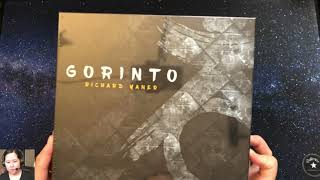
- Compact, simple components
- Includes solo and co-op modes for replayability
- Thematic, abstract puzzle feel
- Clear box text and theme on the back of the box
- Draw bag and multiple colors for player markers
- Some components feel light; could be heavier
- Tile weight/feel lighter than expected
- Color tones on video may differ from real life
- Orientation of symbols on tiles could be confusing at first
- Balancing elemental forces to develop a shrine and meet evolving challenges
- Abstract, shrine-building theme inspired by five elements; players balance a Gorinto shrine to gain wisdom
- Procedural puzzle-driven with minimal narrative
- Azul
Mechanics (from transcript analysis)
- Bag Building — Use a draw bag to draw components and determine available actions
- Co-op / partnership mode — A cooperative variant where players work together on the shrine
- Draw bag randomness — Use a draw bag to draw components and determine available actions
- Resource balancing of five elements — Manage earth, water, fire, wind, and void resources to optimize shrine balance
- Solo mode rules — Rules and components specific to solo play, including additional markers
- Stacking and Balancing — Manage earth, water, fire, wind, and void resources to optimize shrine balance
- Tile Placement — Place and stack elemental tiles to shape the Gorinto shrine and influence scoring
- Tile placement / stacking — Place and stack elemental tiles to shape the Gorinto shrine and influence scoring
Video topics + discussion points
Quotes (from this video)
- a calm and compelling abstract game where you must harness the power of the five elements earth water fire wind and void to build a gorinto memorial shrine
- you seek to achieve the most wisdom balancing your shrine to meet a new challenge each time each time you play
- it's obviously solo friendly
- there's a co-op version on the back that's partnership mode
- cool
- very simple components
- i'm sure i'll be doing a play through of this solo mode
- not huge probably the size of a chess board
References (from this video)

- beautiful components
- fast-paced yet thinky
- solo mode available
- rules may be dense for new players
- pagoda-building with elemental tiles
- ancient Japan-inspired setting
- abstract strategy / tableau-building
- Azul
Mechanics (from transcript analysis)
- set collection / pattern scoring — build a pagoda tableau to meet rotating objectives
- Tile Placement — place five element tiles (earth, fire, wind, water, void) to acquire more tiles
Video topics + discussion points
Quotes (from this video)
- we wanted to put together this new show that was gonna spotlight you know people of color women lgbtq you know all of those underrepresented voices
- these are the kinds of comments that i got in the survey
- this is what i was looking for
- we love talking to you too and then one more thing family always know always remember we love you
References (from this video)

- Abstract strategy game
- Easy to teach
- Tile choosing mechanism
- Satisfying gameplay
- Hits the table a lot
- Gateway plus game
- Family-friendly
- Great depth despite simple teaching
- High replay value
- abstract strategy
Mechanics (from transcript analysis)
Video topics + discussion points
Quotes (from this video)
- it's a full day of gaming you got a plan for snack breaks you need to plan for nap breaks
- this cool game about sliding these things around the board and it's so stinking satisfying
- we really enjoy unfair but i don't enjoy all the mean stuff so every single piece so fun fair just really fixes that problem
- this one completely changed what a roll and write can do
- my brain turned to much like i literally need to power down for a little while and let my brain reset
- there's something special about it you know that really makes it stick out amongst everybody else
- this replaces terraforming mars for me
- it is just such a smart idea that is so simple
- orange nebula designs just incredibly unique incredible experiences
- the way that you use your hand management and the resource management it all just sings together really well
- they're there this isn't like a we're just going to reskin something
- it does a really great job of letting those last two players have the opportunity to really challenge the people that are in first and second
- it's quacks of quinlenberg the dice version
- i'm a sucker from dice i love the tactical sensation of just chuck and dice
- you really are paying attention to what's going to fill up each cauldron
- the best hidden movement game that i've played ever
- if you like the crew to begin with you can literally throw it in the trash and get this version
- it's brilliant from a design standpoint it's absolutely brilliant
- it's that wonderful tension right every round where am i gonna place where am i going to you know place my bid
- it's so relaxing it's so satisfying it's gorgeous
- i've needed my board gaming to be a warm thumpy blanket