/pic8061469.png)

























Grimcoven Deep Dive
What the Community Thinks About Grimcoven
Grimcoven has captured the imagination of board game enthusiasts across the community. Reviewers consistently praise the game as a standout release that offers something fresh in the crowded boss battler landscape. The Dice Tower team gave it a perfect 10, calling it a "seal of excellence," while BoardGameCo's verdict settled at a similarly enthusiastic rating. Reviewers acknowledge the game's demanding nature but view this as a strength rather than a weakness. Players recognize that Grimcoven rewards those willing to invest time in learning its systems and mastering its tactical depth.
Core Mechanics That Define Grimcoven
Dice Allocation and Personal Engine Building
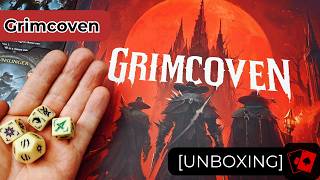
At Grimcoven's heart lies an elegant dice allocation system that feels fresh despite drawing from familiar traditions. Players roll colored dice with different symbol distributions, then allocate these dice to activate actions on their personal boards. Black dice favor powerful attacks with double icons, blue dice offer shields and movement, green dice excel at mobility, and purple dice provide magical effects needed for cleansing. What makes this system special is how it forces meaningful decisions every turn. Unlike games where dice are merely decorative, here the specific colors you roll create real constraints. You must choose which actions to attempt and often make painful choices about what to leave undone.
The genius of Grimcoven emerges in how characters evolve through the lament spending system. As you defeat enemies and collect lament, you draw from your personal evolution deck during the lament phase. Each character has a unique set of cards offering new actions and abilities. This creates a character-building experience that unfolds organically during play. Players describe moments of genuine dilemma when they must choose between powerful new abilities or taking another die to improve action efficiency. The Dice Tower reviewers highlighted how satisfying this system becomes as you learn your character and make increasingly strategic decisions about what abilities synergize with your playstyle.
Deterministic Enemy Actions and Cooperative Pressure
Grimcoven strips away the excuse of bad luck through its fully telegraphed enemy system. Players can always see what enemies will do this turn and next turn, transforming the game into a pure puzzle of positioning, damage calculation, and coordination. The griefbound boss executes action cards in strict sequence, its attacks always visible on the board. Minions and elites follow predictable patterns. This determinism creates intense cooperative gameplay where table talk becomes essential. Players must coordinate their actions across increments of two, creating planning challenges that reward communication but punish quarterbacking. The Dice Tower emphasized how this design choice shifts Grimcoven from a "big dumb boss battler" into a highly tactical experience comparable to Spirit Island in its blend of thematic setting with mathematical puzzle-solving.
The Grimcoven Experience
Tension Between Power and Corruption
The game creates a unique thematic tension through the corruption track. As you grow stronger by collecting lament, you also advance on the corruption track, drawing cards that inflict increasingly harsh debuffs. You gain powerful abilities and extra dice, but the cost is vulnerability to new threats. Reviewers noted that this creates a delicious risk calculation. The track features status effects like hunger, which forces you toward the nearest ally and can deal damage if you collide. Weak and vulnerable modify how your dice behave or how enemies can harm you. The system elegantly mirrors the game's dark Victorian atmosphere where power comes at a spiritual cost. Your hunter becomes increasingly corrupted, and at the highest levels, you risk transforming into a griefbound yourself.
A Mounting Sense of Dread and Discovery
Grimcoven maintains pacing tension through its environmental and event systems. The map tiles themselves are modular and feature environmental cards that create memorable moments, from a witch's hut offering secret cards to coffins that harbor both treasures and horrors. These aren't just decoration. Reviewers highlighted how discovering what's in a coffin or interacting with a carriage can swing the momentum of an entire game. The event deck feeds constant surprises that players must react to while maintaining their strategic plans. Combined with the boss's escalating time track that adds new stage cards bringing fresh threats, Grimcoven prevents the game from becoming purely mechanical. There's always something new to contend with, keeping the experience fresh even across multiple plays.
What Makes Grimcoven Stand Out
Elegant Rules That Enable Deep Decisions
For an Awaken Realms game, Grimcoven breaks the mold by offering surprisingly clean rules architecture. The game avoids the rules convolution that has plagued some of the publisher's story-driven titles. Instead, Grimcoven presents focused systems that create natural complexity through interaction rather than exception handling. The combat system is straightforward: match symbols on dice to action slots and resolve abilities. The progression is clear: spend lament to advance on your track and draw evolution cards. The enemy phase follows five distinct steps clearly marked by tokens. Yet within this clarity, tactical depth emerges organically. Players praise how the game teaches itself through elegant design, where component placement and visual clarity guide play. Reviewers noted that once you understand the fundamentals, advanced play opens naturally without requiring constant rulebook consultation.
Asymmetric Hunters with Distinct Playstyles
Each of the six base hunters approaches the game fundamentally differently. The Gunslinger loads bullets to enhance attacks, creating a resource-loading puzzle. The Technomancer gains exclusive orange dice and extra movement options. Duality manipulates light and dark tokens as alternate resources. The Mannequin can be controlled by other players. The Keeper and Death Jester each bring unique mechanical hooks. Reviewers consistently praised this design, noting that you don't just play "a hunter" but develop a personal relationship with your chosen character. The Dice Tower team observed that even late in the game, once you know what's in your evolution deck, you're making increasingly sophisticated choices about which cards feed your character's identity versus which abilities you genuinely need. This creates meaningful asymmetry that makes each player's experience distinctly their own.
Potential Drawbacks
Extreme Difficulty and Brutal Learning Curve
Grimcoven does not hold players' hands. The included tutorial scenario is explicitly difficult and designed to show what can happen rather than guarantee a positive first experience. Reviewers universally noted that the tutorial ends with "you may continue playing" even though players are about to be thoroughly defeated. The Dice Tower team suggested this messaging should instead reset and direct players toward an entry-level scenario once they understand the mechanics. The game's difficulty makes early plays punishing, with wins requiring both understanding the systems and executing nearly flawless play. This creates a high barrier to entry. Players who can't embrace the challenge after multiple defeats will find Grimcoven impenetrable. Some reviewers wish the game offered easier difficulty settings that felt as rewarding as normal mode.
Setup Burden and Organizational Complexity
Grimcoven's large box and numerous components create a setup challenge that plagues many big-box games from premium publishers. The modular hex map requires careful placement, the extensive card decks need sorting, and getting everything back in the box after play feels like a puzzle of its own. Setup can stretch 30 minutes or more even for experienced players. The standard edition lacks an insert to organize components, forcing players to create their own storage solutions. Multiple reviewers mentioned that they set the game up the night before play to avoid eating into actual playing time. This setup friction doesn't diminish the game experience once it's in motion, but it is a legitimate barrier to repeated plays. Players who enjoy pulling a game off the shelf for a quick evening won't find Grimcoven accommodating.
If You Enjoy Grimcoven
If Grimcoven resonates with you, several games scratch similar itches. Spirit Island shares the high-cooperation tactical puzzle and thematic depth, though it approaches them from a completely different angle. Cthulhu Death May Die offers a similar corruption track and boss battling framework with its own chaos and mutation systems. Kingdom Death Monster and Oath serve similar niches of uncompromising, thematically resonant games that demand player commitment. For the dice-building element specifically, ISS Vanguard and Frosthaven offer related experiences with modular exploration. Chronicles of Junogore and Gloomhaven share DNA with Grimcoven's approach to cooperative adventuring, though with different mechanical cores.
What Reviewers Are Saying
"This is a very rare 10 for me. I recognize its flaws. It has big setup time. It's kind of a commitment into that setup. The tutorial is ridiculously hard, I think, and gives the game not a great first impression, but it is really thinky and tactical in ways that reminds me of some of my favorites like Spirit Island."
— The Dice Tower
"The dice, the leveling up system is my favorite thing because every time you level up as you get closer and closer to going full crazy, you're going to be drawing those cards from this really solid deck of cards and you get to pick what you want. It is so cool because you have those moments of oh my gosh, these are both so amazing."
— The Dice Tower
"The components are absolutely incredible. Every single miniature in this box is packed with detail. The card art is gorgeous, the dice feel great in your hand, and the board presence when you have everything set up is genuinely impressive."
— BoardGameCo