/pic5194254.png)
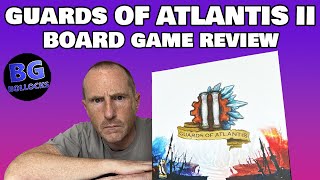
Guards of Atlantis: Tabletop MOBA is a competitive "zero-luck" team-based board game inspired by computer games of the MOBA genre.
In the game, each player controls a single hero and uses a hand of cards to move that hero around the game board, employ special abilities, and attack enemies. Defeating enemy minions earns you coins, which are used to buy levels and upgrade your hero. Your goal is to help your "minions" — units that are not directly controlled by the players — reach the enemy base and capture it.
Guards of Atlantis II is a complete overhaul of the original game with 32 new heroes, new double-sided game board and much more. In addition to new content, Guards of Atlantis II streamlines the rules of the original, making it faster and tighter.
—description from the publisher


- Captures MOBA style gameplay well.
- Each hero plays radically different.
- High replayability due to many heroes.
- Simple to learn, yet deep strategy.
- Game length is player-determined.
- No randomness, purely strategic.
- Heroes have unique roles and abilities.
- Mechanisms like leveling and card upgrades are engaging.
- Pity coin system keeps players involved.
- Heroes having one hit point creates strategic decisions.
- Player can control game length.
- Intuitive for new players.
- Can be a staple game.
- Thin box design is inconvenient for storage.
- Rules about no communication between teammates after cards are played can be restrictive.
- Hyperspecific card text can be unforgiving.
- MOBA style gameplay
- Mech Versus Minions
- Onward
- Battle Con
Mechanics (from transcript analysis)
- Card discard for defense — Defending against an attack requires discarding a card with a defense value, leading to card loss.
- Card Upgrades — Players can upgrade their hero's cards as they level up, choosing between abilities or stat buffs.
- Hand Management — Players have a hand of cards and play one per round, with opponents able to see played cards.
- Hero leveling — Heroes level up by killing minions and other heroes, gaining money to upgrade cards and stats.
- Minion pushing — Minions are used to push lanes, and removing opposing minions allows for game-winning pushes.
- No health points — Heroes have only one hit point, meaning an attack that gets through results in defeat for that hero.
- player vs. player combat — Heroes fight against each other, with a win condition of defeating opposing heroes a certain number of times.
- Team-based gameplay — The game is designed for 2v2 play, requiring coordination with a teammate.
- two-player variant — A two-player variant exists where each player controls two heroes.
Video topics + discussion points
Quotes (from this video)
- The second, and this is probably my biggest negative, and I get why they were doing it, but for some reason, they really, really wanted that aspect of no communication.
- This game is incredibly easy to pick up, not long to play, actually, you do you determine how long it is, and has insane insanely high depth to the characters and to the play style is almost an anomaly.
- There is zero zero luck in this game.
- So that's just kind of like a one example of of great synergy between teammates and trying to counter one another.
- It is just such an amazingly clean game and every hero just plays radically different from one another.
References (from this video)
- tabletop MOBA feel
- highly asymmetrical heroes with unique abilities
- team-based hero combat
- fantasy, tabletop MOBA
- Gloomhaven
Mechanics (from transcript analysis)
- Card-driven combat — five-card hand each round with initiative values
- Combat: Deck/Hand — five-card hand each round with initiative values
- Combat: Deterministic — no dice rolling; outcomes driven by card play
- deterministic play — no dice rolling; outcomes driven by card play
- team-based play — 2 teams compete with multi-hero control
Video topics + discussion points
Quotes (from this video)
- these aren't necessarily the games that we think might be the best at the end of the year or whatnot they're just games that we want to explore
- we're canadian very proud of the country we live in
- it's basically going to be very similar to cl team flicks but in a futuristic sci-fi setting
- you're basically an explorer going into temples
- this is a massive campaign game
References (from this video)

Mechanics (from transcript analysis)
Video topics + discussion points
Quotes (from this video)
- we are moving studios that is happening
- thank you so much for all the support
- we're hoping to attend conventions we want to start meeting some of you guys
References (from this video)
- strong production value and componentes
- diverse hero roster and strategy
- deck/movement-based combat with no luck involved
- team-based MOBA-like fantasy skirmish
Mechanics (from transcript analysis)
- card-driven, no dice — Use a hero's five cards with initiative built into the system
- team-based play with multiple heroes — Each player controls a hero with unique abilities; team-based objective
Video topics + discussion points
Quotes (from this video)
- I can't wait to get my hands on this
- it's one of the most exciting things I've seen
- this looks stunning on the table
References (from this video)
- intriguing heroes and card interactions
- potential for impressive unboxing/setup
- no luck-based dice; pure card/initiative-driven play
- fantasy-themed team-based fight with heroic cards
Mechanics (from transcript analysis)
- card-driven actions with initiative — Simultaneous play with resolved initiative order
- team-based hero cards — Each player controls a hero with unique abilities in a team game
Video topics + discussion points
Quotes (from this video)
- I can't wait to get my hands on this
- it's one of the most exciting things I've seen
- this looks stunning on the table
References (from this video)
- deep team-versus-team tactical play
- engaging character and objective variety
- clear design and accessible to teach
- may require mood/maturity for certain players; not ideal for all game nights
- Heroes of the Storm
- cloudspire (mentioned as a heavier alternative)
Mechanics (from transcript analysis)
Video topics + discussion points
Quotes (from this video)
- it's one of the most unique games I've probably ever played
- this is one of my biggest surprises of the year
- it's a Triumph of game design
- colorful and combo-tastic
- team versus Team battles with zero luck
References (from this video)

- Excellent MOBA adaptation
- Strategic depth with characters
- Supports a wide range of player counts
- Requires experienced players to fully appreciate.
- League of Legends
- Heroes of the Storm
- Cloudspire
- Toy Battle
Mechanics (from transcript analysis)
- asymmetric characters — Players control unique heroes with distinct abilities.
- Lane pushing — Involves moving units down lanes to attack the opponent's base, similar to video game MOBAs.
- team-based combat — Players engage in strategic combat as part of a team.
Video topics + discussion points
Quotes (from this video)
- Like I just I remember thinking if we could play this a lot more, I think we would really like plumb the depths of what what makes this game so special.
- Like it you should know it so well.
- Um and I think it's either got to be lots of cards to explore or something kind of yeah with that classic feel.
- Like that's one that has the depth there that if I was enjoying it, I probably could just get really into Through the Ages.
- But if I could just like have a group where oh yeah, I'm playing Twilight Imperium once a month. I know the rules. I don't have to refresh and I'm just like playing the same faction for a bit then I'm trying a different one.
- Like I don't know if there's really an answer. I more so I just want to get your thoughts on it.
- So, I think it has done two things for me. One is that it has made me sort of upset that I didn't start like branching out sooner.
- But at the same time it's given me the perspective to see the level of depth that games can have competitive to what it what you get on that first impression.
- Gloomhaven is really the only board game that I have played consistently for a long period of time with the same people or same person or whatever um at a table, right?
- It's like a lesson in you can't have your cake and eat it, too.
- Like you kind of have to pick your lane and just commit to it at different points in your life. Otherwise, you're going to feel like you're not fully experiencing either lane to its fullest, you know?
- I've had games that I've thought at times like this could be a lifestyle game, so I'm not going to play it yet because if I do, I'm going to get so into it that it's going to prevent me from getting to those other games that are should be a higher priority for me right now.
References (from this video)
- Zero luck, team-based gameplay
- Players feel outplayed rather than cheated
- Unique heroes with distinct card sets
- Satisfying level-up system with permanent buffs
- Captures the MOBA feel
- No table talk rule can be frustrating
- Can be very 'sweaty' when played at two players
- Team-based combat on a battlefield
- MOBA style
- Onward
- Exceed
Mechanics (from transcript analysis)
- Card Play — Players play cards from their hand to execute actions and counter opponents.
- Hand Management — Each hero has five cards, and players play four in a round.
- Level Up System — Players level up by gaining money, choosing a card upgrade, and potentially gaining a permanent stat buff.
- Objective-based — The goal is to remove minions, allowing a 'push' to the next area, with victory achieved after a second push.
- team-based — A 2v2 MOBA-style game.
Video topics + discussion points
Quotes (from this video)
- The theme really doesn't come through. It's just how the scoring and the gameplay is why it's here.
- that that thing is always the thing that catches people that very first time. They're like, 'Oh, I see now.'
- It's such a short game.
- It takes longer to score the game than it does to play the game
- Guards of Atlantis 2 is a MOA style uh t 2v2 game.
- I absolutely love that there's a reason why I'm not a big fan of exceed or onward in this in this mobile case is because I don't like randomness in these head-to-head games
- if I'm outplayed, I know my opponent outplayed me.
- every single uh, hero has only five cards that they can play and they'll play four of them in a given round.
- I really like that that level up system.
- Onward 100% feels more like a MOA than Guards of Atlantis does.
- I've had a great time every single time I've played it.
References (from this video)
- Strong thematic battles
- Solid two-player capability
- Some play with more players less ideal
- Array
- Fantasy arena
- Competitive skirmish
- Skytear
- Runebones
Mechanics (from transcript analysis)
- Area/Team-Based Combat — Asymmetric or symmetric arena-style combat with miniatures-style units.
Video topics + discussion points
Quotes (from this video)
- I love Shallow Sea. I am really enjoying this one.
- I do not think it's forever game.
- There’s a fun little tension of laying cards down and trying to min-max where each card goes as it goes towards multiple scoring criteria.
- The Druids of Adora, I cannot wait to give you a review on this one, but I need more plays first.
- Onward is replacing Guards of Atlantis.
- Way Too Many Cats had way too many symbols and things going on to be able to at a glance understand what's happening.
References (from this video)

- Strategic MOBA-on-a-board feel with minimal randomness
- New win condition and hero-skill variety in the second edition
- New miniatures and updated mechanics
- Potentially complex setup and learning curve
- Niche appeal for players who want MOBA-like play on a board
- team-based hero combat with deck-building and minions
- Fantasy MOBA-style battlefield on a tabletop board with two teams and spawn points
- procedural, tactical strategy with focus on abilities and board control
Mechanics (from transcript analysis)
- Board movement and travel — Shoe icon allows movement; fast travel allowed if no enemies in target zone.
- Card-based actions — Play one card per turn; each card offers attack, shield/defense, move, and/or a special ability depending on its text.
- Deck Building — Spend coins to upgrade hero skills; draw new cards by paying costs and discarding; some cards become items under the board.
- Deck-building and economy — Spend coins to upgrade hero skills; draw new cards by paying costs and discarding; some cards become items under the board.
- Hero and spell systems — Heroes have different stats and skills; levels are shown on sliders and can be upgraded with coin cost.
- Hidden Victory Points — You can push enemy lines or kill heroes until their spawn tokens are exhausted (new in second edition).
- initiative and turn order — Initiative value on each card determines turn order within a round; four turns per round are resolved.
- Minion and spawn system — Minions spawn in the middle; defeating minions yields coins and affects spawn tokens.
- Victory condition variations — You can push enemy lines or kill heroes until their spawn tokens are exhausted (new in second edition).
Video topics + discussion points
Quotes (from this video)
- MOBA on the board with zero randomness
- if you like strategy game if you don't like randomness or if you just like MOBA on the board I think you should be on this campaign and you should support this project
References (from this video)
- Coordination matters in a cooperative setup, rewarding team play
- Low hand size (five cards) keeps decisions approachable and scalable
- Deterministic outcomes (no dice and no random draws)
- Strong strategic depth for a light skirmish experience
- Balanced tension between planning and immediate reaction
- Longer session length for a short game footprint
- Forgetting the post-reveal confer rule can disrupt play
- Box content feels lean for a Kickstarter-era release; expansions likely expected
- Some card text and pacing can lead to moments of underutilized turns
- Cooperation under structured constraints; tactical team combat with lane control and minion management.
- Fantasy arena where two teams of heroes and minions contend on a shared map to push a lane toward the enemy throne room.
- n/a
- Rum and Bones
- Guards of Atlantis 1
- other traditional two-team skirmish games
Mechanics (from transcript analysis)
- Card Crafting — Between rounds, players upgrade their cards via a color-based system to improve stats or capabilities.
- Card upgrading — Between rounds, players upgrade their cards via a color-based system to improve stats or capabilities.
- Card-based actions — Players select actions by playing cards from a small hand; actions resolve in a round after all cards are revealed.
- lane push and victory conditions — Win via advancing lanes to the enemy throne, defeating opposing heroes, or achieving a final round victory.
- Movement and combat resolution — Heroes move on a grid, attack with melee or ranged options, and minions advance toward the opponent's throne.
- Simultaneous Reveal — All players reveal their chosen actions at once, enabling planning and coordination with teammates.
- simultaneous reveal and execution — All players reveal their chosen actions at once, enabling planning and coordination with teammates.
Video topics + discussion points
Quotes (from this video)
- Coordination actually matters in this cooperative setup
- No loudmouth shouting matches; you can focus on teamwork
- You can chain actions together and plan between rounds
- There’s no luck yet; there’s no rolling of the dice or random card draws
References (from this video)

- art style; thematic translation from video game to board game
- polarizing; not for Euro-focused players; can be time-consuming with multiple plays
- two-player team-based skirmish with card-driven actions
- MOBA-inspired fantasy battlefield
- head-to-head combat with hero cards
- Arboretum
- video game adaptations
Mechanics (from transcript analysis)
- one-hit-point system with shield counters — items and heroes have shields; damage reduces shields and cards are discarded
- two-player asymmetric hero roles with shared minions — each side has unique abilities; minions spawn for buffs/debuffs
Video topics + discussion points
Quotes (from this video)
- I have started to make sponsored content for this channel as well as sponsored content not even for this Channel
- I will never take money to make reviews for this channel
- I am excited and nervous about the overall reception that this is going to have
- it has not tarnished my love for board gaming
- long-term goals for this channel i.e. a fully funded business or a hobby