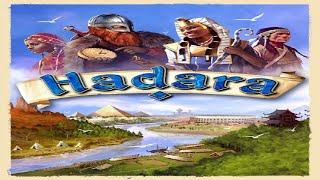






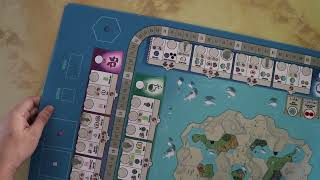

Hadara carries you off into the world of cultures and countries of this earth. Over three epochs, you will experience the transformation of your new world from a small settlement to a high culture. You want to populate this world with people who come from different cultures and continents as well as different ages. To bring glory and honor to your world, you should choose the persons and accomplishments skillfully. But you should not ignore agriculture, culture, and military power, otherwise one of your competitors might get bigger and more successful than you. Who will succeed first in creating a new flourishing high culture?
—description from the publisher
•••
Hadara entführt dich in die Welt der Kulturen und Länder dieser Erde.
Über 3 Epochen hinweg erlebst du die Verwandlung deiner neuen Welt von einer kleinen Siedlung zu einer Hochkultur.
Du willst diese Welt mit Personen besiedeln, die dabei aus verschiedenen Kulturkreisen, Kontinenten aber auch Zeitaltern stammen.
Um deiner Welt zu viel Ruhm und Ehre zu verhelfen, solltest du die Personen und Errungenschaften geschickt aussuchen. Dabei solltest du aber die Landwirtschaft, die Kultur und die militärische Macht nicht außer Acht lassen, sonst kann es passieren, dass einer deiner Mitkonkurrenten größer und erfolgreicher wird. Wem gelingt es zuerst, eine neue blühende Hochkultur zu erschaffen?
—description from the publisher (German)
Hadara - Board Game Review
Middara 1.1 Encounter 7 Into The Gloom
- High replayability due to deck variation, board changes, and randomized colony bonuses, which consistently produce distinct experiences across games
- Colorful, vibrant component design; icons are clear and readable even on smaller euro-sized cards; insert and storage are well considered
- Strong physical design, including well-thought-out player boards with dedicated slots for bonuses, which helps with tactile satisfaction and ease of scoring
- Accessible for players who enjoy Azul, Splendor, and lighter euros; offers a good bridge for players who are curious about civ themes without the heavier commitments
- Solid replay hooks from starting cards and long-tail asymmetries that push players toward different strategic aims over multiple plays
- Theme feels tentative at times; the civ veneer is more thematic flavor than a deep civ simulation, which can disappoint players seeking a richer civ experience
- May be too light for hardcore gamers or non-gamers who want a fully spread-out civ-game feeling; balance sits in a gray zone between entry-level and light strategy
- Some players may find the purple bonuses and color-based discounts a little opaque at first glance, requiring a learning phase to fully grok how best to sequence colors
- Public information in the drafting phase can dampen the element of surprise and slightly reduce strategic tension, since everyone sees the same potential options and can plan to obstruct or preempt others
- Thematically, the red/blue tracks and purple bonuses can feel underexplored or under-explained in the rule set, leading to momentary confusion during first plays
- Civilization and empire-building are the flavor, but the game emphasizes approachable gameplay over simulating a full civ experience; it leans toward theme as a wrapper for accessible mechanics rather than a deeply thematic simulation.
- Civilization-themed city-building and empire management framework presented through a compact, card-driven euro-game structure.
- Theme-forward with a subtle strategic undercurrent; the game communicates a hopeful, polished aesthetic through bright visuals, accessible icons, and a tightly designed flow that encourages planning and adaptation.
- Splendor
- Through the Ages
- Azul
Mechanics (from transcript analysis)
- Affordable early power with escalating costs — Early rounds are designed to be approachable and help players build a workable core, while later rounds introduce more expensive, powerful options that require careful resource management and timing. This creates a gentle ramp that rewards planning without overwhelming new players.
- card drafting — Players simultaneously draw or select from a subset of available cards each round, then add the chosen card to their tableau or sell it for coins. The drafting is public and tends to create shared information about what others are pursuing, contributing to a dynamic, slightly interactive environment.
- Discount chaining — The cost of future cards of a given color is reduced based on how many cards of that color you have already acquired. This mechanic encourages color-coding and planning how to accelerate certain colors to gain cheaper access to high-value cards later in the round or in subsequent rounds.
- engine building — Early rounds are designed to be approachable and help players build a workable core, while later rounds introduce more expensive, powerful options that require careful resource management and timing. This creates a gentle ramp that rewards planning without overwhelming new players.
- Set collection / track advancement — Cards contribute to multiple tracks—economy, military, culture, and food—represented on the board. Collected cards advance these tracks, and colored cards open up bonus opportunities and synergies; purple cards provide various bonuses that can influence strategy in more nuanced ways.
- Simultaneous drafting rounds — Most of the action happens in rounds where all players perform their choices at roughly the same time, creating a fast pace and a need to anticipate opponents’ likely moves. This structure keeps everyone engaged and reduces downtime, but also increases the potential for misreads and clever play to undercut others.
Video topics + discussion points
Quotes (from this video)
- Hadara is a light civilization themed game
- it's fairly quick and light
- the colors are all pop off the table
- the insert is terrific
- it's a great next step for anyone who loves games like Azul or Splendor
- this could be the hidden gem you were looking for
- Hadara has a surprising amount of replayability
- not multiplayer solitaire at least not in the face up drafting round
- Hadara is a great game as long as you know what you are getting
References (from this video)
- Streamlined for a large, thematic game without Twilight Imperium-level complexity
- Fast combat despite large scale due to limited dice per unit, and two-phase combat balance
- Strong faction variety with thematic artwork and distinct upgrade paths
- Two-player works surprisingly well and is less taxing than expected for a big dice chucker
- High-quality components and well-thought storage trays that aid setup/teardown
- Very large box and space requirements; storage can be difficult in small spaces
- Exploration introduces randomness, which can feel luck-based and hard to plan around
- Dice-heavy mechanics may frustrate players seeking tighter control or fewer RNG elements
- Does not reach the complexity level of games like Twilight Imperium or Eclipse
- Array
- Steampunk world blending magic and technology
- Strategic, descriptive discussion of factions and technologies
- Twilight Imperium
- Eclipse
Mechanics (from transcript analysis)
- Area movement — On each turn players place an order token in a region and can move units between regions, triggering potential combat when they share a region.
- Combat: Dice — When combat occurs, both sides roll dice at the same time, with outcomes based on unit speed/type and defenses, removing enemy units if possible.
- Development cards and upgrades — End of round reveals development cards to draft; upgrades are applied by flipping cards to enhance ships and grant ongoing powers.
- Expansion and variable player count — Expansion content adds new factions and scales for five or six players, including event cards that modify round rules.
- Exploration and card rewards — After moving and often fighting, players may explore by placing a token to gain exploration or development cards that provide bonuses or upgrades.
- Factions with unique powers — Four factions provide distinct starting techs and ongoing powers that influence playstyles in meaningful but balanced ways.
- Map setup and terrain value — The hex map is randomized at setup, and terrain tiles offer different resource opportunities (e.g., gold mines yielding coins).
- region-based movement — On each turn players place an order token in a region and can move units between regions, triggering potential combat when they share a region.
- resource generation and expenditure — Control of map locations yields coins and crystals, which can be spent to buy points or upgrade units.
- Resource management — Control of map locations yields coins and crystals, which can be spent to buy points or upgrade units.
- Simultaneous dice combat — When combat occurs, both sides roll dice at the same time, with outcomes based on unit speed/type and defenses, removing enemy units if possible.
- Two-phase combat (light vs heavy) — Battles involve a light phase (weaker units) and a heavy phase (stronger units), allowing smaller ships to contribute and potentially prolong fights.
- Unique player powers — Four factions provide distinct starting techs and ongoing powers that influence playstyles in meaningful but balanced ways.
- variable map — The hex map is randomized at setup, and terrain tiles offer different resource opportunities (e.g., gold mines yielding coins).
- Variable Set-up: Player — Expansion content adds new factions and scales for five or six players, including event cards that modify round rules.
- X-like structure with a primary combat focus — The game is framed as a 4X experience with a heavy emphasis on combat; exploration and expansion are present but less central than conflict.
Video topics + discussion points
Quotes (from this video)
- This is really about fighting, about rolling the dice.
- it's a head-to-head dice chucker. Like this is fight fight fight. That is the main thing you're doing in this.
- The two-player game works shockingly well for this kind of game.
- not going to be anywhere near that level of complexity.
- There is a ton of dice rolling.
- There is a lot of randomness, because when you're exploring that part of it is just all random.
- I've been very pleasantly surprised by this.
- This is a very big game.
References (from this video)
- Good thematic fit with the Realm
- Relatively easy to achieve three stars
- Harder to surpass three stars
- Rolling Realms
- original Rolling Realms
Mechanics (from transcript analysis)
- dice drafting
- dice-drafting
Video topics + discussion points
Quotes (from this video)
- it's exactly the same as the original Rolling Realms but there is a bunch of stuff that's different
- I feel like one of the big reasons this game even exists is because it's kind of the big box for Rolling realm
- I will say that it is not waterproof we learned that the hard way
- this is our first one back in London so let's see if this sticks or not
- what we're going to do from now on is I think just mix it in with the rest of the Rolling Realms
- Meadow has this terrific drafting mechanism where you're putting your little number arrows
- Planet Unknown is probably my favorite of all the games represented
- this would have been in the fourth category but we played it just recently again and it grew on me
- I like this one a lot
References (from this video)
- Huge quantity of content and components (books, dice, tiles, tokens, cards, and 44 miniatures)
- Narrative-driven, with decisions shaping the story
- Long-form play potential (over 90 hours)
- Massive box and heavy to handle
- Cooperative storytelling with branching narratives and high tabletop heft
- Ultra Modern fantasy universe coexisting alongside our own, with a dash of mutant-dinosaur flavor
- Cooperative choose-your-own-adventure style RPG
- The Lost Expedition
Mechanics (from transcript analysis)
Video topics + discussion points
Quotes (from this video)
- Ignorance is Bliss which I can really get into adds a bunch of brand new recruit cards and Market tiles that can be used to replace or augment those from the original game
- this expansion called ignorance is bliss
- it's really a beautiful production
- we tried the new Cooperative mode and came up just just a few turns short of a win
- this redesigned version called CO2 Second Chance features new iconography a completely Rewritten rule book more balanced gameplay a new events track improved and streamlined mechanisms and upgraded wooden components
- Judge Dread the cursed Earth may be worth checking out
- mutants dinosaurs and possibly mutant dinosaurs because why stop there
- the cursed Earth itself as they search for an object of immense power before it falls into the wrong hands possibly dinosaur hands
- this game is ridiculous
- this box is packed with stuff there's five different books 17 dice 40 stand 36 double-sided tiles 342 tokens one of those red plastic screen decoder thingies over 800 cards and 44 miniatures
- the Lost Expedition was over on that shelf too
- if you enjoy the lost expedition or mutant dinosaurs wielding immense power then Judge Dread the cursed Earth may be worth checking out
- this video is really not not going very well
References (from this video)
- Color-based discounts encourage color diversification
- Drafting and color synergy create an appealing engine-building vibe
- Can be complex for new players
- Requires careful tracking of color synergies
- Cultural development and color synergy
- A civilization-building drafting game with color-based incentives.
- Strategic, civilization-building
Mechanics (from transcript analysis)
- Color-based ongoing discounts — Card costs are discounted based on number of same-color cards already in play.
- Multi-use cards — Card costs are discounted based on number of same-color cards already in play.
Video topics + discussion points
Quotes (from this video)
- Skyler: My favorite game featuring ongoing discounts is Flamecraft.
- Dylan: This is my favorite of the West Kingdom trilogy, and managing ongoing discounts is a major key to success in the game.
- Aaron: Space the final frontier. These are the voyages of whatever you name your ship.
- Caitlyn: In Ark Nova, you can claim partner zoos in four of the five continents. And whenever you play an animal into your zoo that matches one of your partner zoos, you get a three credit discount on the animals cost.
- Skyler: This creates a very low conflict environment where everyone helps to improve the town, making it awesome for families.
- Jamie: Lord of the Rings Duel for Middle-earth really got me thinking about the decision space of do I spend money on a card now or wait to get the resource that a card provides so I don't have to pay it in the future.
References (from this video)
Mechanics (from transcript analysis)
Video topics + discussion points
Quotes (from this video)
- And it's not just small publishers that are being affected.
- The tariffs applied to their products are equal to $14.50 for every $10 that they spend on manufacturing for an estimated total of $1.5 million of additional expenses just in import taxes.
- I do believe that the first step towards inflicting change for the better is for each of us to start finding opportunities to speak up, speak out, speak often.
- Using your voice empowers others to do the same.
- That's why I made this video to use my little voice to hopefully try and encourage all of us to use our voice.
- That's all I got.
References (from this video)
- significant balance improvements and deeper tactical options
- token-driven systems clarified by rulebook and tokens section
- new monster variants and higher HP pools add challenge and longevity
- community-driven balancing and collaboration with Succubus Publishing
- increased complexity and steeper learning curve
- wording and terminology shifts may require additional reference material
- relearning many card interactions due to tokenized mechanics
- cooperative exploration and tactical combat with collectible upgrades and token-driven effects
- fantasy dungeon crawl with a modular monster set and evolving encounter rules
- informational/design-update focus; card-by-card and rule-change oriented
Mechanics (from transcript analysis)
- combatant tokens and bulbs — bulbs and other tokens drive special powers and AI choices; 1.1 consolidates bulb-related text into a tokens system
- dice pools and conviction dice — combat uses customizable dice pools with conviction dice; 1.1 refines dice colors, outcomes, and interactions
- Energy tokens — new energy tokens power certain spells and abilities; they are used for determining force and other effects
- monster loot and upgrade system overhaul — monster loot cards become spendable for gold or upgrades via a material tag; upgrades become universal rather than rarity-bound
- monsters and AI step changes — monster stats, ai steps, and debuffs reworked across numerous enemies for balance and variety
- summoning and loyal espers — summoning mechanics shifted to loyal espers with persistent effects across encounters; summoning now uses upgrade pack tokens
Video topics + discussion points
Quotes (from this video)
- greetings i'm barron and welcome to meet me at the table
- everybody was able to work together to create a massively fantastic game
- i'm excited to show you these changes
- succubus publishing is a fantastic company
References (from this video)
- Asymmetric faction design
- Combat is accessible without overwhelming rules
- Discovery cards add ongoing variety
- Multiple paths to victory
- 4X exploration and conquest
- Fantasy world with dragons and space dwarves
- Strategic civilization building with combat
Mechanics (from transcript analysis)
- 4X gameplay — Explore, expand, exploit, exterminate in fantasy setting
- asymmetric factions — Four different factions with unique asymmetric abilities
- Combat — Combat system that is not overloaded with rules and easy to get into
- Discovery cards — Cards that give ongoing powers as players explore
- Objective Completion — Fulfill secondary objectives and reach 20 points to trigger end game
- Unit upgrades — Units have different powers and can be upgraded
Video topics + discussion points
Quotes (from this video)
- the infinite replayability of cartographers...is because like the order that the cards come out that show those land types will always be different
- the game is how do I deal with the puzzle that's given to me right
- you're playing the player right...it's about positioning it's about all that kind of stuff
- this is a game that's been around for a very long time it's still such a lifestyle game for some people
- you can just play forever and ever and ever there's always strategies to explore
- the playability comes with the fact that there's this massive menu of options
- we'll never create the same Clover twice
- literally has millions of combinations of different puzzles
- the entire purpose of the game is you were given this hand of cards...how do I make this work
- the puzzle is always interesting because the puzzle is what's in your hand
- the puzzles going to be different every time and it's just always always interesting and fun to play
- every single one of these Spirits plays wildly differently...they're super asymmetric
- it's infinitely playable...it really is...a lifestyle game for so many many people
References (from this video)
- Deep tactical combat with dice and card-driven actions
- Rich upgrade and loot system with meaningful rewards
- Varied character kits and synergy between items and spells
- Engaging swarm encounters and boss dynamics (Earth Loa)
- High complexity and long play sessions; difficult to learn
- Reliance on dice can lead to frustrating misses
- Tracking many tokens and statuses can be tedious
- adventure, combat with monsters and relics
- fantasy dungeon crawl, underground vaults, earth loa
- procedural narration with live commentary; no fixed story text; story moments occur via reading and pages later
Mechanics (from transcript analysis)
- Armor and barrier — Armor tokens provide defense; barrier tokens grant additional protection against damage.
- Combat: Damage Based — Damage tracked with tokens; some abilities adjust effective HP; heals occur via status phases and items.
- Conviction dice and spellcasting — Spells rely on conviction dice; magic items like the magic staff or gore shot interact with dice results and opponent defenses.
- Health, damage tokens and HP — Damage tracked with tokens; some abilities adjust effective HP; heals occur via status phases and items.
- Hive mind / swarm enemies — Cave Sickle swarm behavior; strength and dice depend on sphere of influence and number present.
- Initiative deck and turn order — A shuffled initiative deck determines the action order each round, creating dynamic pacing.
- Loot and relics — Loot is gained from defeated enemies; combatant loot cards and relics provide powerful ongoing or one-time effects.
- Once-Per-Game Abilities — Certain powers and items are usable per encounter or grant persistent benefits; some powers require exhaustion.
- Per-encounter abilities and items — Certain powers and items are usable per encounter or grant persistent benefits; some powers require exhaustion.
- Shop, XP, and upgrades — Experience points spent on disciplines; gold used to purchase items and upgrades in a shop-like phase.
- Stamina pool and action economy — Each character starts with a stamina pool; actions consume stamina; can empower attacks by spending stamina.
- Status tokens and paralysis — Status effects (e.g., paralyzed) hinder actions and can require conviction checks to recover.
- Terrain and hindering terrain — Movement, line of sight, and attack ranges are affected by terrain; hindering terrain can impede actions.
- Winning condition and exit — Escape to a blue exit marks success; losing all adventurers is a loss; encountering earth loa introduces a boss dynamic.
Video topics + discussion points
Quotes (from this video)
- gosh i love magic in this game
- not quite unkillable
- zeke is now the bearer of justice
- i love gold
References (from this video)
Mechanics (from transcript analysis)
Video topics + discussion points
Quotes (from this video)
- I've really liked it my many plays of this game over the years.
- it's probably better to move it on.
- I don't think I'd be sad to never play Kalimala again.
- This has been on my mind for a couple of months now honestly.
- we are planning on doing something ... playing games with my friends that also turns into play-throughs that people can enjoy.
- there's a lot of kinks that we're trying to work through.
References (from this video)
- Gorgeous anime-inspired art with vibrant colors
- High-quality, heavy components
- Rich narrative structure with act-based progression
- Diverse character designs and equipment options
- Detailed resin minis for collectors and hobbyists
- Very heavy and bulky box
- Rulebook is lengthy and dense
- Resin minis require assembly and are fragile
- Packaging content can be confusing (mixed content types)
- Glossy art can cause glare in video reviews
- Dark magic, covens, and epic battles with vividly stylized characters
- An anime-inspired fantasy world with a campaign-driven quest structure
- episodic campaign with act-based progression (Act One included)
Mechanics (from transcript analysis)
- Art-forward immersion — Artwork and flavor text contribute to mood and theme.
- Campaign narrative progression via act books — Act One book and diagrams guide the adventure flow.
- card crafting — Cards provide weapons, relics, props, and abilities for characters.
- Card-driven abilities — Cards provide weapons, relics, props, and abilities for characters.
- Dice-based resolution — Combat and skill checks are resolved with dice rolls.
- Loot, relics, and equipment management — Decks of loot and equipment provide progression options.
- Modular map tiles and double-sided tiles — Campaign map uses punch-out tiles that are double-sided for exploration.
- Standees and minis for characters/enemies — Visual representations of units, including resin minis and standees.
Video topics + discussion points
Quotes (from this video)
- I'm sold
- I love the artwork
- this art will be seen elsewhere
- the box is heavy
- I could be paint minis forever
References (from this video)
- educational live painting demo
- enthusiastic host and community interaction
- practical tips on brush care and paint management
- camera angles and focus occasionally obstruct view
- long-form, time-intensive session may deter casual viewers
- adventure, exploration, and fantasy combat
- fantasy battlefield with undead guardians
- linear campaign with fail-forward elements
- Myth
- Kingdom Death: Monster
- Folklore: The Affliction
- Marvel Champions
- Tiny Epic
Mechanics (from transcript analysis)
- base coating and basing — techniques to base and mud-texture bases
- contrast paints usage — use contrast paints and washes to speed painting
- dry brushing — minimal dry brushing for highlight effects
- metallics and washes — layering metallics with washes for depth
- paint-along workflow — live painting while discussing gameplay and strategy
Video topics + discussion points
Quotes (from this video)
- I've always got a plan
- paint on move on
- gold is always the key to victory
- baron's got a plan
References (from this video)
- Rich theme and multiple viable paths to victory
- Strong interaction in a mid-weight euro
- Some may find the scoring feels opaque at first
- Expansion-rich meta can be overwhelming
- Civilizational development through card drafting
- Ancient civilizations and cultural advancement
- Multi-spectral, with varied civilizations
- Concordia
- Earth
Mechanics (from transcript analysis)
- Auction / Bidding — Players bid or select cards to optimize future rounds.
- auction / set collection — Players bid or select cards to optimize future rounds.
- card drafting — Draft cards to build a diversified strategy and score points.
- Drafting / card play — Draft cards to build a diversified strategy and score points.
Video topics + discussion points
Quotes (from this video)
- This is Mind Management, the best hidden movement game I’ve played in a long time.
- The central mechanism of ruby on that around that mala… it’s simple but deliciously clever.
- This is Aridia. I love this game from the first playthrough.
- This is a game system that’s incredibly versatile and has staying power—Marvel United.
References (from this video)
- Clean, well-balanced drafting with a central wheel mechanic
- Solid feel similar to Seven Wonders but distinct in wheel drafting
- Purple deck (special abilities) could be expanded for more variety
- Seven Wonders-like drafting with a turning wheel
- Ancient world, civilization-building with cards
- Strategic, multi-resource drafting
- Seven Wonders
- Gaia Project
Mechanics (from transcript analysis)
- Drafting with a rotating wheel — Simultaneous drafting with a wheel that turns each round, producing dynamic card availability
Video topics + discussion points
Quotes (from this video)
- One list to rule them all. the greatest list since last year's list.
- This is Batman the Dark Knight Returns.
- I started from scratch.
- I like this arc of Batman quite a bit.
- This game is fast, which I think helps you. You play a lot of rounds, but the rounds are so fast.
References (from this video)
- Highly thematic and immersive with strong narrative drive.
- Deep customization through disciplines, items, and spells.
- Dynamic combat with meaningful spell/uptime synergies.
- Cooperative play encourages team coordination and planning.
- Complex rule set and numerous interactions can be intimidating.
- Currents/elevation/line-of-sight rules are easy to misread and may slow play.
- Long play sessions and heavy setup may deter casual players.
- Cooperative dungeon-crawl with spellcasting, tactical combat, and exploration.
- Fantasy cave exploration with river currents, totems, and a multi-act storyline.
- Story-driven campaign feel with Foreteller app integration and act-based progression.
Mechanics (from transcript analysis)
- Combat Dice — Combat relies on colored dice with symbols; weapons and items modify outcomes; some abilities flip dice to higher results.
- Combat: Dice — Combat relies on colored dice with symbols; weapons and items modify outcomes; some abilities flip dice to higher results.
- Currents and Elevation — Board-wide currents push figures and tokens; elevation affects line of sight and reach; fall damage and pits are lateral hazards.
- Encounters — Encounters trigger special rules (e.g., shotgun token mechanics) and offer alternate win/lose conditions.
- Loot and Gear — Loot cards (combatant loot, common loot) and consumables drive power spikes and resource management.
- Movement — Stamina-based movement; movement costs vary by terrain (currents, elevation) and flying abilities.
- Resource management — Loot cards (combatant loot, common loot) and consumables drive power spikes and resource management.
- Spellcasting — Casting uses spell dice, conviction checks, and various upgrades/items; magic can ignore armor in some cases.
- Status Effects — Paralyze, barrier, armor, immunity, flight, and other conditions influence actions and survivability.
- Token Pairing — Totems, exit tokens, loot tokens, and special terrain drive map dynamics; some terrain is impassable or dangerous.
- Token/Tile Rules — Totems, exit tokens, loot tokens, and special terrain drive map dynamics; some terrain is impassable or dangerous.
- Turn Order — Initiative is randomized each round; currents and end-of-turn effects may shift engagement priority.
- Turn Order: Variable — Initiative is randomized each round; currents and end-of-turn effects may shift engagement priority.
Video topics + discussion points
Quotes (from this video)
- an absolute immense game
- Remy is the master of spell resistance
- this game is absolutely amazing
- the customization is unbelievable
References (from this video)
- High tactical depth from combining dice, cards, and character abilities
- Strong party synergy with multiple spellcasters and ranged options
- Engaging swarm/boss encounter (Earth Loa and cave sickles) offers dramatic, turn-by-turn decisions
- Loot progression and unique items add a satisfying sense of advancement
- Narrative framing with Foreteller narration and SparkNotes options enhances storytelling
- Rule complexity and occasional misreads; version differences (1.1 vs 1.2) can cause confusion
- Earth Loa encounter is extremely challenging and punishes mistakes heavily
- Long, dense turns with many mechanics can slow momentum and be overwhelming
- Reliance on narration or external content to follow story may affect accessibility
- Narrative-driven cooperative campaign featuring spellcasters, ranged combatants, and swarm monsters
- Fantasy setting with Ramstead Cliffside and dungeon-like encounters; quest-driven campaign with swarms and bosses
- Foreteller narration or SparkNotes summaries offered as story support
Mechanics (from transcript analysis)
- Barrier and armor mechanics — Armor provides protection; barrier tokens grant temporary defense improvements against attacks
- Character-specific abilities and equipment — Characters gain upgrades (e.g., better weapons, cores, or relics) that alter stats and provide new tactics
- Combat: Dice — Combat uses teal, orange, red, purple and black dice with special symbols that influence range, damage, and effects
- Dice-based combat with color-coded dice — Combat uses teal, orange, red, purple and black dice with special symbols that influence range, damage, and effects
- Energy tokens — Earned by dealing damage and spent to heal, remove effects, or enhance actions; adds resource management to battles
- Initiative deck and turn order — Turn order is determined by initiative cards; strategic sequencing is key to handling threats and boss monsters
- Resource management — Earned by dealing damage and spent to heal, remove effects, or enhance actions; adds resource management to battles
- Spellcasting with conviction checks — Spells require conviction checks; failures can deal irreducible damage or produce other spell-focused outcomes
- Sphere of influence and healing/ buffing — Characters affect allies within a radius; healing and buffs can be cast to those within range
- Stamina system — Actions such as moving, attacking, and encounters require spending stamina; stamina can be replenished or managed across turns
- Swarm enemies and loot rewards — Defeating swarm-type enemies yields combatant loot; unique and common loot tokens drive progression
- Terrain hazards and checks — Slippery rocks, dangerous edges, and current tiles require agility, perception, or other checks and can alter movement
- Totems and exploration mechanics — Totems reveal hidden aspects of the map; line of sight and action placement around terrain influence strategy
Video topics + discussion points
Quotes (from this video)
- This game is so bonkers good.
- This spell is so bonkers good.
- This campaign game is so good.
- I rocked this thing.